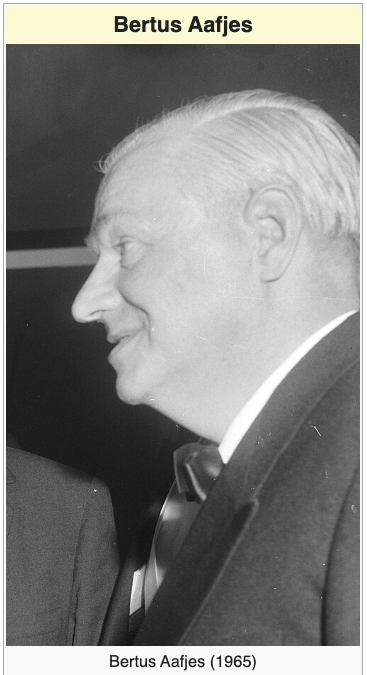
(Amsterdam, May 12, 1914 – Swolgen, April 22, 1993).
Dutch writer and poet. He also published under the pseudonyms ‘Jan Oranje’ and ‘Sick Sack’. Bertus Aafjes first began priestly training (at the College of the Crosiers in Uden, at the Minor Seminary in Heemstede, and at the Philosophicum in Warmond), made a year-long journey on foot to Rome, subsequently studied archaeology for a while at the University of Leuven and at the Pontifical Institute for Christian Archaeology in Rome, settled as a lord of the manor in Hoensbroek—the state mines made part of the castle available—and then devoted himself to literary and journalistic work. He debuted as a poet in 1940 with *Hetgevecht met de muze* and wrote the prosaic *Een laars vol rozen* in 1942. In 1947, he traveled to Egypt with a circus. He was part of the editorial staff of the literary magazines Criterium and Ad Interim, was one of the founders of the magazine Klondyke, and contributed to numerous magazines.
Bertus Aafjes. Photo wikipedia.org
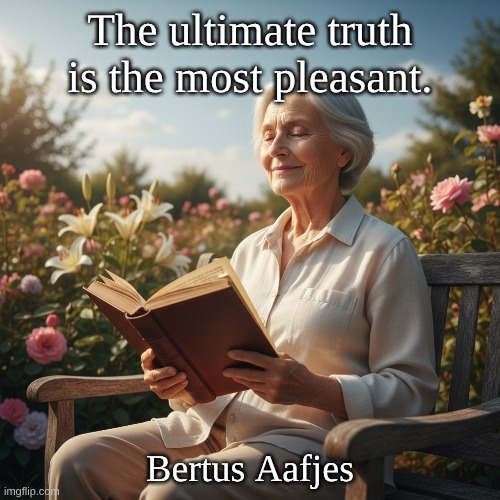
The ultimate truth is the most pleasant.
Image: Peter van Geest AI. 🧐 Meaning: The statement suggests that the ultimate truth, or the conclusion reached after considering all the facts or enduring a period of uncertainty, is often more positive or satisfying than what one initially feared or thought. It can also mean that the acceptance of the truth, however difficult it may be at first, ultimately leads to peace and contentment. 💡 Origin and Author:Bertus Aafjes (1914–1993), a well-known Dutch poet and writer. This quote appears in his collection “De laatste waarheid” (1953), and it is an expression that fits well with his philosophical and sometimes melancholic style, in which he often sought beauty and solace in life, even amidst transience and suffering. It is not so much an old proverb or saying of unknown origin, but rather a well-known saying that has become popular through Aafjes’ work. In summary:Meaning: The ultimate truth, or the acceptance of it, often brings peace, contentment, or a more positive outcome than expected. Origin & Author: The saying is strongly associated with the Dutch poet and writer Bertus Aafjes.
Door Pieter
Mensenmens, zoon, echtgenoot, vader, opa.
Spiritueel, echter niet religieus.
Ik hou van golf, wandelen, lezen en de natuur in veel opzichten.
Onderzoeker, nieuwsgierig, geen fan van de mainstream media (MSM).