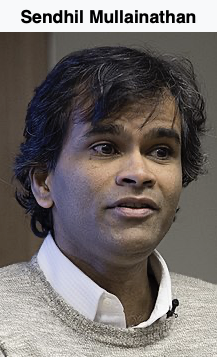
(born c. 1973).
American professor of economics at the Massachusetts Institute of Technology. He was a professor of Computation and Behavioral Science at the University of Chicago Booth School of Business from 2018-2024. He is the author of Scarcity: Why Having Too Little Means So Much (with Eldar Shafir). He was hired with tenure by Harvard in 2004 after having spent six years at MIT.
Sendhil Mullainathan (2014). Photo: wikipedia.org
January is always a good month for behavioral economics. Few things illustrate self-control as vividly as New Year’s resolutions. February is even better, though, because it lets us study why so many of those resolutions are broken.
Meaning:Self-Control: This quote emphasizes the importance of self-control, especially in January, when people often make New Year’s resolutions. Behavioral Economics: This refers to the study of how psychological, social, and emotional factors influence economic decisions. Resolutions: In February, people reflect on their New Year’s resolutions and their failures to keep them, leading to a better understanding of human behavior and choices. Origin: This quote stems from insights from behavioral economics, a field that studies the interaction between psychology and economics. January is often seen as a time for new beginnings, while February offers an opportunity to evaluate the reality of these resolutions. Author:Sendhil Mullainathan: A prominent behavioral economist and professor at Harvard University. Known for his research on the impact of psychological factors on economic decisions, he has contributed to the understanding of how people make choices in everyday life. Summary: Mullainathan’s quote reveals how the challenges of self-control and the failure to keep New Year’s resolutions provide insights into human behavior and economic choices. January is a month of hope, while February reveals the reality of our choices.
Door Pieter
Mensenmens, zoon, echtgenoot, vader, opa.
Spiritueel, echter niet religieus.
Ik hou van golf, wandelen, lezen en de natuur in veel opzichten.
Onderzoeker, nieuwsgierig, geen fan van de mainstream media (MSM).