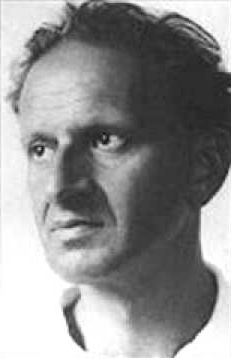
Also written Iwan Goll, born Isaac Lang.
(29 March 1891 – 27 February 1950).
French-German poet who was bilingual and wrote in both French and German. He had close ties to both German expressionism and to French surrealism.
Iwan Goll. Photo: youtube.com
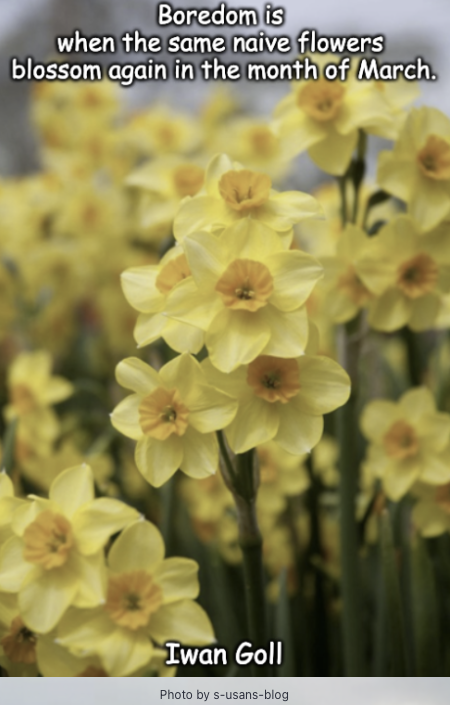
Boredom is when the same naive flowers blossom again in the month of March.
Meaning 📚: Yvan Goll’s quote is a powerful and melancholic meditation on the state of a culture that is materially rich but spiritually bankrupt. In this context, boredom is not a temporary state of mind, but a fundamental state of soullessness. The naive flowers in March are the image of a world that continues to spin mechanically and unthinkingly, without true renewal or purpose. It is a beautiful, yet empty repetition. It is a prophetic critique of a society that has sold its soul for comfort and routine, and is now confronted with the ultimate emptiness of its existence. It is a call to awaken from this comfortable stupor and to seek true meaning and inspiration. 🕵️♂️ Deeper Analysis: The Full Context of Boredom: The full passage paints a much broader, cultural and societal picture of “boredom.” It is not about individual boredom (such as “I have nothing to do”), but about an “existential and societal standstill.” Let us dissect the various elements: 1.The Original Quote: “Naive Flowers.” The quote began—“When the same naive flowers bloom again in the month of March”—now takes on a very different light. Naive: It implies an ignorant, innocent repetition. The flowers simply bloom because it is March. They know no better. The Metaphor: In the context of the full passage, these flowers are a metaphor for a society that repeats itself thoughtlessly. It is an image of “cyclical boredom.” Life goes on, season after season, without real renewal, change, or inspiration. It is “beautiful” in a superficial, predictable way, but without depth. 2.Boredom as a Societal Diagnosis: Goll argues that this boredom is a symptom of a “people who no longer believe, but are doing just fine nonetheless.”Material Prosperity vs. Spiritual Emptiness: This is a crucial observation. The people have everything they need materially (“doing fine”), but have lost their faith, their ideals, and their spiritual anchor. They live in a comfortable void. 3.The Other Symptoms of Boredom: The other examples in the passage reinforce this image of a mechanical, soulless world: ⏱️ Clocks running in sync: A symbol of extreme uniformity, bureaucracy, and control. Everything is perfectly arranged, but there is no room for spontaneity or individuality. 📰 Obituaries: The death of “respectable heads of families” is reported in the newspaper in a routine, almost banal manner. Death itself has been stripped of its tragedy and mystery. ⚔️ War in the Balkans: Even war becomes a predictable, recurring phenomenon. It is no longer a shocking event, but a routine, a “far from my bed” show. 🌌 Poems about the stars: A critique of art that has become clichéd and detached. The artist no longer has anything to say about real, living human existence. 4.The Conclusion: Aging and Exhaustion. The passage ends with a somber conclusion: Boredom is a symptom of aging. A culture that is bored is a culture that has lost its youthful vitality, its dreams, and its imagination. The diagnosis that talent and virtue are slowly being used up. This is the most pessimistic part. It suggests that the sources of human creativity and morality are drying up. There is no new “talent” and no new “virtue” left to breathe new life into the world.
Door Pieter
Mensenmens, zoon, echtgenoot, vader, opa.
Spiritueel, echter niet religieus.
Ik hou van golf, wandelen, lezen en de natuur in veel opzichten.
Onderzoeker, nieuwsgierig, geen fan van de mainstream media (MSM).