Cynthia Rylant:
(née Smith; June 6, 1954).
American author and librarian.
She has written more than 100 children’s books including works of fiction (picture books, short stories and novels), nonfiction, and poetry. Several of her books have won awards including her novel Missing May, which won the 1993 Newbery Medal, and A Fine White Dust, which was a 1987 Newbery Honor book. Two of her books are Caldecott Honor Books.
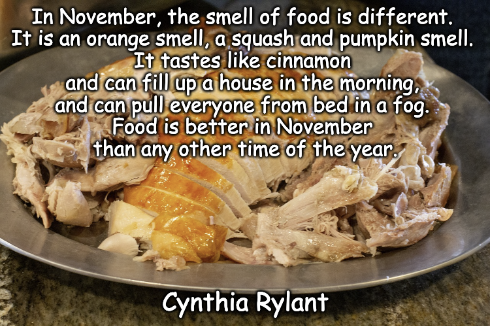
In November, the smell of food is different. It is an orange smell, a squash and pumpkin smell. It tastes like cinnamon and can fill up a house in the morning, and can pull everyone from bed in a fog. Food is better in November than any other time of the year.
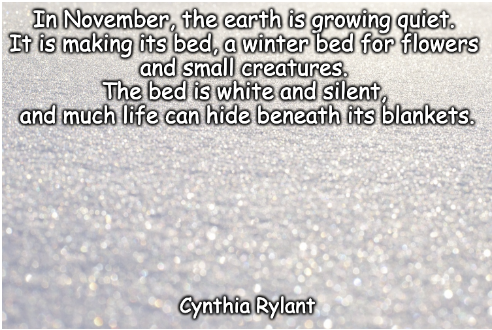
In November, the earth is growing quiet. It is making its bed, a winter bed for flowers and small creatures. The bed is white and silent, and much life can hide beneath its blankets.
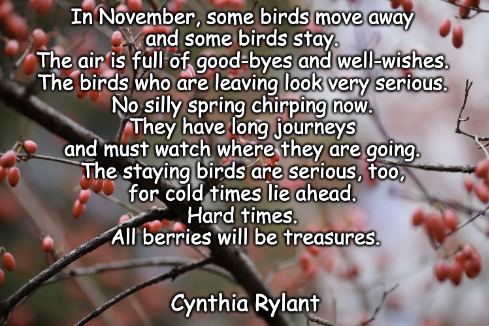
In November, some birds move away and some birds stay. The air is full of good-byes and well-wishes. The birds who are leaving look very serious. No silly spring chirping now. They have long journeys and must watch where they are going. The staying birds are serious, too, for cold times lie ahead. Hard times. All berries will be treasures.
In November, the trees are standing all sticks and bones. Without their leaves, how lovely they are, spreading their arms like dancers. They know it is time to be still.

The passage describes trees after they have shed their leaves:
– “All sticks and bones”:
compares their bare branches to a visible skeleton.
– “Spreading their arms like dancers”:
personifies the branches, presenting the leafless trees as graceful rather than lifeless.
– “They know it is time to be still”:
refers to winter dormancy—the period when trees conserve energy and wait for spring.
More broadly, the passage suggests that ‘stillness, rest, and apparent emptiness can have their own beauty’. It presents the seasonal cycle as natural and wise: November is a time to slow down, accept change, and prepare quietly for renewal.
📖 Author and origin:
This passage is by Cynthia Rylant, from her children’s picture book “In November”, illustrated by Jill Kastner and first published in 2000 by Harcourt.
It is not a traditional proverb or anonymous quotation; it comes directly from Rylant’s lyrical description of nature preparing for winter.
In November, people are good to each other. They travel very far on a special November day just to share a meal with one another and to give thanks for their many blessings.

