Eckhart Tolle:
Born as Ulrich Leonard Tölle.
(Lünen, Germany, 16 February 1948).
German teacher and author on spirituality. His first book ‘The Power of Now’ became a bestseller.
He lived with his father in Spain from the age of 13. Around the age of 20, he moved to England. As he had not done a high school education, he had to take an evening course to qualify for university. He then attended the University of London and Cambridge University. At twenty-nine, he said he experienced a ‘spiritual transformation’ that marked the beginning of his functioning as a spiritual counsellor and teacher. He then changed his name to ‘Eckhart’, after the 13th-century mystic Master Eckhart.
Today, he lives in the Canadian city of Vancouver.

Sometimes letting go is much more powerful than defending or holding on.

📝 Core Idea:
‘Redefining Power’
– Conventional thinking equates power with ‘control, winning, and holding ground.
– Tolle flips this:
True power is the ‘inner freedom from compulsive reaction’.
The Ego’s Role 👤:
🛡️ ‘Defending’:
Fear of being wrong or diminished
✊ ‘Hanging on’:
Fear of loss or emptiness
🕊️ ‘Letting go’:
Requires ‘no fear’ — comes from inner wholeness
Connection to Presence 🧘♂️:
– ‘Letting go’:
= living in alignment with the present moment
– ‘Defending/hanging on’:
= living from past identity or future anxiety
– Reflects Tolle’s central thesis:
Suffering arises from the mind’s resistance to “what is”.
Paradoxical Strength 💪:
– Society often equates ‘assertiveness’ with strength
– Tolle suggests ‘surrender’ (conscious non-resistance, not weakness) requires ‘more’ inner strength than fighting
– Echoes his broader teaching:
“Whatever you fight, you strengthen, and what you resist, persists.”
📖 Origin:
– Found in the chapter dealing with ‘ego defense mechanisms’ — specifically how the ego sustains itself through:
– Defending opinions, status, and self-image
– Clinging to grievances, possessions, relationships, and identity
– Needing to be “right” or maintain control
– The quote serves as a ’turning point idea’ in the text, encouraging readers to recognize these patterns and practice conscious release instead
✍️ Author: Eckhart Tolle
📚 Book:
“A New Earth: Awakening to Your Life’s Purpose” (2005)
– 🌍 Tolle is a German-born spiritual teacher, best known for “The Power of Now” (1997) and “A New Earth”
– His work centers on ‘ego transcendence’, ‘presence’, and ‘consciousness’ as paths to inner peace and purpose
– “A New Earth” became especially popular after being featured in ‘Oprah Winfrey’s online book club’, reaching a massive global audience.
Nothing has happened in the past; it happened in the Now. Nothing will ever happen in the future; it will happen in the Now.

– “Nothing has happened in the past; it happened in the Now.”
– The past only exists as ‘memory/thought’ happening in the ‘present (Now)’.
– “Nothing will ever happen in the future; it will happen in the Now.”
– The future only exists as ‘anticipation/imagining’ until it becomes experience in the ‘present’.
✅ Core idea:
You can only directly experience ’the Now’—past and future are mental constructs.
📍 Origin:
– The quote is ‘attributed on Goodreads’ to Eckhart Tolle from his book “The Power of Now: A Guide to Spiritual Enlightenment”.
– From the information available, I can say ‘Goodreads presents it as coming from that book’, but I ‘can’t fully verify the exact word-for-word passage’ inside the specific edition without the page/chapter.
✍️ Author:
– Eckhart Tolle ✅ (as shown on Goodreads).
Surrender becomes so much easier when you realize the fleeting nature of all experiences and that the world cannot give you anything of lasting value.

This saying touches on a core spiritual/philosophical teaching found in many contemplative traditions:
– ‘Impermanence (Anicca)’:
— All experiences, possessions, relationships, and achievements are transient. Nothing in the external world is permanent.
– ‘Surrender’:
— When one truly internalizes that nothing lasts, the need to grasp, control, or resist life’s flow naturally diminishes. Surrender isn’t passive defeat, but an active release of the ego’s demand that circumstances be different.
– ‘Seeking fulfillment outward vs. inward’:
— The implication is that lasting peace/fulfillment cannot come from external things (status, money, relationships, pleasure) because they are all impermanent — true peace must come from an inner state of being, not from acquiring or controlling outer circumstances.
👤 Author & Origin:
– Likely attribution: Eckhart Tolle
— This phrasing is highly consistent with his teachings in books like “The Power of Now” and “A New Earth”, where he frequently discusses:
– The illusory, fleeting nature of thought-based experience
– “Surrender” as acceptance of the present moment
– The ego’s futile search for identity/security in external things
⚠️ Caveat:
I cannot verify this as a word-for-word verified quote from a specific published Tolle text. It’s possible this is:
– A paraphrase of his ideas circulating online
– From a talk/interview rather than a book
– Misattributed (quotes like this are often reworded and recirculated without verification).
Surrender is the inner transition from resistance to acceptance, from no to yes.

This quote describes ‘surrender’ as an active, internal process—not as passive resignation or giving up.
– 🚫 “Resistance” (“no”):
→ the mental opposition to reality as it presents itself; fighting against what ‘is’.
– ✅ “Acceptance” (“yes”):
→ fully allowing and acknowledging the present moment, without the desire to change it or struggle against it.
– 🔄 “The transition” itself is the core:
Surrender is not a static state, but a ‘movement’
— a conscious internal shift from resistance to consent.
Core idea:
Suffering often arises not from the circumstances themselves, but from our ‘resistance’ to them. Surrender dissolves that suffering by saying an internal “yes” to what is—not as an act of submission, but as a form of liberation.
📚 Origin:
Book (English): “Stillness Speaks” (2003)
Original text:
“Surrender is the inner shift from resistance to acceptance, from no to yes.”
📝 “Stillness Speaks” is written in an ‘aphoristic style’:
Short, compact insights intended to be read slowly and contemplated—not a continuous narrative like the one found in “The Power of Now.”
This quote is a typical example of that concise, definition-like writing style.
✍️ Author: Eckhart Tolle.
— A German-Canadian spiritual writer and teacher, known for:
– 📘 “The Power of Now” (1997)
– 📗 “Stillness Speaks” (2003)
– 📙 “A New Earth” (2005)
The theme of ‘surrender vs. resistance’ is a recurring core concept throughout Tolle’s body of work, but in “Stillness Speaks,” it is articulated in its most concise and direct form.
No matter how long your journey appears to be, there is never more than this: one step, one breath, one moment…Now.

1. Illusion of the “Long Journey”:
– The mind often perceives life, goals, or spiritual growth as a vast, overwhelming path with many years or steps ahead.
– This creates anxiety, impatience, or a feeling of being “far from” where we want to be.
2. The Reality of the Present:
– In actual lived experience, we ‘never’ live in the past or future — only in ’this instant’.
– The “journey” is a mental construct; what truly ‘exists’ is always just:
– 👣 ‘One step’
– 💨 ‘One breath’
– ⏳ ‘One moment’
3. Core Teaching:
‘Presence’:
– This reflects Tolle’s central philosophy (from “The Power of Now”):
– Suffering comes from mentally living in past regrets or future anxieties.
– Peace comes from anchoring in the ‘Now’ — the only moment we ever truly inhabit.
4. Practical Takeaway:
– Big goals feel manageable when broken into this moment’s action.
– It’s a call to ‘stop projecting overwhelm’ onto the future and instead act/breathe/be ‘here’.
✍️ Author & Origin:
– Likely Attribution:
This quote is widely circulated online and attributed to Eckhart Tolle, the spiritual teacher known for works like “The Power of Now” and “A New Earth”.
– ⚠️ Caveat:
‘I cannot confirm with certainty that this exact phrasing appears in one of Tolle’s published books’. It’s possible that:
– It’s a ‘paraphrase’ or ‘summary’ of his teachings created by someone else
– It circulated on social media/quote websites and was ‘attributed’ to him without verified sourcing
– It could be from a lesser-known talk, interview, or compilation.
You find peace not by rearranging the circumstances of your life, but by realizing who you are at the deepest level.

Core Message:
The quote draws a contrast between ’two approaches to finding peace’:
❌ External Approach, ✅ Internal Approach
❌ Rearranging circumstances, ✅Realizing your true nature
❌Changing job, relationships, location, ✅ Self-inquiry & awareness
❌Temporary, conditional peace. ✅ Lasting, unconditional peace
🌊 Deeper Breakdown:
1. “Rearranging circumstances” 🔄:
– Refers to the common human tendency to seek happiness by changing ‘external’ factors — new job, new partner, more money, different environment
– Tolle suggests this is a flawed strategy because circumstances are always shifting and impermanent
2. “Realizing who you are at the deepest level”:
🪞- Points to ‘spiritual self-inquiry’ — recognizing your identity isn’t your thoughts, emotions, job title, or life story
– In Tolle’s framework, this means connecting with your ’true Being’ or ‘consciousness’ — the awareness ‘behind’ your thoughts
– This is sometimes called the “present moment awareness” or recognizing the “I Am” presence.
🧩 Philosophical Roots:
This idea echoes several traditions:
– 🕉️ “Advaita Vedanta” (non-dualism):
— the self (Atman) is already whole and peaceful
– ☸️ “Buddhism”:
— suffering arises from attachment to impermanent external conditions
– 🌌 “Mysticism” broadly:
— true peace is an ‘inner state’, not an outer achievement
💭 Practical Takeaway:
> Peace isn’t something you ‘chase’ by fixing your outer life — it’s something you ‘uncover’ by shifting your relationship to your inner identity.
🔑 ‘Key shift’:
From “I’ll be at peace when things change”:
→ “I can access peace now by recognizing my deeper nature, regardless of circumstances.”
✍️ Author & Origin:
– Likely Author:
This quote is widely attributed to Eckhart Tolle ✅
– Source:
It aligns closely with themes from his books, particularly:
– 📘 “The Power of Now” (1997)
– 📘 “A New Earth” (2005)
– Caveat:
⚠️ As with many popular spiritual quotes circulating online, the ‘exact’ wording isn’t always traceable to a specific page or verified original source. It may be:
– A paraphrase of Tolle’s broader teachings
– Condensed from an interview, talk, or social media adaptation
– Consistent with his voice, even if not a direct verbatim quote from a published book.
The “second coming” of CHRIST is a transformation of human consciousness, a shift from Time to PRESENCE, from Thinking to PURE consciousness, not the arrivel of some man or woman.

This sentence reframes a traditional Christian eschatological concept (the literal return of Jesus Christ) into a ´psychological/spiritual metaphor´:
– “Christ”:
→ represents an archetype of awakened consciousness, not a historical person returning
– “Second coming”:
→ symbolizes an ´inner event´:
the awakening of presence within humanity
– ¨Shift from Time to Presence¨:
→ moving from psychological time (past/future, memory/anticipation) into the eternal ´Now´
– ¨Shift from Thinking to Pure Consciousness¨
→ transcending the egoic mind/thought-stream to rest in awareness itself
This is a classic ´non-dualist reinterpretation´ of religious symbolism — common in perennial philosophy, where literal religious narratives are seen as pointing to inner, experiential truths.
✍️ Likely Authorship: Eckhart Tolle
This phrasing is ´highly consistent with Eckhart Tolle’s teaching style´, especially in:
¨The Power of Now¨ (1997):
– Time vs. Presence; ego/thought vs. Being
¨A New Earth¨ (2005):
– Reinterprets “Christ” as a state of consciousness available to all, not just Jesus; discusses collective awakening
Tolle explicitly writes (paraphrased from ¨A New Earth¨) that:
– “Christ” is not a name for a person, but a title denoting “anointed” consciousness
– Awakening is happening collectively, not through a messianic figure
– The ego’s obsession with time is the root of suffering; presence is liberation
⚠️ Caveat:
I cannot 100% verify this as a ´direct verbatim quote´ from a specific page — it may be:
– A close paraphrase of Tolle’s ideas
– A summary/interpretation by a teacher, student, or secondary source quoting/channeling his themes
– Possibly attributed to Tolle online without exact textual sourcing
🌐 Broader Origin:
Not Unique to Tolle.
This idea has roots in a longer lineage:
– Gnostic Christianity
– “Christ consciousness” as an inner principle (2nd–4th century texts, e.g., Gospel of Thomas)
– A Course in Miracles (1976):
– explicitly teaches “Christ” as a state of mind, not a person
– Paramahansa Yogananda:
– “Christ consciousness” as a universal principle present in all beings
– Ramana Maharshi / Advaita Vedanta:
– Presence (Being) over thought, though not using Christian terms
Tolle likely ´synthesized´ these existing non-dual/esoteric Christian ideas into his own accessible, modern language.
When you realize that there is a voice in your head that pretends to be you…you realize that who you are is not the voice – the thinker – but the one who is aware of it.
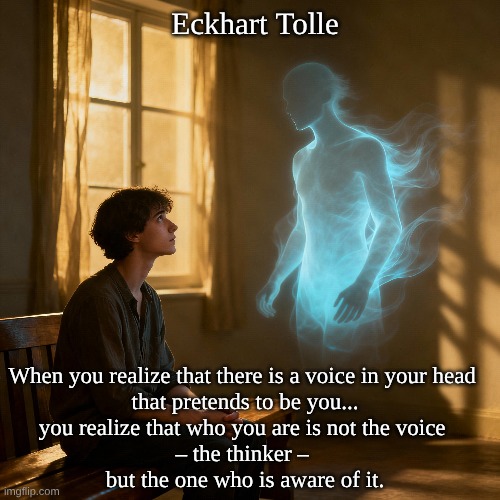
🧠 The “Voice in the Head”:
– Refers to what Tolle calls the “thinker” or ‘ego-mind’
— the constant stream of internal dialogue, commentary, judgment, and narrative we experience.
– Most people ‘unconsciously identify’ with this voice, believing “I am my thoughts.”
👁️ The “Observer” or “Awareness”:
– Tolle’s central teaching: true identity is ‘consciousness itself’ — the silent awareness that ‘notices’ thoughts, rather than the thoughts themselves.
– This awareness is sometimes called:
– The “watcher” 👀
– “Presence” 🌿
– “Being” 🌌
🌱 Spiritual Significance:
– This distinction is foundational to many contemplative traditions, not just Tolle:
– 🕉️ Buddhism:
— concept of ‘anatta’ (non-self) and mindfulness of thought
– 🧘 Advaita Vedanta:
— the witness-consciousness (‘Sakshi’)
– 🗣️ Influenced by teachers like:
Ramana Maharshi and J. Krishnamurti, whom Tolle often cites as inspirations
🎯 Practical Takeaway:
– The moment you can ‘observe’ your thoughts (“there goes that voice again”), you create a ‘gap’ between yourself and the thought.
– This gap is the doorway to:
– Reduced suffering (less identification with negative self-talk)
– Greater inner peace
– Access to what Tolle calls the “Now” — present-moment awareness beyond mental noise.
✍️ Author & Origin:
– Author: ✅ Eckhart Tolle
– Source:
This idea appears (in various phrasings) in his seminal work:
– 📘 “The Power of Now: A Guide to Spiritual Enlightenment” (1997)
– Related concepts are also echoed in his second major book, 📗 “A New Earth: Awakening to Your Life’s Purpose” (2005)
– Note on exact wording:
Tolle’s teachings are often delivered in talks, interviews, and books with slightly varying phrasing. This specific sentence is a commonly circulated paraphrase/summary of his core teaching, widely shared on social media and quote sites — the ‘essence’ is 100% Tolle, though the ‘exact sentence’ may be a condensed version rather than a verbatim book quote.
Many people don´t realize until they are on their deathbed and everything external falls away that nothing ever had anything to do with who they are.

Whatever the present moment contains, accept it as if you had chosen it. Always work with it, not against it. Make it your friend and ally, not your enemy. This will miraculously transform you whole life.

1. Radical Acceptance (“Accept it as if you had chosen it”) 🕊️. The Now is inevitable: The present moment ‘is’ already as it is. Resisting it is like arguing with reality. The paradox of choice: By acting ‘as if’ you chose this specific situation yourself, you stop being a victim. You take full responsibility for your inner attitude toward the situation. Inner peace: This does not mean that you have to approve of everything that happens (for example, injustice or pain), but that you accept the ‘reality’ of the moment without inner resistance.
2. Cooperation instead of Conflict (“Work with it, not against it”) 🤝: Ego resistance: The ego often wants reality to be different than it is. This creates tension, stress, and suffering. Effortless action: When you stop fighting against ‘what is’, energy is released. From a state of acceptance, you can act much more clearly and effectively (if action is needed) than from a state of anger or denial.
3. Reality as an Ally (“Make it your friend and ally, not your enemy”) ❤️: Perception shift: Most people treat the present moment as an obstacle on the way to a ‘better’ moment in the future. Friendship with the Now: By embracing the Now as your best friend, the constant underlying fear and dissatisfaction disappear. You no longer live ‘for’ the future, but ‘in’ the now.
4. The Transformation (“This will miraculously transform your whole life”) ✨: The end of suffering: According to Tolle, almost all our psychological suffering is the result of resistance to the present moment (either longing for the past or fear of the future). Awakening: Acceptance is the gateway to inner silence and ‘being’. It transforms your entire life experience from a constant struggle into a state of peace and flow, regardless of external circumstances.
🎯 Core message: Stop fighting against the reality of this moment. Embrace it, work with it, and thus find lasting inner peace. Author 📜 🕵️♂️ : This quote is a concise summary of a fundamental spiritual attitude to life: ‘acceptance’ and ‘surrender’ to the present moment. This quote is by Eckhart Tolle. Origin: It is one of the central teachings in his worldwide bestseller: 📖 Book: “The Power of Now”: ‘A Guide to Spiritual Enlightenment’. 📅 Publication year: 1997. The quote summarizes the essence of the entire book. Tolle repeats this thought in various wordings throughout his oeuvre and in his lectures.
Suffering is necessary until you realise that it is unnecessary.
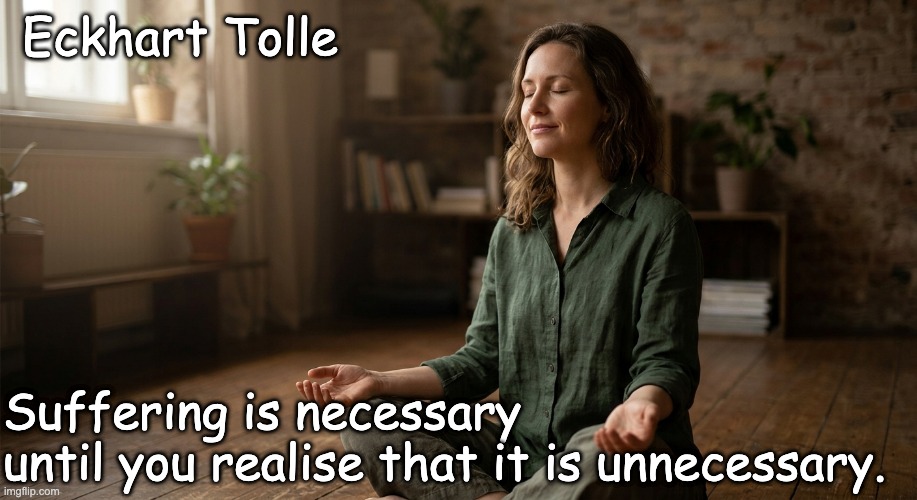
The essence of this statement lies in the transformation of our consciousness. It suggests that suffering is an inevitable part of the human experience as long as we identify with our thoughts, emotions, and the ego. This suffering acts as a ‘wake-up call’ or a catalyst that compels us to turn inward and examine the nature of our mind.
The “necessary” aspect refers to the role suffering plays in the process of awakening. It is often pain and dissatisfaction that motivate us to seek truth and liberation. Without this suffering, we might never feel the need to break free from our habitual patterns of thinking and reacting.
The “unnecessary” aspect becomes clear when we reach a state of deeper presence and awareness. When we no longer get entangled in the narratives of our mind and the constant stream of judgments and resistance, we realize that much of our suffering is self-created. It is resistance to the present moment, attachment to the past, or fear of the future that causes the pain.
In short:
The saying invites us to see suffering as a teacher that ultimately leads us to a state where we no longer need a teacher. It is a path from suffering to liberation, where the suffering itself holds the key to the door of our own freedom.
Origin:
The exact source of this saying cannot be determined with absolute certainty. Although often attributed to Eckhart Tolle—and despite its core message strongly aligning with his teachings—the phrase is more likely a paraphrase or summary of his ideas than a verbatim quote from one of his books.
Possible sources and contexts include:
– “The Power of Now”:
Many of Tolle’s readers and followers likely derived this phrase from the general philosophy of his best-known book. The book emphasizes the importance of living in the present moment and letting go of identification with the ego—which, according to Tolle, is the source of all suffering. The idea that suffering can shake us awake and lead us to a state of enlightenment where suffering is no longer necessary is a central theme in this work.
– Spiritual Traditions:
The notion that suffering can be a path to liberation is not unique to Tolle; it is a theme found in many spiritual traditions, including Buddhism and Hinduism. The “Four Noble Truths” in Buddhism, for instance, describe the nature of suffering, its cause, and the path to its cessation. The idea that suffering can help us see the truth and liberate us from ignorance is a fundamental concept in these traditions.
– Modern Interpretations:
It is also possible that this phrase is a modern interpretation or summary of these timeless insights, adopted and disseminated by various teachers and authors. The phrase’s simplicity and directness make it easy to remember and share, which may have contributed to its popularity. Author:
This profound saying is often attributed to Eckhart Tolle, a contemporary spiritual teacher and author best known for his book “The Power of Now”. Although, as noted above, it is likely not a verbatim quote, it captures the essence of his teachings on the nature of suffering and the path to liberation through presence and awareness.
The present moment is the only place where life can be found.
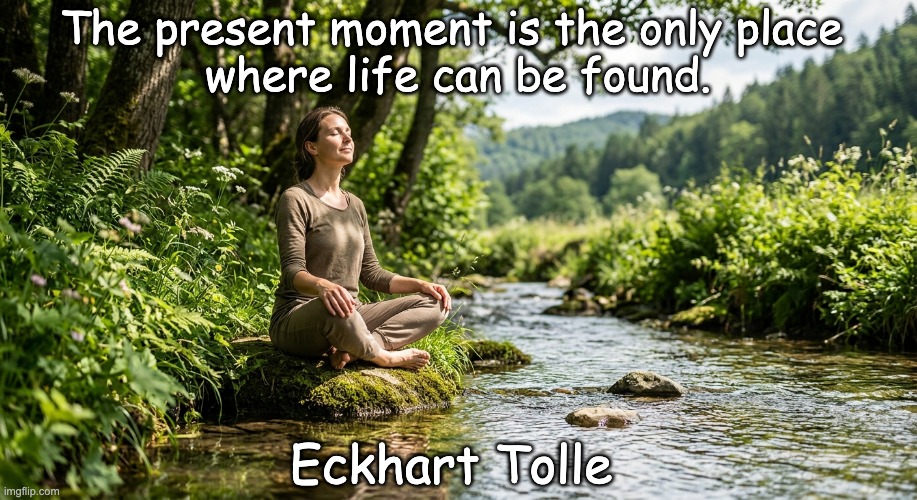
It emphasizes the importance of mindfulness and being fully present in the current moment. Life doesn’t happen in the past (memories) or the future (fears and hopes); it unfolds only now. True fulfillment and connection to life can only be experienced in the immediacy of the present.
Origin:
While the exact phrasing might vary slightly, the core concept is central to many spiritual and philosophical traditions, including Buddhism, Taoism, and Stoicism. Eckhart Tolle, in his influential book “The Power of Now,” popularized this idea for a modern audience, exploring how our identification with the mind and its constant stream of thoughts keeps us trapped in the past or future, preventing us from experiencing the peace and presence of the now.
Author:
Eckhart Tolle is widely recognized as the author of this particular wording. He elaborates on this concept throughout his teachings, encouraging people to step out of their minds and into the direct experience of life as it happens.
Accept — then act. Whatever the present moment contains, accept it as if you had chosen it. Always work with it, not against it. Make it your friend and ally, not your enemy. This will miraculously transform your whole life.
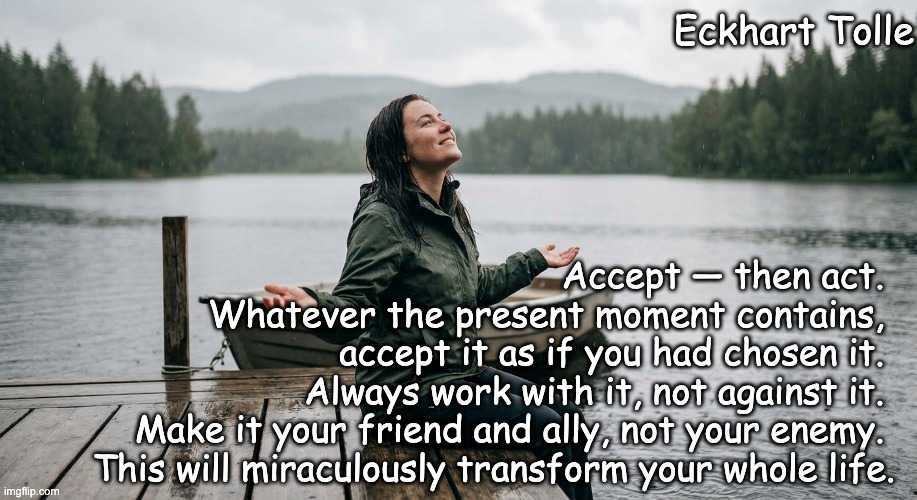
This quote encapsulates ‘a core principle of Eckhart Tolle’s teachings on mindfulness and presence’.
– ‘Accept — Then Act’:
This is the crucial first step. It doesn’t mean passive resignation. ‘It means acknowledging the reality of the present moment exactly as it is, without resistance, judgment, or emotional reactivity’. Only from this place of clear acceptance can you take truly effective, conscious action.
– ‘Whatever the Present Moment Contains, Accept it as if You Had Chosen It’:
This is a radical shift in perspective. ‘Instead of fighting reality (which is futile and creates suffering), you embrace it fully’. By “pretending” you chose it, you drop all internal conflict and align yourself with the flow of life.
– ‘Always Work with It, Not Against It’:
When you resist the present (e.g., getting angry about traffic, a difficult conversation), you are fighting reality, which drains your energy. ‘Accepting it allows you to use that energy productively ‘within’ the situation.’
– ‘Make it Your Friend and Ally, Not Your Enemy’:
This shifts your relationship with life. ‘Instead of seeing challenges as personal attacks, you view them as neutral circumstances or even opportunities for growth and conscious response.’
– ‘This Will Miraculously Transform Your Whole Life’:
By eliminating internal resistance and suffering caused by fighting reality, ‘you access a state of peace, clarity, and heightened effectiveness, fundamentally changing how you experience life.’
📚 The Origin:
This quote is from the widely acclaimed spiritual guidebook, “The Power of Now: A Guide to Spiritual Enlightenment.” First published in the late 1990s, it became a massive bestseller and is considered a modern spiritual classic.
👤 Author: Eckhart Tolle.
Eckhart Tolle is a German-born spiritual teacher and author living in Canada. After a profound inner transformation in his late twenties, he spent years wandering and in a state of deep peace before beginning to teach. He is known for his simple yet profound teachings on mindfulness, presence, and the nature of human consciousness, emphasizing the importance of living in the “Now” and transcending the ego.
🖼️ Visualizing the Wisdom:
This image captures a woman sitting calmly on a weathered wooden deck. She is facing a turbulent coastal storm, with crashing waves and a dramatic, cloudy sky. Instead of fighting the elements or running for cover, she is present and composed, holding a mug and gazing out with acceptance. The dramatic lighting and natural setting visualize the idea of embracing a challenging “present moment” and making it an ally rather than an enemy.
The key to happiness is being present in the here and now.
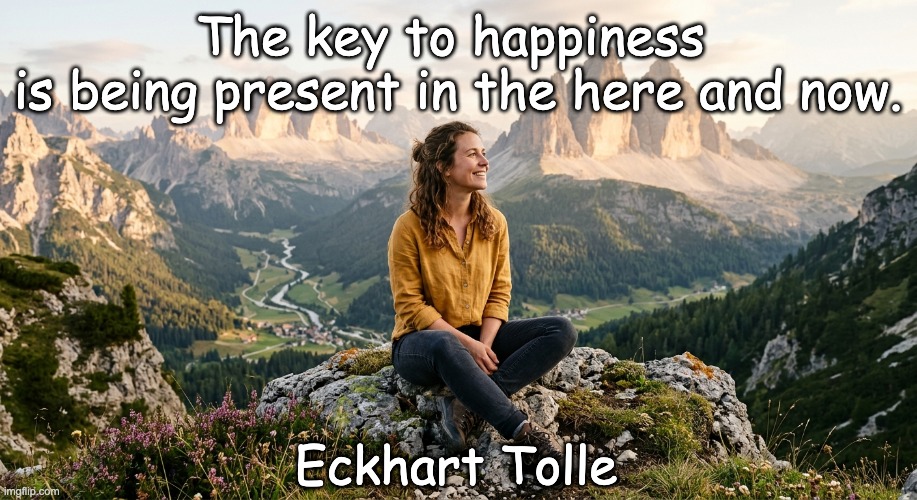
This saying highlights several key aspects of mindfulness:
– Acceptance:
Being present means accepting the current moment as it is, without judgment or resistance. This doesn’t mean you have to like everything that’s happening, but rather that you acknowledge it without trying to force it to be different.
– Awareness:
It involves being fully aware of your thoughts, feelings, bodily sensations, and surroundings without getting caught up in them. This awareness allows you to observe your experiences with clarity and objectivity.
– Non-Attachment:
Being present means letting go of the past and future. While we can learn from the past and plan for the future, getting stuck in either can lead to suffering. Focusing on the present allows you to live more fully in each moment.
– Appreciation:
Being present allows you to appreciate the small joys and beauty in life that often go unnoticed when you’re distracted or preocupied. This can lead to a greater sense of gratitude and well-being.
Origin and Author:
The concept of being present has been explored in various philosophical and religious traditions for centuries. While the exact phrasing might vary, the underlying message is a common thread in many teachings.
Eckhart Tolle is a modern spiritual teacher who has popularized this concept through his best-selling books, such as “The Power of Now” and “A New Earth.” In these works, Tolle emphasizes the importance of present-moment awareness as a path to liberation from suffering and the realization of our true nature.
While Tolle didn’t invent the concept, he has made it accessible to a wide audience through his clear and practical teachings. He often uses the term “the Now” to refer to the present moment and encourages readers to cultivate a state of “presence” or “mindfulness.”
Other Influential Figures and Traditions:
– Buddhism:
The core teachings of Buddhism emphasize the importance of mindfulness and living in the present moment as a way to alleviate suffering. The practice of meditation is often used to cultivate this awareness.
– Stoicism:
The Stoic philosophers, such as Seneca and Marcus Aurelius, emphasized the importance of focusing on what is within our control and accepting what is not. This includes focusing on the present moment and not worrying about the past or future.
– Taoism:
The Taoist tradition emphasizes living in harmony with the natural flow of life, which involves being present and accepting the present moment.
– Other Spiritual Teachers:
Many other spiritual teachers, such as Ram Dass, Jon Kabat-Zinn, and Thich Nhat Hanh, have also emphasized the importance of being present and mindful.
Practical Application:
Cultivating present-moment awareness is a practice that requires patience and consistency. Here are some simple ways to incorporate mindfulness into your daily life:
– Mindful Breathing:
Take a few deep breaths and focus on the sensation of air entering and leaving your body. This simple practice can help you ground yourself in the present moment.
– Sensory Awareness:
Pay attention to your senses. Notice the sights, sounds, smells, tastes, and textures around you. This can help you connect with your surroundings and become more aware of the present moment.
– Mindful Eating:
When you eat, focus on the taste, texture, and aroma of your food. Avoid distractions like watching TV or checking your phone. This can help you appreciate your food and eat more mindfully.
– Mindful Walking:
Pay attention to the sensation of your feet touching the ground as you walk. Notice the rhythm of your steps and the feeling of movement in your body.
– Mindful Listening:
When someone is speaking to you, listen attentively and without judgment. Focus on their words, tone of voice, and body language.
By incorporating these practices into your daily life, you can begin to cultivate a greater sense of presence and find more happiness and peace in the here and now.
Realize deeply that the present moment is all you ever have.
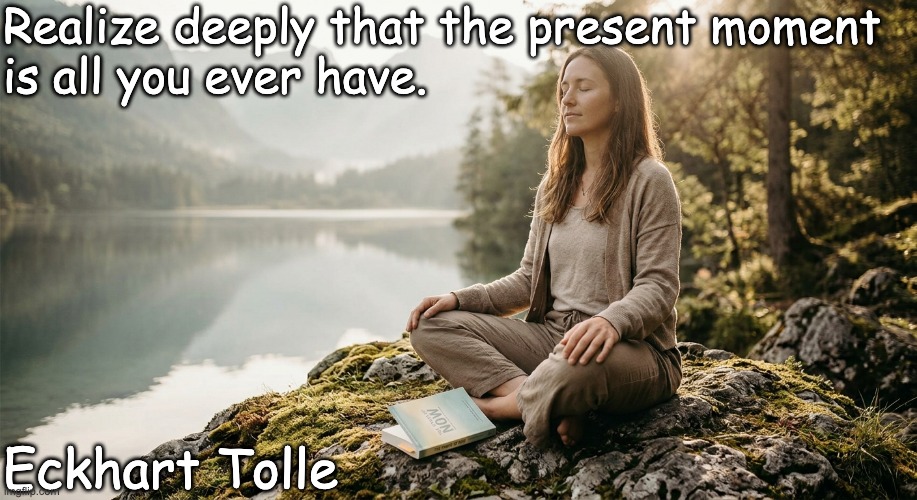
– The Only Reality:
This quote emphasizes that the past is gone, and the future is yet to be, making the present moment the only tangible reality we truly possess.
– Escaping the Mind’s Grasp:
Our minds often dwell in the past (regret, nostalgia) or the future (worry, anticipation). This quote urges us to break free from these mental constructs and ground ourselves in the ‘now’.
– Finding Peace and Contentment:
By fully embracing the present moment, without judgment or resistance, we can experience a sense of peace, clarity, and contentment.
– Living Authentically:
When we are fully present, we can respond to life with greater awareness and authenticity, rather than reacting from past patterns or future anxieties.
– Deepening Connections:
Being present allows us to truly connect with others and the world around us, fostering deeper relationships and a greater appreciation for life.
Origin:
– The Power of Now:
The quote is a central theme and a frequently repeated phrase in Eckhart Tolle’s best-selling book, “The Power of Now: A Guide to Spiritual Enlightenment.”
– Spiritual Traditions:
While Tolle popularised this concept in contemporary spirituality, the idea of living in the present moment has roots in various ancient spiritual traditions, including Buddhism, Taoism, and Stoicism.
Author: Eckhart Tolle.
The author of “The Power of Now” and the source of this influential quote is Eckhart Tolle. He is a renowned spiritual teacher and author known for his teachings on mindfulness, presence, and awakening to one’s true nature.
In Essence:
This quote serves as a powerful reminder to detach from the constant chatter of our minds and to fully immerse ourselves in the richness and immediacy of the present moment. It’s a call to experience life as it unfolds, free from the burdens of the past and the anxieties of the future.
By cultivating presence, we can unlock a deeper sense of peace, joy, and fulfillment in our lives.
Do not seek peace. Do not seek a state other than the one you are in right now; otherwise, you will experience inner conflict and unconscious resistance. Forgive yourself for not having peace.
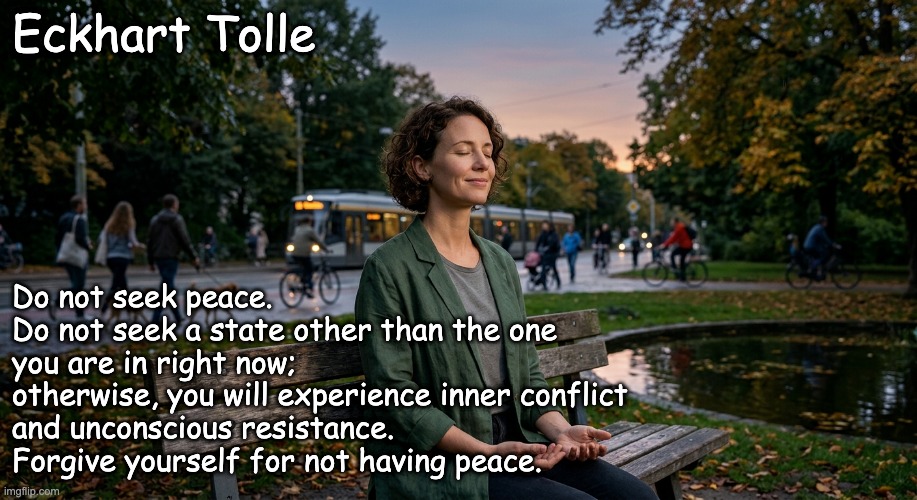
The core message is that “true peace does not come from fighting against your current reality, but from fully embracing it.”
– No resistance:
If you are desperately searching for peace while feeling restless, you create an internal conflict. You are fighting against yourself. That struggle leads to “more” tension, not less.
– Radical acceptance:
The key is to fully accept the state you are in “right now” — whether it is chaos, sadness, anger, or restlessness. Say to yourself: “This is how I feel at this moment, and that is okay.”
– Self-forgiveness:
The most important part is the final sentiment. Forgive yourself for “not” feeling at peace. Be gentle with yourself. It is human not to feel perfect all the time. By accepting that imperfection, a deeper form of peace paradoxically emerges: the peace of simply “being allowed to be.”
✍️ Author and Origin:
This quote is attributed to Eckhart Tolle.
It is a central concept in his revolutionary book, “The Power of Now”.
In this book, Tolle explains how identifying with your thoughts and resisting the present moment is the source of all human suffering. This particular quote perfectly encapsulates that philosophy.
🖼️ Visual Illustration of the Meaning:
Description of the image:
This image shows a woman sitting calmly on a park bench. Although the world around her is in motion—people walking by, trees rustling, the city bustling with activity—her entire being radiates a deep, inner peace. She does not fight against her surroundings; she simply ‘exists’ within them. Her open demeanor and gentle smile reveal that she fully accepts her current state. This is the visual embodiment of “forgive yourself for not having peace”: she does not seek peace outside of herself, but rather finds it by allowing everything to be exactly as it is.
There is nothing wrong with setting goals and striving to achieve things. The mistake lies in using it as a substitute for the feeling of life, for Being. The only point of access for that is the Now.
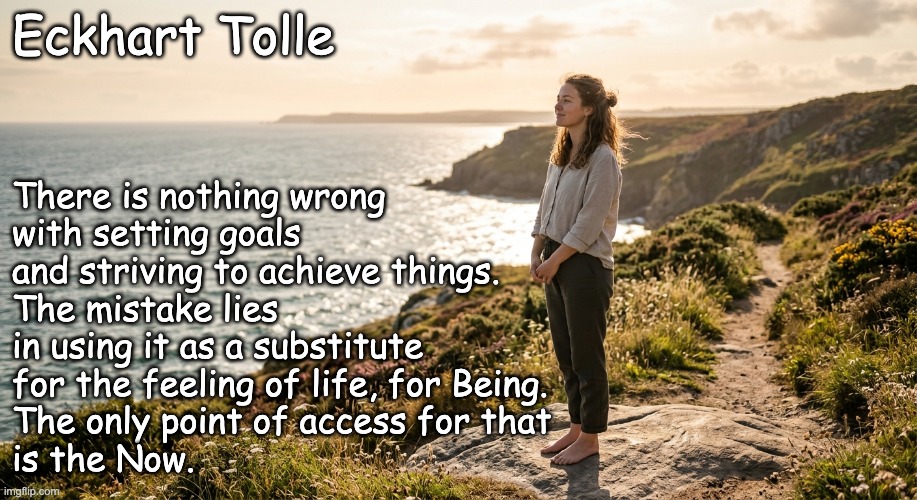
Tolle’s quote addresses a central theme in his teachings: the difference between “doing” and “being.”
1. Goals vs. Life:
He clarifies that having ambitions, setting goals, and striving for achievements are ‘not’ inherently wrong or negative. They are natural aspects of human life.
2. The Mistake (The Trap):
The error, according to Tolle, is when we use the ‘pursuit’ of these goals—the future outcome—as our primary source of fulfillment, happiness, or sense of self. We mistakenly believe that “once I achieve X, ’then’ I will be happy/complete.” This turns life into a constant state of ‘becoming’ rather than ‘being’.
3. The Feeling of Life (Being):
The true “feeling of life” or “Being”—a sense of inner peace, connection, and presence—is not something that can be achieved in the future. It is a state that exists only in the present moment.
4. Access Point:
The ‘only’ way to access this state of Being is through the “Now.” By constantly looking to future goals for fulfillment, we miss the richness and aliveness of the only moment we ever truly have: this one.
In essence:
Tolle urges us to pursue our goals with diligence but to root our sense of completeness and peace in the simple awareness of the present moment, rather than deferring it to a future achievement.
Tolle is addressing the common human tendency to live in the future—always planning, striving, and waiting for the next big milestone to bring happiness or fulfillment. He is not condemning the act of setting goals; he acknowledges that planning and striving are practical aspects of life.
The “mistake” he identifies is the psychological reliance on those future achievements to provide a sense of aliveness or identity. When we do this, we treat the present moment merely as a means to an end, effectively missing the only time we are truly alive. “Being” (or the “feeling of life”) is the deep, underlying sense of presence that is only accessible when we fully inhabit the “Now.”
💫 Author & Origin:
This profound statement is attributed to Eckhart Tolle.
It is sourced directly from his landmark 1997 spiritual guide, “The Power of Now: A Guide to Spiritual Enlightenment”, specifically on page 81.
🌅 Visual Illustration of “The Power of Now”:
This is a photorealistic image that visually captures the essence of this teaching:
The serene experience of “Being” in the “Now,” distinct from the future-oriented pursuit of goals.
📖 Meaning and Context
🖼️ Visualizing “The Power of Now”:
The image depicts a moment of pure “Being.” A woman stands still and present on a dramatic coastal cliffside during the golden hour. Rather than actively striving or looking toward a distant goal (symbolized by the trail leading away), she is barefoot and grounded, fully immersed in the sensory experience of the “present moment”—the warmth of the sun, the sound of the ocean, and the simple act of existing. The vastness of the horizon emphasizes the depth found within the “Now.”
I have lived with several Zen masters- all of them cats.
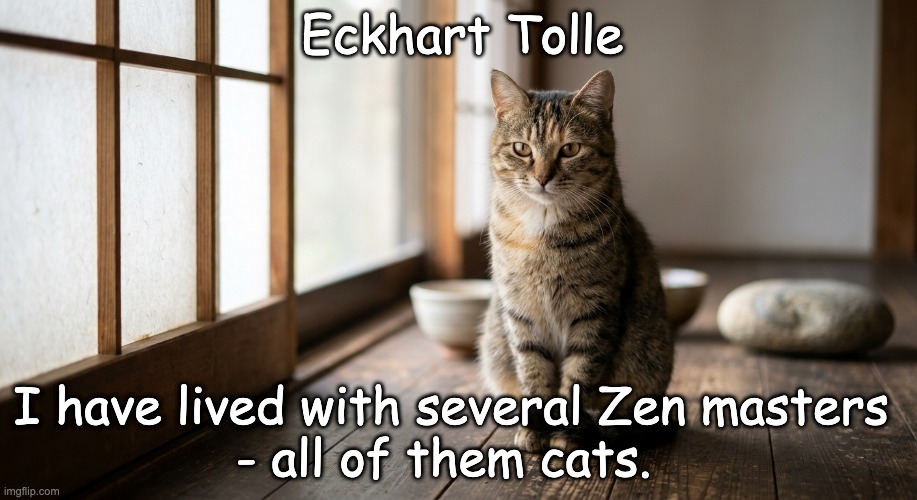
This quote beautifully illustrates a core principle of Zen philosophy:
‘being present in the moment.’
– Mindfulness:
Cats are exemplary models of mindfulness. They are entirely absorbed in whatever they are doing—whether it’s stalking a toy, grooming intensely, or sleeping with absolute abandon. They do not worry about the past or fret about the future; they ‘exist’ in the now.
– Detachment and Acceptance:
Cats often display a sense of detached observation. They accept their environment and circumstances (the warm sunbeam, the available food, the cozy lap) without judgment or resistance. This mirrors the Zen practice of accepting things as they are.
– Simple Existence:
Unlike humans, whose minds are often cluttered with complex thoughts, anxieties, and egos, cats embody a pure, unadulterated state of being. They are not ’trying’ to be something; they just ‘are’.
By observing a cat, one can learn the value of stillness, focus, and finding contentment in simplicity—all central tenets of Zen Buddhism.
📜 Origin and Author:
The quote is widely attributed to Eckhart Tolle, a contemporary spiritual teacher and best-selling author of books like “The Power of Now” and “A New Earth”.
While it’s ‘difficult to pinpoint the exact moment or interview where he first said it’, the sentiment aligns perfectly with his teachings. Tolle frequently uses simple, everyday examples—including the behavior of animals—to illustrate complex spiritual concepts like presence and the illusion of the ego.
📸 Visualizing the Meaning:
Above is a photorealistic image that captures the stillness, presence, and simple “being” that this quote describes. It focuses on the cat as a model of mindfulness, existing perfectly in its moment.
The light is too painful for someone who wants to remain in darkness.
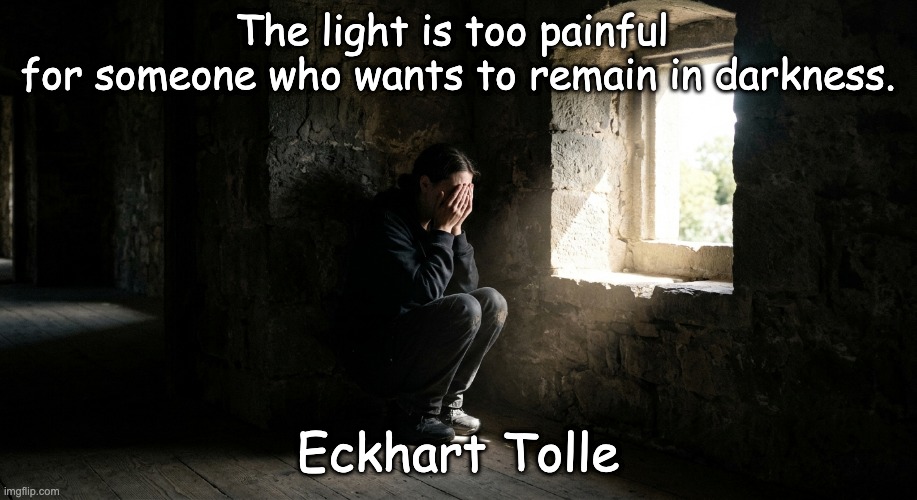
The sentence is a metaphor about ‘awareness and resistance’:
– ‘Light’:
represents truth, consciousness, self-awareness and spiritual presence.
– “Darkness”:
represents denial, unconscious habits, fear and identification with the ego.
– When someone is strongly attached to familiar beliefs or emotional patterns, greater awareness may initially feel threatening or painful. It exposes things the person does not yet want to acknowledge.
In other words:
‘Truth can feel uncomfortable to someone who prefers the safety of denial’. The saying also suggests that insight cannot be forced upon another person; readiness must come from within.
Author: Eckhart Tolle
Source:
“The Power of Now: A Guide to Spiritual Enlightenment”
– First published: 1997
– Original language: English
The wording may differ slightly between editions and translations, so page numbers are not consistent.
Broader background:
Although the formulation is associated with Tolle, the contrast between ‘light and darkness’ is much older. It appears in:
– Christian and other religious traditions, where light symbolizes spiritual truth;
– Plato’s allegory of the cave, in which light is initially painful to someone accustomed to darkness;
– broader philosophical and mystical traditions concerning awakening and ignorance.
Thus, Tolle’s sentence is a modern expression of an ancient metaphor rather than an entirely new philosophical idea.
The mind unconsciously loves problems because they give you an identity of sorts.
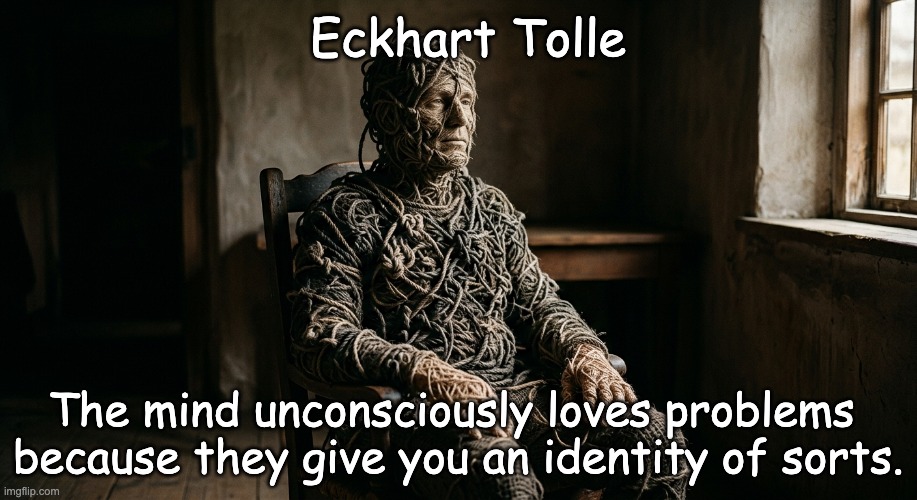
🪞 The Ego Needs Content:
– The ‘ego (mind-based sense of self)’ isn’t a fixed, stable thing — it needs constant ‘material’ to sustain itself.
– Problems, worries, and complaints give the mind something to ‘grab onto and process’.
🎭 Identity Through Struggle:
– When you have a problem (health issue, relationship conflict, financial stress), the mind can say:
– “I am the person dealing with X.”
– “I am a victim of Y.”
– “I am someone who overcame Z.”
– This becomes a ‘narrative identity’ — a story the mind tells about ‘who you are’.
🔄 Unconscious Attachment:
– The word “unconsciously” is key:
people don’t ‘choose’ to love their problems deliberately.
– The mind ‘habitually generates or clings to problems’ because:
– It reinforces a sense of ‘separate self’
– It gives life a sense of ‘drama, purpose, or meaning’
– It keeps the person in familiar ‘mental loops’ (safer than the unknown)
🌿 Contrast with Presence:
– True peace, in this framework, comes from being fully in the ‘Now’ — a state without mental narrative.
– Without problems to identify with, the ego feels a kind of “threat,” because ‘presence has no story’, and the ego ‘is’ a story.
📍 Origin:
– The quote reflects a ‘recurring theme’ in contemporary spiritual/self-help literature, especially around ‘ego psychology’ and ‘mindfulness’.
– It closely echoes ideas from ‘Eckhart Tolle’s’ works, particularly:
– “The Power of Now” (1997)
– “A New Earth” (2005)
– ⚠️ Important caveat:
This exact wording does ‘not appear to be a verified direct quote’ from either book. It may be:
– A paraphrase circulating online
– A loosely reconstructed version of something said in a talk, interview, or audio teaching
– Misattributed or reworded by secondary sources (common in quote-sharing culture)
✍️ Author:
– Most likely attributed to: Eckhart Tolle
– Reasoning for attribution:
– The language and concept (ego, identity, unconscious patterns, “the mind”) are ‘hallmarks of Tolle’s writing style.
– Tolle frequently discusses how the mind resists dissolution of problems because doing so threatens the ‘ego’s sense of self’.
– Confidence level:
🟡 Moderate — thematically consistent with Tolle, but not confirmed as an exact textual quote.
🎨 Visual Symbolism Breakdown:
Element = Meaning:
🧵 Tangled rope/string body = The mind-made identity woven from problems
🌑 Dense knots at chest/head = Core sense of self entangled with mental struggle
✋ Looser threads near hands = Potential for release, awareness, letting go
💡 Single soft light source = Presence/awareness breaking into the unconscious pattern
😌 Calm, unaware expression = Unconscious identification — the person doesn’t see the knot as a problem
🌫️ Empty dark background = The stillness of “the Now” surrounding the noise of the ego.
Forgive yourself for not being at peace. The moment you completely accept your non-peace, your non-peace becomes transmuted into peace. Anything you accept fully will get you there, will take you into peace. This is the miracle of surrender.
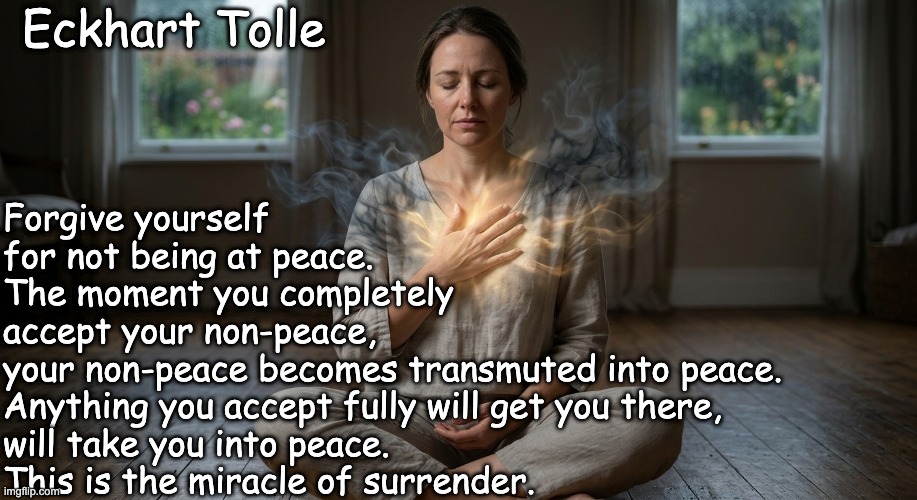
The Miracle of Surrender.
This passage explains a central concept in Tolle’s teachings:
‘The transformative power of acceptance.’
– Forgive Non-Peace:
It begins with self-compassion. The constant struggle to “be at peace” often creates ‘more’ anxiety. Tolle advises to first forgive yourself for not feeling calm.
– The Alchemy of Acceptance:
The core of the message is a paradox. The moment you stop fighting your restlessness, anxiety, or unhappiness, and ‘completely accept it’ as your present-moment experience, that feeling begins to change.
– Transmutation into Peace:
By fully surrendering the resistance to “what is,” the negative emotion loses its power. This complete surrender ‘is’ the state of peace itself. Accepting your non-peace means you are no longer at war with yourself, which is the definition of true inner peace.
✍️ Author: Eckhart Tolle.
Eckhart Tolle is a spiritual teacher and author born in Germany. He is widely recognized for his teachings on mindfulness, presence, and the importance of living in the “now” as a path to ending human suffering.
📕 Origin:
“The Power of Now”.
This saying originates from Tolle’s most famous book, ‘The Power of Now: A Guide to Spiritual Enlightenment”, first published in 1997. The book is a foundational text in contemporary spiritual literature, offering guidance on how to avoid the pitfalls of dwelling on the past or worrying about the future.
📸 Visual Illustration: The Miracle of Surrender
Here is a photorealistic image that illustrates this concept. It visualizes the internal shift from struggle and resistance (the turbulent background and tight posture) to the sudden, transformative peace that comes only after complete acceptance and surrender (the radiating calm and the single, resting hand).
The stronger the ego in you, the more likely it is that in your perception other people are the main source of problems in your life.
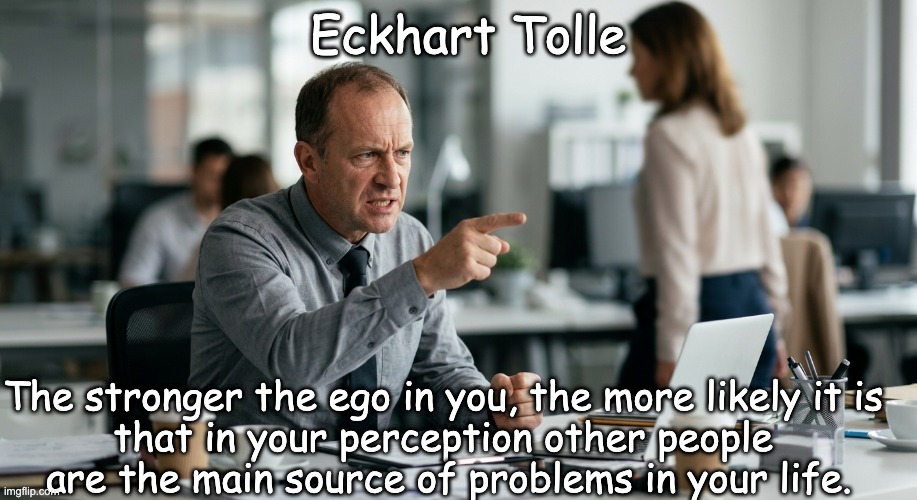
The essence of this statement lies in the way our ego—our false self-image, our identification with thoughts and emotions—colors our perception of reality. When the ego is strong, it tends to:
1. ‘View itself as the center of the universe’:
The ego is obsessed with its own needs, desires, and fears. It projects these onto the outside world, interpreting events and the actions of others solely in relation to itself.
2. ‘Blame others’:
When faced with problems or challenges, the ego often looks for the cause outside of itself. It is easier to blame others for our unhappy feelings or circumstances than to look inward and take personal responsibility.
3. ‘Create conflict and separation’:
The ego thrives on conflict and separation. It fosters a sense of “us” versus “them,” leading to judgment, criticism, and resentment. This reinforces the belief that others are the source of our problems.
4. ‘Cultivate a victim mentality’:
By constantly blaming others, we adopt the role of a victim. This provides a false sense of righteousness and absolves us of the need to change or grow.
In essence, the saying suggests that our perception of the world is a mirror of our inner state. If we are trapped within our ego, we will see the world as a hostile place filled with people who are working against us. But when we become aware of our ego and begin to live from a place of presence and acceptance, we discover that the source of our problems often lies not outside of us, but within.
Origin:
This statement is often attributed to the spiritual teacher and author Eckhart Tolle, known for books such as “The Power of Now” and “A New Earth.”
Although the exact wording may vary, the core idea behind this statement is deeply rooted in the spiritual teachings of Eckhart Tolle. In his books and lectures, he consistently emphasizes the importance of recognizing and transcending the ego as the key to inner peace and enlightenment. This particular statement comes from his book “A New Earth.”
Author: Eckhart Tolle.
Photorealistic Image Illustrating the Meaning:
A photorealistic image is shown here that illustrates the meaning of the statement.
When you don’t feel at home in the Now, no matter where you go, you will carry unease with you.

This quote emphasizes the importance of living in the present moment. Tolle suggests that if you are constantly dwelling on the past or worrying about the future, you will experience a sense of unease or discomfort, regardless of your external circumstances or physical location. True peace and contentment come from accepting and being fully present in the “Now.”
Origin:
The quote is from his book, “Stillness Speaks: Whispers of Now.” This book, published in 2003, is a collection of aphorisms and short passages designed to guide readers toward spiritual awakening and presence.
Author:
Eckhart Tolle is a German-born spiritual teacher and author who is widely recognized for his teachings on mindfulness, spiritual enlightenment, and the importance of living in the present moment. His other highly influential works include “The Power of Now” and “A New Earth.”
The image reflects the essence of finding peace in the present moment.
Death is a stripping away of all that is not you. The secret of life is to “die before you die” and find that there is no death.
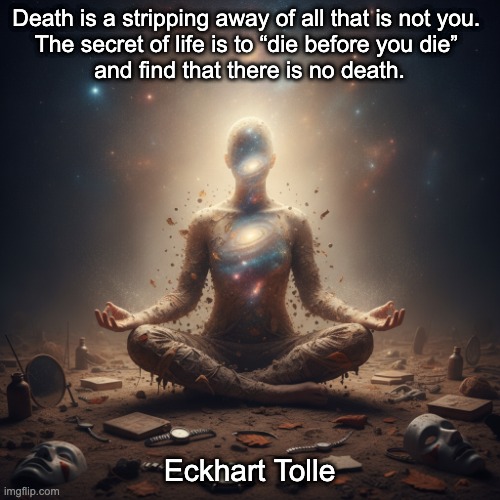
– “Death is a stripping away of all that is not you.”: This refers to the idea that much of what we identify with in life – our ego, our material possessions, our social roles, our past experiences, and future anxieties – are not our true, essential self. Physical death, in this context, is the ultimate detachment from these external and mental constructs.
– “The secret of life is to ‘die before you die’…”:
This is a metaphorical death, not a literal one. It encourages a radical shift in consciousness, urging individuals to transcend their ego-driven mind while still alive. It means letting go of identification with thoughts, emotions, societal conditioning, and the illusion of a separate self. It’s about disidentifying from the incessant mental chatter and the stories we tell ourselves about who we are.
– “…and find that there is no death.”:
By “dying” to the ego and its attachments, one discovers their true nature, which Tolle refers to as the “Presence” or “Being.” This essential self is seen as timeless, boundless, and unaffected by physical decay or the cessation of the body. From this perspective, what truly “is you” cannot die; only the temporary forms and identifications cease to exist.
Author: Eckhart Tolle
Origin:
“The Power of Now: A Guide to Spiritual Enlightenment” (published in 1997).
Tolle’s teachings emphasize living in the present moment, transcending the ego, and connecting with one’s inner stillness to experience a deeper reality beyond the confines of the conceptual mind.
The imageis illustrating this concept.
Forgiveness happens naturally when you see that it has no purpose other than to strengthen a false sense of self.
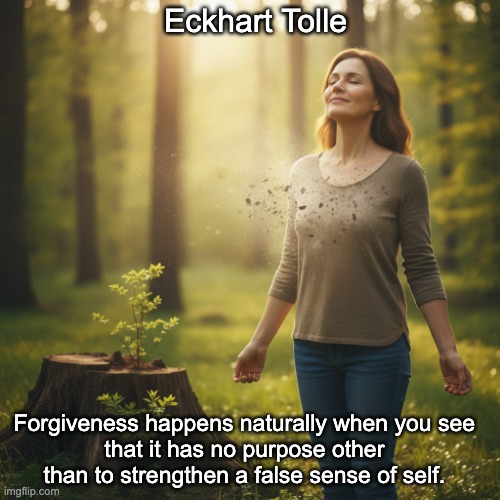
The quote suggests that forgiveness isn’t something we ‘do’ as an act of will, but rather something that arises spontaneously when we realize the futility of holding onto grievances. Here’s a breakdown:
– “Forgiveness happens naturally when you see that it has no purpose…”:
Tolle argues that holding onto resentment, anger, or the need for revenge is ultimately self-defeating. These negative emotions don’t harm the other person as much as they keep ‘us’ trapped in a cycle of suffering.
– “…other than to strengthen a false sense of self.”: The “false sense of self” refers to the ego. The ego thrives on separation, on being “right,” and on identifying with stories of victimhood or injustice. By clinging to unforgiveness, the ego reinforces its own existence and its perceived need to defend itself. When we see through this illusion – when we realize that unforgiveness is just serving to feed our ego and create more suffering for ourselves – then the need to forgive simply dissolves. It’s not an effort; it’s a recognition.
In essence, Tolle is saying that true forgiveness isn’t about condoning the other person’s actions, but about liberating ‘ourselves’ from the emotional burden of the past. It’s an internal shift in perspective that occurs when we realize the self-imposed prison of unforgiveness.
Author: Eckhart Tolle
Origin:
Book: “A New Earth: Awakening to Your Life’s Purpose”
Publication Year: 2005
Eckhart Tolle is a spiritual teacher and author known for his teachings on present moment awareness, the nature of the ego, and spiritual awakening. “A New Earth” is one of his most influential works, building upon the concepts introduced in his earlier book, “The Power of Now.”
The image illustrates the meaning of this saying.
Every complaint is a little story the mind makes up that you completely believe in.
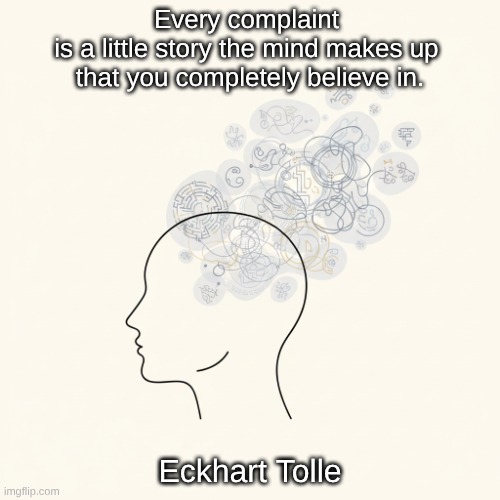
The quote suggests that our complaints are not necessarily objective truths but rather narratives constructed by our minds. We often become deeply invested in these narratives, believing them to be absolute reality.
– Mind’s Construction:
It highlights that the mind is an active storyteller. When we complain, we are often engaging in a mental process of creating a narrative around a situation, person, or event.
– Belief and Identification:
The phrase “you completely believe in” points to our tendency to identify with these mental stories. We fuse with them, making them part of our perceived identity and reality, which can intensify suffering and dissatisfaction.
– Detachment:
The underlying message encourages a step back from these mental stories. By recognizing a complaint as a “story” rather than an undeniable fact, we can begin to create a space between ourselves and the complaining mind, leading to greater peace and presence.
Origin and Author 📚:
The quote is from Eckhart Tolle’s book, “A New Earth: Awakening to Your Life’s Purpose”.
Eckhart Tolle:
He is a spiritual teacher and author known for his emphasis on ´present moment awareness and transcending the ego´. His work often explores how our identification with our thoughts and emotions creates suffering.
– A New Earth:
Published in 2005, this book builds upon the themes introduced in his earlier work, ¨The Power of Now¨.
It delves into the nature of the ego, the collective human dysfunction, and the potential for a new state of consciousness. This particular quote fits perfectly within Tolle’s teachings about observing the mind and disidentifying from its constant stream of thoughts and judgments.
The illustration helps to visualize the concept.
Emotions arise in the place where your mind and body meet.
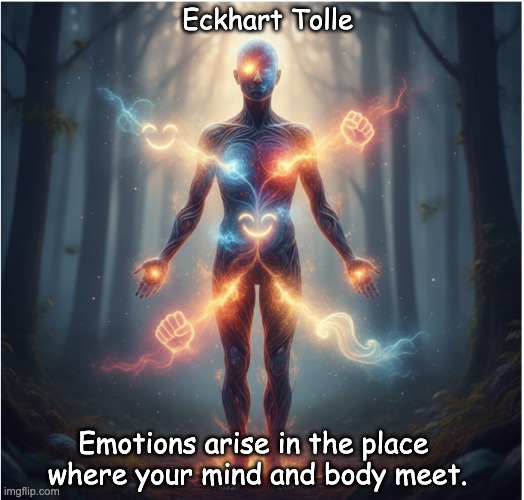
Eckhart Tolle is describing ‘emotion as the meeting point between thought and physical sensation’:
– The ‘mind’:
produces thoughts, judgments, memories, or interpretations.
– The ‘body’:
responds through sensations and physiological changes—tension, warmth, heaviness, a rapid heartbeat, and so on.
– That embodied response is experienced as ‘emotion’.
In Tolle’s formulation, emotion is therefore “the body’s reaction to your mind.” This is a spiritual or phenomenological description, not a complete scientific definition of emotion.
📖 Origin and author:
The statement comes from Eckhart Tolle, in “The Power of Now”.
The fuller original wording is:
> “Emotion arises at the place where mind and body meet. It is the body’s reaction to your mind—or you might say, a reflection of your mind in the body.”
It appears in Chapter 2, “Consciousness: The Way Out of Pain,” in the section commonly titled “Emotion: The Body’s Reaction to Your Mind.”
✍️ Accuracy of the quoted sentence
This version —
> “Emotions arise in the place where your mind and body meet.”
— is a ‘slightly altered or paraphrased version’. Tolle’s published wording is generally:
> “Emotion arises ‘at’ the place where mind and body meet.”
Page numbers vary by edition. “The Power of Now” was first published in 1997, with later widely distributed editions from New World Library.
Attachment to things drops away by itself when you no longer seek to find yourself in them.

The saying “Attachment to things drops away by itself when you no longer seek to find yourself in them” speaks to a core concept in many spiritual and philosophical traditions, particularly those focusing on mindfulness and non-duality.
– “Attachment to things drops away by itself”:
This suggests that letting go of material possessions, external achievements, or even specific relationships isn’t something we have to force or struggle with. Instead, it’s a natural consequence of a deeper shift in perspective.
– “when you no longer seek to find yourself in them”:
This is the key. We often project our identity onto external things. We might think “I am successful because I have this job,” or “I am loved because I have this partner,” or “I am important because I own these things.” When our sense of self is derived from external sources, we become attached to those sources because we fear losing our identity if they are gone. When we realize that our true self is not dependent on these external factors – when we find our identity internally – then the need to cling to “things” (which can be anything external, not just physical objects) naturally dissipates.
In essence, it’s about shifting from an externally validated sense of self to an internally validated one. Once you realize your inherent worth and completeness, the “things” that once seemed essential for your identity become less significant, and attachment to them simply falls away.
Origin and Author 📚:
This saying is widely attributed to Eckhart Tolle.
He is a contemporary spiritual teacher and author, best known for his books “The Power of Now” and “A New Earth.” His teachings often center on present moment awareness, the ego, and transcending identification with the mind and external forms. This quote perfectly encapsulates many of his core ideas.
Illustrative Image 🖼️:
A photorealistic image that aims to illustrate the meaning of this saying, focusing on the idea of detachment and finding inner peace.
In the present moment, you are always happy. If you are not happy, you are not in the present moment.
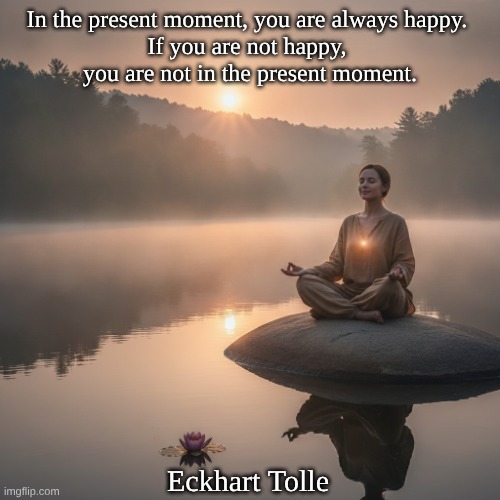
The quote, encapsulates a core teaching of Eckhart Tolle’s philosophy, particularly as presented in his widely acclaimed book, “The Power of Now.”
– ´The Present Moment as the Source of Joy´:
Tolle argues that true happiness and peace reside solely in the present moment. He believes that suffering often arises from dwelling on the past (regret, guilt) or worrying about the future (anxiety, fear).
– ´The Mind’s Role in Unhappiness´:
When we are unhappy, according to Tolle, it’s because our minds are entangled in these past or future narratives, or caught in judgment and resistance to “what is.” This mental activity pulls us away from the direct experience of the present.
– ´Happiness as Our Natural State´:
For Tolle, happiness isn’t something we achieve; it’s our natural state when we are fully present and not identified with the incessant chatter of the egoic mind. When we quiet the mind and simply ¨be¨ in the now, we connect with an underlying sense of peace and joy that is always available.
Author: Eckhart Tolle
Origin📚:
It is a central theme and idea explored extensively in his bestselling book, “The Power of Now: A Guide to Spiritual Enlightenment,” first published in 1997. While the exact phrasing might appear in various places within his work or teachings, the essence of it is fundamental to his message.
Tolle’s work encourages readers to cultivate a state of presence through mindfulness and by observing their thoughts without getting lost in them. He suggests that by doing so, one can transcend the ego and experience a deeper, more enduring happiness.
The illustration might evoke the feeling of being present.
Suffering is necessary until you realize it is unnecessary.
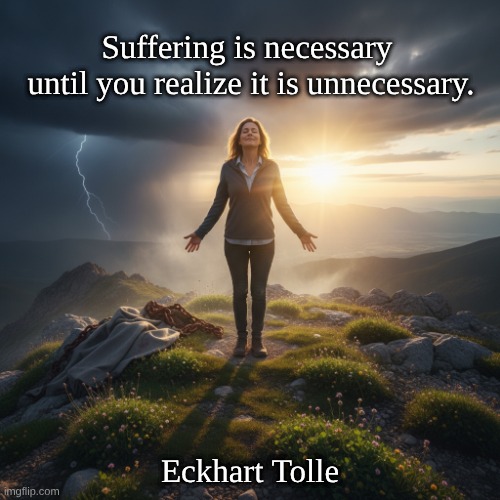
The quote, “Suffering is necessary until you realize it is unnecessary,” from Eckhart Tolle’s ¨Stillness Speaks: Whispers of Now¨, points to a transformative understanding of human experience. It suggests that:
– Suffering as a Catalyst:
For many, suffering acts as a powerful teacher. It can be the impetus that drives individuals to seek deeper meaning, change their perspective, or escape cycles of negativity. Until one reaches a point of profound dissatisfaction with suffering, they may not be motivated to look for alternatives.
– The Illusion of Necessity:
The “unnecessary” aspect highlights that much of our suffering is self-created through resistance to the present moment, identification with egoic thought patterns, and clinging to past grievances or future anxieties. When we realize that our current suffering often stems from our “reaction” to circumstances rather than the circumstances themselves, we begin to see that it’s not an inherent or unavoidable part of existence.
– Awakening to Presence:
The realization that suffering is unnecessary often comes with an awakening to the power of the present moment. By fully inhabiting the “now,” one can detach from the mind’s incessant judgment and resistance, thereby alleviating much of the psychological pain that constitutes suffering. It’s about shifting from a state of unconscious reaction to conscious awareness.
Author: Eckhart Tolle.
Origin: It is found in his book “Stillness Speaks: Whispers of Now” (2003). This book is a collection of aphorisms and short passages designed to guide readers toward spiritual awakening and presence. Tolle is a contemporary spiritual teacher best known for his works “The Power of Now” and “A New Earth”, which emphasize living in the present moment and transcending the ego.
Photorealistic Image Illustrating the Quote:
The image that aims to capture the essence of realizing that suffering is unnecessary.
Your life’s journey has an outer purpose and an inner purpose. The outer purpose is to arrive at your goal or destination, to accomplish what you set out to do, to achieve this or that, which, of course, implies future.
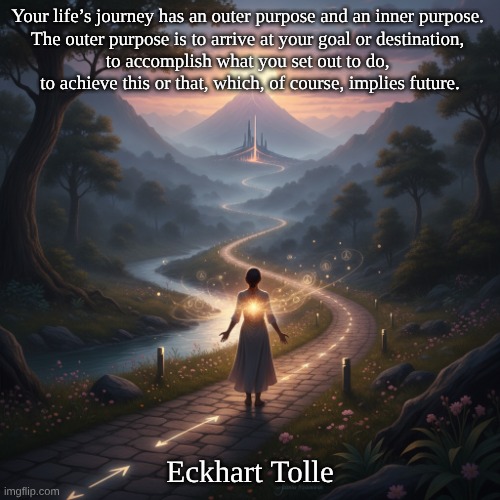
Eckhart Tolle suggests that our lives operate on two levels of purpose:
– Outer Purpose:
This refers to the tangible goals and achievements we strive for in the future. It’s about what we want to ´do´ or ´have´ – our career aspirations, personal projects, destinations we want to reach, and accomplishments we aim for. This purpose is inherently tied to the concept of time and the future.
– Inner Purpose:
While not explicitly detailed in this specific snippet, Tolle’s work emphasizes that the inner purpose is about the quality of our consciousness in the present moment. It’s about being fully present, finding peace and joy in the “now,” regardless of our outer circumstances or future goals. The outer purpose often serves as a vehicle for the inner purpose.
In essence, he’s highlighting that while we naturally focus on external achievements, there’s a deeper, more significant journey happening within us:
– how we experience life as it unfolds.
✍️ Author: Eckhart Tolle
📖 Book: “The Power of Now: A Guide to Spiritual Enlightenment”
Year: 1997
Eckhart Tolle is a spiritual teacher and author known for his teachings on mindfulness, presence, and transcending the ego. “The Power of Now” is one of his most influential works, guiding millions to a deeper understanding of spiritual awakening.
Photographic Image Illustrating the Meaning 📸.
Any action is often better than no action, especially if you have been stuck in an unhappy situation for a long time. If it is a mistake, at least you learn something, in which case it’s no longer a mistake.
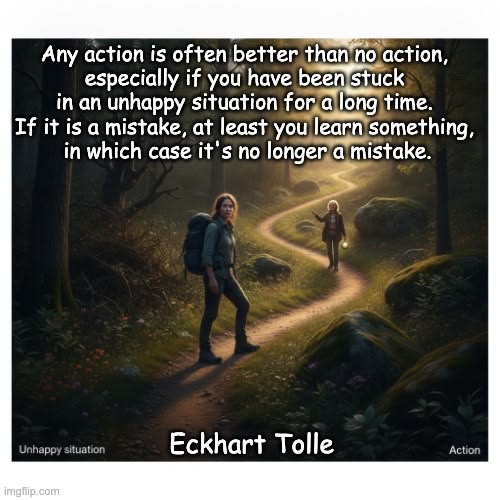
The quote emphasizes the importance of taking initiative, particularly when one feels trapped or stagnant in an undesirable situation. It suggests that:
– Action over Inaction:
Even imperfect action is preferable to remaining paralyzed by fear or uncertainty.
– Learning from Mistakes:
Errors are reframed as valuable learning experiences, transforming them from failures into opportunities for growth.
– Breaking Free:
Taking a step, any step, can be the catalyst needed to escape an unhappy state and move forward.
Author: Eckhart Tolle
Origin: “The Power of Now: A Guide to Spiritual Enlightenment”
Year: 1997
The image illustrates this meaning.
It is not uncommon for people to spend their whole life waiting to start living.
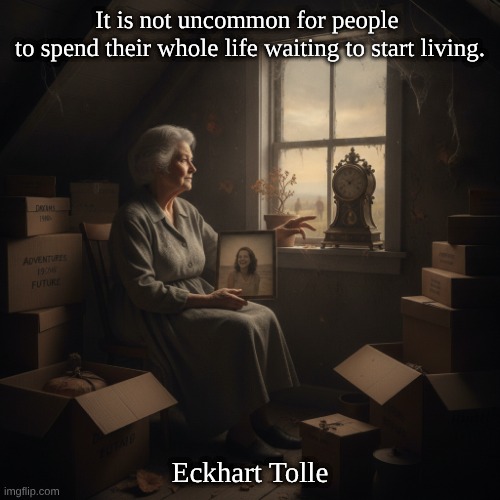
This quote suggests that many individuals postpone truly engaging with their lives, often by dwelling on past regrets or future anxieties. They might be waiting for a “perfect” moment, a specific achievement, or an ideal set of circumstances before they allow themselves to experience joy, fulfillment, or presence. Tolle’s philosophy emphasizes the importance of living in the present moment, as the past is gone and the future is not yet here. By constantly waiting, people miss out on the richness and potential of their current existence.
Quote: “It is not uncommon for people to spend their whole life waiting to start living.”
Author: Eckhart Tolle
Origin: ¨The Power of Now: A Guide to Spiritual Enlightenment” (1997)
Visual Representation:
The photo-realistic image shows the meaning of this saying,
