Karl Raimund Popper:
(Vienna, 28 July 1902 – London, 17 September 1994).
Austrian-British philosopher widely regarded as one of the greatest philosophers of science of the 20th century.
If you can’t say it simply and clearly, you should keep quiet and keep working until you can say it clearly.
The value of a dialogue depends above all on the diversity of competing opinions.
Our attitude towards the future must be: We are now responsible for what happens in the future.

Meaning:
This sentence articulates Popper’s fundamental idea of an active, future-oriented ethic: The future is not predetermined (Popper decisively rejected all historicism—that is, the idea of compelling “laws of history”), but is shaped by what we do or fail to do ’today’. Responsibility, therefore, does not refer to something that will only arise in the future, but to present decisions whose consequences shape the future. It is thus a call for taking responsibility for action in the present instead of passively waiting or fatalistic thinking about the future.
This fits with Popper’s other work: He emphasized, for example, that we should “not be prophets, but rather become the creators of our own destiny,” and that the future depends on ourselves, not on a “historical necessity”—a central theme of his critique of the philosophy of history (e.g., in “The Poverty of Historicism” and “The Open Society and Its Enemies”).
Origin:
The precise primary source (book, lecture, or interview) cannot be definitively established via the usual citation portals—they consistently list only “Karl Popper” without specifying the work. Thematically and stylistically, the sentence fits well with Popper’s later, more essayistic and public pronouncements on responsibility for the future and progress (e.g., in interviews and lectures from the 1980s and 90s, such as those related to “All Life Is Problem Solving” or “In Search of a Better World”).
In the name of tolerance, we should reserve the right not to tolerate intolerance.

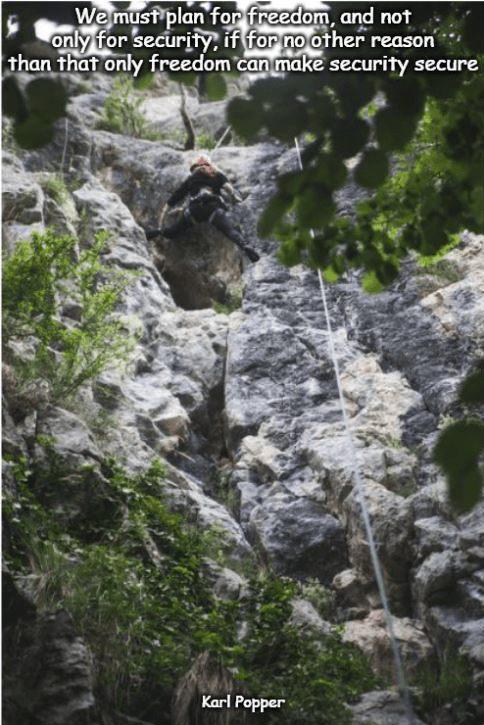
We must plan for freedom, and not only for security, if for no other reason than that only freedom can make security secure.
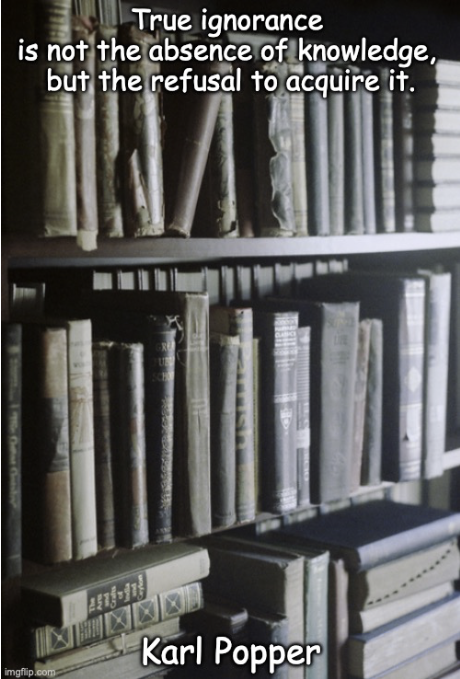
True ignorance is not the absence of knowledge, but the refusal to acquire it.