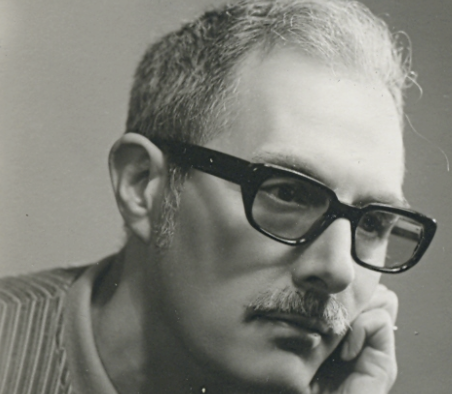
Van Acker was an employee of the National Railway Company of Belgium (NMBS) and, as a socialist leader, a member of the executive bureau of the General Central of Public Services (ACOD), Railway section. During the Second World War, he was active in the resistance. In 1959, together with Mark Braet, he founded the literary magazine Kruispunt and served as its editor-in-chief for fifteen years. He was the laureate of the aphorism competition organized by the magazine Oprispingen. His work has been translated into French, Russian, Hungarian, and Yugoslavian. Van Acker passed away in 2003.
Georges van Acker Photo ronnydeschepper.com
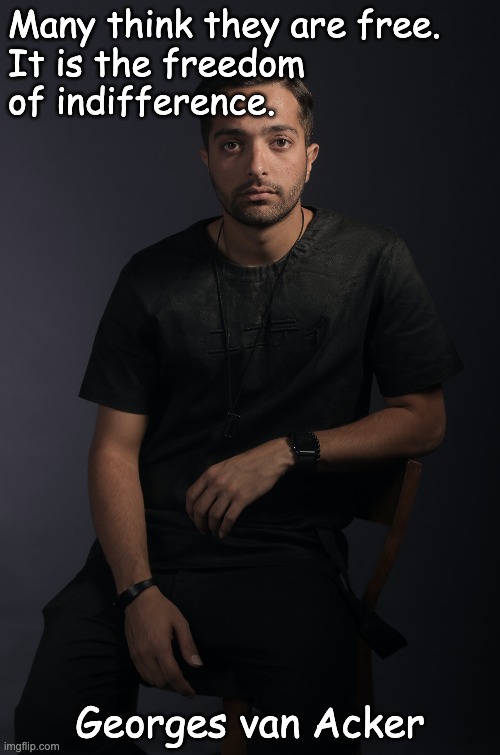
Many think they are free. It is the freedom of indifference.
Photo: Hadi Yazdi. Meaning 📚: This quote touches upon deep philosophical ideas about freedom and the human condition. The core is that what many experience as freedom may actually be a form of indifference. Let’s break that down: Freedom: Traditionally associated with autonomy, the ability to make choices and act without coercion. Indifference: This implies a lack of interest, involvement, or care. When the two are combined, the quote suggests that people feel free because they do not concern themselves with certain matters, are not faced with difficult choices, or perhaps even do not foresee the implications of their actions. It is a “freedom from”—being free from responsibility, free from depth, free from genuine involvement. This type of freedom can be superficial and may mask a deeper lack of true autonomy or critical thinking. It can also refer to the freedom that arises from not being aware of the chains one carries, or not seeing the necessity to act or take a stand. 🌍 Origin and Author: The quote is often attributed to Georges van Acker. Georges van Acker (1940–2022) was a Belgian philosopher, psychoanalyst, and writer. He was known for his in-depth analyses of the human psyche, society, and philosophy, often from a Lacanian perspective. His work frequently dealt with themes such as desire, subjectivity, power, and, indeed, freedom. Context of the quote: This quote fits well within Van Acker’s body of thought, who took a critical look at modern society and the way individuals position themselves within it. He would argue that true freedom is often accompanied by consciousness, responsibility, and the willingness to grapple with complex issues, rather than fleeing into indifference or passivity. The “freedom of indifference” is then not true freedom, but rather an illusion or a disguised form of powerlessness.
Those who fear the future have already half spoiled that future.
Image: Peter van Geest AI. Meaning 📚: The quote “He who fears the future has already half spoiled that future” means that the way we look at the future and how we feel about it has a direct influence on how that future will unfold. Fear as a self-fulfilling prophecy: If you are constantly afraid of what is to come, that fear influences your actions, decisions, and state of mind. You might miss opportunities, be less open to new experiences, or worry unnecessarily about things that might never happen. Negative influence on the present: Fear of the future robs you of the joy and possibilities in the present. You are so focused on potential negative outcomes that you overlook the positive aspects of today. Reduced resilience: Fear can reduce your resilience. If you are already “half spoiled” by fear, you are less well-equipped to deal with challenges when they actually arise. In short, the quote encourages a proactive and positive attitude towards the future, because our mental attitude is a powerful force that helps shape our reality. 🧐 Origin and Author:Georges van Acker: This quote is very often attributed to Georges van Acker (1913-1994). He was a Belgian priest, writer, and philosopher. He was known for his wisdom and aphorisms. Many of his sayings reflect a deep insight into human psychology and life. Locations: The quote can be found in various collections of sayings and wisdom, often with Georges van Acker listed as the author. It is a thought that, although often attributed to one person, reflects a universal truth that recurs in different cultures and philosophies. ✨ Conclusion: It is a powerful reminder not to get bogged down in fear, but to face the future with openness and resilience.
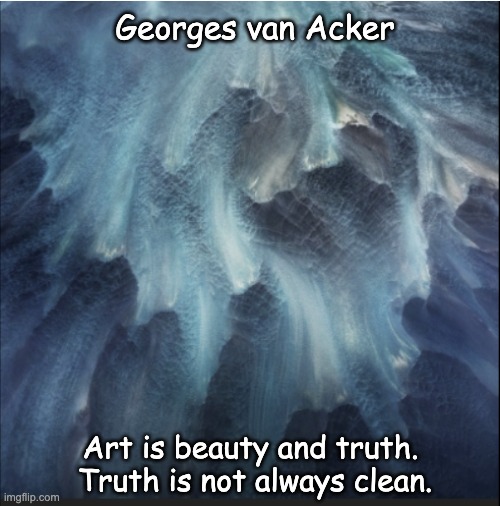
Art is beauty and truth. Truth is not always clean.
Photo: s-usans-blog. Meaning 🧐: The quote “Art is beauty and truth. The truth is not always beautiful” touches upon the complex relationship between art, aesthetics, and reality. “Art is beauty and truth.” Beauty: This refers to the aesthetic value of art. Art often has the power to delight, move, and evoke a sense of harmony or pleasure. It can be a visual, auditory, or conceptual beauty. Truth: This aspect of art concerns the capacity to capture and convey the essence of reality, human experiences, emotions, or deeper insights. Art can hold up a mirror to us, confront us with ideas, or offer us a new perspective on the world. “The truth is not always beautiful.” This second part of the quote introduces a crucial nuance. It acknowledges that the truth, reality, can often be raw, painful, unpleasant, or even repulsive. Think of subjects such as suffering, injustice, death, or the dark sides of human nature. It implies that, to be true to the truth, art must sometimes dare to show those less “beautiful” aspects as well. The artist may choose to portray harsh reality, even if that confronts the viewer or listener rather than entertains them. Together, the quote posits that true art encompasses both the beautiful and the true, and that the truth art presents does not always have to conform to traditional notions of beauty. Rather, it may be about authenticity and depth. Origin and Author 🤔: After some research, it appears that this is Georges van Acker (1947), a Belgian poet and philosopher who has engaged extensively with art, truth, and beauty. It is highly likely that this quote originates from him, given the themes he addresses in his work. He is known for his poetic and aphoristic statements that often push the boundaries of language and meaning. Unfortunately, specifically tracing the precise publication or context in which he made this quote, without direct access to his complete oeuvre, is difficult. Quote databases and online sources often confirm that these types of statements are by him, but the exact source (e.g., a specific poetry collection, essay, or interview) is not always cited.
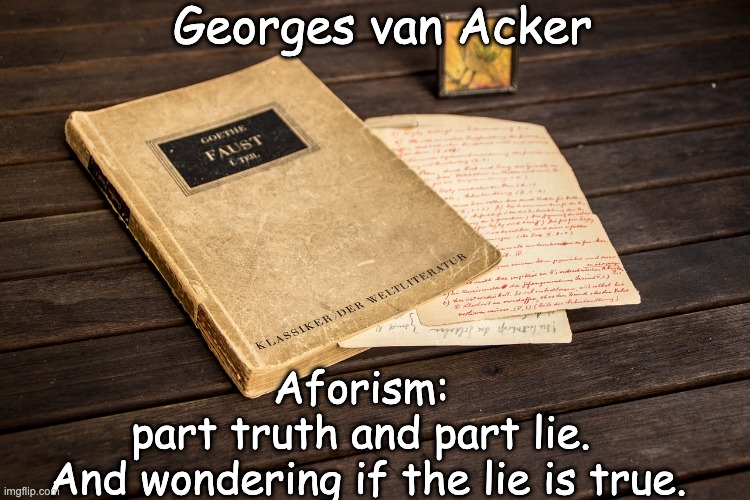
Aforism: part truth and part lie. And wondering if the lie is true.
Photo: Metsik Garden. Meaning 🤔: The aphorism “part truth and part lie. And wondering if the lie is true” plays with the nature of truth, perception, and deception. “part truth and part lie”: This suggests that aphorisms (and perhaps many statements or human concepts) are rarely purely black and white. There is often a kernel of truth in them, mixed with an element that may be exaggerated, misleading, or simply incorrect. It is the blending of these two elements that makes the aphorism complex. “And wondering if the lie is true”: This is the most intriguing and philosophical component. It challenges us to look beyond the surface. Why should we wonder if a lie is true? Subtle truth in the lie: Sometimes a “lie” (a distortion, an exaggeration, a metaphor) can expose a deeper, hard-to-express truth that a literal representation could not. Perception versus reality: It can also refer to how easily we can be misled, or how our own biases and desires make us believe in the “truth” of something that is factually incorrect. The nature of aphorisms: Aphorisms are often paradoxical and challenging. They make you think, and this specific aphorism does so by forcing the reader to examine the boundaries of truth and falsehood within the statement itself. In short, the aphorism invites critical thinking about the information we receive and the tendency to seek or find a form of truth even in falsehoods. Origin and Author 🕵️♀️:Georges van Acker (1918-1996), a Flemish aphorist and philosopher, known for his sharp and often paradoxical statements. Indeed, he wrote many works that play with the concepts of truth, illusion, and the human condition. His aphorisms are often imbued with deep psychological and philosophical observation. Attribution: This specific aphorism is attributed to Georges van Acker. It fits his style and themes perfectly. He had a penchant for dissecting complex ideas into concise, striking sentences. This aphorism is a beautiful example of his work and illustrates how he challenged the reader to think more deeply.
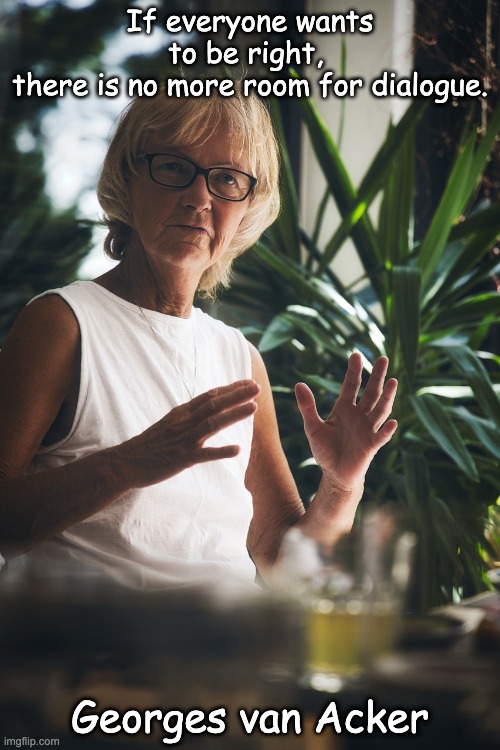
If everyone wants to be right, there is no more room for dialogue.
Photo: Julian Hacker. Meaning: Anyone solely intent on being right uses a conversation as a platform rather than an exchange. A true dialogue presupposes openness and a willingness to listen and, if necessary, change one’s point of view. Dogmatism and dialogue are mutually exclusive. Origin: The aphorism was presumably inspired by Van Acker’s personal experiences in the left-wing labor movement, where ideological rigidity and internal squabbling over “being right” were a familiar phenomenon. Source: Most likely from the collection of aphorisms ¨Bezeten van vrijheid¨ (1987). The quote also circulates in ¨Het Grootstecitatenboek ter Wereld¨ by Gerd De Ley (Lannoo, 2014). The exact original publication could not be established with complete certainty. Author:Georges van Acker (1919–2003), Flemish aphorist and editor-in-chief of the literary magazine ¨Kruispunt¨. Known for his sharp, paradoxical statements about humanity, society, and politics.
Door Pieter
Mensenmens, zoon, echtgenoot, vader, opa.
Spiritueel, echter niet religieus.
Ik hou van golf, wandelen, lezen en de natuur in veel opzichten.
Onderzoeker, nieuwsgierig, geen fan van de mainstream media (MSM).