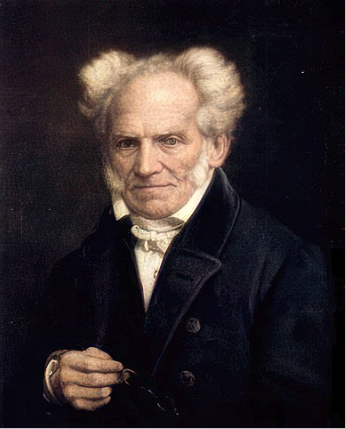
Arthur Schopenhauer:
(Danzig, 22 February 1788 – Frankfurt am Main, 21 September 1860). German philosopher who formulated a distinctly pessimistic world view. He is also known as a great stylist. His best-known work is Die Welt als Wille und Vorstellung (1818, 1844) in which he sets out his own metaphysics: behind the sensory world is a general will of which we humans are merely phenomenal manifestations. Therefore, in this worldview, man is primarily a ‘willed’ being in which desire is central and not reasonable reason. Because of this philosophy, Schopenhauer is considered the main forerunner of the philosophy of life. Schopenhauer was of great influence for philosophy in the second half of the 19th century, but in the 20th century his influence has gone into obscurity.
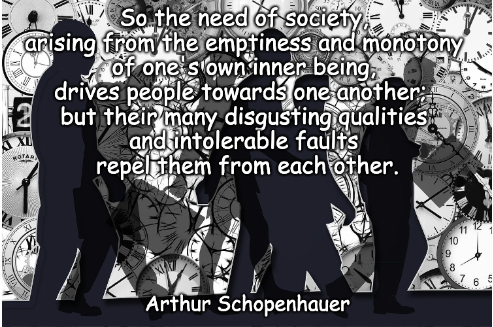
So the need of society, arising from the emptiness and monotony of one’s own inner being, drives people towards one another; but their many disgusting qualities and intolerable faults repel them from each other.
Fate shuffles the cards and we play.

It would be good to buy books if you could buy the time to read them together with them, but people often confuse buying books with learning their contents.

We are responsible not only for what we do, but also for what we accept without objection.
True, deep peace of heart and complete tranquility of mind can only be found in solitude.

Ever since I got to know people, I have loved animals.

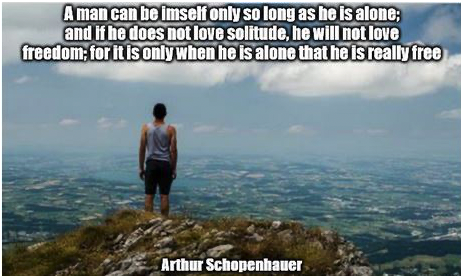
A man can be himself only so long as he is alone; and if he does not love solitude, he will not love freedom; for it is only when he is alone that he is really free.
Those who do not enjoy solitude will not love freedom.

To free a man from error is not to take something from him, but to give him something.
Newspapers are the second hand of history. This hand, however, is usually not only of inferior metal to the other hands, it also seldom works properly.
It is difficult to find happiness within oneself, but it is impossible to find it anywhere else.
Distance and long absences are detrimental to any friendship, however reluctant one is to admit it. So Goethe’s saying proves true here too: The present is a powerful goddess.
No greater mistake can be made than to imagine that what has been written latest is always the more correct; that what is written later on is an improvement on what was written previously; and that every change means progress.
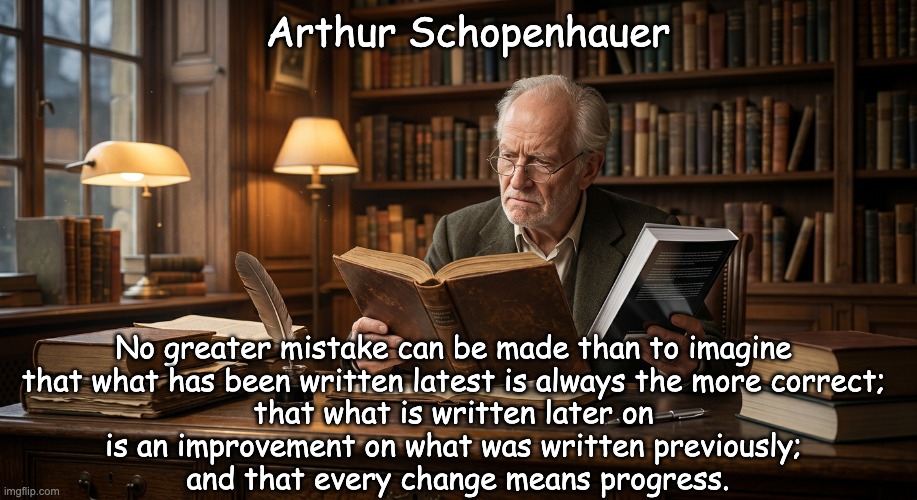
This profound quote, often attributed to Arthur Schopenhauer, addresses the critical examination of the idea of constant progress, particularly in the areas of thought, writing, and intellectual development.
– Questioning the belief in progress:
The quote cautions against blindly assuming that newer insights or later writings are automatically better, more correct, or more progressive than older ones. It advocates for critical examination and evaluation, regardless of when they were written.
– Appreciation of the old:
It emphasizes that wisdom, truth, and profound insights can also be found in older works and are not necessarily superseded by newer publications.
– Skepticism towards change:
The quote expresses a certain skepticism towards the mere desire for change and emphasizes that not every change automatically represents progress. There can also be regressions or mere fads.
– Importance of critical thinking:
It encourages one not to be blinded by the topicality or novelty of a statement, but rather to independently examine and evaluate its content and arguments.
Origin:
This quote is generally attributed to the German philosopher Arthur Schopenhauer (1788-1860). It reflects his skeptical and often pessimistic worldview, which was also expressed in his critique of the belief in progress prevalent in his time.
Context: Schopenhauer lived in a time of rapid social and technological change, in which the belief in the unstoppable progress of humanity was widespread. His philosophy challenged this optimism and emphasized the suffering and irrationality of human existence.
Author: Arthur Schopenhauer:
As already mentioned, Schopenhauer is considered the author of this quote. He was one of the most important philosophers of the 19th century and significantly shaped the history of philosophy with his work “The World as Will and Representation.” His thoughts on topics such as free will, pessimism, and aesthetics continue to have an influence today.
