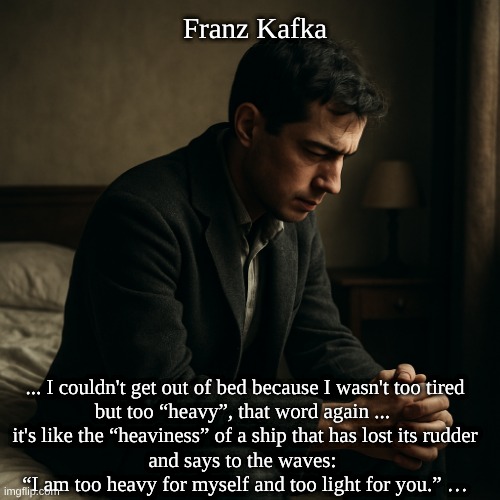
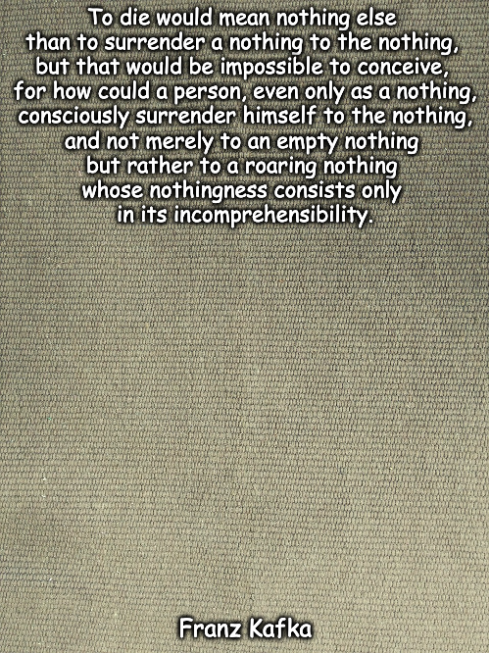
Franz Kafka:
(Prague, 3 July 1883 – Kierling, 3 June 1924).
German-language writer who is considered one of the most important authors of the twentieth century. His work had a major influence on Western literature, especially after his death.
Kafka was initially a citizen of Austria-Hungary and, more specifically, of the province of Bohemia. He grew up in the German-speaking Jewish community of Prague. After the collapse of the Habsburg Empire and the establishment of the First Czechoslovak Republic in 1918, Bohemia was incorporated into that state and Kafka thus became a Czechoslovak citizen. He also spent some time in Berlin, the capital of the Weimar Republic. This made him a German-speaking and Central European author who belonged in Bohemia at that time. Historically speaking, it is not entirely correct to refer to Kafka as a “Czech” author, as the state of the Czech Republic did not exist before 1918. He can best be characterised as a typical Bohemian, because he was fluent in both German and Czech and got on very well with both language communities in Prague. During the period when Kafka was a Czechoslovak citizen – from 1918 to 1924 – he lived and worked mainly in Austria and Germany.6
To die would mean nothing else than to surrender a nothing to the nothing, but that would be impossible to conceive, for how could a person, even only as a nothing, consciously surrender himself to the nothing, and not merely to an empty nothing but rather to a roaring nothing whose nothingness consists only in its incomprehensibility.
The truth is what every human being needs in order to live and yet cannot get or buy from anyone.

It is, after all, not necessary to fly right into the middle of the sun, but it is necessary to crawl to a clean little spot on earth where the sun sometimes shines and one can warm oneself a little.

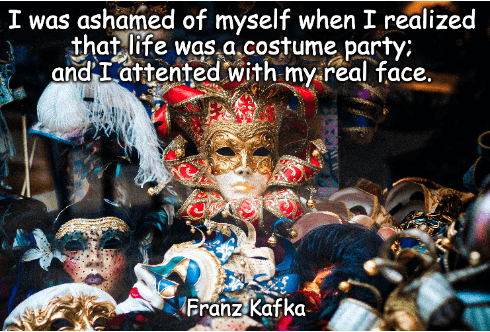
I was ashamed of myself when I realized that life was a costume party; and I attented with my real face.
There are times when I am convinced I am unfit for any human relationship.
I am constantly trying to communicate something incommunicable, to explain something inexplicable, to tell about something I only feel in my bones and which can only be experienced in those bones.
I’m not saying goodbye. There isn’t any goodbye, unless gravity, which is lying in wait for me, pulls me down entirely. But how could it, since you are alive.
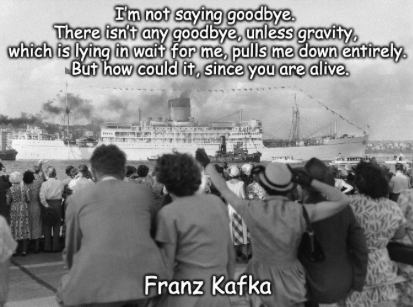
The sentence is a typical Kafkaesque image of farewell, steeped in his characteristic melancholy and fatalism. He is essentially saying:
– “I am not saying goodbye” — he refuses to accept the idea of a definitive farewell, because for him, parting is synonymous with death.
– “gravity lurking upon me” — an image for death, illness, or inner darkness that constantly threatens him and threatens to “pull him down,” toward the grave.
– “But how can it be, since you are alive” — as long as Milena lives (and thus as long as *-’their’connection through the letters persists), he cannot fully surrender to that downward pull. Her existence is what keeps him alive.
Kafka saw himself as a weak, sick man (he had tuberculosis) who clung to contact with Milena as something that literally kept him afloat. Time and again, Kafka expressed a fact that seems evident: that he lived for and through Milena’s letters, and indeed died a year after he stopped receiving them, because these were the only thing keeping a man as fragile as he was alive.
In short: it is not a literal farewell to life, but an expression of a death wish held back by the love/presence of the other — very characteristic of Kafka’s self-image as someone who constantly balanced on the brink of collapse.
Origin:
The quote comes from “Letters to Milena,” the work that compiles the correspondence Kafka addressed to Milena Jesenská between 1920 and 1922. The letters not only show the transition from a friendship to a love, but also reveal the emotional sensitivity and intimacy of the Czech author. Milena Jesenská was a Czech translator and journalist with whom Kafka had an intense, difficult love affair. Author:
Franz Kafka (1883–1924), the Prague writer, known for works such as “The Trial” and “The Metamorphosis”. This passage is taken from his personal letters, not from his fiction — which explains its directness and vulnerability.
To say that you abandoned me would be very unjust, but that I was abandoned, and at times horribly, is true.
It’s only because of their stupidity that they’re able to be so sure of themselves.

“Speaker” within the text: Josef K. (main character), as a thought/inner commentary in chapter 1. Scholarly edition: Franz Kafka, Der Proceß, ed. Malcolm Pasley, S. Fischer Verlag (1990), ISBN 978-3-10-038148-3.
What if I slept a little more and forgot about all this nonsense.
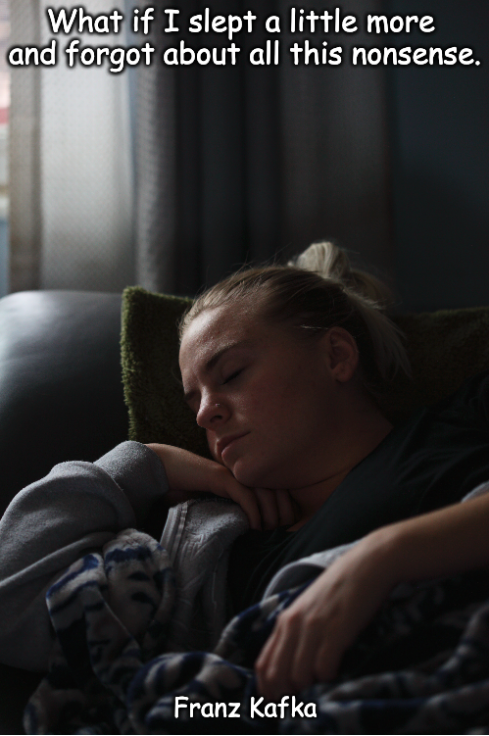
… I couldn’t get out of bed because I wasn’t too tired but too “heavy”, that word again … it’s like the “heaviness” of a ship that has lost its rudder and says to the waves: “I am too heavy for myself and too light for you.” …