Non litiges cum homine potente, ne forte incidas in manus illius.

This ancient Latin proverb carries a timeless warning about the dynamics of power and conflict.
Literal Translation:
“Do not strive with a mighty man, lest thou fall into his hands.”
– Modern Interpretation:
This saying advises against entering into conflict, legal battles, or arguments with individuals who possess significantly more power, wealth, or influence than you do. The core message is pragmatic:
’the powerful have resources and leverage that can lead to your ruin, even if you are right.’ It is a counsel for caution, strategy, and self-preservation.
📜 Origin and Author:
This proverb originates from the “Bible”, specifically from the Old Testament book of “Ecclesiasticus” (also known as the Wisdom of Sirach).
Author:
The book was written by Ben Sira (Jesus, son of Sirach), a Jewish scribe and scholar who lived in Jerusalem in the 2nd century BCE.
– Context:
The Book of Ecclesiasticus is a collection of ethical teachings and practical advice on how to live a wise and virtuous life. This specific verse (found in Ecclesiasticus 8:1) is part of a section detailing how to conduct oneself in society and avoid unnecessary trouble.
To illustrate the meaning of
“Non litiges cum homine potente,”
we present a ‘photorealistic image capturing the inherent imbalance of such a conflict’.
Eandem incudem tundere.

– ‘To keep focusing on the same point or idea’.
– ‘To repeat the same argument or action’
– Often implies ‘persistence without progress’, like not adapting or not changing strategy.
Common nuance:
– Slightly ‘negative/ironic’:
“You’re going over the same thing again and again.”
Origin 🌍:
This sentence is a ‘metaphorical proverb’ drawn from the image of a blacksmith:
– A smith ‘uses a hammer on an anvil’ to shape metal.
– If you keep hitting the same spot, you’re ‘staying with the same target’—or, in a figurative sense, ‘staying with the same idea’.
> Note:
Latin has the expression “eandem incudem tundere” (‘to hammer on the same anvil’), and there was a similar expression in Greek. Erasmus included it in his “Adagia” (under the entry “Eandem incudem tundere”), whereby it became part of the European common heritage through humanist anthologies.
Author 👤:
– ‘No single definitive author’ is widely agreed upon for this exact wording.
– It is best treated as an ‘anonymous proverbial/figurative expression’ rather than a quote with a known author.
Quick example ✍️:
– “He just kept ‘hammering on the same anvil’—the same complaint, the same evidence, no new angle.”
Melius est aliquid quam nihil.

– English:
“Better to have something than nothing.”
– Idea:
‘Even a small or imperfect outcome is preferable to having none at all.’
🏛️ Origin:
– Language:
Latin
– Source context:
This wording is commonly associated with ‘classical Greco-Roman thought’, especially the general ethical principle found across ancient moral philosophy:
‘Partial good is better than total absence of good.’
– Important note:
The ‘exact phrasing’ “Melius est aliquid quam nihil” is ‘often treated as a proverb’, and its ‘precise single “first author” is not always consistently documented’ in standard references.
👤 Author:
– ‘No single universally agreed author.’
– ‘Commonly regarded as a proverb’ (or a later classical/medieval formulation) rather than an unequivocal quote from one famous person.
Anguillam cauda tenes.

Trying to “control or hold onto something that is slipping away,” but doing so in an “ineffective or impossible” way.
– The idea is that if you grab an eel by the tail, it “escapes”:
Therefore, the action is “doomed to fail.”
– By extension:
Someone who “holds the eel by the tail” is trying to maintain control over a situation, person, or circumstance that is “elusive,” “unstable,” or “difficult to manage.”
🧠 Origin:
– It is a “very old and widespread” Italian idiom based on a concrete image:
– the eel is a “slippery animal” that is hard to hold onto;
– if you grab it from the “wrong end” (the tail), it “slips away” even more easily.
– Its origins are primarily “folk/rural,” rooted in the observation of nature and fishing activities.
> 📌 Note:
Similar variations exist in other languages and cultures (as metaphors for “something that slips out of one’s grasp”), but in Italian, the imagery specifically centers on the eel.
✍️ Author:
– “There is no single, documented author.”
– It is a “proverbial saying”: such idioms usually emerge gradually in everyday speech and “are not attributed to any one person.”
– While it may appear in proverb collections or literary texts, the expression itself is considered part of “folk tradition.”
Pira dum sunt matura, sponte cadunt.
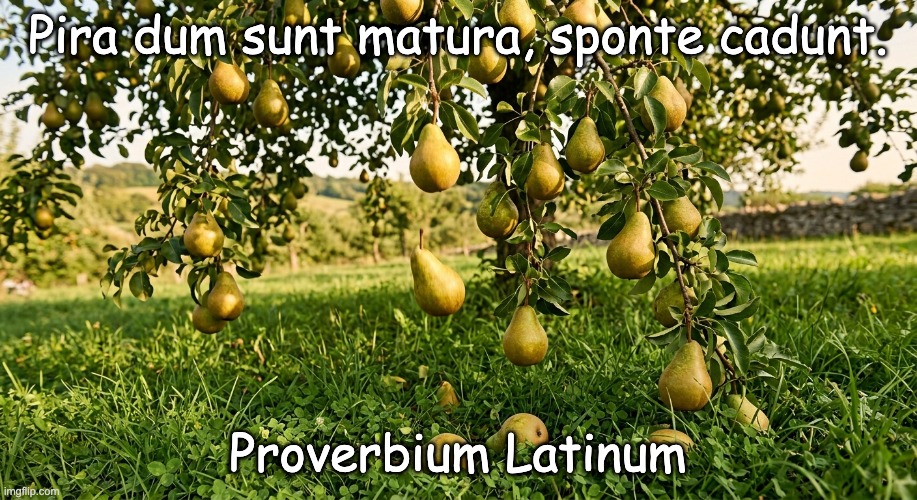
Literally:
> “Pears, when they are ripe, fall of their own accord.”
Figuratively, it means that ’things happen naturally when the proper time has come’. One should not force events prematurely; patience and maturity will bring the expected result.
📜 Origin and author:
The exact sentence is generally treated as a ‘Latin proverb or later Latin maxim’, and ‘no reliable ancient author can be assigned to it’. Online attributions to particular Roman writers should therefore be treated cautiously.
A closely related classical image occurs in Cicero’s “Cato Maior de Senectute” (§71):
> Quasi poma ex arboribus, cruda si sunt, vi avelluntur; si matura et cocta, decidunt…
> “Just as fruits, if unripe, are torn from the trees by force, but when ripe and mature, fall naturally…”
Cicero uses the comparison to describe death: the young may be taken by force, whereas the old die through natural maturity.
📝 Note:
It is more accurately called a ‘proverb or maxim’ than an idiom. A slightly more classical formulation would be:
> ‘Pira, cum matura sunt, sponte cadunt.’
> “Pears, when they are ripe, fall by themselves.”
Pomum compunctum cito corrumpit sibi junctum.
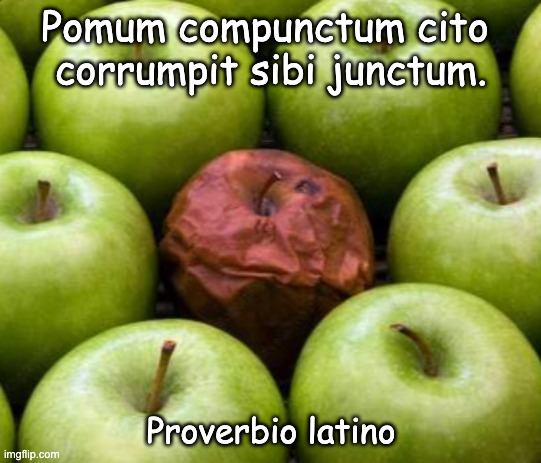
Literally:
> “A damaged/punctured apple quickly spoils the apple next to it.”
Figuratively:
> ‘One corrupt or harmful person can quickly corrupt those around them.’
It corresponds to the English proverb:
“One bad apple spoils the barrel/bunch.”
Word by word:
– “pomum” — apple or fruit
– “compunctum” — punctured, bruised, damaged
– “cito” — quickly
– “corrumpit” — spoils, corrupts
– “sibi iunctum” — joined to it, placed beside it
“Junctum” is an older spelling of “iunctum”.
📜 Origin and author:
The expression is generally classified as a ‘medieval Latin proverb or moral maxim’, rather than a quotation from a known classical Roman author.
Its rhyming ending—‘compunctum / iunctum’
— is characteristic of medieval mnemonic and proverbial Latin.
No individual author can be identified with confidence. It circulated anonymously, especially in moral and religious contexts, to warn against the influence of bad company.
Thus the safest attribution is:
> ‘Anonymous medieval Latin proverb’ — exact date and original author unknown.
Pomum compunctum corruptor est pomorum.
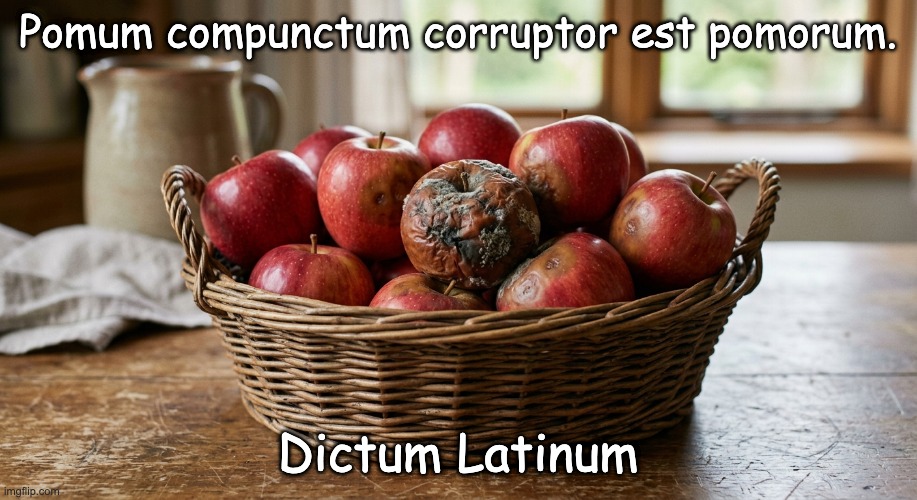
– Literal translation:
“A pricked/bruised apple is the corrupter of apples.”
– Idiomatic meaning:
“One rotten apple spoils the rest.”
In other words, one bad, corrupt, or harmful person can negatively influence or damage a whole group.
🧩 Word-by-word:
– Pomum
= apple / fruit
– compunctum
= pricked, pierced, bruised, damaged
– corruptor
= corrupter, spoiler
– est
= is
– pomorum
= of apples
So the idea is that a damaged or rotten apple causes nearby apples to rot as well.
📜 Origin:
This is best understood as a ‘Medieval or Neo-Latin proverb’, not a famous Classical Roman idiom from authors like Cicero, Virgil, or Horace.
A more common medieval-style Latin version is:
> ‘Pomum compunctum cito corrumpit sibi iunctum.’
> “A bruised apple quickly corrupts the one next to it.”
The proverb reflects the practical observation that spoiled fruit can cause other stored fruit to decay.
👤 Author:
– ‘No specific author is known.’
– It is generally treated as an ‘anonymous Latin proverb’.
– The same idea appears in many languages and later English forms, such as:
– “One rotten apple spoils the barrel.”
– “A bad apple spoils the bunch.”
🏛️ Related English tradition:
A famous early English version appears in “Geoffrey Chaucer’s Canterbury Tales”, in “The Cook’s Tale”:
> “Well better is a rotten apple out of the hoard,
> than that it rot all the remnant.”
Meaning: it is better to remove one bad member than allow the whole group to be corrupted.
Ancoris duabus niti bonum est.

> “It is good to rely on two anchors.”
Figuratively, it means:
> ‘It is wise not to depend on only one support, safeguard, plan, or hope.’
Similar English expressions include:
– “Don’t put all your eggs in one basket.”
– “Have a backup plan.”
– “Do not rely on a single hope.”
Origin 🏛️:
The phrase comes from the ancient world’s ‘nautical imagery’:
‘A ship is safer when secured by ’two anchors’ rather than only one.’
The idea appears in both Latin proverb tradition and Greek Stoic moral teaching.
A closely related saying attributed to Epictetus is:
> “A ship should not ride on a single anchor, nor life on a single hope.”
So the origin is best understood as an ‘ancient Greco-Roman proverbial idea’ about prudence and having more than one source of security.
Author ✍️:
The Latin form:
> “Ancoris duabus niti bonum est”
> “It is good to rely on two anchors.”
is often attributed to:
– Publilius Syrus / Publius Syrus
– A Roman writer of moral maxims
– 1st century BCE
However, a very similar maxim is also attributed to:
– Epictetus
– Greek Stoic philosopher
– 1st–2nd century CE
Epictetus’ associated version is usually given as:
> “A ship should not ride on a single anchor, nor life on a single hope.”
So, in short:
– Latin wording:
Commonly linked to Publilius Syrus
– Similar Stoic version:
Attributed to Epictetus.
Nemo mittens manum suam ad aratrum.
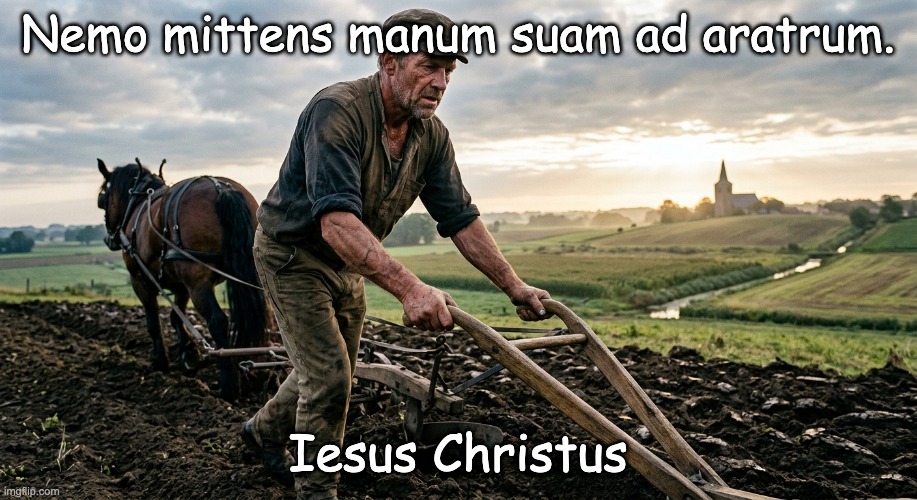
“No one, putting his hand to the plow, looks back.”
It conveys a powerful message about ‘commitment, focus, and unwavering dedication’ to a task or purpose.
Key interpretations include:
– Singular Focus:
Once you have begun a significant endeavor or made a solemn commitment, you must look forward towards your goal, not backward at what you are leaving behind or at other distractions.
– Irreversible Commitment:
It suggests that certain decisions, especially spiritual or profound life choices, require complete devotion, and hesitation or second thoughts render one unfit for the task.
– The Danger of Looking Back:
Looking back is seen as a sign of regret, doubt, or lack of conviction, which ultimately leads to failure or unworthiness.
📖 Origin and Author:
The origin of this idiom is directly from Christian Scripture, specifically the New Testament.
– Author: The traditional author is Saint Luke the Evangelist.
– Source: It is found in the Gospel of Luke, Chapter 9, Verse 62 (Luke 9:62).
In the context of the Gospel, Jesus is speaking to a disciple who offers to follow him, but first asks permission to go and say farewell to those at his home. Jesus responds with this parable, illustrating that following him requires immediate, absolute, and single-minded devotion, much like a plowman who must keep his eyes fixed forward to create a straight furrow.
The original Greek text is:
“Οὐδεὶς ἐπιβαλὼν τὴν χεῖρα ἐπ’ ἄροτρον καὶ βλέπων εἰς τὰ ὀπίσω εὔθετός ἐστιν τῇ βασιλείᾳ τοῦ Θεοῦ.” (No one who puts his hand to the plow and looks back is fit for the kingdom of God.)
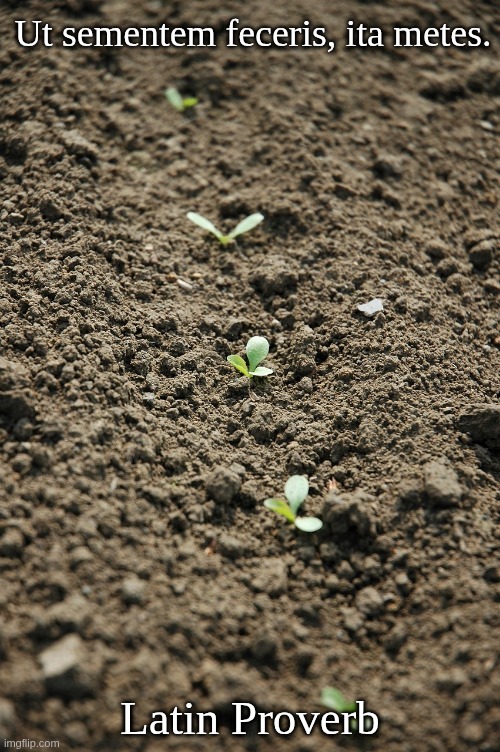
Ut sementem feceris, ita metes.
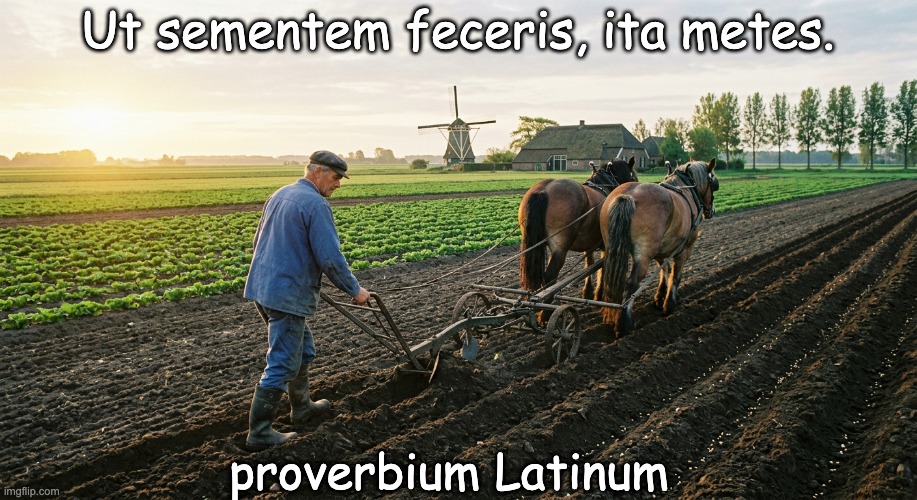
– ‘Your actions have consequences.’
– If you do good things, you are likely to receive good results.
– If you do bad things, you may face bad consequences later.
In simple words: ‘What you do today will affect what happens to you tomorrow.’
📌 Example:
– If you treat people with kindness, they will likely treat you kindly too — ‘as you sow, so shall you reap’.
– A student who works hard will get good results; one who neglects studies may fail.
📖 Origin:
The saying comes from the Bible, specifically from the ‘New Testament’. The famous line appears in Galatians 6:7 :
> “Whatsoever a man soweth, that shall he also reap.”
This is from the King James Version of the Bible, published in 1611.
✍️ Author:
The verse is traditionally attributed to Saint Paul / Apostle Paul, who wrote the ‘Epistle to the Galatians’.
However, the idea itself is very ancient and comes from farming life:
– ‘Sowing’ means planting seeds.
– ‘Reaping’ means harvesting the crop.
– So the metaphor suggests that the “seeds” of our actions produce similar “harvests” in life.
Vestis virum facit.
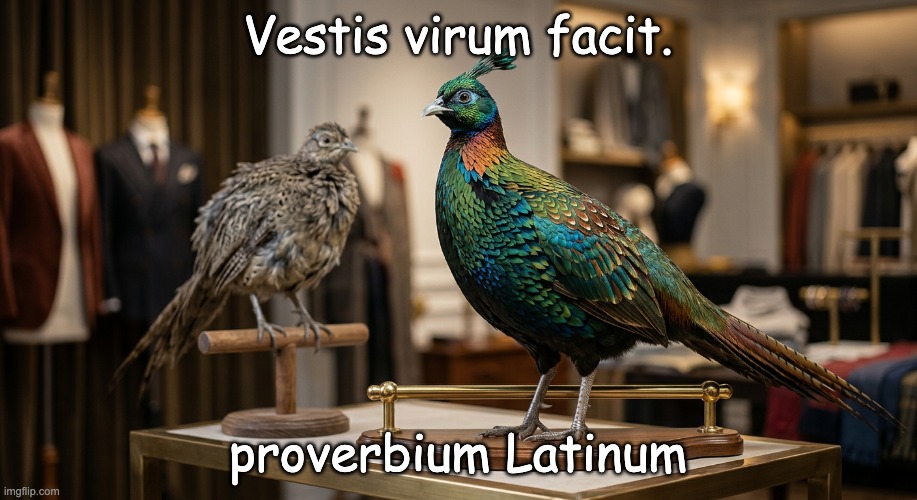
– Literal: “Clothes make the man.”
– ‘Sense / usage’: A person’s appearance—especially clothing or presentation—can shape how they are judged or perceived (e.g., status, professionalism, authority).
🕰️ Origin:
– This is a ‘Latin proverb’ (a traditional saying).
– It expresses a broadly old idea: that ‘external appearance influences social perception’.
– A common modern English parallel is “clothes make the man.”
> Note: The phrase is generally treated as a ‘classic Latin saying/proverb’, but pinpointing a single first author for the exact wording is often difficult with proverbs because they circulate orally and in many texts over time.
✍️ Author:
– ‘No single universally agreed author’ is attached to the exact proverb “Vestis virum facit.”
– Like many proverbs, it’s considered ‘anonymous/traditional’ rather than the work of one clearly identified writer.
📌 Related references (useful context):
– The idea overlaps with writings on ‘appearance and social status’ found in classical literature, but for the exact sentence “Vestis virum facit”, it’s typically cited as a ‘proverb’ rather than attributed to a specific classical author.
Canis timidus vehementius latrat quam mordet.

People who frequently threaten, swear, or use strong words are usually not the ones who actually take action (violence). Anyone who expresses their aggression audibly — “barks” — has, as it were, already lost that energy in the sound, and rarely actually takes any action. The saying is often used to reassure someone who is afraid of a threat or an angry reaction from another person.
A well-known side note reads: “Barking dogs don’t bite, but who shoots a barking dog?” — a variation indicating that a threat must sometimes be taken seriously after all.
Origin:
The saying is a classic folk proverb without an identifiable individual originator. Virtually every European language has an equivalent:
– English: “His bark is worse than his bite” / “Barking dogs seldom bite”
– German: “Hunde, die bellen, beißen nicht”
– French: “Chien qui aboie ne mord pas”
The idea can be traced back to classical antiquity. In the historical work of the Roman historian Quintus Curtius Rufus, the sentence “Canis timidus vehementius latrat quam mordet” (“A frightened dog barks more fiercely than it bites”) appears, a passage from Book VII, Chapter 4, verse 13 of his work on the campaigns of Alexander the Great. Through popular usage and later collections of proverbs (such as Erasmus’s “Adagia” in the 16th century), this classical comparison has spread throughout Europe and eventually found a permanent place in Dutch as well. Author:
No specific author of the saying itself can be identified — it is centuries-old folk heritage and is included in virtually all major dictionaries of proverbs.
However, there is an identifiable source for the underlying Latin phrase: Quintus Curtius Rufus, a Roman historian (presumably active in the 1st century AD, although the exact dating is disputed among classicists). He wrote “Historiae Alexandri Magni”, a historical work about Alexander the Great, in which the aforementioned phrase appears. Important to note: this is a historical prose work, not a poem — the concise, proverbial form as it circulates today has been slightly modified over the centuries compared to the original.
Parum sibi consulit aegrotus qui medicum heredem facit.

The proverb means: A patient who makes the doctor his heir is essentially signaling that he expects death, not recovery.
Therefore, it implies: Such a patient is not likely to recover, because making a will for the doctor suggests the person believes they won’t live long.
🌍 Origin:
It originates from Latin Roman moral/proverb tradition (short sententious sayings), where health and fate were often discussed through warnings and ethical maxims.
(“does little for himself… who makes the doctor his heir”).
✍️ Author: Publius Syrus (1st century BC),
a Roman author known for moral sayings/epigrams (sententiae) that later became proverbial.
Cucullus non facit monachum.
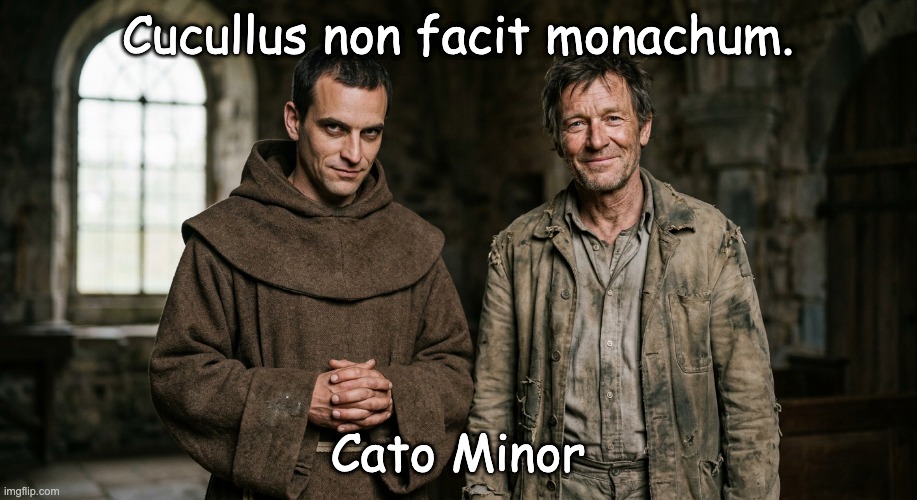
This proverb means that outward appearances don’t reflect inner character — a person’s clothing, title, or external attributes don’t determine who they truly are. Someone can dress or look the part without actually being what they appear to be. It’s a caution against judging people (or things) by superficial qualities alone.
It’s closely related to the more common English saying “Don’t judge a book by its cover.”
Origin:
The expression has medieval Latin roots: “cucullus non facit monachum” — literally, “the hood does not make the monk.” In monasteries, the cowl (a distinctive hooded robe) was the visible mark of a monk’s identity and devotion. The proverb warned that simply wearing the habit didn’t make someone truly pious or virtuous — the spiritual life had to be lived inwardly.
The Latin form was widespread across medieval Europe and appeared in various languages:
French: “L’habit ne fait pas le moine”
Italian: “L’abito non fa il monaco”
Spanish: “El hábito no hace al monje”
Authorship:
It has no single author — it’s a traditional proverb of medieval clerical culture, passed down orally and in written collections. However, several notable attributions exist: Often attributed to Cato the Younger, a Roman senator and writer.
William Shakespeare used a version of it in “Othello” (c. 1603): “I am not what I am” reflects the same idea, and in Measure for Measure he wrote more directly on the theme of habit vs. character.
Erasmus included the Latin form “cucullus non facit monachum” in his “Adagia” (1500), a famous collection of classical proverbs, which helped spread it across Renaissance Europe.
The phrase also appears in earlier English literature, notably in William Langland’s Piers Plowman (c. 1370s).
So while Erasmus is often credited with popularizing it in its written form, the saying belongs to the collective wisdom of medieval Europe rather than any one author.
Non omnia possumus omnes.

– Literal translation: “We all cannot do all things.”
– Natural English meaning: “Not everyone can do everything.”
– It expresses the idea that:
– everyone has limits,
– people have different talents and abilities,
– no one is capable of mastering or accomplishing everything.
🏛️ Origin:
– The phrase comes from ‘classical Latin literature’.
– It appears in “Virgil’s Eclogues”, also called the “Bucolics”.
✍️ Author:
– Publius Vergilius Maro, known in English as Virgil or Vergil
– Dates: 70–19 BCE
– Work: “Eclogues” / “Bucolics”
– Reference: “Eclogue 8, line 63”
🧠 Notes:
– The phrase later became a proverbial saying or motto.
– It is often used to counsel humility or acceptance of human limitations.
Nemo judex in causa sua.

Literal translation:
“No one should be a judge in their own case.”
General meaning: A person should not make decisions in a matter where they have a personal interest, because it creates bias or a conflict of interest.
🏛️ Origin:
The saying is a Latin legal maxim rooted in principles of natural justice.
It is strongly associated with Roman law and later became important in English common law.
✍️ Author:
‘There is no single known author’ of the exact phrase.
A famous related form was used by Sir Edward Coke, an English jurist, in the principle that no person should be judge in their own cause.
Fronti nulla fides.

– Literal translation: “No trust to the face/front.”
– Natural English meaning:
– “Appearances are deceptive.”
– “Do not trust outward appearances.”
– “You cannot judge a person by their face/look.”
🏛️ Origin:
– This is a ‘Latin phrase’ from ‘Roman literature’.
– It is generally attributed to Juvenal (Decimus Junius Juvenalis), the Roman satirical poet.
– It comes from his “Satires”.
✍️ Author: Juvenal
– Work: “Satires”
– The phrase is commonly cited as:
– “Fronti nulla fides.”
🧠 Sense of the expression:
– The word “fronti” comes from “frons”, which can mean:
– ‘forehead’
– ‘face’
– ‘outward appearance’
– So the phrase warns that:
– someone may ‘look honest but not be honest’
– the ‘external appearance does not reveal the ’true character’
✅ In simple modern English
– ‘Don’t judge by appearances.’
– ‘Looks can be misleading.’
Inter superbos semper iurgia sunt.

Biblical/proverbial tradition: traditionally Solomon
Superbia ante ruinam.
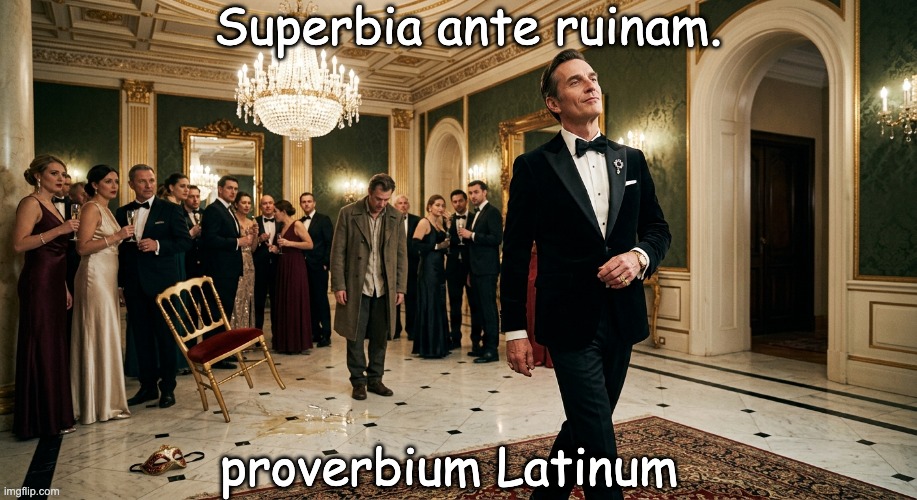
“Pride goes before a fall.”
Omnia mors aequat.
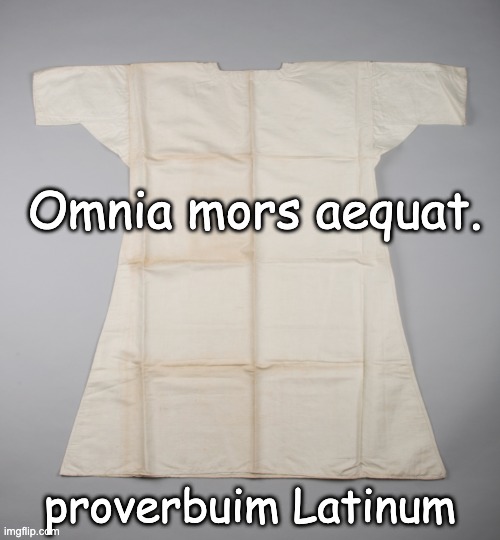
Origin: The phrase originates from the Roman poet Marcus Annaeus Lucanus, better known as Lucan, who lived during the 1st century AD. It appears in his epic poem “Pharsalia,” also known as “De Bello Civili” (On the Civil War). The poem details the conflict between Julius Caesar and Gnaeus Pompeius Magnus (Pompey the Great). In “Pharsalia,” Lucan uses the phrase “Omnia mors aequat” to highlight the point that even the most powerful and influential figures are not exempt from the grasp of death. It serves as a philosophical reflection on the fleeting nature of life and the futility of human ambition in the face of mortality. Key aspects of the phrase “Omnia mors aequat”: Universality: Death is an inevitable part of the human experience that affects everyone, regardless of their station in life. Equality: In death, all social, economic, and political distinctions disappear. Mortality: The phrase serves as a poignant reminder of our limited time on earth. Humility: Understanding that death is the ultimate equalizer can foster humility and a greater appreciation for the present moment. The enduring popularity of the phrase “Omnia mors aequat” is a testament to its profound and timeless message. It continues to resonate with people across cultures and generations, offering a somber yet insightful perspective on the human condition.
Exempla docent.

Pons asinorum.

Diabolus est Dei simia; Satan simia Dei.

Author 👤: No unique author: It is a traditional, early Christian saying. Early attestations / attributions: Tertullian (c. 160–220): often cited as a source of the formulation/idea. Augustine (354–430): extensively develops the imitation motif. Luther (1483–1546): widely popularized the saying in German. Variants and translations 🌍: Latin: Diabolus est Dei simia; Satan simia Dei. German: Der Teufel ist Gottes Affe. English: The devil is God’s ape/monkey. Dutch: De Duivel is Gods aap. Examples of use 📎: Warning against “false” sacraments or miracles that imitate true religion. Criticism of pseudo-piety or ideological copies of Christian truths. General: Indication that evil often masquerades as something good. Further reading 📚: Tertullian, De Baptismo (on demonic imitation of rituals). Augustine, De civitate Dei and other works (on demons and imitation). Martin Luther, sermons, and Tischreden (where the German form appears frequently).
In flagranti delicto.

Sed fugit irreparabile tempus.

Tempus fugit

Ex toto corde et anima tua.
Amicus certus in re incerta cernitur.

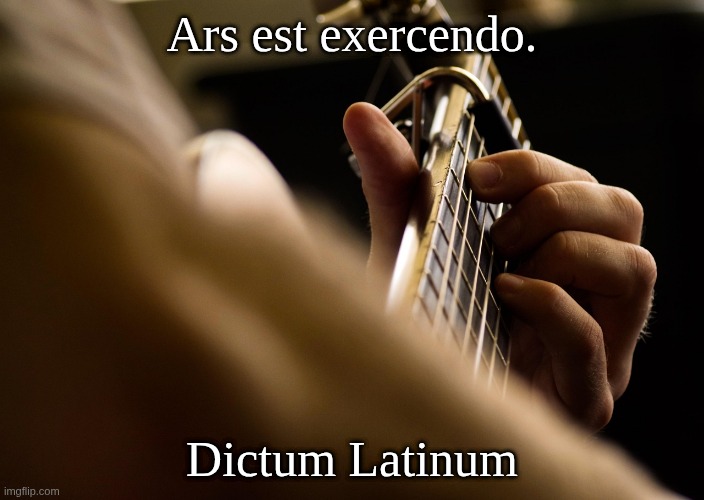
Ars est exercendo.
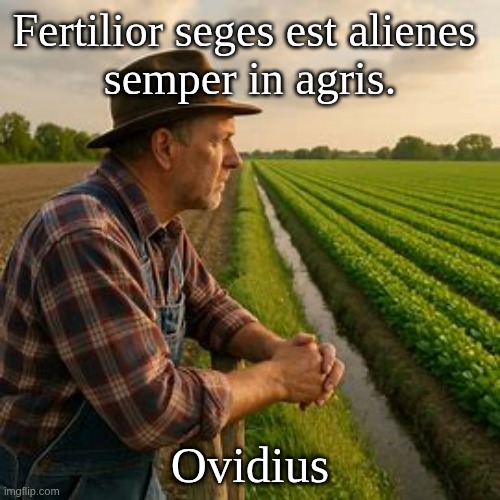
Fertilior seges est alienes semper in agris.
Optima sunt gratuita.

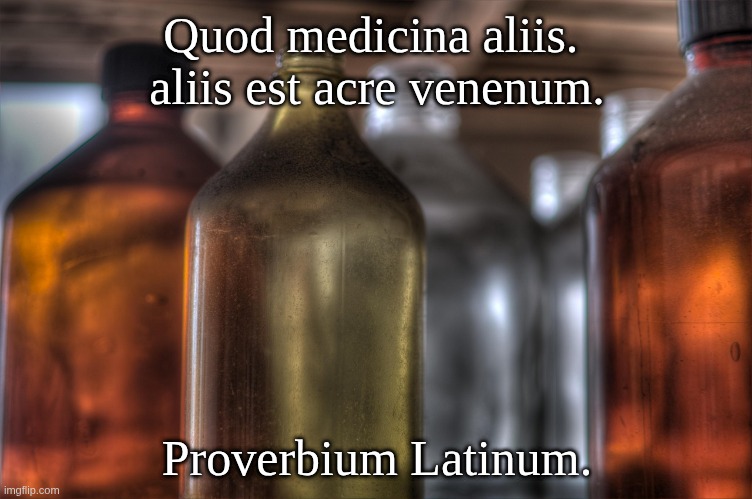
Quod medicina aliis. aliis est acre venenum.
Quod me non necat me certe confirmat.

Dimidium facti, qui coepit, habet.

Amicus certus in re incerta cernitur.

Acta non verba.

Veritas vincit.

Nullae litterae, bonae litterae.

Malum venit cum sociis.

Praemonitus, praemunitus.
Ut sementem feceris, ita metes.
Fallacia enim est bona fama.

Silentium aureum.

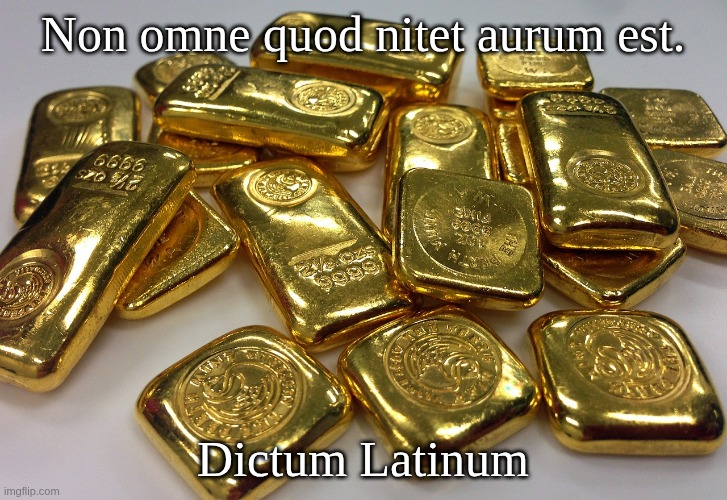
Non omne quod nitet aurum est.
Dimidium facti, qui, habet.

Homo fugit velut umbra.
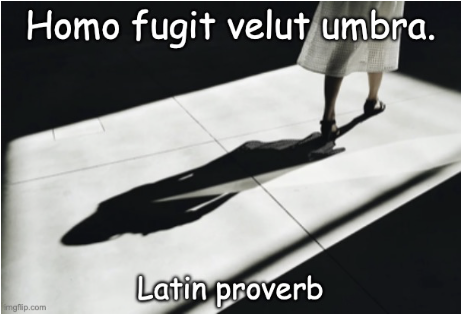
Martino Pietropoli
In cauda venenum.

Argumenta, morum ex minimis quoque licet capere.