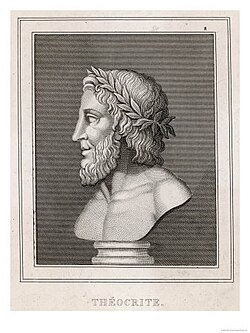
(/θiːˈɒkrɪtəs/; Ancient Greek: Θεόκριτος, Theokritos; Sicilian: Tiòcritu, Teocritu;).
Born c. 300 BC, died after 260 BC). Greek poet from Sicily, Magna Graecia, and the creator of Ancient Greek pastoral poetry. Little is known of Theocritus beyond what can be inferred from his writings. We must, however, handle these with some caution, since some of the poems (Idylls; Εἰδύλλια) commonly attributed to him have little claim to authenticity. It is clear that at a very early date two collections were made: one consisting of poems whose authorship was doubtful yet formed a corpus of bucolic poetry, the other a strict collection of those works considered to have been composed by Theocritus himself.
Photo: wikipedia.org
Hushed are the voices of the winds and seas; But O not hushed the voice of my despair.
Photo: Yucar Studios.🧠 Meaning 🌊: Contrast between the outer and inner world Outside: nature is still/calm (sea and wind have subsided). Inside: sorrow remains unchanged and does not “Hushed”. Stylistic device: Repetition of “hushed” (parallelism) creates an incantatory, plaintive tone that fits well with despair / homesickness / lovesickness. 🏺 Origin: 📜 The reference “Idylia 2, 38” points to: Theocritus’ Idyll(e) 2, line/verse 38 (in editions this is often shown as line numbers). Important: This is originally Ancient Greek; ✍️ Author 👤:Theocritus (also spelled Theokritos), Hellenistic poet of the 3rd century BC. Known as a key figure in idyllic/pastoral poetry (Idyllia = Idylls).
The tibia is further away than the knee.
Photo: Anne Nygard. Meaning:The poem operates via a classical reasoning from nature: every creature is attracted to its own kind — the cicada seeks the cicada, the ant the ant, the hawk the hawk. This is the Greek principle of homoioi philousi homoious (“like loves like”), which also appears in Aristotle. But the poet consciously breaks that pattern: his nature is that of poetry and the Muses, not that of an animal or an ordinary human being. Song is his element, just as spring is for the flower, or flowers for the bee. The final line — that the presence of the Muses pleases him more than sleep or spring — is a classic poetic self-portrait: the poet as someone whose nature is poetry, not possessions, power, or honor. Origin and context:Theocritus (born c. 300 BC, died after 260 BC) was a Greek poet from Sicily and the creator of ancient bucolic poetry. He wrote in a combination of lyrical tone, epic meter, and the Doric dialect of his native Sicily, creating an idealized pastoral landscape. The fragment is titled “Birds of a Feather” in English translations and is one of his shorter poems. This little poem is not an idyll in the strict sense, but a short epigrammatic poem — a personal confession of faith by the poet himself. It is related to the Hellenistic tradition of the poetic sphragis (seal), in which a poet describes his own nature and calling. The Greek word for cicada (tettix) held a special significance in antiquity: the cicada was considered the symbol of the poet and the singer, because it sings all day long without eating or drinking — an image of pure, selfless song. The text: In English translation it reads: > Cicada is dear to cicada, > Ant loves ant, hawks hawk; > But me the Muse and song enchant. > Of this may my house be full. > For neither sleep nor spring > Suddenly appearing is sweeter, > Nor flowers to bees, > Than the presence of the Muses to me. That makes the opening line all the more striking: the cicada recognizes the cicada, and the poet recognizes the Muse.
Now begins a torrent of worlds and a trickling sense.
Photo by Danny Lines
Youth passes like a dream.
Photo: Chris Malinao. Meaning: The saying expresses one of the most universal human experiences: youth is fleeting, it slips away before you realize it, just as a dream vanishes upon waking. It is a memento iuventutis — a reminder to cherish youth, for it is short-lived and cannot be recovered. Author and origin: Theocritus (c. 300 BC – after 260 BC) was a Greek poet from Sicily and the founder of Greek pastoral poetry. The saying “Youth passes like a dream” is attributed to him. Its precise origin within his work is difficult to pinpoint. His surviving work consists mainly of a collection of 30 poems, known as the Idylls (Εἰδύλλια), some of which, however, are not attributed to him with certainty. The saying is consistently linked to Theocritus in books of quotations, but it is more of a distillation or summary of a theme running through his work than a single literally quoted sentence. For instance, he writes extensively in his poems about the transience of youth and beauty — another well-known quote of his reads: “Beautiful is the bloom of youth, but it lasts only for a short time.” The broader theme was already deeply rooted in Greek literature before Theocritus: in Pindar and in Greek lyric poetry, too, youth is compared to a dream or a fleeting flower. Theocritus masterfully articulated this sentiment in the pastoral atmosphere of his idylls. Conclusion: The saying is attributed to Theocritus as a summary of a recurring theme in his Idylls. It is one of the most timeless observations of classical antiquity and has resonated throughout the centuries in European literature and culture.
Beauty is an evil in an ivory setting.
Photo:Kamila Maciejewska. Meaning: The image is deliberately paradoxical. Ivory in antiquity was a precious, lustrous material used to frame and display things of great beauty — think of carved ivory boxes or the chryselephantine (gold-and-ivory) statues of the gods. To call beauty itself “an evil in an ivory setting” is to say: beauty is something dangerous or harmful, and all the more so because it comes adorned and presented magnificently. The “ivory setting” heightens rather than redeems the “evil” — the beautiful thing is all the more perilous for being so exquisitely displayed. Author: The quote is universally attributed to Theocritus, the Greek pastoral poet from Sicily who lived around 300–260 BC and is considered the creator of ancient Greek pastoral poetry. His main surviving works are the Idylls, a collection of roughly 30 poems, though some of those commonly attributed to him have little claim to authenticity. That said, there is a significant caveat worth knowing: the exact source within his works is very hard to pin down. Quote databases uniformly attribute “Beauty is an evil in an ivory setting” to Theocritus, but none specify which Idyll it comes from, and it doesn’t appear verbatim in the standard translations of the Idylls available online. This strongly suggests one of two things: 1. It’s a translation of a line from one of the lesser-known or disputed Idylls, rendered in a particular English version that differs from the more common translations — not unusual for ancient Greek, where translators make very different choices. 2. It may be a paraphrase or aphorism extracted and polished from a longer passage, a common fate for ancient quotes that circulate in anthologies. This fits perfectly with the broader themes of Theocritus’s Idylls, which are full of the torments of erotic love — the suffering that beautiful people and things cause in those who desire them. In that world, beauty is not simply pleasant; it is a kind of affliction.
Age overtakes us all; our temples first; then our cheek and chin, slowly and surely, creep the frost of time. Up and do somewhat, ere thy limbs are sere.
Photo: Format arw. 📜 Meaning: The saying “Age catches up with us all; our temples first; then our cheeks and chin slowly and surely creep through the frost of time. Rise up and do something before your limbs are withered” is a poetic yet highly practical reflection on the transience of life and the importance of action. Transience and Aging: The first half of the quote vividly describes the physical signs of aging. The “frost of time” is a beautiful metaphor for the inexorable influence of old age leaving its mark slowly but surely, starting at the temples and spreading across the face. It emphasizes the inevitability of the aging process. Call to Action: The second half of the quote is a powerful exhortation. “Rise up and do something before your limbs are withered” is a direct call to live life actively, seize opportunities, and act before physical limitations (symbolized by “withered limbs”) make this impossible. It encourages the utilization of youth and vitality, and warns against passivity and procrastination. Carpe Diem (Seize the Day): The core of the message aligns closely with the famous concept of “Carpe Diem,” or “seize the day.” It reminds us that time is limited and that we must use it wisely. 🏛️ Origin and Author:Theocritus (circa 310 – circa 250 BC): He was a Hellenistic Greek poet, best known as the founder of bucolic poetry (pastoral poems). His works often focused on idyllic rural life and love, but he was also capable of deeper philosophical reflections on life and the human condition. Context: This type of reflection on old age, the transience of time, and the call to action were common themes in Greek literature and philosophy. Poets often used nature and the human body as metaphors to describe these universal experiences. It is a beautiful and timeless saying that is still very relevant today! ⏳✨
All cats love a cushioned couch.
Photo: Hendrik Kilimann. Meaning📝 🐈: The statement “All cats like a couch with cushions” is essentially a gnomic observation. This means that it is a short, generally true and wise insight into life or nature. Literal meaning: Cats are naturally drawn to comfort and soft places. A sofa with cushions offers exactly that. This is a universal truth for anyone who knows cats. Figurative or deeper meaning: Although it is a simple observation about cats, it can also be symbolic of: The search for comfort and well-being: A basic need that both humans and animals share. The immutable nature of creatures: Some preferences and behaviors are inherent to a species. The Beauty of Everyday Truths: Sometimes the deepest insights lie hidden in the simplest observations of the natural world. 🏛️ Origin and Author: The statement is attributed to Theocritus, an important Greek poet who lived in the 3rd century BC. Theocritus (c. 310 – 250 BC): He was the founder of bucolic poetry, also called pastoral poetry. His works often describe rural life, shepherds and nature, and are full of lively observations and dialogues. Gnomic observation: This phrase can be found as a gnomic observation in his work. Theocritus often wove these types of short, wise life lessons into his poems, which was a hallmark of much Greek literature of the time. It gave his work an extra layer of depth and reflection. Location: The specific reference; “Delphi Complete Works of Theocritus, page 71,” is very valuable and confirms the presence of this phrase in his oeuvre. This indicates that it is probably part of one of his ‘Idylls’ or another shorter poem. 💡 Context in the Work of Theocritus: Within the context of Theocritus’ work, which was often about nature and rural life, an observation about cats fits perfectly. It shows his keen eye for detail and his ability to find universal truths in the everyday world around him. It brings the reader closer to nature and the simple pleasures of life. It’s wonderful how a seemingly simple sentence can have such a rich history and meaning!
Even a little gift may be vast with loving kindness.
Photo: Tong Nguyen Van. Meaning 🎁:The core idea: This idiom emphasizes that the thought and affection with which a gift is given are paramount. A small, inexpensive, or even handmade gift, when offered with genuine love and kindness, can be perceived as more valuable and meaningful than a large, expensive gift given without heart. Focus on the giver’s intent: It shifts the focus from the material value of the item to the emotional and relational value embedded in the act of giving. Gratitude and appreciation: It encourages both givers and receivers to appreciate the sentiment behind the gift, fostering deeper connections. Origin and Author 📜:Theocritus (c. 310 – c. 250 BC). The quote is widely attributed to him. He was a Hellenistic Greek poet, best known as the creator of bucolic poetry (pastoral poetry). His works, often called “Idylls,” depict idealized rural life and the lives of shepherds. The specific quote: The sentiment : “Even a little gift may be vast with loving kindness” (or variations of it) is found in his Idylls. A common translation of a relevant line from Theocritus is: “With a good will, even a little gift is great” or “A small thing given with good will, is great.” This captures the same spirit, highlighting that the will or intent (loving kindness) makes any gift significant. Why it Resonates ✨: This saying has endured for centuries because it speaks to a universal human truth about relationships and generosity. It reminds us that true value often lies beyond the tangible, in the realm of emotion and connection. It’s a timeless principle that applies not just to physical gifts, but also to acts of service, words of encouragement, or simply the gift of one’s time and attention.
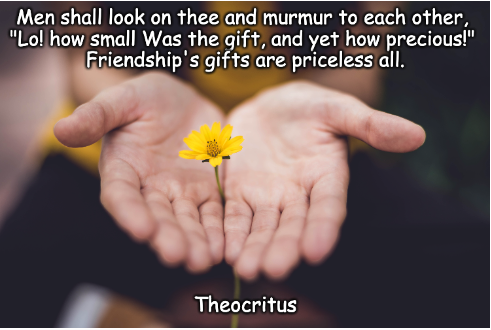
Men shall look on thee and murmur to each other, “Lo! how small Was the gift, and yet how precious!.” Friendship’s gifts are priceless all.
Photo: Lina Trochez. Meaning 🎁:The essence of this saying is:Value is not in size: A small gift can be immensely valuable if given with friendship and genuine affection. Material value is secondary to emotional and symbolic value. Friendship is priceless: True friendship and its expressions, such as gifts, cannot be measured by a price. They are inherently “priceless” because they arise from love and connection. Intention counts: The saying emphasizes that the intention behind giving is far more important than the gift itself. A well-considered, small gesture from a friend is more valuable than a large, impersonal gift. Origin and Author 📜:Theocritus (c. 310–250 BC): He was a Greek poet known as the founder of bucolic poetry. His idyllic poems often portray rural life, nature, and—most importantly—human relationships, including friendship and love. Context: This quote fits perfectly within the theme of Theocritus’ work, where simple, sincere feelings and gestures often gain a deeper meaning. Exact location: The specific quote comes from Idyll XXVIII, titled “The Spindle”. In this poem, Theocritus sends a spindle as a gift to his girlfriend Theugenis. The context of the poem emphasizes the value of a small, personal gift from a friend. Summary ✨: This saying by Theocritus reminds us that the wealth of friendship is not for sale. It teaches us to see the beauty and value in small, meaningful gestures, which say more about the bond between people than the largest material possessions.
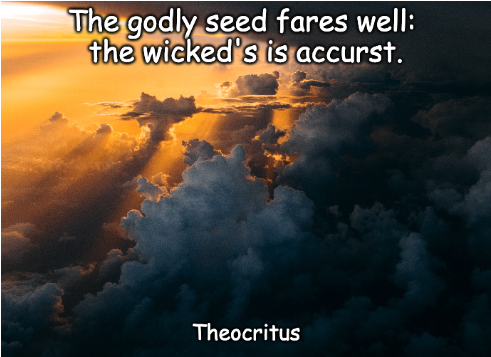
The godly seed fares well: the wicked’s is accurst.
Photo: Tom Barrett. Meaning: The proverb is both religious and moralistic in nature: in the Greek tradition, “seed” (sperm) represents both literal offspring and the nature or origin of a person. The idea is that piety and devoutness are passed on to posterity and are rewarded, while impiety brings a curse. It reflects the archaic Greek belief that a person’s fate is strongly determined by the nature of their ancestors and their relationship to the gods. Author and source:Theocritus was a Greek bucolic poet active in Syracuse, Cos, and Alexandria in the third century BC. The saying originates from Idyll 26, line 36, in a translation by C. S. Calverley. Context in Idyll 26: Idyll 26 (also called the Bacchae or Lenai) describes the Bacchanalian murder of Pentheus by his own mother Agave and her sisters, at the instigation of Dionysus. In the final line (vv. 27–33), the poet argues that good things come to the children of righteous fathers, not to those descended from the wicked—and he himself wishes to be pure and to do the will of those who are pure, just as the eagle is honored by Zeus. Related thoughts: The same idea recurs in the Hebrew Scriptures: Psalm 37:25–28 states that the seed of the righteous is a blessing, while the seed of the wicked is cut off. It is a widespread religious idea that appears independently in both Greek and Jewish literature.
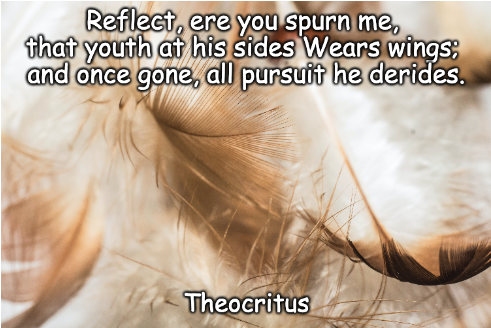
Reflect, ere you spurn me, that youth at his sides Wears wings; and once gone, all pursuit he derides.
Photo by Julian Hanslmaier
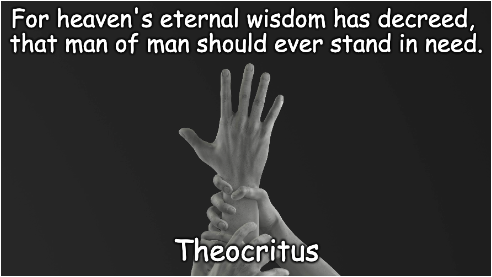
For heaven’s eternal wisdom has decreed, that man of man should ever stand in need.
Photo by Thomas Claeys
Cicala to cicala is dear, and ant to ant, and hawks to hawks, but to me the muse and song.
Photo: Anh Tuan To.🏛️ Meaning: This quote, “Cicada to cicada is dear, and ant to ant, and hawks to hawks, but to me the muse and the song,” is a beautiful expression of a universal truth about connection and passion. Let’s explore the meaning step by step: Natural Affinity 🌱: The quote begins with examples from nature – cicadas, ants, and hawks. It suggests that beings with similar traits and interests are naturally drawn to and appreciate one another. It is a celebration of the bond that forms between those who share a common ground. The Power of Passion 💡: The focus then shifts to the speaker themselves. By saying “but to me the muse and the song,” the speaker emphasizes that their deepest connection and passion lie in art, creativity, and expression. It suggests that their true ’tribe’ is the world of music and poetry. The Unity of Artists 🤝: In a broader sense, the quote can be seen as an acknowledgment of the special bond that exists between artists, musicians, and poets. They share a unique understanding of the world and a passion for creating and sharing their work. Just as cicadas, ants, and hawks find each other, artists, too, find solace and inspiration in each other’s company and creations. The Timeless Appeal of Art 🎨: This quote evokes the importance of art in our lives. It reminds us that creativity and expression are a fundamental part of the human experience and that they have the power to connect, inspire, and enrich us. It is a celebration of the muse and the song that give our lives color and meaning. 📜 Origin and Author:Theocritus 🏛️: The attribution of this quote to Theocritus, a Greek poet from the 3rd century BC, is indeed correct. He is known as the founder of pastoral poetry, in which he glorified life in the countryside and the beauty of nature. The Poem 📖: The quote comes from one of Theocritus’ most famous poems, the ‘Idylls’, specifically from Idyll 10, also known as ‘The Reapers’. In this poem, one of the characters, the shepherd and singer Thyrsis, speaks the quoted words. The Context 🌾: In the ‘Idylls’, Theocritus created an idyllic world of shepherds, shepherdesses, and the beauty of the countryside. He used the pastoral setting to explore themes such as love, loss, and the power of art. The quoted passage reflects the central role of music and poetry in the lives of the characters in his poems. Other Attributions ❓: Although Theocritus is the most likely author, other possible sources have also been suggested. Some sources attribute the quote to the Greek philosopher Aristotle, while others suggest it may be an anonymous folk song. However, the most widely accepted attribution is to Theocritus. 🎉Conclusion: This quote by Theocritus, “Cicada to cicada is dear, and ant to ant, and hawks to hawks, but to me the muse and the song,” is a powerful reminder of the beauty and importance of connection, passion, and the power of art. It celebrates the natural affinity we feel with those who share our interests and passions, and reminds us of the timeless appeal of music, poetry, and creative expression! 😊
Faults are beauties in a lover’s eye.
Photo: Victoria Roman. Meaning:The expression describes a universal psychological truth: those who are in love do not see the flaws of the loved one as mistakes, but as charming or even beautiful qualities. Love colors perception so strongly that objective assessment becomes impossible. It is related to the Dutch saying “love is blind”, but more subtle — it is not the flaws that are not seen, but they are actively transformed into beauties. The Author:Theocritus was a Greek poet of the 3rd century BC, known as the inventor of the bucolic (pastoral) genre of poetry. He came from Sicily and probably also lived for some time in Alexandria. The quote: In English it reads: “Faults are beauties in a lover’s eye” — or in a slightly older translation: “Faults are beauties, when survey’d by love.” The source is The Idylliums of Theocritus (1767), p. 61 — an early modern English translation of his Idylls (Εἰδύλλια). The precise context within the Idylls cannot be determined with certainty based on the available sources, but it fits perfectly with the theme of Theocritus’ work about love, desire and the distortion that love causes. Relationship with other expressions: The idea lives on in countless languages and centuries. Shakespeare wrote something similar in A Midsummer Night’s Dream, and the English “beauty is in the eye of the beholder” touches on the same idea, although that is a slightly broader statement about the subjectivity of beauty in general.
Cats will always lie soft.
Photo by Kote Puerto
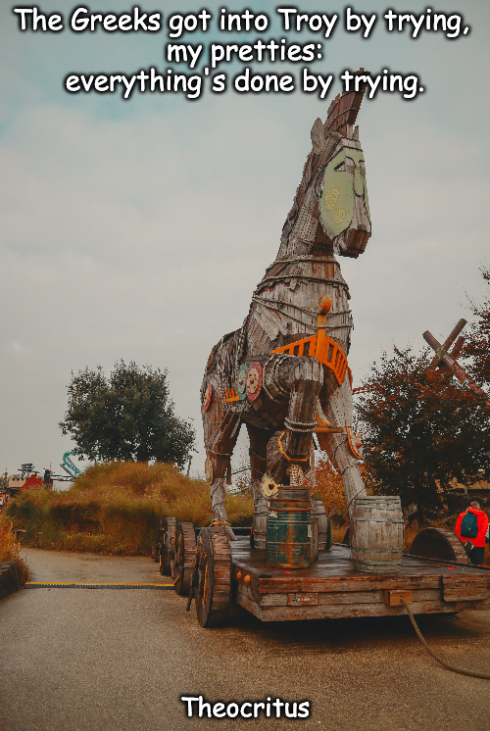
The Greeks got into Troy by trying, my pretties: everything’s done by trying.
Photo by Tayla Kohler
Sleeping we imagine what awake we wish; Dogs dream of bones, and fishermen of fish.
Photo: Shane. Meaning 🤔 😴: This saying is a beautiful observation about the nature of our dreams and desires. The gist of the saying is that our dreams often reflect our deepest desires, hopes, and what we are occupied with or strive for in our daily lives. “We imagine while sleeping what we wish for while awake”: This suggests that our unconscious mind continues to process our conscious desires during sleep. Dreams are not random figments of our imagination, but often symbolic representations of our goals, ambitions, or even unfulfilled needs. “Dogs dream of bones and fishermen of fish”: These specific examples illustrate the point perfectly. A dog, whose instinctive desire is food, will likely dream of bones. A fisherman, whose daily occupation and source of income is catching fish, will dream of a bountiful catch. It demonstrates how basic needs and professional focus manifest in the dream world. In short, the saying emphasizes the continuity between our conscious desires and our unconscious dream world. Origin and Author 📜: This statement is attributed to Theocritus, a Greek poet of the 3rd century BC. He is known as the founder of bucolic poetry, which focuses on idyllic pastoral life and nature. Theocritus and his Idylls: In his poems, known as the “Idylls,” Theocritus often described rural life, love, and the everyday thoughts and feelings of shepherds and ordinary people. These kinds of observations about human nature and dreams suit his style and themes well. Specific Passage: The exact formulation or a very similar idea can be found in the 21st idyll of Theocritus, titled “The Fishermen.” In this poem, two old fishermen dream of catching a golden fish. One of them then says: “They dream also of what they wish, who are asleep, and such is life: the fishermen dream of fishing, and the hunters of the hunt.” This English translation is a common and poetic rendering of this Greek origin. The attribution to Theocritus is most likely correct and widely accepted. It is a timeless observation that resonates to this day. Conclusion ✨: This saying is a profound reflection on the human psyche, reminding us that our dreams can be a window into our deepest wishes and desires. Theocritus beautifully summarized this centuries ago.
Beautiful is the bloom of youth, but it lasts only for a short time.
Image: Peter van Geest AI. 🌸 Meaning: The period of youthful beauty, vitality, and recklessness is beautiful, but unfortunately, it passes. It is a reflection on: Transience: Everything beautiful is temporary. Youth is a phase that inevitably gives way to old age. Carpe Diem: Indirectly, it encourages enjoying youth while one can, because the moment quickly passes. Nostalgia: It can also express a sense of wistfulness over the loss of youth. 📜 Origin and Author:Theocritus is a very likely source of inspiration for this saying. Theocritus was a Greek poet from the 3rd century BC, known for his idylls (pastoral poems) that often celebrate the beauty of nature, love, and rural life, but also touch on the melancholy of transience. One particularly similar passage comes from his Idylls (Idyll XXIII), where he says, “Beautiful is the rose when it blooms, but quickly it fades; beautiful is the bloom of youth, but quickly it passes away.” It’s important to note that such wisdom about the transience of youth and beauty was ubiquitous throughout classical antiquity and across cultures. Many philosophers and poets have expressed similar thoughts. Consider the Latin proverb “Tempus fugit” (time flies) or “Carpe diem” (seize the day). Theocritus’s formulation, however, is very direct and striking, making it a classic saying that has resonated throughout the centuries and has been adopted in various languages and variations.
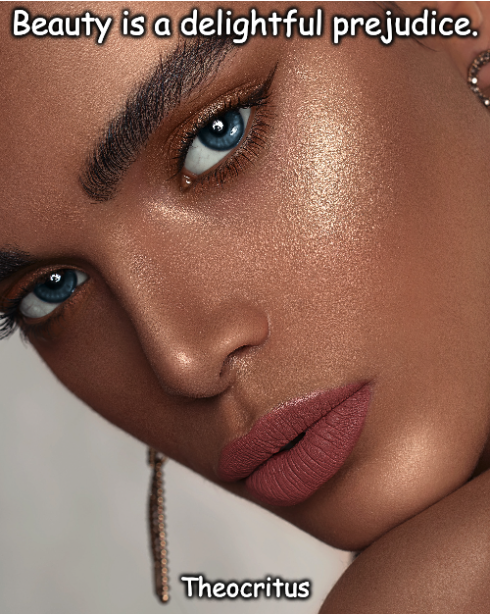
Beauty is a delightful prejudice.
Photo: Amir Seilsepour. Meaning 🤔: The statement “Beauty is a delightful prejudice”suggests that our perception of beauty is often not based on objective facts, but rather on a subjective preference or unconscious inclination. It implies that: Beauty is subjective: What one person finds beautiful, another may not. It is not a universal truth. Beauty influences our judgment: When we find something or someone beautiful, we are often inclined to think more positively about it or judge it more favorably, even when there is no objective reason for this. It is a “delightful” prejudice because it can be pleasurable to find and appreciate something beautiful. It can be misleading: A “prejudice”can also mean that we jump to conclusions or are swayed by appearances, which can sometimes lead to wrong judgments. Essentially, it recognizes the power and subjectivity of beauty and how it can color our perception and judgments. Origin and Author 📜: This statement is often attributed to Theocritus, a Greek poet who lived in the 3rd century BCE. He is known for his idylls, pastoral poems that often celebrate the beauty of rural life and love. While the precise phrase “Beauty is a delightful prejudice” in English may be a later translation or interpretation, the idea is consistent with the philosophy expressed in his works. Theocritus’ poetry often emphasizes the sensory experience and emotional impact of beauty. It is typical of ancient Greece that people already reflected deeply on the nature of beauty, virtues, and the human condition. Philosophizing about the subjectivity of beauty was therefore not uncommon. Other possible sources: A similar idea is sometimes attributed to Plato, who wrote in his works about ideal forms and the perception of beauty. However, the specific phrase “delightful prejudice” better fits the poetic and human observations that characterize Theocritus.
Trying will do anything in this world.
Photo: lay Banks. Meaning 📌 ✅ : This is a free/paraphrasing Dutch rendering of a Greek proverbial idea: that by trying / daring (and not giving up in advance) you can get things done. Initiative and attempt are decisive: without an attempt, nothing happens. It expresses a practical life wisdom: try it first, take action, only then will it become clear what is possible. In modern English it is close to: “Nothing ventured, nothing gained.” “Nothing ventured, nothing gained.” 🎯 🏛️ Origin: 📜 Attribution: The idea is often linked to Theocritus (3rd century BC), in the Idyllia, especially Idyll 15 (Adoniazusae). 🔎 Placement in the text: The reference “Idyllia 15, 85” is plausible, because in that section, two women (in an everyday setting) speak in a tone that is often proverbial/saying-like. Importantly, the English sentence is not a literal translation, but a summary translation of a short Greek phrase along the lines of: “one must try (everything)” / “by trying, you achieve things.” ⚠️ Note: Without an exact Greek/Latin source line, it is difficult to guarantee verbatim that Theocritus has the exact formulation: “Trying brings about everything in this world.” What often happens in practice: a short Greek proverb line is taken (something like “one must try”) and turned into a snappy moral motto in modern languages (like this English sentence). 🗣️ Context in Idyll 15: Idyll 15 is a realistic dialogue (two women on a journey/in the city). Such texts often contain everyday wisdom, sayings, and exhortations like “Come on, let’s just give it a try.” This makes it plausible that this quote (or its essence) began circulating as a saying through this idyllic setting.
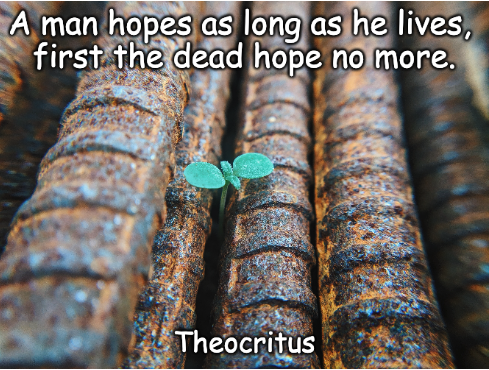
A man hopes as long as he lives, first the dead hope no more.
Photo: Faris Mohammed. 📌 Meaning:Key idea: “Hope is part of life.” As long as someone is alive, there remains room (however small) to expect that things can get better. “Second half as reinforcement”: The dead no longer hope → whoever has died no longer has any expectations for the future; so “despair” is “for later”, not for now. Practical meaning: an encouragement to “persevere”, “not give up”, and “comfort” in adversity. 🌱. 🧾 Origin (classical origin): This saying is usually seen as a translation/paraphrase of a “Greek gnomic utterance” (a “wisdom saying”) that may also have had a “proverbial character” in antiquity. 🇬🇷Author:Theocritus (Θεόκριτος), Hellenistic poet (3rd century BC). Work: “Idyllia” (Bucolic Poems). Place: Often cited as “Idyll 4, verse 42” (note: “verse numbering may vary by edition,” sometimes 41/42). Meaning of the Greek wording (content): “For the living there is hope; for those who have died, hope no more.” Important: many anthologies give this sentence as “Theocritus 4.42”, but the “exact Greek word form” may vary slightly between manuscripts/editions; the “thought” is stable. 👤 Author:Theocritus — but possibly also a proverb 🏛️ In Theocritus’ “Idylls”, “proverbial wisdom” regularly appears in the mouths of shepherds/characters. Therefore, it is quite possible that Theocritus here: either formulates a pithy saying “himself”, or uses “already existing folk wisdom” literary. 🔁 Related proverb (useful for clarification); Latin: “Dum spiro, spero” = “As long as I breathe, I hope.” The addition about the dead makes it just a little sharper: hope is “by definition something for those who are still living”.
For those who doing well, everything goes well.
Photo: Jennifer Griffin. 🗣️ Meaning: Those who are already lucky/prosperous seem to have it all figured out. Success works like a snowball effect: once you’re “running well,” other things fall into place more easily. It can also be an ironic/social observation: those who are in a favorable position often get even more opportunities. Close to: “Luck attracts luck” / “To all who have, more will be given” (but this saying is more down-to-earth and less religiously charged). 🏛️ Origin (classical source): This saying is usually traced back to the Greek poet Theokritos (Theocritus) (3rd century BC). In his Idyll 15 (Adoniazousai, “The Women Who Attend the Adonis Festival”) there is a short, proverbial statement that translates as: “For those who are well, everything goes well.” 📌 Regarding the placeholder (Idyll 15, line 24?): The attribution “Idyll 15, (around) line 24” is plausible and common, but: line numbering varies by edition (Greek text edition, translation, prologue lines included/not included, etc.). That’s why you sometimes see 15.24 in sources, and sometimes a line just before/after. ✍️ Author:Theokritos / Theocritus. Work: Idyllia (Idylls), Idyll 15. 🔎 Context:In Idyll 15, characters engage in an everyday conversation (typically “mimes”/urban idyll). In such dialogues, Theokritus regularly uses gnomai (general wisdom, almost proverbs). This sentence functions precisely in this way: a pithy life observation about prosperity and its effects.
Only poverty stimulates skills; she is the teacher of effort.
Photo: Chitto Cancio. ✅ Meaning💡: Poverty forces resourcefulness and the learning of skills: those who have little must be able to/learn something to survive. Poverty “teaches” you to work: lack makes you make an effort, develop discipline, and seek solutions. Related to the broader idea: “Necessity is the mother of invention.” (same idea, different classical tradition) 🏛️ Origin 📜: Author:Theocritus (Θεόκριτος), Hellenistic poet (± 3rd century BC). Work and place: Idyllia / Eidyllia (Εἰδύλλια), Idyll 21 (often titled “Fishermen” / Halieis) line 1 (in many editions): the poem opens with precisely this adage-thought. Please note: numbering may vary between editions (sometimes the line number or arrangement shifts slightly), but the attribution to Theocritus, Idyll 21 (beginning line) is standard. 🇬🇷 (Approximation of) the Greek formulation + explanation: In textbooks and quotation collections this often circulates along the lines of: “Πενία τὰς τέχνας ἐγείρει”. Penía tàs téchnas egeírei → “Poverty awakens/activates the arts (skills).” and/or as the second part of the same thought: “(ἡ) πενία … διδάσκαλος (ἐστὶ) …” → “Poverty is a teacher … (of labor/effort). 🔁 Related classical variants (same idea): If you encounter this saying elsewhere, it may also appear as: “Poverty is the mother of art/ingenuity”. “Poverty teaches to work”. (Latin parallel in spirit, not literally the same): “Necessitas…”-sayings (necessity compels), often later formulated as “necessitas est mater inventionis.” 📚 Practical reference (as you can quote it): Theocritus, Idyllia 21, 1 (opening of Halieis / “Fishermen”). Saying: poverty begets skill and is a teacher of effort/labor.
There is no medicine and no plaster for love.
Photo: Brian Patrick Tagalog. ✅ Meaning❤️🩹: The pain of love cannot be easily “healed” like a physical wound; ordinary remedies (medicines, ointment, plasters) do not help against infatuation/heartache; love is presented as a wound for which there is no standard treatment. In more modern terms: love cannot be repaired with simple means. 📜 Origin: ancient imagery “love as a wound”. The image of love as a wound/disease is a classic motif in Greek and later Roman literature. “Plaster” here do not refer to a modern band-aid, but to a (medical) wrapping/compress or poultice (Greek: cataplasma), something physicians applied to wounds. 🏛️ Author and source: Theocritus (yes—but usually in a longer form) ✅ The wording comes (in essence) from Theocritus, the Hellenistic poet (3rd century BC). Specific source: Theocritus, Idyll(e) 11 (Idyll XI), at the beginning. There, the speaker says to Nicias (a physician): that there is no remedy for love, neither in ointments, nor in plasters/curls, except (in Theocritus’ version) the Muses—that is: poetry, song, art/word art. Why your quote sounds a bit “shorter”? In many later quotes/sayings, the final part (“except the Muses”) is omitted, resulting in: “For love there is no remedy, nor any plaster.” Theocritus’ point is therefore more subtle: art/poetry can indeed provide a kind of relief, even though love cannot be cured “medically.”
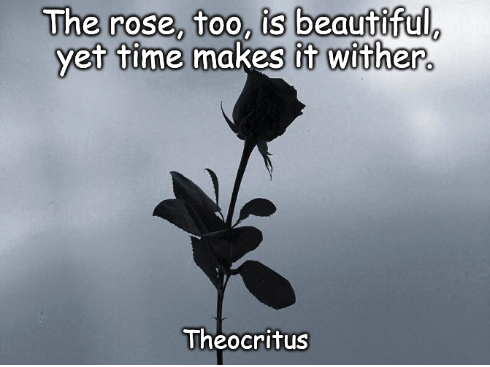
The rose, too, is beautiful, yet time makes it wither.
Photo: pxfuel.com. ✅ 1) Meaning: The sentence expresses the classical idea of transience: even the rose—a symbol of beauty, youth, and blossoming—withers under the influence of time. 🏛️ 2) Origin: The image “rose + time + withering” is an ancient literary topos (vanitas/memento mori), common in Greco-Roman and later European traditions. It is therefore a traditional motif, not necessarily a single, clearly identifiable “primordial source.” 🇬🇷 3) Text-critical conclusion (why it is not a robust “literal quotation”). The Greek variants circulating online are likely modern paraphrases or back-translations (partly due to Modern Greek word choices such as τριαντάφυλλο instead of classical ῥόδον). Therefore, it is unreliable to present this as a literal ancient verse without an exact source (edition + verse number). ✍️ 4) Authorship:Theocritus / Idyllia 23 vs. Constantine Palaiologos. Attribution to Theocritus (Idyll 23): occurs frequently online, but is not verifiable without a verse number and consistent source; moreover, Idyll 23 is often regarded as Pseudo-Theocritus (Appendix Theocritea) in modern philology. Attribution to Constantine (XI) Palaiologos/Paleologus: seems to be mainly a later, secondary (internet) attribution; there is no generally accepted primary source where this rose metaphor demonstrably belongs to him.
Verily, great grace may go with a little gift; and precious are all things that come from friends.
Image: Peter van Geest AI. 📜 Meaning (in modern Dutch): The saying expresses that the value of a gift is not primarily in its size/price, but in: the goodwill (grace / favor / good intention) behind it, and the relationship (friendship) between giver and receiver. Key idea: A small gift can be a great sign of affection. Everything that comes from a friend is “precious” because it embodies friendship. 🔍 Origin & ancient basis: 1) It is a gnomic (saying-like) idea from Greek antiquity. The English formulation sounds like a modern translation/paraphrase of a Greek sententia: “Even small things are dear/valuable when they come from friends.”2) The author is Theocritus (3rd century BC), and his poetry (the Idylls) contains saying-like sentences about friends, favors, and the value of small things. In quotation collections, an (English/Latin/Dutch) aphorism often circulates along the lines of: “A small gift may accompany great kindness; everything from friends is precious.” Important: the precise English sentence quoted here is probably not a literal, word-for-word “standard translation” from a single fixed edition, but a polished paraphrase that has circulated in anthologies. Source: Idylle 17. 🧠 Related classical proverbs (same idea, different traditions); Latin parallel wisdom (general tradition): “Non quantum, sed quanta benevolentia.” (idea: not quantity, but benevolence). Broad ancient morality: Small gifts = great when they come from friendship. A similar motif can also be found in later literature and moral traditions (Stoics, Christian examples), but this formulation sounds primarily classical/Hellenistic.
Beautiful is the bloom of youth, but it lasts only for a short time.
Image: Peter van Geest AI. 🌸 Meaning:The period of youthful beauty, vitality, and recklessness is beautiful, but unfortunately, it passes. It is a reflection on: Transience: Everything beautiful is temporary. Youth is a phase that inevitably gives way to old age. Carpe Diem: Indirectly, it encourages enjoying youth while one can, because the moment quickly passes. Nostalgia: It can also express a sense of wistfulness over the loss of youth. 📜 Origin and Author:Theocritus is a very likely source of inspiration for this saying. Theocritus was a Greek poet from the 3rd century BC, known for his idylls (pastoral poems) that often celebrate the beauty of nature, love, and rural life, but also touch on the melancholy of transience. One particularly similar passage comes from his Idylls (Idyll XXIII), where he says, “Beautiful is the rose when it blooms, but quickly it fades; beautiful is the bloom of youth, but quickly it passes away.” It’s important to note that such wisdom about the transience of youth and beauty was ubiquitous throughout classical antiquity and across cultures. Many philosophers and poets have expressed similar thoughts. Consider the Latin proverb “Tempus fugit” (time flies) or “Carpe diem” (seize the day). Theocritus’s formulation, however, is very direct and striking, making it a classic saying that has resonated throughout the centuries and has been adopted in various languages and variations.
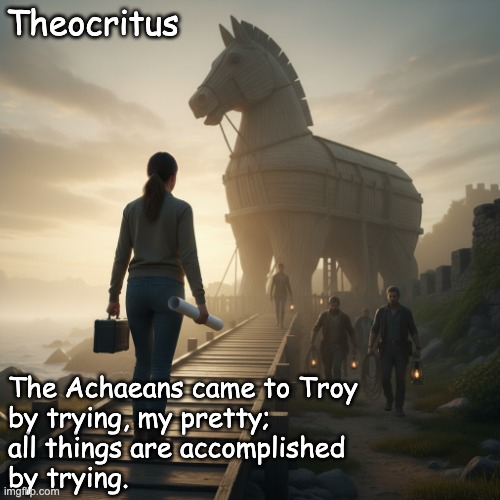
The Achaeans came to Troy by trying, my pretty; all things are accomplished by trying.
Image: Peter van Geest AI. 🧠 Meaning💡: It’s an encouragement to just take the plunge: Even the Achaeans/Greeks reached Troy “by trying” → so: take action, try. General life wisdom: “Through trying, everything comes about / by trying, you get things done.” 🏺 Origin & context (why Troy?) 🐴: In Greek culture, Troy is the classic example of something that was extremely difficult and lengthy (the Trojan War). Theocritus uses this as a maximum comparison: if even that succeeded by “trying,” then that applies even more to the everyday. ✍️ Textual explanation (language nuances) 🔎: ἐς Τροίαν = “to Troy / into Troy” (direction / goal; in translation often idiomatically “to enter/reach Troy”). πειρώμενοι (partic. of πειράομαι) = “trying, making an attempt”. Ἀχαιοί = “Achaeans” = Homeric term for “Greeks”. καλλίστα παίδων = form of address: literally something like “most beautiful of the girls / children” → idiomatic: “my most beautiful / my dearest”. πείρᾳ θην: πείρᾳ = “by attempt/by trying”. θην is an emphasized particle (something like “really/truly/certainly”). πάντα τελεῖται = “everything is accomplished / brought to an end.”
Cats will always lie soft.
Image: Peter van Geest AI. Meaning:The expression has two layers:1.Literally: cats always seek the most comfortable, softest place to lie down—a timeless observation any cat lover will recognize.2.Figuratively / proverbial: people (or beings) of taste or rank always know what’s best for themselves. It can also be used ironically for someone who always makes things easy for themselves—who “always lands softly.”Author:Theocritus ✓.Theocritus was a Greek poet of the 3rd century BC, probably from Syracuse, who later lived on Kos and in Alexandria. He is considered the inventor of pastoral poetry. Origin: The saying “Cats will always lie soft” is attributed to Theocritus, as is the related saying “All cats love a cushioned couch.”The original context: The phrase comes from Theocritus’s “Idylls,” where the character Praxinoe—a talkative woman—says to her maid Eunoe, “Take up your work and beware, lazy girl, that you don’t leave it lying around again; hai galeai (the cats) love to lie down softly.” This appears in Idyll 15, a vivid realist poem about two Greek women in Alexandria. It’s a casual, humorous remark—Praxinoe is chiding her maid for the cat’s snuggling up on the abandoned handiwork. It’s remarkable how modern and relatable this ancient observation still sounds—proof that cats have changed little in 2,300 years.
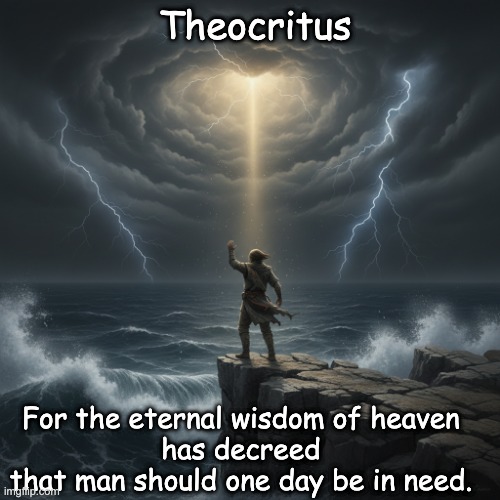
For the eternal wisdom of heaven has decreed that man should one day be in need.
Image: Peter van Geest AI. Meaning:The sentence expresses a stoic-fatalistic view of life: The gods (or fate, the eternal order) have predetermined that human life will inevitably experience moments of adversity, poverty, or distress. This is not a punishment, but a cosmic law—a fundamental fact of existence. The implicit message is often one of resignation and dignity: if even heaven has decreed this, one need not be ashamed of it and can bear it. Broader context: The theme aligns with what Virgil (“sunt lacrimae rerum”) and the Stoa would later elaborate: suffering is part of the human condition, and wisdom lies in accepting it. Origin and author: This quotation indeed originates in classical antiquity, but the attribution deserves some nuance. It is a verse by Theocritus (c. 310–260 BCE), the Greek poet from Syracuse known as the father of bucolic (pastoral) poetry. The verse originates from his Idylls, more specifically Idyll IV, or is sometimes attributed to fragments circulating in his name. The original Greek text reads roughly: “ἐκ Διὸς ἀρχώμεσθα”—but the specific sentiment about human need and heavenly provision is more closely related to a passage also attributed to Moschus or the broader Hellenistic tradition.
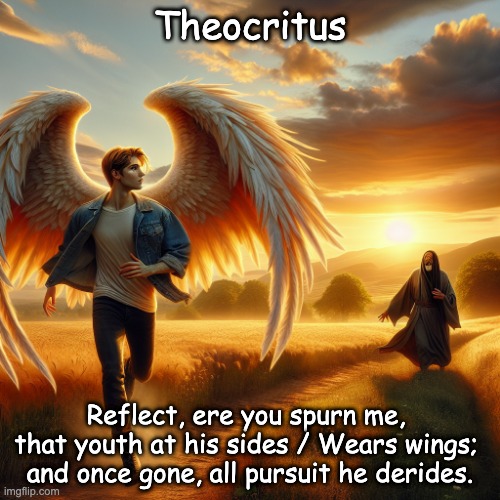
Reflect, ere you spurn me, that youth at his sides / Wears wings; and once gone, all pursuit he derides.
Image: Peter van Geest AI. Meaning:Core message: Youth is fleeting and swift; it “moves on wings” and can quickly vanish. Act therefore promptly; otherwise, there will be only regret, and the pursuit will be ridiculed by the departed youth. Connotation: A warning about acquiring opportunities in love or advancement; whoever is too late loses the chance, and sees its passing as something laughable to the one who has departed. Theme comparison: A classic motif in Theocritus: the fleeting nature of youth and beauty, and the need to act promptly. Origin and author:Theocritus of Syracuse, “Idylls” (pastoral poems). Exact source: Idyll 29; Calverley’s translation places the line in that context. Several translations exist, but Calverley’s is a familiar and oft-quoted form. Important to know: While the line is robust and familiar, the exact word choice may vary slightly from translation to translation. The message remains the same: youth on wings, act quickly or lose the consequences.
(Σαμερον αδιον ασω) “I shall sing a sweeter song tomorrow.”
Photo: Claudia Raya. Meaning: In the Idylls, the “sweeter song” stands for the promise of artistic perfection. The poet acknowledges that his current work is already beautiful, but projects even greater beauty into the future. Figuratively—as the saying has come to live in the Dutch language—it means: *now I fall short, but tomorrow I will do better.” Author:Theocritus. The expression dates back to the Greek poet Theocritus (c. 300–260 BC), the founder of bucolic (pastoral) poetry from Sicily. He is considered the creator of ancient Greek pastoral poetry. The original text: The statement in Greek reads “Σαμερον αδιον ασο” (Sameron adion aso), which translates as: “I shall sing a sweeter song tomorrow.” The sentence comes from Idyll I, the opening poem of his Idylls. At the end of that poem, the shepherd Thyrsis says to the Muses: “Farewell, oh, farewells manifold, ye Muses, and I, some future day, will sing you yet a sweeter song.” It is therefore not a proverb later attributed to Theocritus, but a direct closing line from his work — spoken by a pastor-poet bidding farewell to the Muses after his song, with the promise that even more beautiful song will follow. Summary:Author:Theocritus (c. 300–260 BC).Source:Idylls, Idyll I,Original language:Greek (Σαμερον αδιον ασο).Literal translation:“I will sing a sweeter song tomorrow.”Meaning:Promise of better performance in the future.
Door Pieter
Mensenmens, zoon, echtgenoot, vader, opa.
Spiritueel, echter niet religieus.
Ik hou van golf, wandelen, lezen en de natuur in veel opzichten.
Onderzoeker, nieuwsgierig, geen fan van de mainstream media (MSM).