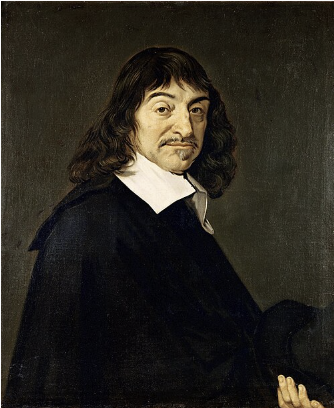
Renatus Cartesius, Latinitate scripsit (Hagae in Turria, die XXXI mensis Martii, anno MDXCVI – Holmiae, die XI mensis Februarii, anno MDCCL)
Philosophus et mathematicus originis Gallicae, qui magnam partem vitae suae in Republica Septem Nederlandiae Unitae degit. Modus eius ad quaestionem cognitionis et naturam mentis humanae pertinere magnum momentum in evolutione philosophiae habuit. Notus est ob dictum suum “Cogito, ergo sum” et late habetur pater philosophiae modernae. Unus ex primis non solum fuit qui philosophiam Aristotelis reiecit, sed etiam eam suo systemate philosophico substituit. Hoc faciendo, fundamenta iecit motui rationalismi saeculi XVII. Cartesius vehementer a progressibus in physica et astronomia affectus est et una ex figuris centralibus Revolutionis Scientificae fuit. Primam ideam praebuit quid scientia naturalis in futuro offerret.
Dubium sapientiae initium est.
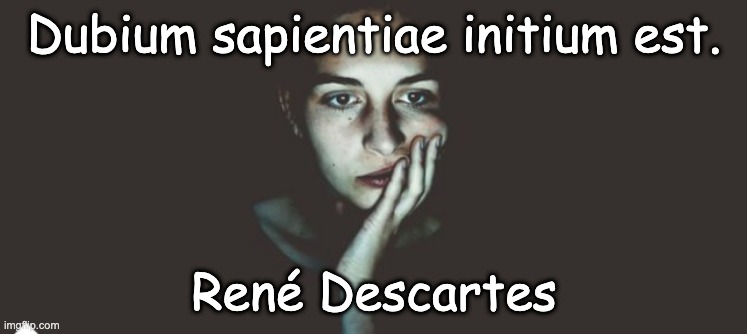
👉 Open mind: By questioning your own prejudices and ‘certainties’, you open yourself up to new insights.
👉 Foundation for knowledge: Doubt is the first step to breaking down superficial assumptions and seeking a deeper, more fundamental understanding. 🖋️ The Author: Aristotle or Descartes? The core of the confusion lies precisely here. Aristotle? ❌ Probably not. In the Dutch-speaking world and on many citation websites, this statement is persistently attributed to the Greek philosopher Aristotle (384–322 BC). However, research indicates that this is most likely an ‘incorrect attribution’. René Descartes? ✅ Very likely. The actual source is almost certainly the French philosopher and mathematician René Descartes (1596–1650). The Latin source: The phrase “Dubium sapientiae initium” is attributed to him. 🕰️ Historical Context and Descartes’ ‘Radical Doubt’. To properly understand the meaning, we must look at the time in which Descartes lived.
1. A world of fixed truths: In the 17th century, religious dogmas and scientific beliefs were rarely questioned.
2. Descartes’ method: Descartes was not satisfied with this. He decided to radically question ‘everything” he thought he knew. 3. The Goal: He did not do this to become cynical, but rather to find a foundation that was ‘absolutely certain,’ something that could not be doubted.💡 The Ultimate Result: “Cogito, ergo sum.” Descartes’ process of doubt led to his most famous insight: He could doubt the existence of the world, his own senses, and even mathematical truths. The paradox: The only thing he could not doubt was the fact ’that he was doubting.’ The conclusion: If he doubted, he was thinking. And if he was thinking, he must exist. The quote: This led to the legendary statement: “Cogito, ergo sum” (I think, therefore I am).
For Descartes, doubt was therefore not the endpoint, but the ‘indispensable first step’ on the road to unshakeable truth. 🧠 A Note of Self-Awareness: The quote from blogger Peter Ros: “That statement, was it by Descartes or by Aristotle after all? I doubt…” The fact that we even doubt the author of the statement about doubt brings things full circle in a beautiful way. It is a perfect example of how doubt forces us to dig deeper for the truth.
