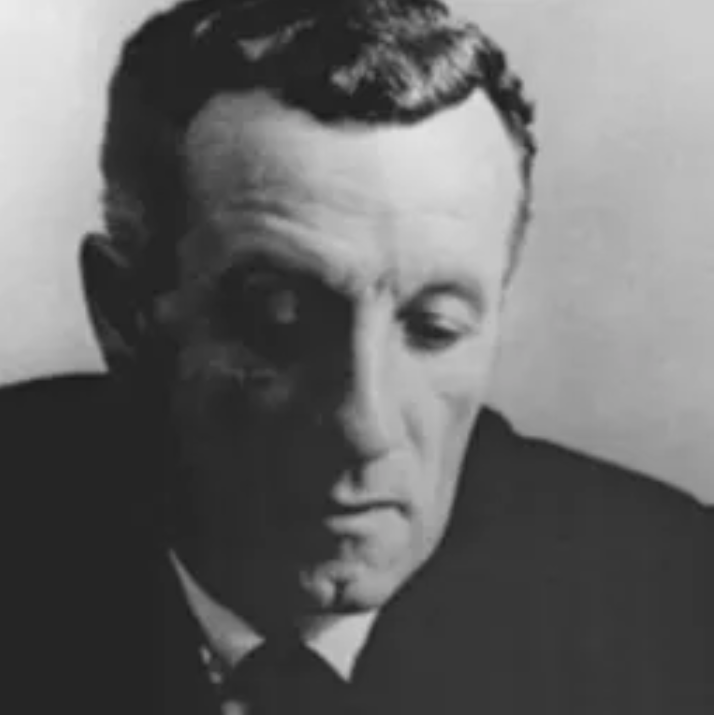
(Quain Devrouze, 22 September 1907 – Le Mesnil-Saint-Denis, 20 February 2003).
French novelist, essayist and philosopher. Blanchot was born on 22 September 1907 in Quain (Saône-et-Loire), where he grew up in a wealthy Catholic family and enjoyed a solid education. After obtaining his baccalauréat at the age of sixteen, Blanchot was determined to study philosophy and German in Strasbourg. However, due to a medical error during abdominal surgery, he had to wait a year before he could continue his studies. His blood was affected, which meant he would always be in poor health: he suffered from chronic shortness of breath, flu, tuberculosis, nervous disorders, pleurisy, dizziness and suffocation. Throughout his life, he would regard this poor health as a delay of death, with which he was constantly confronted. Despite his poor health, he lived to be 95. As a survivor of his own life, Blanchot devoted himself to writing – “Writing in order not to have to die”, as Michel Foucault would later put it in an essay about Blanchot.
Foto quotir.com
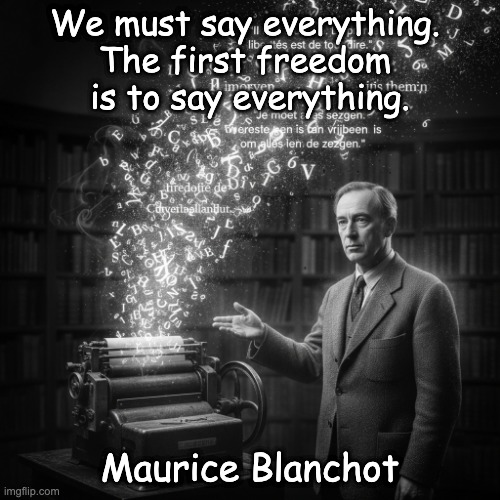
We must say everything. The first freedom is to say everything.
Image: Peter van Geest AI. Meaning 🗣️: The core of this saying lies in emphasizing the absolute necessity of free expression. It states that: Everything must be able to be said: There should be no taboos or forbidden topics when it comes to expression. This implies an open dialogue where all thoughts, ideas, criticism, and even controversial viewpoints are welcome. Freedom of speech is fundamental: It is not just one of the freedoms, but “the first” or the most essential. Without the freedom to express yourself, other freedoms (such as of thought, assembly, etc.) are limited or even meaningless. It is the foundation upon which an open society rests. Influence on truth and progress: Only when everything can be said can the truth emerge, wrongs be addressed, and a society can develop and improve. Origin and Author:Maurice Blanchot ✒️. Maurice Blanchot (1907-2003) was an influential French literary theorist, philosopher, and writer. His work often straddled the intersection of literature, philosophy, and politics, and he was a key figure in postmodernism. The specific formulation you mention comes from his 1948 essay “Literature and the Right to Die.” In this essay, Blanchot examines the relationship between language, literature, and human existence, touching on fundamental questions of freedom and expression. The context in which he makes this statement emphasizes the radical and sometimes dangerous nature of literature and writing, which knows no bounds and doesn’t even shy away from death in its quest for absolute expression. He advocates for total freedom of speech, even when it is painful or confrontational. In short, it’s a powerful statement that places the importance of unrestricted expression at the heart of human freedom, and it perfectly aligns with the ideas of a thinker like Maurice Blanchot.
Door Pieter
Mensenmens, zoon, echtgenoot, vader, opa.
Spiritueel, echter niet religieus.
Ik hou van golf, wandelen, lezen en de natuur in veel opzichten.
Onderzoeker, nieuwsgierig, geen fan van de mainstream media (MSM).