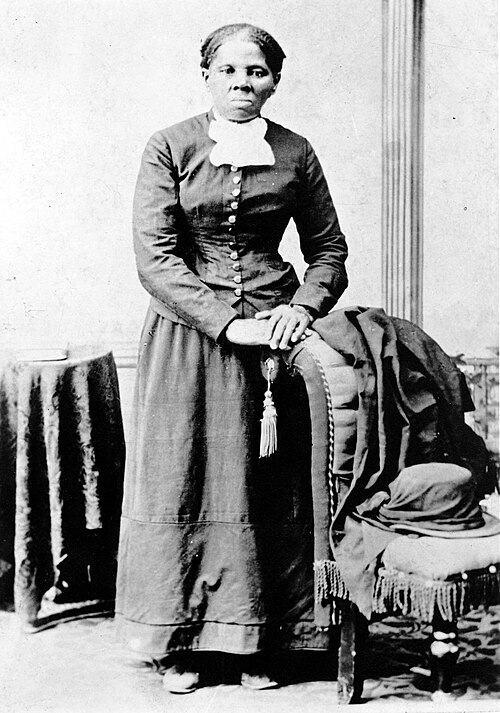
(Dorchester County, Maryland, 1823 – Auburn, March 10, 1913).
American abolitionist. She was an escaped slave. On an estimated 13 trips to the southern United States, she helped approximately 70 slaves escape to the North or to Canada, using the network known as the Underground Railroad.[1][2] She helped John Brown recruit men for his Raid on Harper’s Ferry, a failed attempt to start a slave rebellion by raiding the arsenal in Harper’s Ferry, West Virginia. During the American Civil War, she served in the Union Army, first as a nurse and cook, and later as an (armed) scout and spy. She guided the Raid on Combahee Ferry, during which over 700 slaves were freed by the Union Army, and worked for Colonel Robert Gould Shaw during the ill-fated attack on Fort Wagner. After the war, she retired to Auburn, New York, where she cared for her elderly parents (whom she herself had helped escape from the South before the war). Later in life, she campaigned for women’s suffrage.
Harriet Tubman Photo wikipedia.org
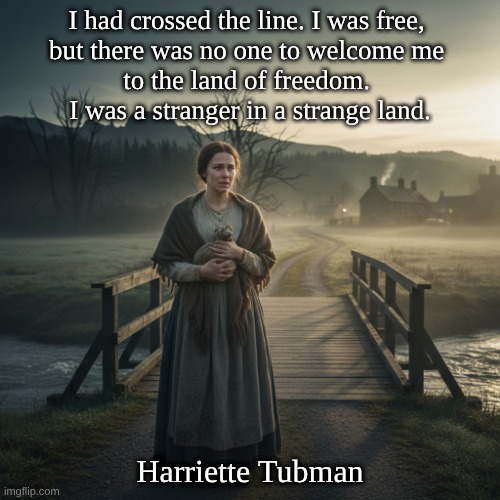
I had crossed the line. I was free, but there was no one to welcome me to the land of freedom. I was a stranger in a strange land.
Image: Peter van Geest AI. 📌 Meaning: Key idea: Someone reaches “freedom” (e.g., after escaping), but immediately experiences loneliness, alienation, and lack of support. “Across the line” usually refers to crossing a border (in this context: from slavery territory to free territory). “Land of the free” sounds hopeful, but the following sentence reverses that: freedom does not automatically mean being home or welcome. “A stranger in a strange land” emphasizes that, even in freedom, one can still be displaced: unfamiliar place, no network, no safety/familiarity. 🧭 Origin: 1) Harriet Tubman context (historical origin) This quote is known (in English) as a passage attributed to Harriet Tubman in the story of her first escape from slavery to the North (United States). A frequently quoted English form is (varying slightly by source/edition): “I was free, but there was no one to welcome me to the land of freedom. I was a stranger in a strange land.” These words appear in 19th-century biographical literature on Tubman. 🧭 2) Biblical echo in the phrasing: The phrase “a stranger in a strange land” is also a clear biblical reference (KJV) to Exodus 2:22: “for he said, I have been a stranger in a strange land.” This means: Tubman’s (attributed) statement resonates with a well-known religious phrasing about exile/displacement.👤 Author / source: ✅ Attribution: Attributed to: Harriet Tubman. 📚 Where was it written down? The passage is usually linked to Sarah H. Bradford, who described Tubman’s life in: Scenes in the Life of Harriet Tubman (1869) (Bradford later published a sequel/supplementary edition.) ⚠️ Qualification regarding “author”: Tubman did not publish these words herself as an exact quotation; they were transmitted (biographically/narratively) through Bradford. As a result, there is variation in exact wording and translations.
Door Pieter
Mensenmens, zoon, echtgenoot, vader, opa.
Spiritueel, echter niet religieus.
Ik hou van golf, wandelen, lezen en de natuur in veel opzichten.
Onderzoeker, nieuwsgierig, geen fan van de mainstream media (MSM).