Boone and Deep Gap, North Carolina. He died on February 5 at the age of 86. He grew up in New Jersey and received his Bachelor of Arts from Mount Saint Mary’s University, his Master of Arts from Niagara University and his PhD from the Catholic University of America. He devoted his entire professional life to children. He began his career as director of the Hillcrest Children’s Center for Emotionally Disturbed Children in Washington, DC, and then moved to the U.S. Department of Health, Education and Welfare, where he led the Joint Planning Committee on Child Advocacy. He later became the first head of the NC Governor’s Advocacy Commission on Children and Youth, appointed by Governor Jim Holshouser. He was a professor at the College of Education, Appalachian State University in Boone, NC. He was also a professor at UNC-CH and finished his career as a special education teacher at Appalachian State (1974-2006), training hundreds of students in working with exceptional children. He authored numerous publications and books, including Fundamentals of Special Education: What Every Teacher Needs to Know, as well as a report called “Hell Without Fire,” an expose on the abuse of children in NC training schools. A clearly dedicated educator and advocate for children throughout his long career.
J. R. Tompkins. Photo: hamptonfuneralnc.com
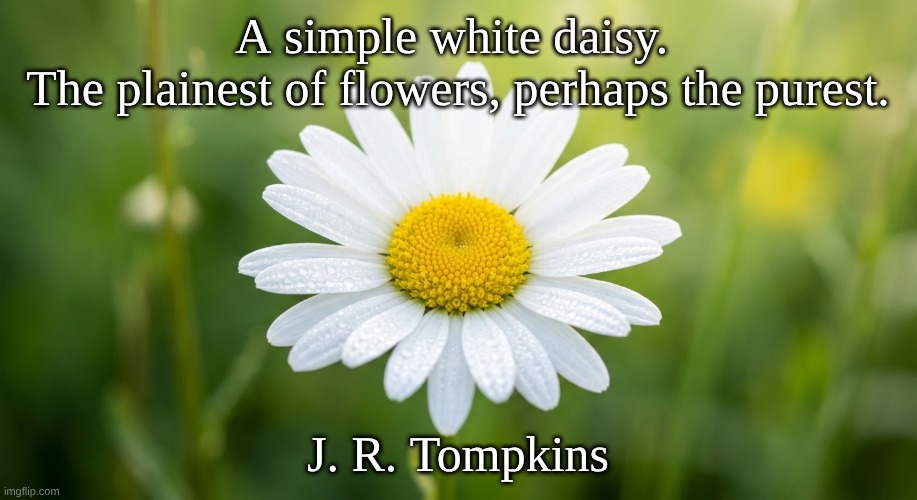
A simple white daisy. The plainest of flowers, perhaps the purest.
Image: Peter van Geest AI. Meaning 🌼: The daisy (Leucanthemum vulgare) carries deep symbolism, often associated with the pure and the immaculate. Innocence in Purity: Due to its bright white petals, the flower symbol represents moral purity and childlike innocence. New Beginning: In many cultural contexts, the daisy marks the arrival of spring and, with it, a fresh start. Faithful Love: In the language of flowers (floriography), the daisy stands for “loyal love” and keeping a secret (“I will never tell”). Simplicity: The structure of the flower—a yellow heart with radiant white petals—is seen as the essence of natural beauty without embellishment. 🖋️Author: J.R. Tompkins. The quote “A simple white daisy. The simplest flower, perhaps the purest” is indeed effectively attributed to J.R. Tompkins (full name often noted as James Randall Tompkins). Tompkins is an author known for his life and poetic reflections on nature. Although he is not a famous classical author like Shakespeare, his words are written and quoted in modern literature and on artistic platforms. Basic principles of all text: All details are listed in the list below. By labeling the Daisy as “the purest”, the reader is encouraged to let go of the world and return to the basics. 🌱 Origin and Etymology: The daisy has both a biological and a linguistic origin of interest: 1.Naming: The word “Daisy” derives from the Greek ´margaritēs´, meaning “pearl”. 2.English name (Daisy): The English name ‘Daisy’ is derived from the Old English term ´dæges eage´, meaning “eye of the day”. Let’s say the name of the Flower is open to the sunrise and then to the sunset. 3.Botanical: The daisy belongs to the ‘Asteraceae’ family. It is a strong perennial plant that can grow in the wild almost anywhere in the world, which reinforces its image of modest strength. ✨ Why this flower is so disruptive:The reason Tompkins’ text resonates so strongly is the headache the daisy offers to an often busy and chaotic world:Minimalism: It proves that beauty does not need a thousand colors or complex forms. Accessibility: Unlike all the rare orchids of the fragile rose, the daisy is for everyone. They grow on the roadside and in the field. Honesty: What you see is what you get; a heart of gold and a wreath of light. ☀️
Door Pieter
Mensenmens, zoon, echtgenoot, vader, opa.
Spiritueel, echter niet religieus.
Ik hou van golf, wandelen, lezen en de natuur in veel opzichten.
Onderzoeker, nieuwsgierig, geen fan van de mainstream media (MSM).