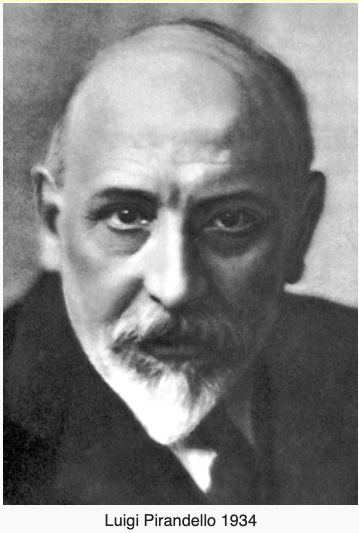
(Agrigento, 28 June 1867 – Rome, 10 December 1936).
Italian writer of poetry, plays and novels. In 1934, he was awarded the Nobel Prize in Literature.
Photo wikipedia.org.
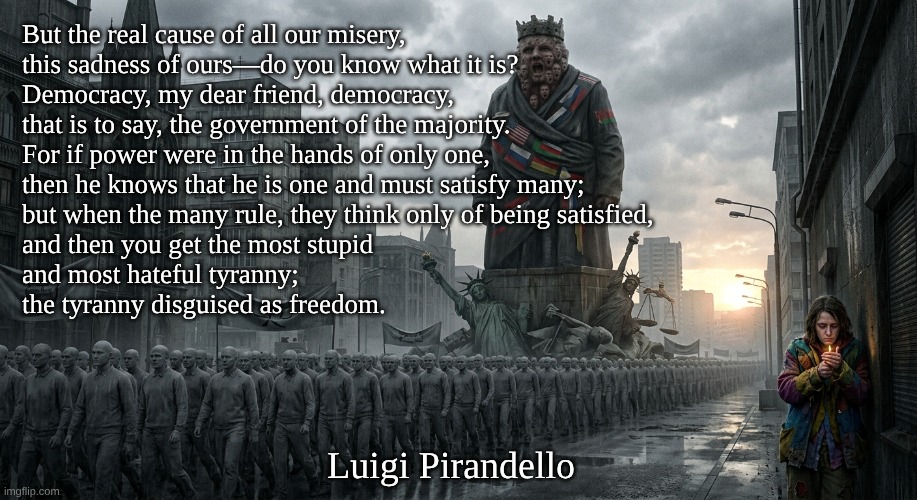
But the real cause of all our misery, this sadness of ours—do you know what it is? Democracy, my dear friend, democracy, that is to say, the government of the majority. For if power were in the hands of only one, then he knows that he is one and must satisfy many; but when the many rule, they think only of being satisfied, and then you get the most stupid and most hateful tyranny; the tyranny disguised as freedom.
Image: Peter van Geest AI. Meaning 📖 😊: This quote is a ‘sharp critique of democracy’, or at least, of the way democracy can play out in practice. The Core Idea: The speaker argues that the true source of misery (“misère”) and sorrow is not a lack of freedom, but rather democracy itself, defined as the “government of the majority”.The Comparison: A comparison is made between a single-person government (an autocracy or monarchy) and a majority government. The Individual: When one person holds power, that person is aware that they stand alone and must keep the “many” (the people) satisfied to maintain their position. This implies a certain responsibility. The Many (The Majority): When the majority rules, the idea is that this group is merely concerned with satisfying its ‘own’ wishes and needs. The Conclusion: According to the speaker, the result of majority government is the “most stupid and most hateful tyranny”. Why? Because it is ’tyranny disguised as freedom’. The majority can oppress the minority and justify this in the name of democracy and the will of the people. 🕵️♂️ Origin and Author: The quote comes from the famous Italian writer Luigi Pirandello.Author:Luigi Pirandello (1867–1936), an Italian playwright, novelist, and poet. He won the Nobel Prize for Literature in 1934. Origin: This specific statement comes from his novel “Il fu Mattia Pascal” (The Dead Mattia Pascal), published in 1904. The quote comes from Chapter X (titled “Acquasantiere”). It is spoken by the character Anselmo Paleari. Paleari is a somewhat philosophically inclined character in whose house the protagonist, Mattia Pascal (under the pseudonym Adriano Meis), rents a room in Rome. 💡 Context and Philosophy:The Speaker: It is important to remember that the quote is spoken by a ‘character’ (Paleari), and does not necessarily reflect the personal, firm conviction of Pirandello himself. Pirandello’s Themes: Pirandello’s work is known for his exploration of themes such as: – The fragmentation of human identity. – The subjectivity of truth. – The contrast between appearance (“the mask”) and reality (“life”). – The relativity of social and political constructs. The Statement in Context: In the context of the novel and Pirandello’s philosophy, this critique of democracy can be seen as an expression of pessimism regarding social organizations. The idea that “the many” can wear a “mask” of freedom while exercising tyranny over the minority aligns well with his general skepticism about society and ‘absolute’ truth.
Door Pieter
Mensenmens, zoon, echtgenoot, vader, opa.
Spiritueel, echter niet religieus.
Ik hou van golf, wandelen, lezen en de natuur in veel opzichten.
Onderzoeker, nieuwsgierig, geen fan van de mainstream media (MSM).