(Cambridge, 11 March 1952 – Santa Barbara, 11 May 2001) British science fiction writer.
Adams was born in Cambridge, the son of Christopher Adams (1927–1985) and Janet Donovan (1927–2016). He attended school in Essex (Brentwood Prep School) and studied at St John’s College, Cambridge, where he unsuccessfully attempted to join the renowned student theatre group Footlights, a breeding ground for television talent. He held a wide variety of jobs, including hospital porter, cleaner, bodyguard, radio producer and script editor for Doctor Who. He also collaborated with Graham Chapman of Monty Python and is credited in one of the episodes.
Douglas Adams. Photo wikipedia.org.
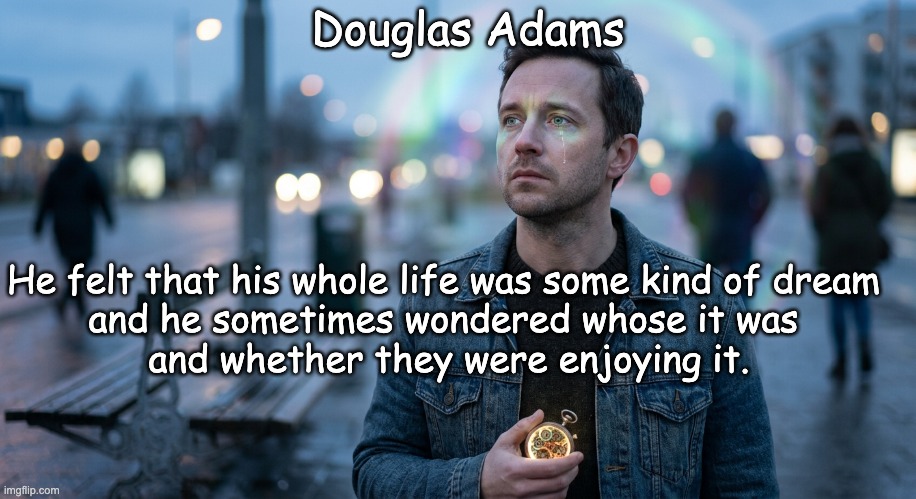
He felt that his whole life was some kind of dream and he sometimes wondered whose it was and whether they were enjoying it
Image: Peter van Geest AI. 💡 Meaning: This poignant quote delves into deep existential themes, capturing feelings often experienced during periods of profound introspection or alienation. It can be interpreted in several ways: Existential Detachment & Dissociation: The core feeling is one of being an observer rather than a participant in one’s own life. The protagonist (and perhaps the reader) experiences reality as surreal and disconnected, much like a dream. The Matrix/Simulation Theory: Taken more literally (especially within the context of the source material), it explores the idea that the protagonist’s entire universe might be a artificial construct—a simulation or a dream belonging to a powerful, perhaps indifferent, entity. A Crisis of Meaning: If life is not ‘real’ in the conventional sense, but rather a manifestation of someone else’s consciousness, then the meaning and purpose of individual actions and choices are thrown into question. It highlights a search for authenticity in an seemingly inauthentic existence. Wondering about the ‘Dreamer’: The second part of the quote (“whose it was and whether they were enjoying it”) shifts the focus from the experience of the dream to the nature of the entity responsible for it. It wonders if the ‘dreamer’ (creator, god, or simulation runner) derives satisfaction or amusement from the suffering and struggles of the characters within the dream. 📜 Origin: Source Material: This line originates from the novel “So Long, and Thanks for All the Fish.”About the Book: Published in 1984, this is the fourth book in “The Hitchhiker’s Guide to the Galaxy” ’trilogy’ (which eventually spanned five, or six depending on how you count, books). Context: The quote describes the state of mind of the protagonist, Arthur Dent, upon his return to Earth. After years of traversing the bizarre and dangerous galaxy (and seeing Earth destroyed multiple times), finding himself back on a seemingly normal Earth—where no one remembers the apocalypse—leaves him questioning his reality and his own sanity. ✍️ Author: This iconic line was written by the brilliant and beloved English author, Douglas Adams (1952–2001). Literary Impact: Adams is famous for blending surreal comedy, science fiction, philosophy, and sharp social commentary. “The Hitchhiker’s Guide to the Galaxy” began as a BBC radio series and exploded into a global multimedia phenomenon. Adams’ Style: The quote is a perfect example of his ability to evoke deep existential dread and profound philosophical questions, only to immediately undercut them with wry humor or absurdity (the thought of whether the creator is enjoying the dream).
Door Pieter
Mensenmens, zoon, echtgenoot, vader, opa.
Spiritueel, echter niet religieus.
Ik hou van golf, wandelen, lezen en de natuur in veel opzichten.
Onderzoeker, nieuwsgierig, geen fan van de mainstream media (MSM).