(‘s-Hertogenbosch, 11 May 1865 – Rotterdam, 21 June 1925).
Dutch poet and classicist who is counted as belonging to Symbolism. He is considered by some to be the most important Dutch poet since Vondel.
After his debut with poems influenced by Gorter and Mallarmé, from 1900 his poetry shows philosophical deepening especially of the Stoa, after 1915 mixed with Eastern religious elements. Leopold’s best-known works are poems that can often be found in anthologies. His poem ‘O nachten van gedragene ecase’ is generally considered one of the most beautiful love poems in Dutch literature.[
Also much admired are the epic poem Cheops from 1915 and the quatrains modelled on Arab and Persian poets in Oostersch from 1922.
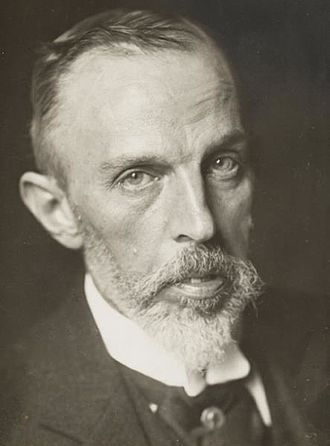
J. H. Leopold (1913) Photo: Henri Berssenbrugge – wikipedia.org
The only undoubted thing, feeling one’s own self.
Photo: Hesam Link
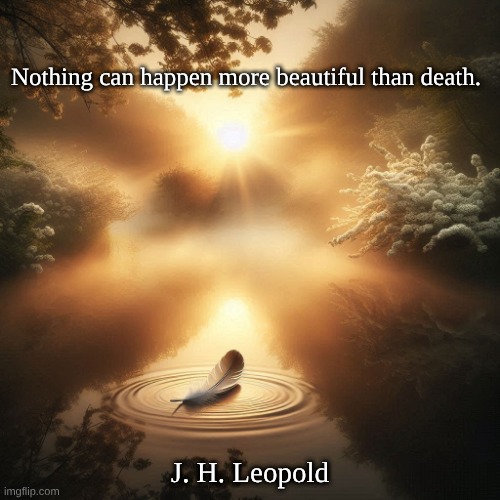
Nothing can happen more beautiful than death.
Image: Peter van Geest AI. Meaning: Leopold considers death a moment of ultimate beauty because it frees humanity from earthly cares, offers a sense of completion, and marks a transition to a (possibly) higher, invisible reality. It is a call to view death not only as loss, but also as a necessary, even sublime, event. Origin: Leopold’s poem “Death,” published in the collection “Verses” (1909). Often wrongly attributed to Walt Whitman.
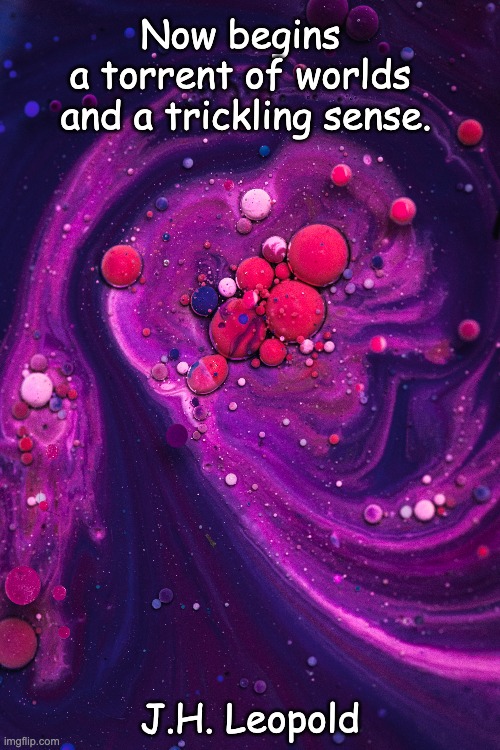
Now begins a torrent of worlds and a trickling sense.
Photo: Danny Lines. Meaning: This poem is a complex and atmospheric work. It is better known by the opening line “Now begins a deluge of worlds…”, and is indeed one of the absolute masterpieces of Dutch literature. The main themes and interpretations are:The Elusive Moment: Central to it is the experience of a decisive moment, the transition from rest to movement, or from silence to a stream of impressions. The “deluge” that begins stands in contrast to the “dripping” sensation, which evokes a feeling of both overwhelmingness and slow, sensory awareness. Melancholy and Longing: A deep melancholy speaks from the poem, an awareness of transience and the unattainability of an ideal or a lost state of being. The poet seems to long for a purity or unity that cannot be found in everyday reality. Sensory Experience: Leopold was a master at evoking atmosphere and feeling through the senses. Words such as “deluge,” “dripping,” “shining,” and the interplay of sound and rhythm in the verses ensure that the reader undergoes the experience almost physically. Musicality and Form: The poem is known for its exceptional musicality. The rhythm and sound repetitions are just as important as the literal meaning of the words. It is an example of ‘poésie pure,’ where form and sound carry the content. Interpretation: The meaning has been deliberately left open and ambiguous. It could concern a love experience, a moment of artistic inspiration, a confrontation with the cosmos, or simply a deep, existential sensation. It compels the reader to a personal interpretation. Origin & Context:Title: The original title, “Oinou hena stalagmon,” is Ancient Greek and means “One drop of wine.” This is a reference to a fragment by the Greek poet Theocritus (c. 300 – c. 260 BC). The Theocritus Fragment: In the original fragment of Theocritus, it likely concerns a small but meaningful gesture or gift (a drop of wine that can mean a great deal). Leopold adopts this title but gives it his own, more melancholic and existential twist. Publication:The poem first appeared in 1913 in the magazine “De Gids” and was later included in his collection “Gedichten*” (1913). Author: J.H. Leopold. Full Name: Jan Hendrik Leopold (1865–1925). He was a Dutch poet and classicist. He is considered one of the most important and idiosyncratic poets of his time, associated with the “Tachtigers” (although he followed a path entirely his own). Characteristics of his Work: Melancholy & Loneliness: His poetry is often characterized by a deep melancholy, a sense of loneliness, and a longing for an unattainable unity or purity. Formal Perfection: Leopold was a perfectionist. He polished his poems endlessly and attached enormous importance to rhythm, sound, and the musicality of language. Classical Influences: As a classicist, he was deeply rooted in Greek and Roman literature. This is evident not only from the title of this poem but also from the concentrated, formally structured nature of much of his work. Philosophical Slant: His poetry often contains philosophical reflections, influenced by Spinoza and the Greek Stoics, among others, on the nature of reality, the self, and suffering. His Significance: Leopold is a ‘poet for poets’. His work is not always easily accessible but is highly appreciated by connoisseurs and later poets for its mastery of language, intense atmosphere, and existential depth. 👋
Door Pieter
Mensenmens, zoon, echtgenoot, vader, opa.
Spiritueel, echter niet religieus.
Ik hou van golf, wandelen, lezen en de natuur in veel opzichten.
Onderzoeker, nieuwsgierig, geen fan van de mainstream media (MSM).