(Vienna, 26 March 1905 – Vienna, 2 September 1997).
Austrian neurologist and psychiatrist, but became best known as a Holocaust survivor.
Frankl was the founder of logotherapy, a form of existential analysis, also called the Third Viennese School of psychotherapy. His book The Meaning of Existence (published in 1978 as a translation of Ein Psycholog erlebt das Konzentrationslager published as early as 1946) outlines his experiences as a prisoner in a concentration camp and describes his psychotherapeutic method for finding meaning of life in all life circumstances and thus a reason to go on living.
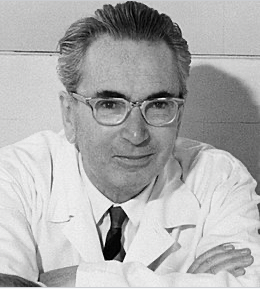
Viktor Frankl. Photo: wikipedia.org
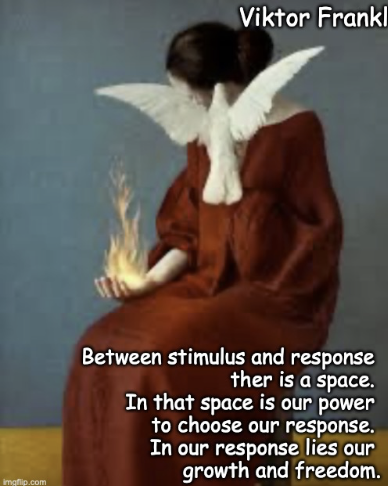
Between stimulus and response ther is a space. In that space is our power to choose our response. In our response lies our growth and freedom.
Painting: Laura Makabresku
When we are no longer able to change a situation, we are challenged to change ourselves.
Photo: magicdreamspoetry
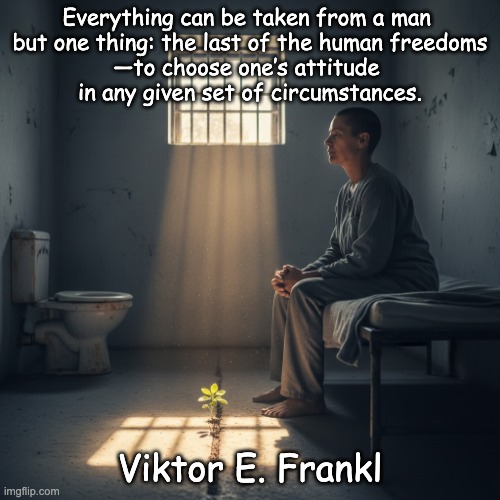
Everything can be taken from a man but one thing: the last of the human freedoms—to choose one’s attitude in any given set of circumstances.
Image- Peter van Geest AI. Meaning 🧭:A t the core: even if you lose almost all outward freedoms, one inalienable freedom remains — you may always choose your own attitude, your inner response. Implication: you retain moral and existential responsibility; you are not merely a passive victim of circumstances. Practically: you cannot always avoid suffering, but you can choose how you relate to it (making meaning, acting with dignity, continuing to choose direction). Origin and context 📚:Origin: from Viktor E. Frankl’s book “Man’s Search for Meaning” (German: “…trotzdem Ja zum Leben sagen”, 1946; English edition 1959). Context: Frankl based this insight on his experiences as a prisoner in Nazi concentration camps. He observed that people who were able to find meaning and purpose were more resilient. Philosophy: this forms a pillar of his logotherapy, in which the “will to meaning” (the search for meaning) is central. Author ✍️:Viktor E. Frankl (1905–1997) — Austrian neurologist and psychiatrist, Holocaust survivor, founder of logotherapy (third Viennese school after Freud and Adler). Known for the idea that meaning is essential for mental health and dignified living. Original wording and translations 🌐: English version (best known): “Everything can be taken from a man but one thing: the last of the human freedoms—to choose one’s attitude in any given set of circumstances, to choose one’s own way.”German rendering (often quoted, varying slightly per edition): “Man kann einem Menschen alles nehmen außer einer: der letzten der mensschlichen Freiheiten – die Wahl der Einstellung zu den gegebenen Umständen, die Wahl des eigenen Weges.”Nuance ⚖️: No “toxic positivity”: it doesn’t deny suffering or condone injustice; it emphasizes inner agency despite circumstances. It’s a call to responsibility and dignity, not to blame those who suffer.
Door Pieter
Mensenmens, zoon, echtgenoot, vader, opa.
Spiritueel, echter niet religieus.
Ik hou van golf, wandelen, lezen en de natuur in veel opzichten.
Onderzoeker, nieuwsgierig, geen fan van de mainstream media (MSM).