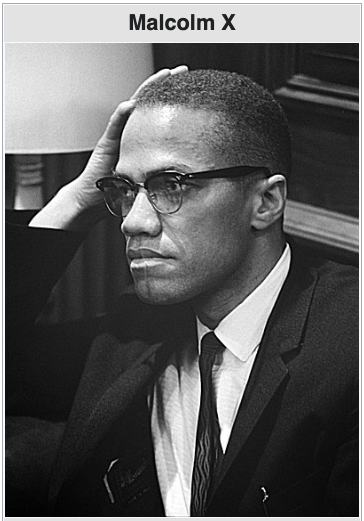
Born as Malcolm Little.
(Omaha (Nebraska), 19 May 1925 – New York, 21 February 1965).
One of the American leaders and spokesmen for the Nation of Islam, an African-American Muslim organisation for equal rights for black people. He founded the Muslim Mosque, Inc. and the Organisation of Afro-American Unity. On 21 February 1965, he was assassinated.
Malcolm X. Photo: wikipedia.org
I’m for truth, no matter who tells it. I’m for justice, no matter who it is for or against. I’m a human being, first and foremost, and as such I’m for whoever and whatever benefits humanity as a whole.
Photo by Yasser Mutwakil
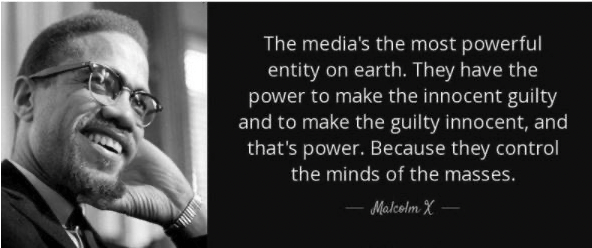
The media’s the most powerful entity on earth. They have the power to make the innocent guilty and to make the guilty innocent, and that’s power. Because they control the minds of the mass.
Photo by unknown
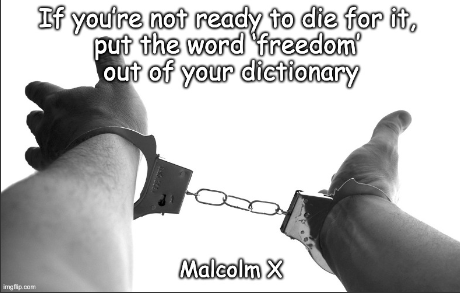
If you’re not ready to die for it, put the word ‘freedom’ out of your dictionary
Photo: Klaus Hausmann
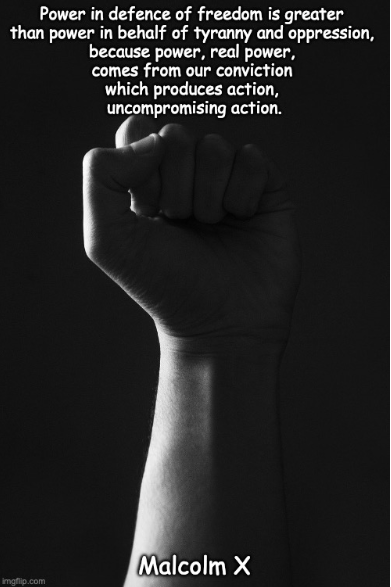
Power in defence of freedom is greater than power in behalf of tyranny and oppression, because power, real power, comes from our conviction which produces action, uncompromising action.
Photo: Nahuel Silva
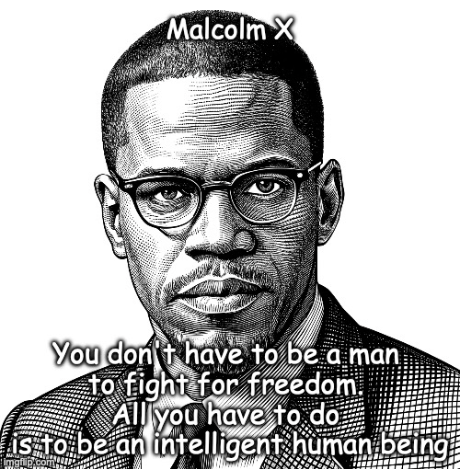
You don’t have to be a man to fight for freedom. All you have to do is to be an intelligent human being
Image: Gordon Johnson
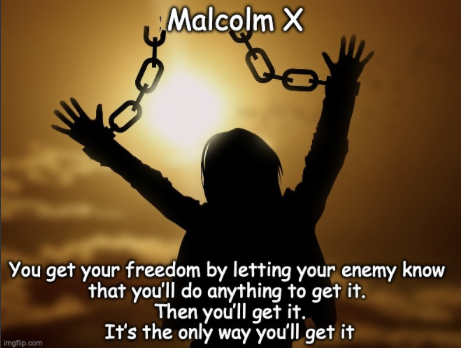
You get your freedom by letting your enemy know that you’ll do anything to get it. Then you’ll get it. It’s the only way you’ll get it
Photo: Elias
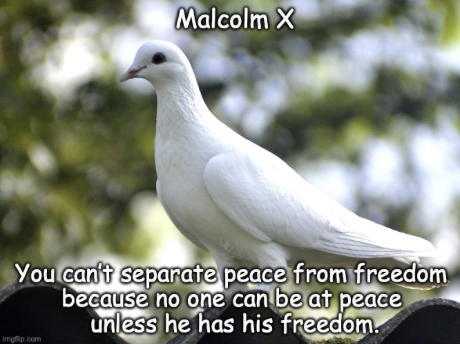
You can’t separate peace from freedom because no one can be at peace unless he has his freedom.
Photo: Roksana Helscher
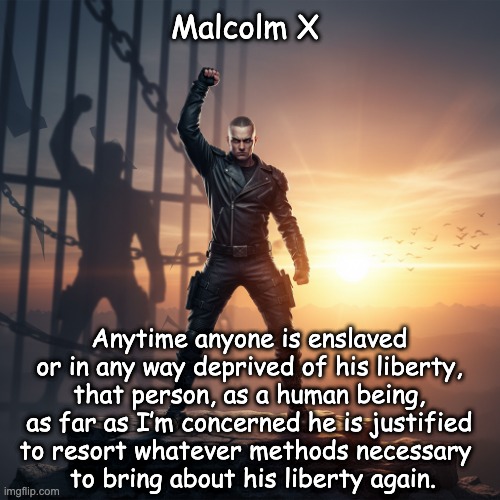
Anytime anyone is enslaved or in any way deprived of his liberty, that person, as a human being, as far as I’m concerned he is justified to resort whatever methods necessary to bring about his liberty again
Image: Peter van Geest AI. Meaning:Key Message: The quote emphasizes the right of every human being to fight for their freedom. It suggests that if someone is oppressed or enslaved, they are entitled to any means necessary to regain their freedom. Ethic of Resistance: The idea that freedom is a fundamental human right and that individuals should not remain passive in the face of injustice. Origin:Context: This quote stems from the long history of slavery and oppression, particularly within the context of the African American struggle for civil rights and social justice. Inspiration: The idea that people should always be able to stand up to oppression can be traced back to several historical figures and movements that have resisted injustice. Author:Malcolm X: While this specific quote is often attributed to Malcolm X, it is important to note that similar ideas have been expressed by other leaders and thinkers. Activism: Malcolm X was a prominent civil rights activist and champion of African American rights in the United States, particularly during the 1960s. Summary: The statement underscores the right to resist oppression and reflects the broader struggle for freedom and equality. Malcolm X is an important figure in this context, but the idea itself is timeless and universal.
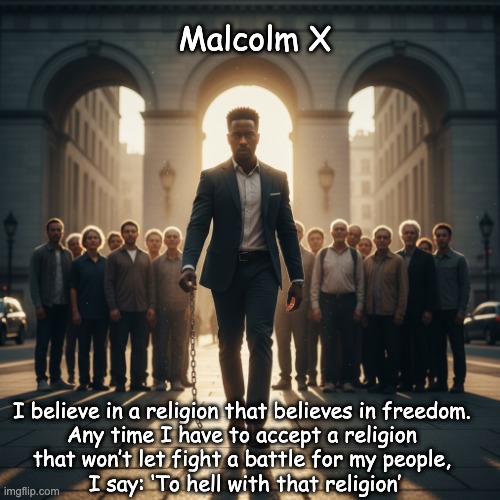
I believe in a religion that believes in freedom. Any time I have to accept a religion that won’t let fight a battle for my people. I say: ‘To hell with that religion’.
Image- Peter van Geest AI. Meaning and interpretation 💡:Core message: Freedom comes before dogma. If religious interpretations stand in the way of emancipation and self-defense, those interpretations must be rejected. Criticism of “passivizing” religion: Malcolm X opposed religious or moral discourses that discourage oppressed people from standing up for their rights. Not anti-religion in general: He was Muslim himself; his point is that religion should support freedom, justice, and self-determination, not block it. Political undercurrent: A plea for pragmatism (“by any means necessary”) and the prioritization of collective liberation over conformity to doctrines that hinder struggle. 🌍 Origin:Originally in English: “I believe in a religion that believes in freedom. Any time I have to accept a religion that won’t let me fight a battle for my people, I say to hell with that religion.” Period and context: Early 1960s, during his speeches on black self-determination and liberation. Possible sources where variations of this quote appear: Message to the Grass Roots (Detroit, November 10, 1963). The Ballot or the Bullet (April 1964, Cleveland/Detroit). Founding Rally of the OAAU (New York, June 28, 1964). Note: The quote circulates with slight variations; the exact wording may vary between transcripts/editions, but the gist is consistent. 👤 Author:Malcolm X (El-Hajj Malik El-Shabazz), American civil rights leader and public speaker. 🧭 Relevance today: Often cited in discussions about the role of religion in social justice, activism, and the legitimacy of self-defense against oppression.
Door Pieter
Mensenmens, zoon, echtgenoot, vader, opa.
Spiritueel, echter niet religieus.
Ik hou van golf, wandelen, lezen en de natuur in veel opzichten.
Onderzoeker, nieuwsgierig, geen fan van de mainstream media (MSM).