(Maisons-Laffitte, July 5, 1889 – Milly-la-Forêt, October 11, 1963).
French poet, novelist, playwright, designer, and filmmaker.
Although Cocteau was active in several fields, he considered himself a poet first and foremost and that all his work was poetry, whether it was a novel, a film, a play, or a painting. Cocteau was one of the most important figures in Surrealism. His work had a significant influence on many artists, including the famous composers of Les Six. His best-known works are the book Les Enfants terribles (1929), the play Les parents terribles, and the film La Belle et la Bête (1946).
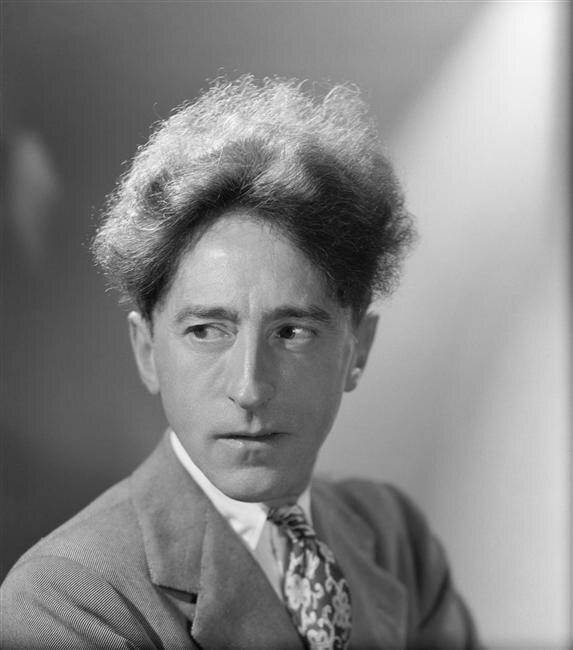
Jean Cocteau (1937) Photo: wikipedia.org
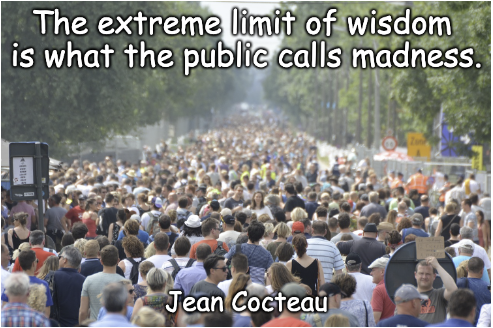
The extreme limit of wisdom is what the public calls madness.
Photo by Ben Kerckx
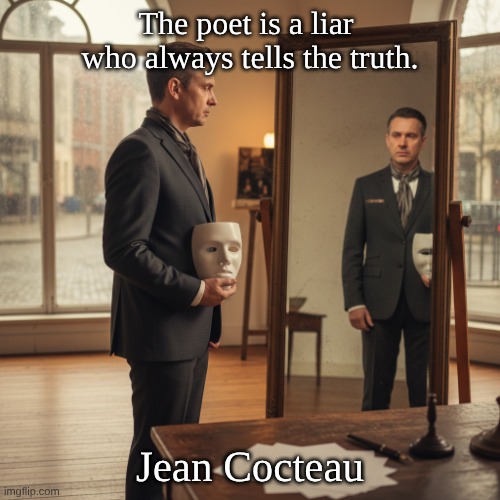
The poet is a liar who always tells the truth.
Image: Peter van Geest AI. Meaning: The expression expresses a paradox: “to lie” = the use of fiction, imagination, metaphor, exaggeration, and symbolism. “The truth” = a deeper, existential, or emotional insight that is not literally, but strikingly true. Core idea: Poetry invents forms to reveal a truth that is difficult to grasp with mere factual language. Origin: Classical roots: In the Poetics, Aristotle argues that poetry is “more philosophical” than history because it touches upon the universal and essential rather than merely the particular. This idea underlies this paradox. Modern formulation: The well-known version is closely related to (and often reduced in Dutch to) Jean Cocteau’s statement: “Le poète est un menteur qui dit toujours la vérité.” Loosely translated: “The poet is a liar who always tells the truth.” In Dutch, this became succinctly: “Poets lie the truth.”
As I get older, I become increasingly convinced that the only thing that is truly lasting is our dreams.
Image: Peter van Geest AI. Meaning 💭: The statement “As I get older, I become increasingly convinced that the only thing that is truly lasting is our dreams” touches upon a deep philosophical concept. Transience of the material: As one ages, one often experiences the fleeting nature of material possessions, relationships, youth, and even physical abilities. Many things that seem important in life eventually turn out to fade or disappear. The power of dreams: Dreams, in this context, refer not only to nocturnal fantasies but also to ambitions, ideals, desires, hope, and the human inner world. This inner world, filled with dreams and aspirations, can feel like something timeless that persists regardless of external circumstances. They provide direction and meaning and can be a source of comfort or inspiration, even when reality is unyielding. A form of immortality: In a sense, dreams suggest a form of immortality. They can propel us forward, even after setbacks, and can leave a legacy through art, innovation, or influence on others. In short, the statement emphasizes the intrinsic value and durability of our inner world and aspirations, in contrast to the transience of the physical and external world. Origin and Author: Jean Cocteau ✅ (1889-1963). Jean Cocteau was an influential French artist and intellectual. He was a multifaceted talent: poet, playwright, filmmaker, novelist, painter, and designer. His work is often characterized by surrealist elements, exploration of identity, and deep introspection. He was a key figure in the Parisian avant-garde scene of the 20th century. The sentence fits his oeuvre perfectly and his tendency to blur the boundary between reality and fantasy, and to emphasize the power of the human spirit and creativity.
Door Pieter
Mensenmens, zoon, echtgenoot, vader, opa.
Spiritueel, echter niet religieus.
Ik hou van golf, wandelen, lezen en de natuur in veel opzichten.
Onderzoeker, nieuwsgierig, geen fan van de mainstream media (MSM).