(born March 16, 1952).
American novelist and young-adult and children’s writer, best known for her 1995 novel Practical Magic, which was adapted for a 1998 film of the same name.
Many of her works fall into the genre of magic realism and contain elements of magic, irony, and non-standard romances and relationships.
Alice Hoffman. Photo: wbur.org
Always keep mint on your windowsill in August to ensure that buzzing flies will stay outside where they belong. Don’t think the summer is over, even when roses droop and turn brown and the stars shift position in the sky.
Photo by sean1573
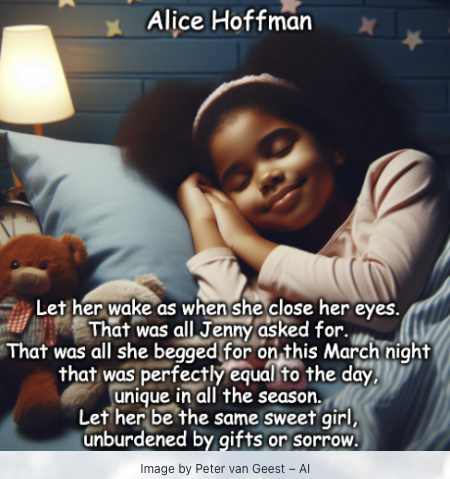
Let her wake as when she close her eyes. That was all Jenny asked for. That was all she begged for on this March night that was perfectly equal to the day, unique in all the season. Let her be the same sweet girl, unburdened by gifts or sorrow.
Meaning 📖: This is a deeply emotional and poetic fragment. Let us dissect the meaning: “Let her wake up as if she were closing her eyes”: This is a powerful request. It implies a desire for a transition that is as peaceful, as natural, and as seamless as falling asleep. It suggests that the awakening itself should not be a shock, a pain, or a traumatic change. It is a wish for continuity and gentleness. “That was all Jenny asked for… begged for”: This emphasizes the desperation and the intensity of the wish. “Begging” indicates that this is not a superficial request, but a deep-seated cry for help. The fact that she asks for only this suggests that everything else is unimportant at this moment. “in this night in March, which was completely like the day, unique in the entire season”: This description creates a specific, almost magical atmosphere. A night that is “equal to day” can point to the vernal equinox (when day and night are approximately the same length), which is a time of balance and transition. “Unique throughout the season” reinforces the idea that this is a special, meaningful moment. “Let her be the same sweet girl, without the burden of gifts or sorrow”: This is the core of the wish. Jenny wants the person in question to remain unchanged. “Without the burden of gifts” is an interesting phrase. It could mean: without the burden of expectations that come with talents or “gifts,” or perhaps without the burden of material things. “Without the burden of sorrow” is clearer: a wish for peace and freedom from emotional pain. 🔍 Origin and Author:Alice Hoffman. This quote strongly resembles a passage from one of her most famous works: 📖 Book: “Practical Magic” ✍️ Author:Alice Hoffman. 🗓️ Publication year: 1995. 🤫 Context in “Practical Magic” (Without major spoilers!). Assuming this is indeed from “Practical Magic,” we can place the context as follows: 1.The Owens Family: The book is about sisters Sally and Gillian Owens, who grow up in a family that has been dealing with magic and an alleged curse for centuries. 2.Jenny’s Role: An important character in the book is Jenny, Sally’s daughter. 3.The Wish: Throughout the story, the characters are confronted with loss, love, and the consequences of their family history. The wish expressed in the quote can be seen as a wish from a mother (or a loved one) for the protection and preservation of a child’s innocence and happiness. It is a plea to spare her from the “burden” that often accompanies their magical heritage and the accompanying emotional baggage. ✅ Conclusion: A beautiful and moving excerpt. It is almost certainly by Alice Hoffman, specifically from her novel “Practical Magic”. It expresses a deep desire for peace, preservation of innocence, and protection from pain, set against the backdrop of a magical-realist world.
Door Pieter
Mensenmens, zoon, echtgenoot, vader, opa.
Spiritueel, echter niet religieus.
Ik hou van golf, wandelen, lezen en de natuur in veel opzichten.
Onderzoeker, nieuwsgierig, geen fan van de mainstream media (MSM).