Thomas Tusser:
(c. 1524 – 3 May 1580).
English poet and farmer, best known for his instructional poem Five Hundred Points of Good Husbandry, an expanded version of his original title, A Hundreth Good Pointes of Husbandrie, first published in 1557.
For Tusser the garden was the domain of the housewife, and the 1562 text expands on this theme. Scholars also consider it a text of interest for its defence of enclosures. It was among the best selling poetry books of the Elizabethan age.
Thomas Tusser. Photo: allpoetry.com
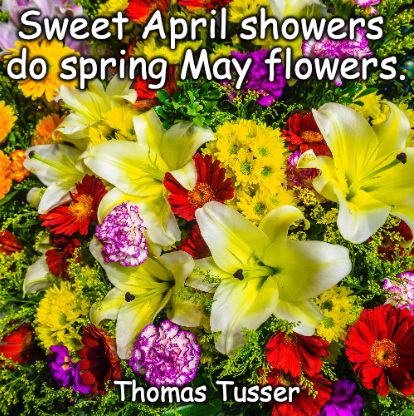
Sweet April showers do spring May flowers.
Photo: Alexander Schimmeck. Meaning 📖 : This is an old saying that is often interpreted literally and figuratively: Literal meaning: Rain showers in the month of April (the “sweet April showers”) are necessary for flowers to bloom in the month of May. It reminds us that rain is an essential part of nature’s growth cycle. 💧🌱 Figurative meaning: This expression is also used as a metaphor. It suggests that periods of discomfort, sadness or “storm” (the rain showers) are often necessary to ultimately lead to something beautiful or positive (the flowers). It is a message of hope and patience: after rain comes sunshine. ✨⏳ Origin and Author: The origin of this expression can indeed be traced back to the 16th century English poet and farmer Thomas Tusser.Author:Thomas Tusser (c. 1524–1580). ✍️ The Original Text: The sentence appears in his best-known work, an instructional poem about agriculture and housekeeping. The Work: The expression comes from the book entitled: “Five Hundred Points of Good Husbandry”, first published in 1557 (originally as “A Hundreth Good Pointes of Husbandrie”). The English Rhyme: In the poem for the month of April, Tusser wrote: “Sweet April showers / Do spring May flowers”. Tusser wrote his book in a rhyme scheme to make it easier for farmers to remember the rules and advice. This particular line has remained so popular over the centuries that it has become a permanent part of the English language and has been translated into many other languages, including Dutch. 🌍 However, this particular proverb from Tusser is unique because it directly emphasizes the ‘positive outcome’ of the bad weather.
Door Pieter
Mensenmens, zoon, echtgenoot, vader, opa.
Spiritueel, echter niet religieus.
Ik hou van golf, wandelen, lezen en de natuur in veel opzichten.
Onderzoeker, nieuwsgierig, geen fan van de mainstream media (MSM).