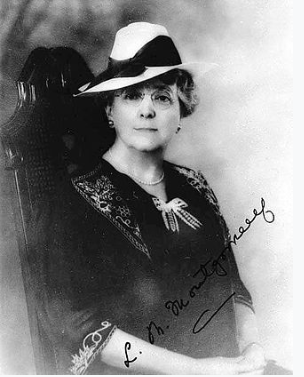
(November 30, 1874 – April 24, 1942).
Published as L. M. Montgomery, was a Canadian author best known for a collection of novels, essays, short stories, and poetry beginning in 1908 with Anne of Green Gables. She published 20 novels as well as 530 short stories, 500 poems, and 30 essays.
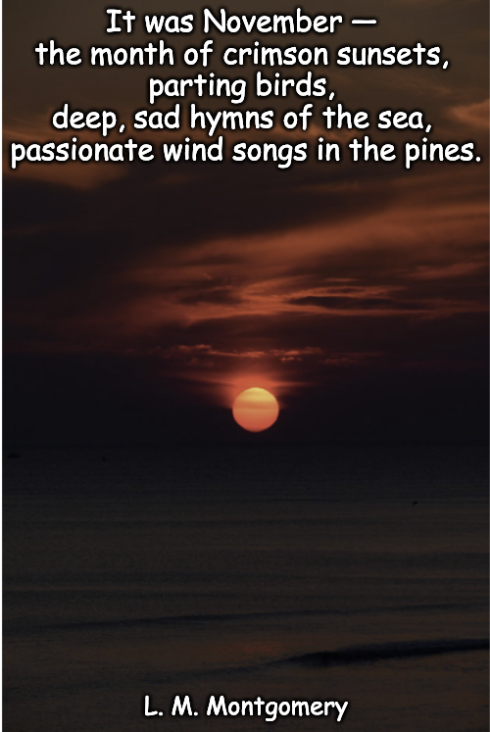
It was November—the month of crimson sunsets, parting birds, deep, sad hymns of the sea, passionate wind songs in the pines.
Photo by Rafael Garcin
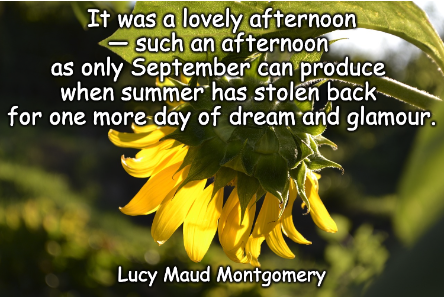
It was a lovely afternoon—such an afternoon as only September can produce when summer has stolen back for one more day of dream and glamour.
Photo: Eszter Hornyai. Meaning: Montgomery captures that special, almost magical quality of certain September days: moments when—after summer has technically ended—the warmth and light unexpectedly return, as if summer has reclaimed one last day before autumn truly sets in. The words “dream and glamour” evoke an enchanting, fleeting atmosphere; the moment is beautiful precisely because you know it cannot last. It is a classic example of Montgomery’s lyrical, nature-attuned writing style, in which the landscape and weather often reflect or shape the characters’ emotional states. The sentence has become a beloved quote that perfectly articulates that bittersweet, golden feeling of early autumn: summer’s final encore before it definitively gives way to the fall season. Origin: It is the opening sentence of “Emily Climbs” setting the scene for a September afternoon in the continuation of the story of Emily Byrd Starr. Author:L. M. Montgomery, the Canadian writer best known for “Anne of Green Gables”.
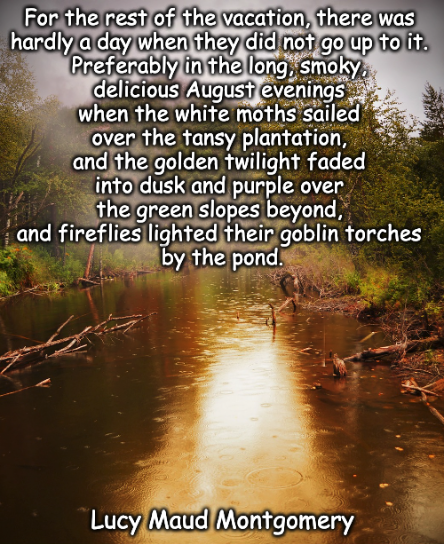
For the rest of the vacation, there was hardly a day when they did not go up to it. Preferably in the long, smoky, delicious August evenings when the white moths sailed over the tansy plantation, and the golden twilight faded into dusk and purple over the green slopes beyond, and fireflies lighted their goblin torches by the pond.
Photo: Larisa Koshkina. ✅ Meaning: This is ‘not a proverb or common “saying”’; it is a ‘literary passage’ describing a beloved place the children visit during the rest of their summer vacation. – “There was hardly a day when they did not go up to it” means: ➜ They went there ‘almost every day’. – The rest of the passage paints a dreamy, nostalgic late-summer scene: – “long, smoky, delicious August evenings” = hazy, warm, beautiful evenings in late summer. – “white moths sailed” = moths moved gently through the air, like little boats. – “tansy plantation” = a large patch of tansy, a yellow-flowered herb. – “fireflies lighted their goblin torches” = fireflies are imagined as tiny magical creatures carrying lights. Overall, the passage conveys ‘childhood wonder, enchantment, and the magical beauty of nature’. 🌿✨ 📚 Author: L. M. Montgomery, full name Lucy Maud Montgomery. – Work: “Rainbow Valley” – First published: 1919 – Series: Part of the “Anne of Green Gables” books – Context: The “it” refers to “Rainbow Valley”, a favorite outdoor play-place of the children. 🖋️ About L. M. Montgomery: Lucy Maud Montgomery was a Canadian author best known for creating “Anne Shirley” in “Anne of Green Gables”. Her writing often features: – vivid descriptions of Prince Edward Island landscapes 🌅 – childhood imagination – romantic, poetic nature imagery – a strong sense of nostalgia and wonder
A cold in the head in June is an immoral thing.
Photo: Victoria Regen. Meaning: The line captures a very human sentiment: getting a summer cold feels like an offense against nature itself. June is the month of warmth, vitality, long days, and blooming things — the very peak of the year’s promise. To be laid low by a stuffy, drippy head cold in the middle of all that beauty and energy isn’t just unfortunate, it’s almost a ‘moral failing’ — as if the sufferer has somehow let the season down, or the universe has played a spectacularly unfair trick. It’s comic exaggeration, of course, but anyone who has sneezed their way through a glorious June afternoon knows exactly what Montgomery means. Context: Montgomery wrote it in “Anne of Windy Poplars” (1936), one of the later novels in her “Anne of Green Gables” series, narrated largely through letters from Anne Shirley. Montgomery had a gift for this kind of wry, affectionate observation about the rhythms of nature and daily life — she wrote elsewhere, for instance, “I wonder what it would be like to live in a world where it was always June.” Interestingly, there’s a companion quote from Oliver Wendell Holmes that seems to have inspired or rhymed with Montgomery’s sentiment: “June comes in with roses in her hand, but very often with a thick shawl on her shoulders, and a bad cold in her head” — suggesting the idea of June being incompatible with colds was already in literary circulation before Montgomery gave it its pithiest form.
I wonder what it would be like to live in a world where it was always June.
Photo: Hanako Hanasakura . Meaning ✨ 🌿: This is not an old proverb, but rather a ‘literary quote’ with a poetic charge. 🌸 Symbolic meaning of “always June”: “June” often evokes associations with: – blossoming and beauty – warmth and light – youth and joie de vivre – carefree – a sense of abundance and hope 💭 What does the quote express? The quote articulates a longing for a world that: – is always beautiful and gentle – never wilts or ages – constantly remains in a state of promise and bloom In other words: it is a ‘romantic musing’ about an ideal, almost paradisiacal state. 👩🦰 Author: – L. M. Montgomery Full name: Lucy Maud Montgomery Canadian writer, best known for the “Anne of Green Gables” series. Source📚 📖 : – Book: “Anne of the Island” – Year: 1915 📝 Context: The quote fits Montgomery’s style well: – dreamy – sensitive to nature – nostalgic – full of wonder at seasons, beauty, and inner life 🌼 Interpretation in one sentence: The quote expresses a ‘longing for an eternal state of beauty, softness, hope, and summer bloom’.
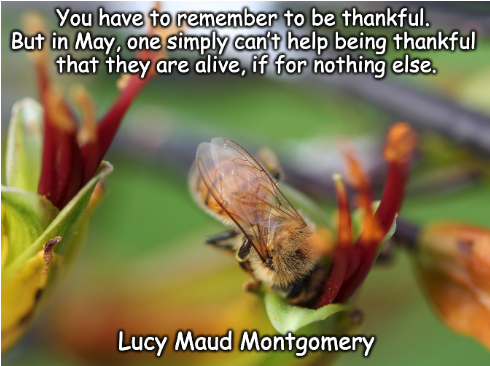
You have to remember to be thankful. But in May, one simply can’t help being thankful that they are alive, if for nothing else.
Photo by Sandy Millar
November is usually such a disagreeable month as if the year had suddenly found out that she was growing old and could do nothing but weep and fret over it. This year is growing old gracefully, just like a stately old lady who knows she can be charming even with gray hair and wrinkles. We’ve had lovely days and delicious twilights.
Photo by Yves Yoseph – Bali
I’m so glad I live in a world where there are Octobers.
Photo: Dana Tentis. 🍂 Meaning: The sentence expresses ‘joy, gratitude, and wonder at the beauty of October’, especially its autumn colors and atmosphere. It reflects an optimistic ability to find happiness in nature and in the changing seasons. In a broader sense, it celebrates ‘appreciating life’s simple pleasures’. 📖 Origin: The quotation comes from the novel “Anne of Green Gables”, first published in 1908. It is spoken by the imaginative heroine “Anne Shirley” while admiring the autumn landscape. The fuller passage reads: > “I’m so glad I live in a world where there are Octobers. It would be terrible if we just skipped from September to November, wouldn’t it?” It appears in Chapter 16, “Diana Is Invited to Tea with Tragic Results.” ✍️ Author: Lucy Maud Montgomery. Commonly credited as L. M. Montgomery (1874–1942), was a Canadian author best known for the “Anne of Green Gables” series.
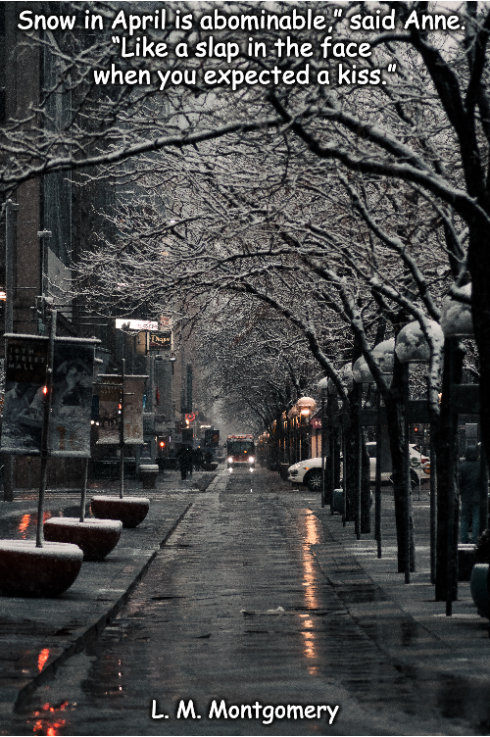
Snow in April is abominable,” said Anne. “Like a slap in the face when you expected a kiss.”
Photo: Colin Lloyd. Meaning 🧐 ❄️ : The saying “Snow in April is awful… Like a slap in the face when you were expecting a kiss” is a vivid ‘metaphor’ for a sudden, painful ‘disappointment’. Expectation (The Kiss): In April, winter is expected to be over. Nature is blooming, the days are getting longer and warmer. It is a symbol of hope, new life, and warmth (the “kiss”). Reality (The Slap): A sudden snow shower in April is cold, unpleasant, and puts an end to that spring feeling. It feels like a “slap in the face” because it is unexpected and brutally shatters a pleasant expectation. In short: It describes the feeling when something you were really looking forward to is ruined at the last minute by something unpleasant. ✍️ Author: The author of this quote is the Canadian writer L.M. Montgomery (Lucy Maud Montgomery). The quote comes from her most famous book series: “Anne of Green Gables”.Origin 📖: The quote appears in the book “Anne of the Island”, the third installment in the ‘Anne of Green Gables’ series.The context in the book: The protagonist, Anne Shirley, says this to her friends (Gilbert Blythe and Philippa Gordon). They are walking through an unexpected snowstorm in April, and Anne expresses her frustration about the weather and how it is ruining her hopes for spring.
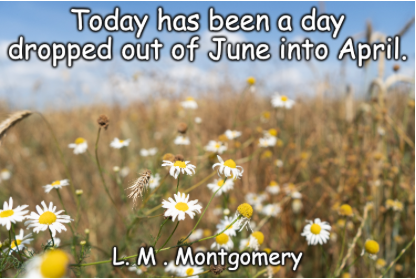
Today has been a day dropped out of June into April.
Photo by Celina Albertz
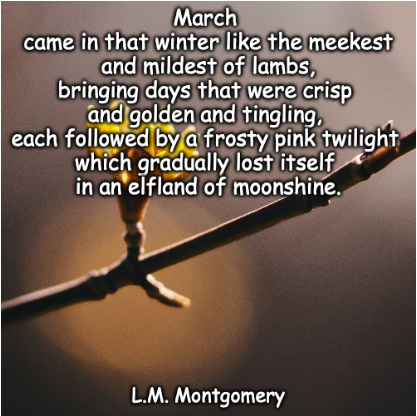
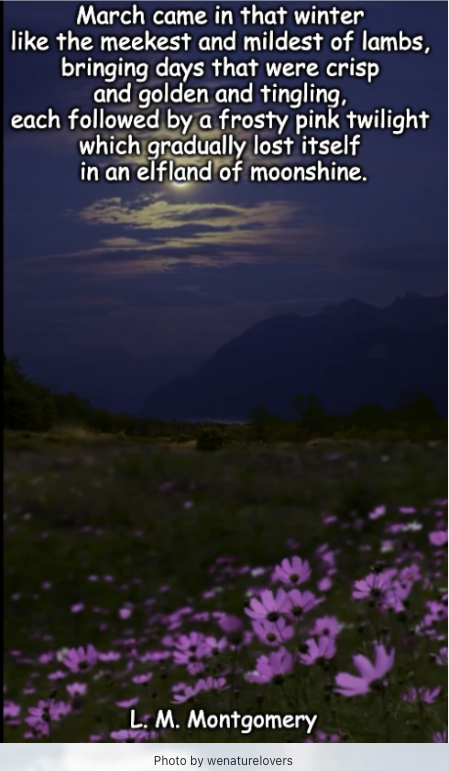
March came in that winter like the meekest and mildest of lambs, bringing days that were crisp and golden and tingling, each followed by a frosty pink twilight which gradually lost itself in an elfland of moonshine.
Photo: Martin Brechtl. Meaning 🔍 📖 : The quoted text is a vivid and poetic description of the transition from winter to spring in the month of March. “March broke in winter like the meekest and gentlest lambs”: This is a variation on the well-known English proverb: “March comes in like a lion and goes out like a lamb.” In this particular year, however, Montgomery describes the month as having begun (“break in”) like a lamb. This suggests that the winter ended unusually mildly, without the usual storms or bitter cold one would expect in March. “fresh and golden and tingling”: These words evoke a sense of bright, sunny days that still carry the coolness of winter within them, but also the promise of spring. It is a sensory description of the weather. “an icy pink twilight”: This describes the beautiful colors of the sunset at this time of year, where the cold air creates bright shades of pink and red. “a fairyland of moonlight”: This metaphor gives the nights a magical, dreamy character, as if the world has transformed into a fairytale landscape under the light of the moon. Conclusion: The sentence paints an idyllic picture of an early, gentle spring initiation, where the harshness of winter gives way to quiet, clear, and magical days and nights.📚 Origin and Author: This quote comes from one of L.M. Montgomery’s most beloved books. Author:Lucy Maud Montgomery (1874–1942). She was a Canadian author, best known for her series of novels about Anne of Green Gables. Her work is known for its beautiful, detailed, and emotional descriptions of nature, particularly of Prince Edward Island. Book: The sentence comes from the novel “Anne of the Island” (translated into Dutch as Anne van het Eiland), published in 1915. Context: This is the third book in the Anne of Green Gables series. It follows Anne Shirley as she goes to Redmond College in Kingsport to obtain her university degree. The quoted passage is at the beginning of Chapter 24, titled “Jonas of Priscilla” (in some translations “Priscilla’s Jonas” or “A Letter from Priscilla”). 🌸 The Original English Quote: For the sake of completeness and to appreciate the original poetry, here is the English text: “March came in that winter like the meekest and gentlest of lambs, bringing days that were crisp and golden and tingling, each followed by a frosty pink twilight which gradually lost itself in an elfland of moonshine.” – L.M. Montgomery, Anne of the Island (1915).
March came in that winter like the meekest and mildest of lambs, bringing days that were crisp and golden and tingling, each followed by a frosty pink twilight which gradually lost itself in an elfland of moonshine.
📌 Meaning 🌤️🌙: It is not a short “weather saying” in the strict sense, but a literary, poetic description of nature. “March entered that winter like the gentlest and mildest lamb”: March (normally bleak and stormy) enters here softly and friendly. The image of the lamb stands for softness, a feeling of spring, innocence. “bright, golden and sparkling”: Days with crystal clear air, sunlight that seems “golden”, and a sparkling (cold but beautiful) atmosphere. “icy pink twilight… elfin land of moonlight”: The evenings are still winter-cold, with pink twilight (typical with clear, cold air). Then the landscape in the moonlight becomes almost fairy-tale-like (“elfenland”). Short: it describes a mild March that turns winter into spring, with clear days and magical, cold evenings. 🧭 Origin:proverb vs. Literary variant 🦁➡️🐑. This passage clearly relies on the well-known (English) weather saying: “March comes in like a lion and goes out like a lamb.” 🦁🐑 Meaning: March often starts stormy and ends mild/springy (or vice versa, depending on the year). Montgomery rotates/sharpens the image: in her description, March immediately comes in like a lamb — so exceptionally mild. (If you’re looking for the “origin” of the proverb itself: it’s old English weather-lore that’s been circulating for centuries; the precise “first author” is not a single person, as with a novel quotation.) ✍️ Author: Generally attributed to Lucy Maud Montgomery (L.M. Montgomery) ✅ Original English formulation (commonly quoted): “March came in like the mildest and gentlest of lambs and brought days that were clear and golden and sparkling, each followed by an icy pink twilight that slowly deepened into a fairyland of moonshine.” So this isn’t folk wisdom, but Montgomery’s prose. 📚 What book is it from? The passage is usually cited as being from Anne of Avonlea (1909), part of the Anne of Green Gables series. Because this quote is clearly a Dutch translation, the exact Dutch wording may vary slightly between editions/translators.
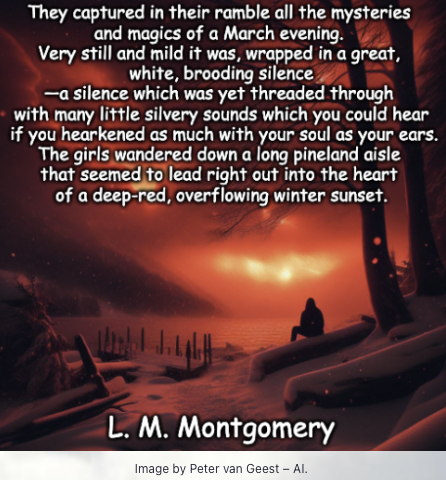
They captured in their ramble all the mysteries and magics of a March evening. Very still and mild it was, wrapped in a great, white, brooding silence—a silence which was yet threaded through with many little silvery sounds which you could hear if you hearkened as much with your soul as your ears. The girls wandered down a long pineland aisle that seemed to lead right out into the heart of a deep-red, overflowing winter sunset.
✨ Meaning: An Analysis 🌲🌅 : The quote is a beautiful example of Montgomery’s ability to set an atmosphere. Let’s dissect the elements: 🌬️ The Atmosphere of a March Evening: It captures the unique transition from winter to spring. “Quiet and mild,” but also “white” and “somber” (from the melting snow). It is a moment of stillness. 🤫 The Silence That Is Not Silence: The phrase “a silence that was nevertheless laced with many little silver sounds” is pure poetry. It suggests that even in the deepest silence of nature there is life (think of melting ice, a distant bird, the wind in the branches). 👂 Listening with Your Soul: This is the core of the mysticism in the quote. It invites the reader not only to listen physically, but to open up to the deeper, emotional experience of a place. It is about connection with nature. 🌲 The Image of the Path: The “long pine-lined walkway” leading to the “winter sunset” creates a sense of perspective and a journey to a beautiful, almost otherworldly destination. The colors (deep red) contrast with the “white silence.” 💡 This excerpt is so beloved because it describes a universal human experience: the moment you become completely absorbed in the beauty of nature and experience a sense of peace and wonder. It reminds us to slow down and listen to the world around us ‘with our soul.’ ✍️ Author:Lucy Maud Montgomery. A world-famous Canadian writer, best known for her timeless book Anne of Green Gables. Her style: She was known for her beautiful, detailed, and lyrical descriptions of nature, often based on the landscape of Prince Edward Island in Canada. 📖 Origin: This specific quote comes from one of her later and slightly more mature works: Title: “The Blue Castle.” Published: 1926. The context: The quote comes from the last chapter of the book (Chapter 45). The “girls” (in the original quote, these are Valancy and Barney, the main characters, so a woman and a man) take a walk and experience this magical evening. In the Dutch translation, “meisjes” is likely a slight adjustment. Here is the original English quote for comparison: “In their vagabondage they caught all the mysteries and magic of a March evening. It was very still and mild, wrapped in a great, white, solemn silence—a silence that was yet threaded with many little silver sounds if you listened as much with your soul as with your ears. They walked down a long aisle of pines that seemed to lead straight into the heart of a deep-red, overflowing winter sunset.”
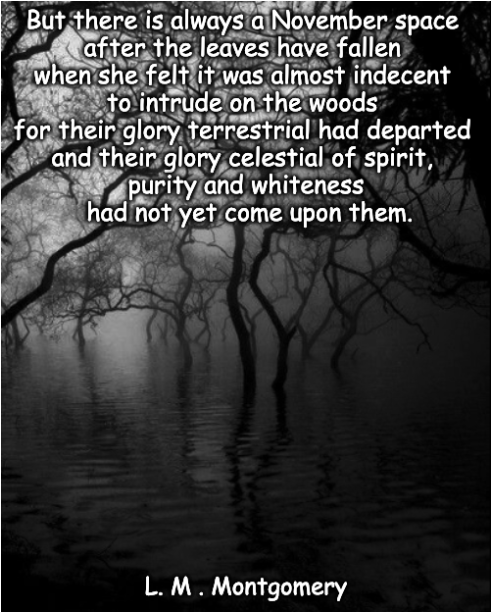
But there is always a November space after the leaves have fallen when she felt it was almost indecent to intrude on the woods for their glory terrestrial had departed and their glory celestial of spirit and purity and whiteness had not yet come upon them.
Photo: wenaturelovers
Door Pieter
Mensenmens, zoon, echtgenoot, vader, opa.
Spiritueel, echter niet religieus.
Ik hou van golf, wandelen, lezen en de natuur in veel opzichten.
Onderzoeker, nieuwsgierig, geen fan van de mainstream media (MSM).