(Oldenburg, February 23, 1883 – Basel, February 26, 1969). Swiss psychiatrist who achieved international fame as a philosopher. He was born in Germany. His father was a lawyer, and his mother worked in an agricultural cooperative.
Jaspers was one of the most prominent representatives of existential philosophy, which he strictly distinguished from Jean-Paul Sartre’s existentialism. He also made a name for himself in the theological field. He was first a teacher and later a lifelong friend of Hannah Arendt, with whom he corresponded for decades. He also maintained a correspondence with Martin Heidegger, which was interrupted during the German fascism and only slowly revived after World War II. He was a long-standing friend of Max Weber, Hans Walter Gruhle, and Kurt Schneider.
Karl Jaspers Photo wikipedia.org
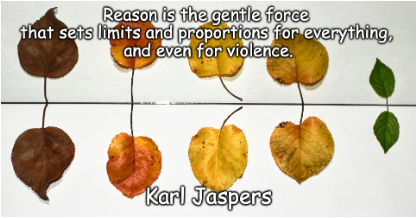
Reason is the gentle force that sets limits and proportions for everything, and even for violence.
Photo by Tolga Ulkan
There must be no freedom to destroy freedom.
Photo by S-usan
Man today faces the alternative: demise of man or transformation of man.
Photo by Oliver Roos
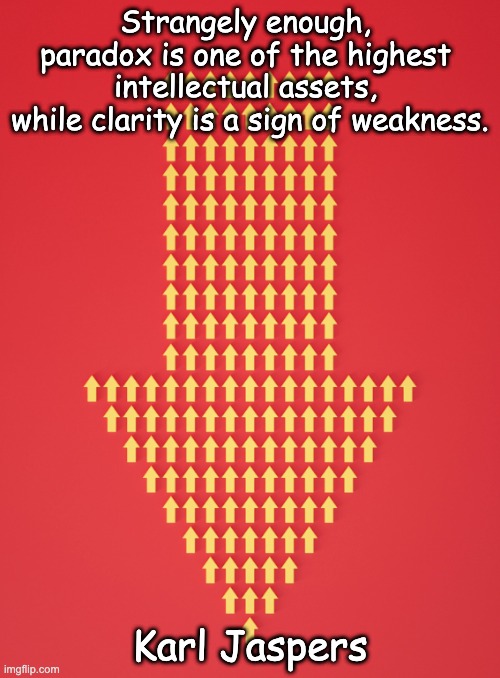
Strangely enough, paradox is one of the highest intellectual assets, while clarity is a sign of weakness.
Image: unsplash. Meaning 🧠:Paradox as a strength: Complex reality and inner contradictions cannot be reduced to one simple, unambiguous formula. The ability to sustain tension between opposites (paradox) is a sign of mature thinking and spiritual depth. Clarity as a weakness:A compelling need for one meaning/one explanation can indicate: oversimplification of a complex matter, dogmatism or ideological narrowing, an inability to tolerate ambiguity and uncertainty. Context: In existential philosophy (Jaspers) and depth psychology (Jung), paradox functions as a necessary form of expression for the coexistence of opposites (e.g., conscious/unconscious, freedom/necessity). Author and attribution 🏷️:Probable author: Karl Jaspers. The language register and themes (“spiritual goods,” criticism of “End-end-end”) closely reflect Jaspers’ existential philosophy, which focuses on paradox and borderline situations. The statement circulates in quotation collections as a Jaspers quotation, but often without precise page references. Why is it often attributed to C. G. Jung? 🤔: Jung repeatedly writes that paradox is indispensable for approaching psychic and life-fulfilling reality. There are very close Jungian formulations in his Collected Works (on the value of paradox and the danger of one-sidedness), which easily makes the quotation “verjugtig” (transliterated). As far as has been documented, this exact turn of phrase does not appear as a literal Jungian sentence in the Collected Works. Origin/source 🔎:Original language: German. Fixed formulation: “Paradox heard from the highest spiritual sources; finality is a sign of weakness.” Primary source: Often cited without precise source references. The idea is in line with Jaspers’ works from the 1930s–1950s (e.g., The Spiritual Situation of Time; Philosophy; Reason and Existence), but an exact page number is not usually given in common quotation collections. Summary 🧾: The statement fits both Jaspers and Jung in substance, but the specific formulation is most convincingly attributed to Karl Jaspers. Jung thought similarly about the value of paradox, which explains the frequent misattribution.
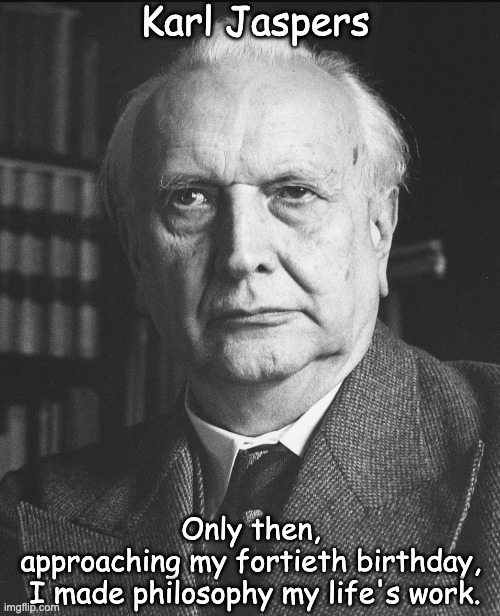
Only then, approaching my fortieth birthday, I made philosophy my life’s work.
Photo: britannica.com. Meaning: Only relatively late in his life (around his 40th birthday) did the speaker decide that philosophy was not just an interest or side activity, but his main task/calling/“life’s work.” After this shift, he came to see philosophy as his central mission. ✍️ Author:Karl Jaspers. ✅ This statement strongly resonates with Karl Jaspers (1883–1969): he began his professional career as a physician and psychiatrist, and only later shifted to philosophy as his main project. Chronology that supports this: Jaspers was primarily known in the 1910s–1920s for his work in psychiatry (Allgemeine Psychopathologie, 1913). Around the early 1920s (when he was in his late 30s/around 40), his philosophical work and position became dominant. In short: in terms of content and biography, “Karl Jaspers” is the most logical author here. 🧭 Origin / source: The English formulation sounds like a translation/paraphrase of an autobiographical passage in German, along the lines of: “First, on my fourth birthday, I made philosophy my life’s work.” These kinds of sentences are usually cited from Jaspers’ autobiographical texts, particularly: “Philosophische Autobiographie” (often included in anthologies/essays), and often mentioned in conjunction with the anthology Rechenschaft und Ausblick (Jaspers, 1958), which includes autobiographical reflections. 📝 Mini-context 🧠:Jaspers’ career is known precisely for the transition: from psychiatry/clinical science ➝ to existential philosophy (borderliness, existence, transcendence). A “late” choice for philosophy as his life’s work is therefore not only plausible, but almost a core motif of his self-description.
Door Pieter
Mensenmens, zoon, echtgenoot, vader, opa.
Spiritueel, echter niet religieus.
Ik hou van golf, wandelen, lezen en de natuur in veel opzichten.
Onderzoeker, nieuwsgierig, geen fan van de mainstream media (MSM).