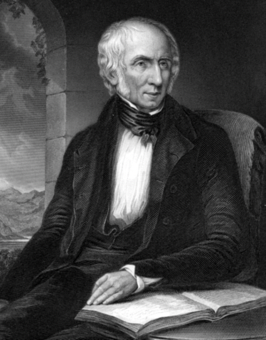
(Cockermouth, 7 April 1770 – Rydal (Westmorland), 23 April 1850). English Romantic poet.
William Wordsworth. Photo: wikipedia.org
The best portion of a good man’s life is his little, nameless unremembered acts of kindness and love.
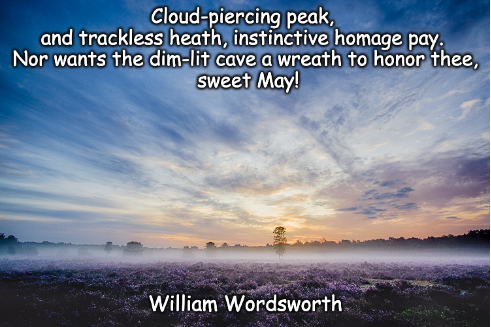
Photo by Lance Reis
Cloud-piercing peak, and trackless heath, instinctive homage pay. Nor wants the dim-lit cave a wreath to honor thee, sweet May!
Photo by Joran Quinten
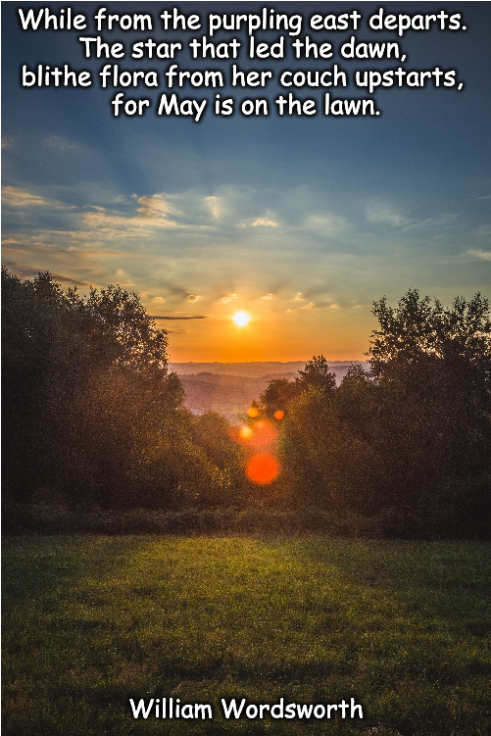
While from the purpling east departs. The star that led the dawn, blithe flora from her couch upstarts, for May is on the lawn.
Photo by Eric Terrade
Truth takes no account of centuries.
Photo by Rohit Tandon
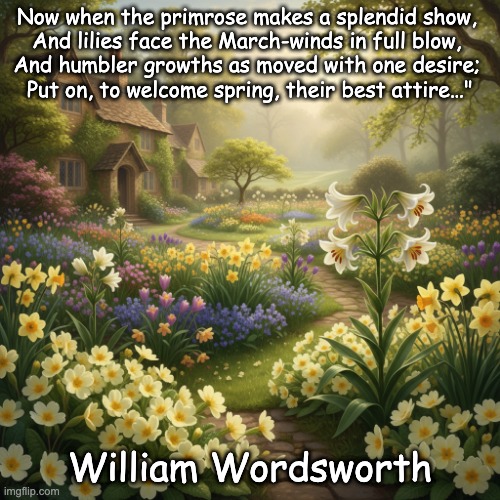
Now when the primrose makes a splendid show, And lilies face the March-winds in full blow, And humbler growths as moved with one desire; Put on, to welcome spring, their best attire…
Image: Peter van Geest AI. Meaning: The poem is a gentle, affectionate meditation on a modest wildflower that can’t compete with the showier blooms of spring, yet finds its own kind of beauty and dignity. The opening lines you quoted paint the grand parade of spring flowers — primroses, lilies, and other plants all putting on their finest display — which makes “Poor Robin’s” lack of flowers all the more noticeable. But Wordsworth doesn’t pity him; rather, he celebrates the plant’s unpretentious vitality and its knack for brightening the scene with what it does have, even without blossoms. The deeper theme is a Wordsworthian favourite: the value of humble, overlooked things in nature. There’s a quiet philosophical point that brightness and worth don’t always come in the most obvious packages. The Poem:“Poor Robin”. The opening lines set a vivid spring scene — primroses in splendid bloom, lilies braving the March winds, and humbler plants all dressing themselves up to welcome the season. Against this backdrop, “Poor Robin” (a herb called herb robert, a type of wild geranium) is still flowerless — yet cheerful, showing off his bright red stalks. Author & Context:William Wordsworth was a major English Romantic poet who, together with Samuel Taylor Coleridge, helped launch the Romantic Age in English literature with their joint publication Lyrical Ballads in 1798. Born on 7 April 1770, his works are noted for their emphasis on the beauty of nature, the importance of emotion, and the value of the individual. “Poor Robin” (1852) is a late-career poem, and very typical of Wordsworth’s lifelong habit of finding profound meaning in the smallest, most overlooked corners of the natural world — a crocus, a daisy, a celandine, and here, a humble roadside weed.
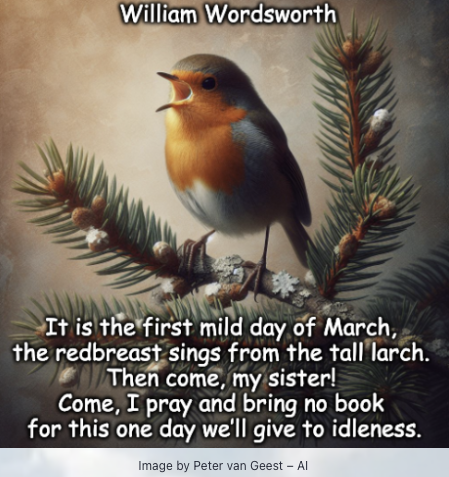
It is the first mild day of March, the redbreast sings from the tall larch. Then come, my sister! Come, I pray and bring no book for this one day we’ll give to idleness.
Meaning: The passage is not merely a saying; it is an invitation to embrace nature and enjoy the simple pleasures of life. It emphasizes:The Desire for Rest: A call to leave behind the daily worries, symbolized by the book, and to enjoy the moment. The Beauty of Nature: The vivid description of the “first mild day of March” and the singing robin in the “tall larch” reminds us of the splendor of the natural world. The Value of Doing Nothing: It reminds us that sometimes it is necessary to escape the hustle and bustle and simply be, without goals or obligations. Origin: The passage is not a direct quote, but rather an interpretation or paraphrase of a poem. The poem underlying this is likely “Lines Written in Early Spring.” This poem, first published in 1798 in the collection “Lyrical Ballads,” is one of the most famous works of the Romantic movement. The poem explores themes such as the beauty of nature, the human condition, and the impact of industrialization. Author:The famous English poet William Wordsworth. Here is the original part of the poem: > While in a grove I sate reclined, > In that sweet mood when pleasant thoughts > Bring sad thoughts to the mind. > To her fair works did Nature link > The human soul that through me ran; > And much it grieved my heart to think > What man has made of man. Note: Although the atmosphere and sentiment are similar, the poem does not contain the exact wording of the quoted passage. This suggests that the passage may be a modern interpretation or a free translation.
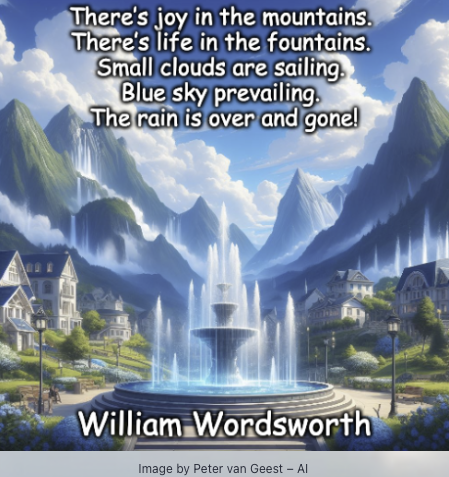
There’s joy in the mountains. There’s life in the fountains. Small clouds are sailing. Blue sky prevailing. The rain is over and gone!
Meaning 🏔️💧☁️☀️🚫🌧️: This is the Dutch translation of part of a famous English poem. Celebration of Spring: It describes the arrival of spring and the end of winter. 🌸 Joy and Life: Nature comes back to life, bringing joy and energy. 😄 Beauty of Nature: It emphasizes the beauty and optimism of a sunny spring day. ☀️ Liberation: The end of the rain symbolizes a sense of liberation and renewal. 🎉 Origin and Author:William Wordsworth (1770-1850).Title of the poem:“Written in March”.Year of publication: 1807, in his collection “Poems, in Two Volumes”. Context: Wordsworth was a prominent English poet and an important figure in Romanticism, known for his appreciation of nature. Here is the original English version of the quoted portion: “The cock is crowing, / The stream is flowing, / The small birds twitter, / The lake doth glitter, / The green field sleeps in the sun; / The oldest and youngest / Are at work with the strongest; / The cattle are grazing, / Their heads never raising; / There are forty feeding like one! / Like an army defeated / The snow hath retreated, / And now doth fare ill / On the top of the bare hill; / The plowboy is whooping—anon—anon: / There’s joy in the mountains; / There’s life in the fountains; / Small clouds are sailing, / Blue sky prevails; The quoted part is the last stanza of the poem.
Look at you comforting others with the words.
Image: Peter van Geest AI
Door Pieter
Mensenmens, zoon, echtgenoot, vader, opa.
Spiritueel, echter niet religieus.
Ik hou van golf, wandelen, lezen en de natuur in veel opzichten.
Onderzoeker, nieuwsgierig, geen fan van de mainstream media (MSM).