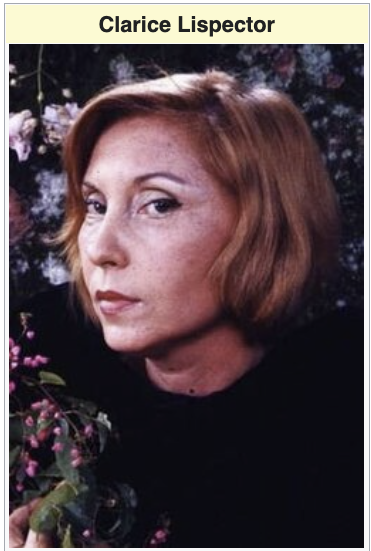
(Chechelnik (Ukraine), December 10, 1920 – Rio de Janeiro, December 9, 1977).
Brazilian writer and journalist. Pseudonyms: Helen Palmer, Teresa Quadros, Ilka Soares. She was born into a Jewish family in Ukraine, but when she was two months old, her father was exiled and they emigrated to Brazil. She lost her mother when she was nine years old. She grew up in Recife but moved with her family to Rio de Janeiro in 1934, where she finished school and graduated in law. She went on to work as a teacher and worked for two magazines. She spoke Yiddish with her parents, but she was the first in her family to learn Portuguese.
Photo wikipedia.org.
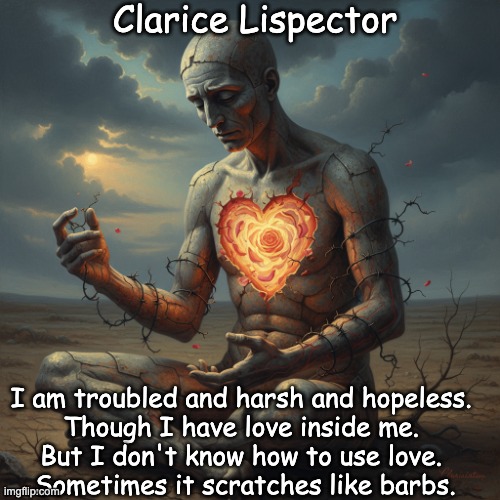
I am troubled and harsh and hopeless. Though I have love inside me. But I don’t know how to use love. Sometimes it scratches like barbs.
Image: Peter van Geest AI. 📖 Meaning and Interpretation: This quote is rich in meaning and touches upon universal human experiences: “I am troubled and hard and hopeless.”Anguished: This indicates a deep inner conflict, a sense of anxiety or torment. It suggests that the speaker is constantly plagued by thoughts or emotions. Hard: Can refer to a defensive attitude, a wall erected to protect oneself from pain, or a sense of rigidity or inflexibility in dealing with life. It can also indicate life experiences that have made the speaker “hard.”Hopeless: A sense of despair or the lack of a way out, which may reflect deep melancholy or pessimism. “Although I have love within me.” This sentence introduces a powerful paradox. Despite the negative feelings (troubled, hard, hopeless), the speaker acknowledges the presence of love. This suggests that love is an intrinsic part of one’s being, a potential or an present force, even when overshadowed by other emotions. “But I don’t know how to use love.” This is the core of the struggle. It is not that love is lacking, but rather the ability to effectively express, share, or be guided by this love is absent. It can indicate: Insecurity: Fear of showing love for fear of rejection or pain. Powerlessness: The feeling of losing control when love is involved. Lack of understanding: Not knowing how to navigate love in relationships or in one’s own life. “Sometimes it scratches like barbs.” This is a very poetic and painful metaphor. Love, which is supposed to be soft and healing, is described here as something that “scratches” and has “barbs.”This can mean: The Pain of Love: Love can lead to jealousy, loss, disappointment, or the feeling of being stuck, which is just as painful as physical wounds. Self-destruction: The way the speaker attempts to express or experience love can be destructive to themselves or to others. Unfulfilled Desires: The presence of love that cannot be expressed can cause inner pain, like a constant irritation. 💭 General Interpretation: The quote speaks about the tragedy of human existence, where deep emotions such as love can be intertwined with fear and suffering. It highlights the internal struggle of someone who carries the potential for love within themselves but does not know how to handle it, causing that same love to become a source of pain and frustration. It is a reflection on the vulnerability and complexity of the human psyche. ✒️ Author and Origin: This quote is widely attributed to Clarice Lispector, one of the most influential Brazilian writers of the 20th century. Her work is known for its profound psychological exploration of human existence, love, fear, and the inner struggle. She had a unique, introspective style that often explored the complexity of emotions and the impossibility of fully expressing them. Work: Although the quote often circulates without a specific source, it is associated with her characteristic themes. Many of her writings, particularly her novels and short stories such as “The Passion According to G.H.” or “The Hour of the Star,” contain similar thoughts on the duality of love and suffering. It is difficult to pinpoint a single exact source, as it captures the essence of her philosophy so well. This quote is a striking summary of the depth and melancholy that are so characteristic of Clarice Lispector’s work.
Door Pieter
Mensenmens, zoon, echtgenoot, vader, opa.
Spiritueel, echter niet religieus.
Ik hou van golf, wandelen, lezen en de natuur in veel opzichten.
Onderzoeker, nieuwsgierig, geen fan van de mainstream media (MSM).