Beware of him whom nature has marked.
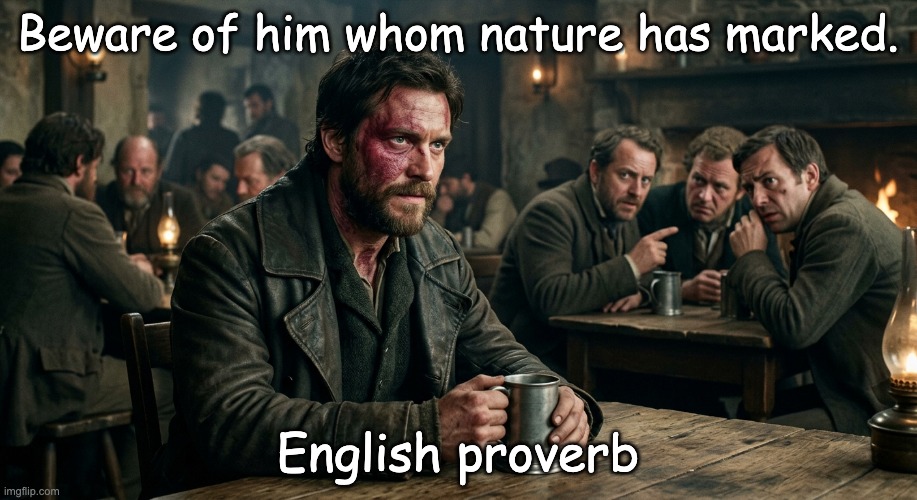
This proverb is rooted in ancient and medieval physiognomy, the pseudoscience of judging a person’s character or future based on their physical appearance.
The core meaning is:
‘Be cautious or distrustful of individuals who possess distinct, unusual, or striking physical characteristics.’ Historically, this was often interpreted negatively, suggesting that physical “markings” or “imperfections” (such as birthmarks, scars, or unconventional features) were outward signs of an inherent flaw in character, morality, or luck.
🏛️ Origin:
The exact phrase is difficult to pin down to a single definitive source, but it is an old English proverb that echoes deeply embedded cultural superstitions. It derives from ancient beliefs that:
– Physical appearance directly reflects inner morality.
– Certain markings are signs of divine disfavor, a curse, or an evil nature.
The origin lies in a time when people sought simple, visual explanations for complex human behavior and looked for external signs to predict trustworthiness.
✍️ Author:
There is ‘no known single author’ attributed to this saying. It is a traditional proverb that evolved over centuries in ‘English folklore and literature’, reflecting collective cultural biases and superstitions rather than the work of a specific individual.
As thin as a rake.

This idiom is used to describe someone who is extremely skinny, lean, or slender. The comparison highlights a person’s lack of body fat, likening their figure to the narrow, straight handle of a traditional garden rake.
🕰️ Origin:
The phrase traces back to Middle English, appearing in literature as early as the 14th century.
During this period, the word “rake” was used not only for the tool but also to describe a lean or gaunt person, possibly referencing the tool’s appearance or the idea of being “raked” or stretched thin.
✍️ Author:
While widely used and embedded in English literature, ’the saying is of anonymous origin’ and cannot be attributed to a single author.
Its development is rooted in common linguistic usage over centuries.
All mouth and no trousers.

🗣️ ‘Big Talk, No Action’:
It describes someone who talks boastfully or confidently but fails to back up their claims with action or evidence.
💨 Empty Promises:
Someone who makes grand plans or commitments but never follows through.
🚫 Lack of Substance:
It suggests that the person is all talk and has no real substance or ability.
Origin:
The origin of this saying is ‘not definitively known’, but there are a few theories:
– Tailoring:
The expression might have originated from the world of tailoring. A tailor might say that a garment is “all mouth and no trousers” if it has an impressive front but is poorly constructed or lacks essential details.
– Military:
In military contexts, it might have been used to describe a soldier who talks bravely but is cowardly in battle.
– Cockney Rhyming Slang:
Some believe it might be a variation of Cockney rhyming slang, with “mouth” rhyming with “south” (meaning “south of the border,” or “trouble”). However, this theory is less widely accepted.
Author:
The exact author of this saying is unknown, as it is a folk expression that has evolved over time. It is not attributed to any specific individual.
Kings have long hands / long arms.

“Kings have long hands/arms” means that a ruler’s ‘power and influence reach very far’. Even people who are distant—or believe themselves safely beyond the ruler’s reach—may still be found, punished, or controlled.
More generally, it can refer to any powerful authority whose influence is difficult to escape.
📜 Origin:
The saying derives from the Latin line:
> “An nescis longas regibus esse manus?”
> “Do you not know that kings have long hands?”
It appears in Ovid’s “Heroides” (Epistle 17, line 166), written around the turn of the first century CE.
✍️ Author:
The earliest well-known literary formulation is attributed to the Roman poet Ovid (Publius Ovidius Naso, 43 BCE–17/18 CE).
However, it later became a widespread proverb, so versions such as “Kings have long arms” do not necessarily have a separate identifiable author. “Hands” and “arms” are simply variant translations of the same image.
🔗 Related expression:
> “The long arm of the law”.
Both expressions describe authority whose power can reach people even at a great distance.
One bad apple spoils the bunch.
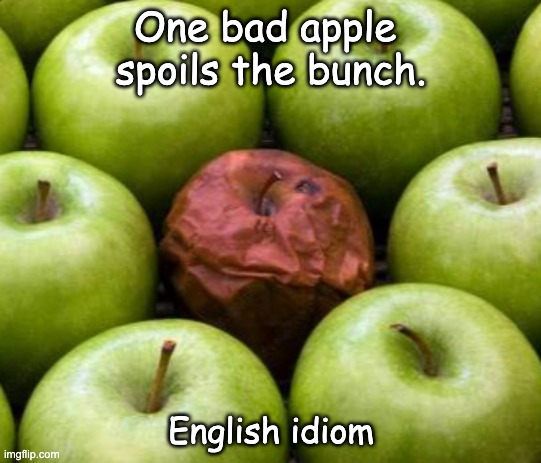
It’s a warning that a single corrupt, dishonest, or harmful person (or thing) within a group can negatively influence or ruin the entire group if left unchecked. It’s often used to justify removing a troublesome individual before their bad influence “spreads” to others — the same logic behind literal rotten fruit: one decaying apple releases ethylene gas that speeds up decay in the apples around it, so the damage really does spread if you don’t intervene.
Author:
‘There’s no single identifiable author.’
It’s a ‘folk proverb’ that evolved over centuries through oral tradition and repeated use in written English, rather than being coined by one person.
Origin:
The idea traces back to Geoffrey Chaucer’s “The Cooke’s Tale” (circa 1390s), which contains a Middle English line to the effect that a rotten apple is better cast aside than left to spoil the rest — an early version of the same folk wisdom, possibly itself drawing on even older proverbial sayings. The exact modern phrasing (“one bad apple spoils the bunch” or “one bad apple spoils the barrel”) developed gradually in English over the following centuries as a common proverb, appearing in various forms in collections of proverbs from the 16th century onward.
A note on the modern twist:
Interestingly, the phrase has sometimes been shortened in casual use to just “one bad apple,” and in that truncated form (especially after being popularized by the Osmonds’ 1970 song “One Bad Apple”) it’s occasionally been used — somewhat ironically, against the proverb’s original meaning — to argue that a single bad actor is just an isolated exception rather than a sign of a systemic problem. Language commentators have noted this shift essentially inverts the original point, which was precisely that one bad apple ‘does’ spoil the rest if you don’t deal with it.
“That is a plum without a stone,” said the devil, when he swallowed a snail.
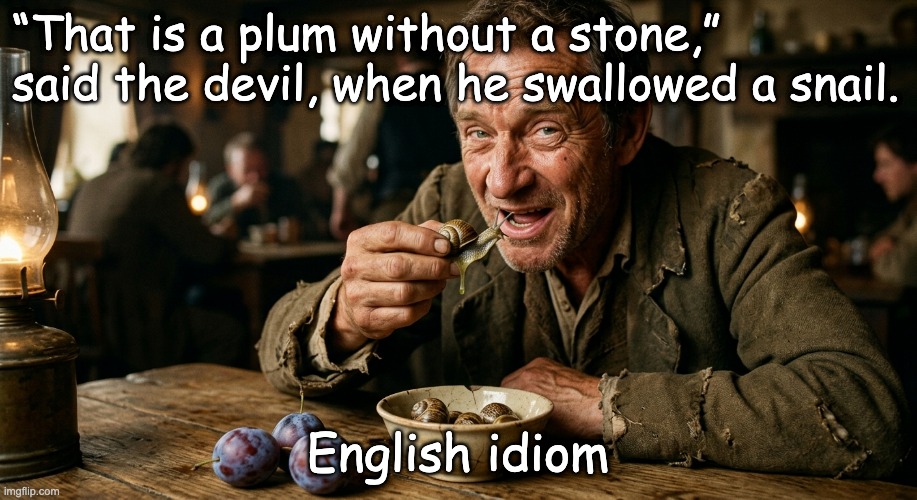
This phrase is an idiomatic expression used to describe ‘making a virtue out of necessity’ or ‘rationalizing an unpleasant situation.’
– The Snail:
Represents something inherently undesirable, difficult, or unpleasant to consume/experience (like swallowing a live snail).
– The Plum:
Represents something sweet, desirable, and easy to enjoy.
– The Devil’s Action:
When the devil is forced (or chooses) to eat the snail, he ‘claims’ it is a “plum without a stone” (seed). He is deliberately deceiving himself (and others) by framing a bad experience as a positive, convenient one.
In essence, it’s about putting a positive spin on a negative event, often with a hint of cynical self-deception or humorous resignation.
🌍 Origin and Author:
This saying is an old English proverb. Its exact origin is difficult to pinpoint to a single author, as is common with folklore and oral traditions.
– Proverbial Nature:
It has been recorded in collections of English proverbs and colloquialisms dating back centuries.
– Literary Usage:
While not attributed to one “author,” it has appeared in various literary works and regional dialects, evolving over time. The imagery of the devil making light of a difficult task is a recurring theme in European folklore.
The phrase is a classic example of folk wisdom encapsulated in a vivid, slightly grotesque image.
Fair apples may be sour.
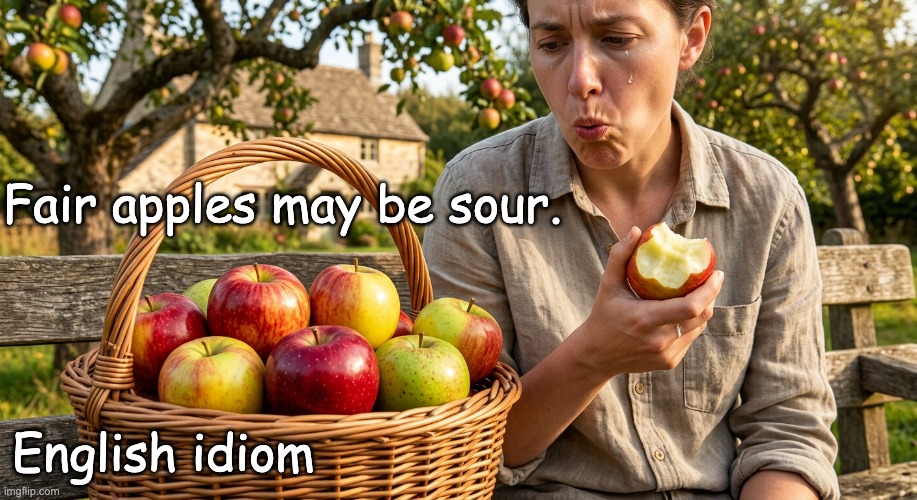
“Fair apples may be sour.” is an old proverb meaning:
– Something that looks good or promising on the outside may be bad or disappointing on the inside.
– In other words:
‘don’t judge by appearances alone.’
– Example uses (interpretation):
– A “friendly” person may have bad intentions.
– A product that looks perfect may fail quickly.
📜 Origin:
This proverb is ‘English in origin’ and belongs to a long tradition of cautions like:
– “Fair words butter no parsnips”
– “All that glitters is not gold”
However, ’the exact earliest printed citation’ for ’this specific wording’ is often hard to pin to a single “author” or date, because many similar proverbs circulate in folk speech and appear in different collections over time.
– Closely related earlier phrasing
You may also find variations in older collections such as:
– “Fair apples may be sour” / similar apple-based warnings
– and parallel versions using other fruit or objects.
🖋️ Author :
– ‘No single author is reliably credited.’
– Like most proverbs, it is considered ‘anonymous / folk wisdom’, later preserved in proverb compilations.
When the apple is ripe it will fall.

“When the apple is ripe, it will fall” means that something will happen naturally ‘when the proper time or conditions have arrived’.
It advises patience rather than forcing events prematurely.
Depending on context, it can refer to:
– An opportunity becoming ready
– A plan reaching completion
– A person eventually revealing their intentions
– An inevitable result occurring in due course
It is similar to:
“Everything happens in its own time” or “When the time is right, it will happen.”
📜 Origin and author:
There is ‘no reliably identified author or single origin’ for this exact wording. It is better described as a ’traditional proverb or proverbial metaphor’, not a formally attributed idiom.
Versions such as:
“When the fruit is ripe, it falls” appear in several cultures and languages. The image comes from ordinary observation: ripe fruit eventually drops without being forced. It also resembles the biblical idea that every event has its proper season, particularly Ecclesiastes 3:1:
> “To every thing there is a season, and a time to every purpose under the heaven.”
However, the apple saying itself is ‘not a direct biblical quotation’, and claims assigning it to a particular famous author should be treated cautiously.
As welcome as a skunk at a garden party.

Someone or something is not wanted at all — an unwelcome presence, given how unwelcome an actual skunk (with its spray) would be among polite company at an outdoor gathering.
Author:
There’s no single known author — it’s a folk idiom, not a coined phrase from a specific writer. It’s often described as a Texan or Southern American saying, though its exact folk origins are untraceable to one person.
Origin:
The saying is a variant of the older phrase “as welcome/popular as a skunk at a lawn party/garden party/picnic,” which has been cited in print since at least 1898, when the novel David Harum used a very similar line about being about as popular as “a skunk in a hen-house.” The “lawn party” version specifically shows up in print by 1916, in a Logansport, Indiana newspaper, describing a heating company as “about as popular as a skunk at a lawn party.” It also appeared in a 1918 memoir, My Lorraine Journal by Edith O’Shaughnessy, referring to the Kaiser.
Over the decades the phrase has been passed around with interchangeable settings — lawn party, garden party, picnic, Sunday school picnic — all riffing on the same joke:
nobody wants a skunk crashing a nice outdoor social event. It’s the kind of proverb that evolved through oral and journalistic use rather than being invented by one identifiable person, similar to sayings like “big hat, no cattle.”
Health is wealth.

The proverb “Health is Wealth” (often attributed to Ralph Waldo Emerson, though its exact origin is debated) highlights a fundamental truth: physical and mental well-being are far more valuable than material riches.
📜 Origin and Author:
The exact origin of the phrase “Health is Wealth” ‘is difficult to pinpoint definitively’. It is a timeless piece of wisdom that has appeared in various forms throughout history.
– Ralph Waldo Emerson:
The quote is most frequently attributed to the 19th-century American essayist, lecturer, and philosopher, Ralph Waldo Emerson. While he wrote extensively about the importance of self-reliance, nature, and well-being, the specific, exact phrasing “Health is Wealth” is often associated with him as a distillation of his broader philosophies.
One bad apple spoils the whole barrel.
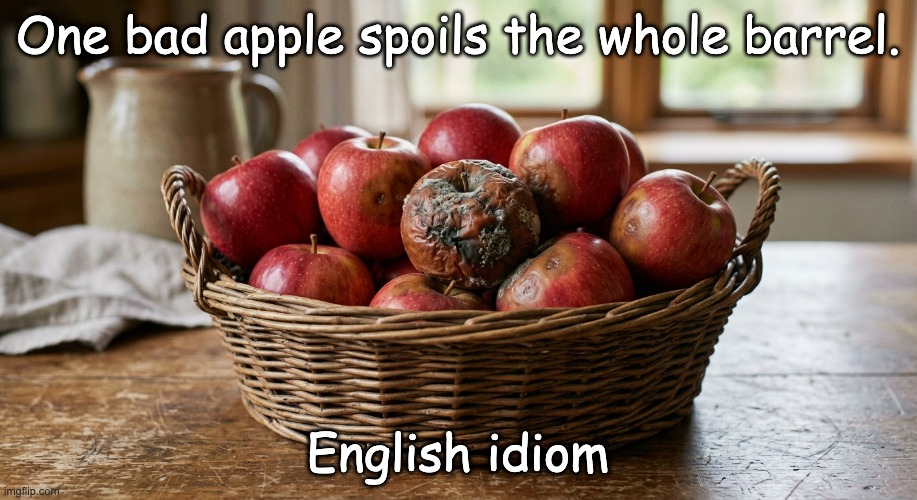
The proverb warns that one corrupt, dishonest, or troublesome person (or thing) in a group can negatively influence or ruin the whole group. It’s used both literally (a rotting apple releasing ethylene gas that speeds spoilage in nearby apples) and figuratively (bad behavior spreading through a team, family, or society).
Origin:
The idea is genuinely old and doesn’t have a single identifiable author — it developed over centuries as a folk proverb, likely because it reflects a real, observable fact about fruit storage: a decaying apple does chemically hasten the decay of apples near it.
– The concept appears as far back as Geoffrey Chaucer’s “The Cook’s Tale” (c. 1390s), which contains a Middle English line to the effect that a rotten apple is better removed before it spoils the rest.
– A similar sentiment shows up in various forms across ‘medieval European proverb collections’, since the observation about spoiling fruit was common agricultural knowledge.
– The now-standard English phrasing, “one bad/rotten apple spoils the barrel” (or “bunch”), became fixed in English usage by the ’17th–18th centuries’, appearing in proverb collections such as John Ray’s “A Collection of English Proverbs” (1670).
No single author:
Like most proverbs (e.g., “don’t count your chickens before they hatch”), it emerged from common oral tradition and practical experience rather than being coined by one identifiable writer — Chaucer is often cited as the earliest known literary trace, not the originator.
Modern twist:
You’ll sometimes hear the phrase flipped — “one bad apple doesn’t spoil the whole bunch” — used to push back against generalizing bad behavior from one group member to everyone else. This became a notable rhetorical point in discussions about, for instance, police misconduct, where critics note the original proverb’s ‘second half’ is often dropped: the full old saying is “one bad apple spoils the whole barrel,” meaning the point was originally about the ‘need to remove’ the bad one before it spreads — not that the rest are automatically innocent.
It’s easy to swim if another holds up your head.

This proverb suggests that tasks are much easier to accomplish when you have support, guidance, or assistance from someone else. It highlights how help can make seemingly difficult challenges manageable, allowing an individual to succeed without having to bear the full weight of the effort alone. It’s a testament to the power of mentorship, friendship, or any form of supportive relationship.
Origin:
The ‘exact origin of this specific phrasing is difficult to pinpoint’. However, the sentiment of shared burden and mutual support is a common theme in proverbs across many cultures throughout history. It likely evolved from ‘similar folk sayings’ that emphasize the value of cooperation and assistance.
Author:
As with many traditional proverbs, ’the author of this saying is unknown’. It is generally attributed to folk wisdom rather than a specific individual.
A ship under sail and a big-bellied woman are the handsomest two things that can be seen common.

– “Big-bellied woman” is an old-fashioned way of saying ‘a pregnant woman’.
– The saying means that ’two ordinary sights are especially beautiful’:
– 🚢 ‘A ship moving under full sail’ — graceful, powerful, full of motion.
– 🤰 ‘A pregnant woman’ — symbol of fertility, life, and abundance.
– “Handsomest” here means ‘most beautiful / most impressive’, not necessarily “handsome” in the modern male sense.
– “Seen common” means ‘commonly seen’ or ‘seen in everyday life’.
In simpler words:
> ‘A sailing ship and a pregnant woman are among the most beautiful everyday sights.’
🏛️ Origin:
– The saying comes from ’18th-century America’.
– It appeared in “Poor Richard’s Almanack”,
a popular annual publication of sayings, advice, weather predictions, and humor.
✍️ Author:
– It is commonly attributed to Benjamin Franklin.
– Franklin published “Poor Richard’s Almanack” under the pen name Richard Saunders.
– However, Franklin often collected or adapted older proverbs, so the exact original source may be older or uncertain.
📝 Note:
This is more accurately a ‘proverb or aphorism’, rather than a modern “idiom,” because its meaning is fairly direct once the older language is understood.
It’s no use locking the stable door after the horse has bolted.
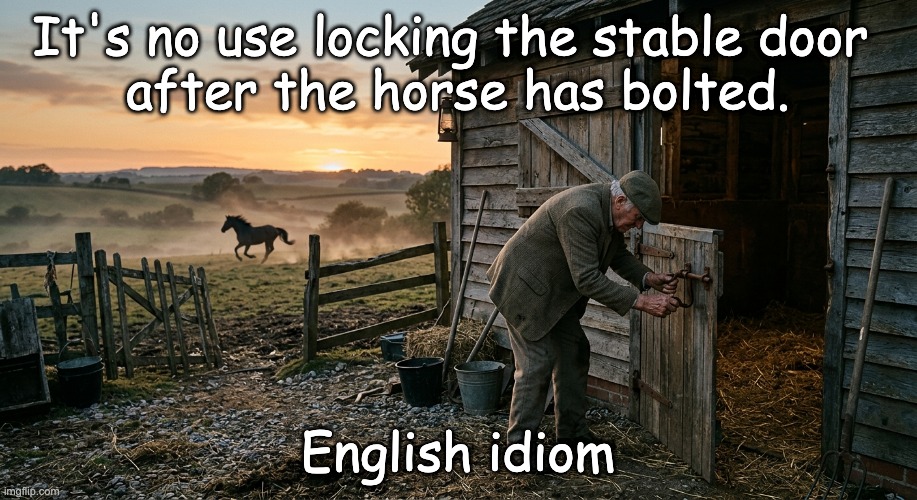
The idiom means it’s pointless to take precautions against something after the damage has already been done. If you fix a problem only after it’s caused harm, you’re too late—the preventive action should have come beforehand.
Origin:
This is an old English proverb with no single identifiable author. It’s a piece of traditional folk wisdom rather than a literary coinage. The earliest recorded versions in English date back to at least the 14th century, though the exact phrasing has varied over time. Some early forms use “steed” instead of “horse,” such as “it is too late to shut the stable door when the steed is stolen.”
The proverb appears in various forms across several centuries of English writing, and similar sayings exist in other languages and cultures, which suggests it reflects a common, universally recognized observation about human behavior—people often only take precautions after suffering a loss, rather than beforehand.
Usage today: It’s commonly used to criticize reactive rather than proactive measures—for example, tightening security only after a break-in, or implementing safety regulations only after an accident has occurred.
Praise the sea, but keep on land.

This idiom expresses the idea that ‘comfort, familiarity, and safety (even if humble)’ are preferable to ‘grandeur and novelty if they come with uncertainty, danger, or discomfort.’
– “The heath with an old cart” symbolizes a simple, known, and potentially safer life, even if it lacks luxury.
– “At sea in a new ship” represents a grand, impressive, or exciting new venture, but one that is inherently risky, unpredictable, and perhaps less stable.
It’s a reminder that bigger and newer isn’t always better, and that peace of mind and security are valuable.
🗺️ Origin:
The exact origin of this specific phrasing is difficult to pinpoint with certainty. However, it belongs to a common type of proverbial comparison found in many cultures.
-Variations:
Similar proverbs exist, such as: “Better a safe ass than a wild horse” or
“Better a lean peace than a fat war.”
– Theme:
The underlying theme of valuing safety over risky grandeur is ancient and universal. It resonates with the human desire for stability and security.
– Usage:
It has been used over time to advise caution and to encourage appreciation for what one has, rather than constantly chasing newer, potentially more dangerous, things.
✍️ Author:
‘No specific known author’.
It is considered a piece of traditional folk wisdom that has evolved and been passed down through generations. Like many proverbs, it belongs to the collective wisdom of a culture rather than a single individual.
Better the devil you know than the devil you don’t.
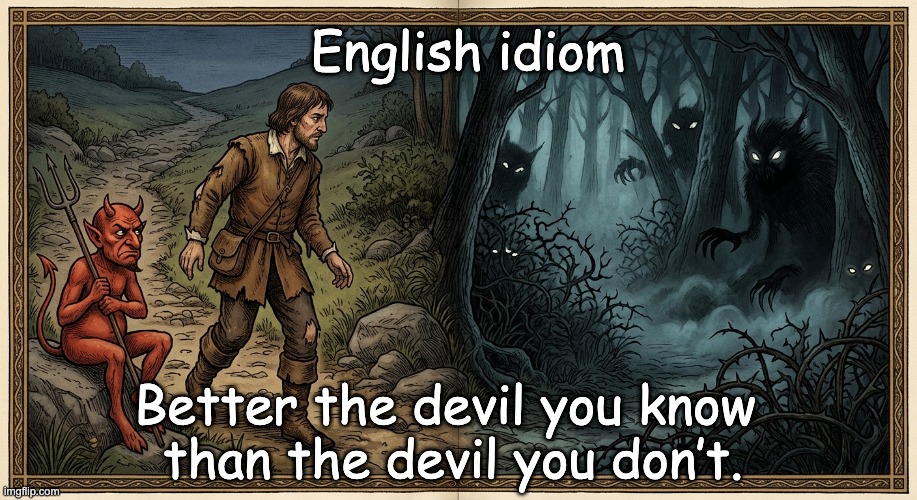
This proverb advises that it is often wiser to deal with a difficult situation or person that you are familiar with, rather than risking an unfamiliar situation or person which might turn out to be even worse. It emphasizes the risk of the unknown and the potential dangers that lie within it.
📚 Origin:
The origin of this idiom is quite old. While the exact phrasing has evolved, the core concept can be traced back to Aesop’s Fables, specifically “The Two Frogs” (circa 6th century BCE). In the fable, two frogs living in a pond decide to seek a new home when their pond dries up. One frog jumps into a deep well, but the other cautions against it, saying that while the well might have water, if that dried up, they would be unable to get out. The moral is often interpreted as avoiding known risks for unknown ones.
The idiom as we know it today began to solidify in English literature and common usage around the 16th and 17th centuries.
✍️ Author:
Because it is a proverb derived from ancient fables and has evolved over centuries through oral tradition and various texts, there is no single, specific “author” responsible for coining the exact phrase “Better the devil you know than the devil you don’t.” Its authorship is attributed to collective wisdom and folklore.
Trust not all your goods to one ship.
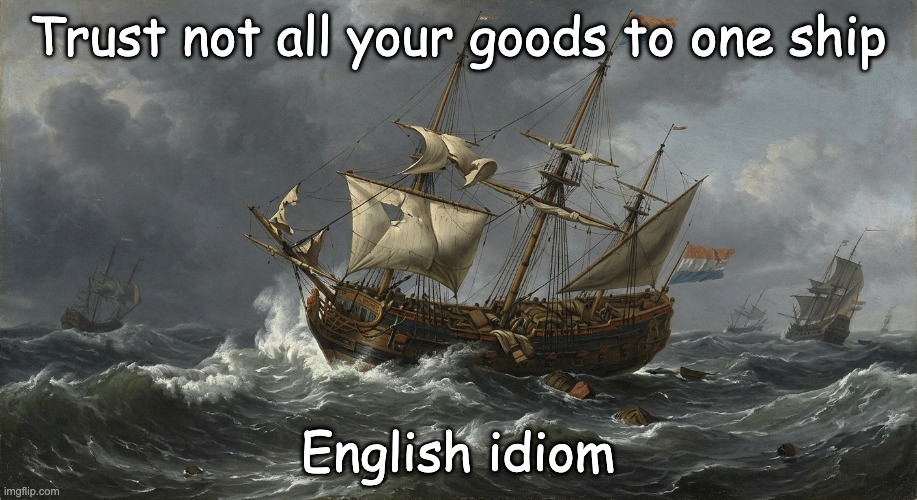
Don’t risk your entire fortune, effort, or resources on a single venture — spread the risk across several, because if that one venture fails (the ship sinks, is lost, or robbed), you lose everything.
Origin:
The phrase draws on the very real hazards of seafaring trade in the pre-modern world. Merchants who shipped valuable cargo — spices, cloth, precious metals — faced constant risk of storms, shipwreck, piracy, and war at sea. A merchant who loaded all his goods onto a single vessel could be financially ruined by one disaster, while a merchant who spread the same goods across several ships improved his odds that at least some cargo would arrive safely. This practical wisdom of merchant life became proverbial and long predates the now more familiar version about eggs and baskets, which was only first recorded in 1710.
The idea appears in various forms across old proverb collections and merchant-culture writing, and it’s echoed famously in literature — Shakespeare gives it dramatic form in “The Merchant of Venice” (c. 1596–1598), where Antonio’s friends assume he must be anxious because he hasn’t spread his mercantile risk:
> “Believe me, sir, had I such venture forth,
> The better part of my affections would
> Be with my hopes abroad.”
Antonio, notably, insists he ‘has’ diversified — “My ventures are not in one bottom trusted” (“bottom” here meaning the hull of a ship) — which is essentially this exact proverb spoken almost verbatim as practical merchant wisdom.
Author: ‘There’s no single identifiable author’.
It’s a folk/proverbial saying that evolved out of common mercantile experience, likely circulating in English (and probably in Latin or other European proverb traditions before that) well before it was formalized in print. It isn’t attributed to any one writer — Shakespeare’s use of the idea in “Merchant of Venice” is one of its most famous literary appearances, not its origin. The saying about trusting all one’s goods to one ship substantially predates the “eggs in one basket” version, but pinning down an exact first usage or coiner isn’t really possible — it belongs to the broad tradition of proverbial wisdom about risk and diversification.
Better to lose an anchor than the whole ship.

A Necessary Sacrifice.
This idiom is a powerful metaphor for prioritizing survival. It means that it’s sometimes better to make a smaller, immediate sacrifice (like losing an anchor) to prevent a much larger and more devastating loss (like losing the entire ship). It’s a reminder that sometimes we need to cut our losses and let go of something valuable to save what’s truly essential.
Here’s how it applies to various situations:
– Personal Life:
Enduring a temporary setback or making a difficult decision (like leaving a toxic job or relationship) to protect your long-term happiness and well-being.
– Business:
Making a strategic decision to close a failing department or product line to save the entire company.
– War:
Sacrificing a smaller unit or territory to protect the main force or a crucial stronghold.
– Health:
Undergoing a challenging treatment or surgery to cure a serious illness and save your life.
🕰️ Origin:
‘A Seafaring Tradition.’
The idiom’s origin is deeply rooted in maritime history and the very real dangers that sailors faced. Imagine a ship caught in a fierce storm, battling powerful winds and raging waves. If the anchor got stuck or the ship was being dragged towards dangerous rocks, the captain might have to make a split-second decision: cut the anchor line and lose the anchor, or risk the entire ship being destroyed.
Here’s why this was a logical choice:
– Anchor Value:
An anchor was a valuable piece of equipment, but it was replaceable.
– Ship Value: A ship, on the other hand, was incredibly expensive, often representing a significant investment, and carried the lives of the crew and cargo.
– Survival:
Losing the anchor might mean temporary difficulties, but losing the ship meant certain disaster.
This practical wisdom from the high seas became a powerful metaphor that transcends its nautical origins.
✍️ Author:
‘Wisdom of the Ages’.
There is ‘no single, credited author of this idiom’. It’s a piece of ‘folk wisdom’ that evolved over time, likely originating among sailors and then spreading to the general population. Its simple yet profound message resonated with people, leading to its widespread use.
The best ground is firm ground.

This idiom emphasizes the importance of having a ‘solid foundation’ before embarking on any major endeavor. It suggests that a stable, secure, and predictable starting point is crucial for success and resilience.
– Stability:
Just as physical structures need a solid base, ideas, relationships, and projects require a strong, reliable start.
– Security:
Building on firm ground minimizes risks and vulnerabilities, providing a sense of security and confidence.
– Dependability:
A firm foundation ensures consistent and reliable progress, making it easier to overcome challenges.
– Predictability:
When you start on solid ground, you have a better understanding of the potential outcomes and can plan accordingly.
Think of it this way:
You wouldn’t build a house on quicksand. Similarly, you shouldn’t launch a significant project or make a life-changing decision without first ensuring you have a solid understanding, adequate resources, and a supportive environment.
🕰️ Origin:
The exact origin of this idiom is difficult to trace. However, it’s likely rooted in practical wisdom and observation of the natural world. People have long recognized the importance of solid ground for stability and success in various aspects of life, from agriculture to construction.
The idiom might have evolved from similar proverbs or sayings emphasizing the importance of strong foundations. It resonates with the universal need for security and predictability in an often uncertain world.
✍️ Author:
Like many common idioms, “The best ground is firm ground” does not have a single, identifiable author. It’s a piece of collective wisdom that has been passed down through generations. Its enduring popularity stems from its universal truth and practical application in various contexts.
This idiom serves as a timeless reminder that a strong start is often the key to a successful journey.
He is like the anchor that is always in the sea, yet does not learn to swim.

The idiom “He is like the anchor that is always in the sea, yet does not learn to swim” describes a person who:
– ‘Is constantly immersed in a particular environment or situation but fails to adapt or gain practical skills from it.’ They are ‘present’, but not ‘participating’ or ‘learning’ in a meaningful way.
– ‘Remains static and unchanging despite being surrounded by opportunity for growth or change.’ Like the anchor, they provide stability (perhaps even to others), but they themselves do not move or evolve.
– ‘Is deeply connected to a place or group but never truly integrates or becomes self-sufficient within it.’ They are ‘in’ the world, but not ‘of’ it, in a practical sense.
– ‘Is resistant to learning or changing their ways, even when it would be beneficial.’ This can imply a level of stubbornness, inertia, or perhaps a lack of desire to engage fully.
📜 Origin:
The precise origin of this idiom is difficult to trace. It’s likely a folk saying or an expression that has evolved over time, rather than a quote from a single, well-known author.
Nautical Imagery:
The idiom relies heavily on nautical imagery, which is common in many languages due to the historical importance of seafaring. This suggests it may have originated in a community with a strong maritime tradition.
– Metaphorical Language:
The use of metaphors to convey life lessons is a universal human trait. This idiom is a classic example, using a concrete image (an anchor in the sea) to represent an abstract concept (a person’s inability to adapt or learn).
– Variations:
Similar expressions might exist in other languages, further suggesting a folk origin rather than a single author.
✍️ Author:
As mentioned, there is ‘no single, verified author for this idiom.’ It’s best understood as a piece of collective wisdom that has been passed down and refined over generations.
In essence, the idiom highlights the irony of being deeply connected to a situation without truly understanding or participating in it. It’s a reminder that simply being present is not enough; true integration and growth require active engagement and a willingness to learn.
Sheet anchor.

Today, the term “sheet anchor” is used figuratively to describe:
– ‘A person or thing that can be relied upon for security and stability in times of difficulty.’
– The last resort; a final hope or support when all others have failed.
📜 Origin:
The origin of this idiom is ‘nautical’. It dates back several hundred years to the days of sailing ships.
– The Literal Object:
In maritime terminology, the sheet anchor was the largest and strongest anchor carried on a sailing vessel. It was usually stowed in the waist of the ship and reserved only for extreme emergencies, such as a severe storm or the threat of being driven onto a dangerous lee shore. It was the “last hope” to prevent shipwreck when smaller bower anchors failed.
– The Metaphorical Leap:
Because the sheet anchor was the final, most reliable defense against disaster, the term naturally evolved into a metaphor for any person, principle, or thing that provides a last line of security and stability.
👤 Author:
There is ‘no single author’ credited with inventing this idiom. It is a classic example of maritime jargon that entered general English usage over time.
– The term “sheet anchor” (describing the literal object) was well-established in naval language by the 15th or 16th century.
– The ‘figurative use’ (referring to a person or concept as a “sheet anchor”) began appearing in literature and speeches by the late 16th and early 17th centuries, as non-sailors adopted the powerful metaphor.
Cut and run.

The idiom “cut and run” is a nautical phrase that has evolved into a common expression for a quick, often desperate, escape.
In modern usage, “cut and run” means to ‘abandon a difficult or difficult situation quickly’ rather than facing it. It implies:
– Abrupt departure:
Leaving suddenly and often without warning.
– Avoiding consequences:
Evading responsibility or trouble.
– Giving up:
Abandoning a project, relationship, or commitment when things get tough.
🚢 Origin:
The phrase has its roots in the ’18th-century British Royal Navy’. When a sailing ship was anchored and needed to make a very hasty departure—perhaps to escape an enemy ship, avoid a sudden storm, or flee a lee shore—the crew wouldn’t take the time to properly raise the heavy anchor.
Instead, they would:
1. Cut: Use an axe to ‘cut the anchor cable’ (the thick rope or chain holding the anchor).
2. Run: Immediately set the sails and “run” (sail) away with the wind.
This was a drastic and expensive measure, as it meant sacrificing the valuable anchor and cable, but it was sometimes the only way to save the ship and crew.
✍️ Author:
While “cut and run” was a common piece of naval jargon long before it appeared in literature, the first recorded ‘literary’ use of the phrase is often attributed to the Scottish author Tobias Smollett.
He used it in his 1762 novel, “The Adventures of Sir Launcelot Greaves”. However, he was using it in its literal, nautical sense, not yet as the figurative idiom we use today. The transition from a literal sailor’s term to a figurative expression for a cowardly retreat happened gradually throughout the 19th century.
Hedge your bets.
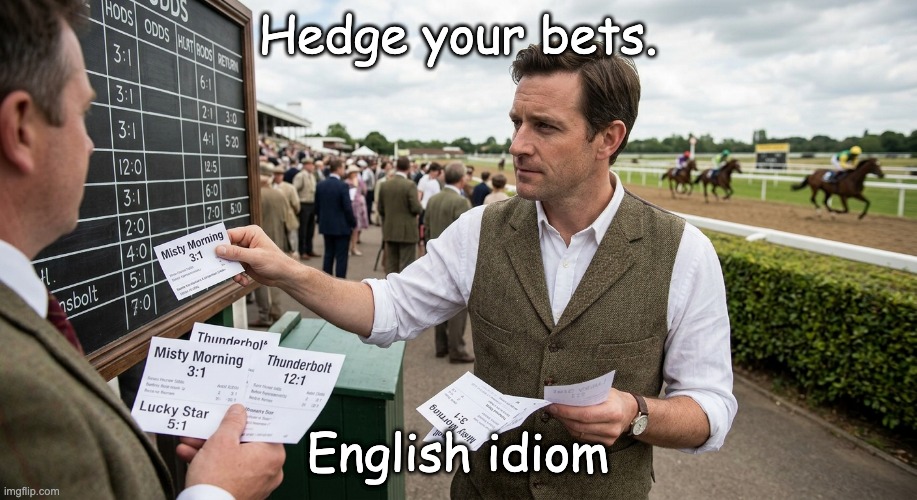
To “hedge your bets” means to protect yourself against potential loss or failure. It involves taking multiple, often opposing, actions or making several investments so that if one fails, others might succeed, thereby reducing overall risk.
Core Concept:
Diversification, risk mitigation, and playing it safe.
In Practice:
It’s like supporting both sides in an argument, investing in different stocks, or applying to several jobs simultaneously.
🕰️ Origin and Etymology:
The phrase originates from the 17th century and is deeply rooted in the concept of boundaries and protection in agriculture.
🌿 1. The literal “Hedge”:
The original meaning of “hedge” (from the Old English ‘hecg’) was a fence or boundary made of closely planted bushes or shrubs. These hedges served to:
– Protect livestock from predators.
– Clearly define property lines.
– Create a physical barrier or defense.
🎲 2. The transition to “Betting”:
By the 1600s, the verb “to hedge” began to be used figuratively in financial and gambling contexts.
– A “hedge bet” was a secondary wager made in opposition to a primary bet.
– If your main bet lost, the hedge bet (which predicted the opposite outcome) would win, thus offsetting the loss.
– The idea was that by “hedging,” you were effectively building a defensive barrier around your money, much like a physical hedge protects property.
The phrase “hedge your bets” was popularized around this time to describe this practice of making a counter-wager to minimize risk.
👤 Author or Creator:
There is ‘no single known author’ credited with inventing the idiom “hedge your bets.”
It is a colloquial phrase that evolved organically over time through common usage, particularly within the gambling and financial sectors of 17th-century England. It emerged as a natural extension of using the word “hedge” to describe a defensive or protective action.
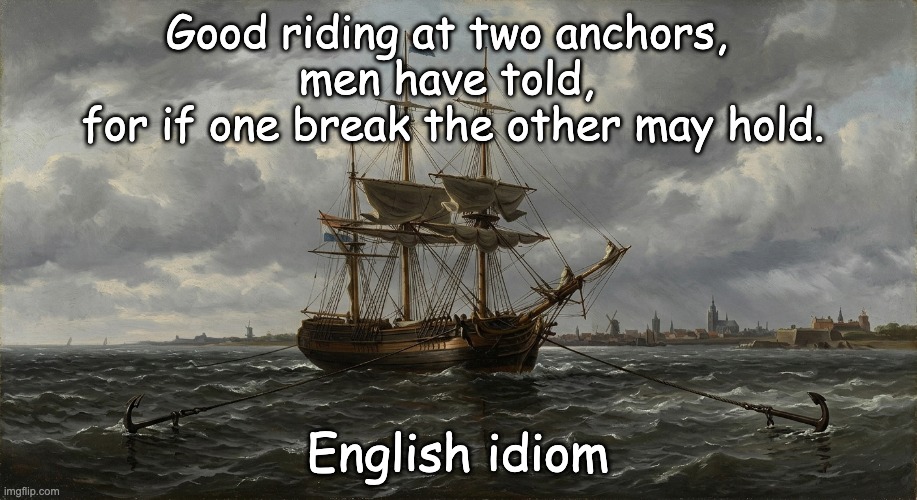
Good riding at two anchors, men have told, for if one break the other may hold.
– It is wise to have ‘a backup plan’.
– Do not depend on only one source of safety, support, income, hope, or protection.
– If one plan fails, the other may still save you.
In modern language, it is similar to:
– “Don’t put all your eggs in one basket.”
– “Have a fallback option.”
– “Two securities are better than one.”
Here, “riding” means a ship lying or floating safely while held by an anchor. A ship with ’two anchors’ is safer because if one anchor breaks loose, the other may still hold it.
Origin 📜:
The saying comes from an old ‘English nautical proverb’. It uses the image of a ship secured by two anchors to express the value of caution and preparation.
It was recorded in the 16th century in:
> John Heywood’s “A Dialogue Conteinyng the Nomber in Effect of All the Prouerbes in the Englishe Tongue.”
> Published in 1546.
The older spelling is often given as:
> “Good riding at two anchors, men have tolde,
> For if the one breake, the other may holde.”
Author ✍️:
The phrase is associated with John Heywood.
– John Heywood was an English playwright, poet, and collector of proverbs.
– He lived roughly from c. 1497 to c. 1580.
– He did not necessarily invent all the proverbs he recorded; many were already part of spoken tradition.
– So, he is best described as the ‘earliest well-known recorder or popularizer’ of this proverb, rather than certainly its original creator.
His last anchor has broken.

– It means ‘his final hope, support, or source of safety has failed’.
– The person is now ‘helpless, desperate, or without any remaining way to rely on something/someone’.
✅ Example:
> “After losing his job, his savings, and then his family’s support, ‘his last anchor had broken”.
Meaning:
He had no remaining support or hope.
🌊 Origin:
– The expression comes from ‘nautical imagery’.
– An ‘anchor’ keeps a ship steady and safe.
– If a ship’s ‘last anchor breaks’, it is left at the mercy of wind and waves.
– Figuratively, an “anchor” came to mean ‘hope, security, or emotional support’.
The idea is also connected with the Biblical metaphor:
> “Hope we have as an anchor of the soul…”
> — Hebrews 6:19
✍️ Author:
– This is ‘not a fixed idiom with a single known author’.
– It is best understood as a ‘common metaphorical expression’ based on seafaring language.
– So the author is generally considered ‘unknown / anonymous’.
To put someone out to pasture.

To “put someone out to pasture” means to ‘force them to retire or step down’ from their job, position, or active role because they are considered too old or no longer useful.
In modern usage, it’s often used with a slightly negative or dismissive connotation, implying that the person is being set aside as if they are no longer capable, though it can also be used more neutrally to describe a well-earned retirement.
For example:
“After 40 years at the company, they finally put him out to pasture.”
“The old manager was put out to pasture to make way for a younger team.”
🚜 Origin:
This idiom comes directly from ‘agriculture and animal husbandry’.
It is a metaphor derived from the practice of retiring old work animals, particularly ‘horses or dairy cows’. When these animals became too old, weak, or injured to perform their tasks (like pulling a plow or giving milk), they were no longer economical to keep in the barn. Instead of being put down, they would be released to graze freely in a pasture, where they could live out their remaining days in peace and relative leisure.
Over time, this practice was applied metaphorically to people who were retiring from active work.
✍️ Author: There is ‘no single author’ for this idiom.
It is a classic example of folk etymology that evolved naturally within the English language from a common agricultural practice.
The phrase has been in use for centuries and cannot be traced back to a specific person, book, or moment in time. Like many idioms, its authorship is collective, arising from the shared experiences and language of people over generations.
He’s spending money like water.

This common idiom is used to describe someone who is spending money recklessly, extravagantly, and without any restraint or concern for the future.
Imagine water flowing freely from a wide-open tap or a rushing river. It moves constantly and effortlessly, with very little control or thought given to how much is being used. When applied to money, it implies that the person is treating their finances as an inexhaustible, easily replaceable resource.
📜 Origin:
While idioms involving water as a metaphor for abundance and easy flow have existed for centuries, the specific phrase “spending money like water” gained traction in the 19th century.
The concept draws on several key ideas:
Abundance and Availability: Historically, water was often viewed as a plentiful and readily available resource, much like how a reckless spender treats their wealth.
Lack of Value:
While essential for life, water was often considered cheap or free (at least compared to precious materials). The idiom suggests the spender is treating money as if it has little value.
Irreversibility:
Once water flows away or is poured out, it’s very difficult, if not impossible, to get that exact water back. This parallels how money, once spent extravagantly, is often gone forever.
One of the earliest recorded examples that closely mirrors the modern idiom is found in the correspondence of British author Robert Southey in the early 1800s. He used the phrase “spending money like water” to describe the profligate spending of certain individuals.
✍️ Author:
There is ‘no single, specific author attributed to creating this idiom’. Like many common expressions, it ‘evolved organically within the English language over time’, likely originating in everyday speech before finding its way into literature and written records. It is a ‘product of collective usage’ rather than a unique creation by one individual.
It’s a drop in the ocean.

“A drop in the ocean” (or sometimes “a drop in the bucket”) refers to something that is:
– Insignificant:
Very small or unimportant when compared to the much larger whole or the total amount required.
– Negligible:
A contribution that makes almost no difference to the final outcome.
> Example:
“The $50 donation was appreciated, but it was just a drop in the ocean compared to the millions needed for the new hospital wing.”
🕰️ Origin and Author:
The idiom is ancient and does not have a single known “author.” Its origins are rooted in classical and religious texts.
– Ancient Sources:
The underlying concept of comparing a small unit to a vast body of water appears in very early literature. For example, similar imagery can be found in the “Bible” (Isaiah 40:15), which states:
“Behold, the nations are as a drop of a bucket, and are counted as the small dust of the balance…”
– Evolution:
Over centuries, the metaphorical comparison of a single drop to the entire ocean became a common linguistic tool across many cultures and languages to describe something vanishingly small in scale. By the 14th century, variations of this phrase (using “bucket” or “sea”) were already in use in English literature.
To be fresh off the farm.
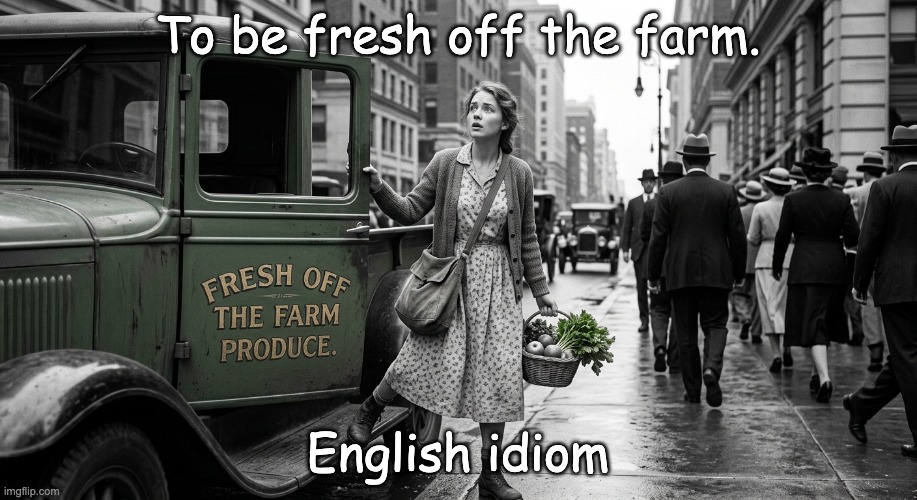
The idiom “fresh off the farm” refers to someone who is naive, unsophisticated, or lacking experience, especially regarding urban life or modern customs. It suggests a person who has recently arrived from a rural or agricultural background and is unfamiliar with the complexities of a new, often urban, environment.
– Inexperience:
The phrase highlights a lack of worldliness or knowledge.
– Simplicity:
It can imply a person is simple, honest, and perhaps a bit gullible due to their sheltered upbringing.
– Newness:
It emphasizes being a newcomer, whether to a city, a job, or a social circle.
📜 Origin:
The origin of “fresh off the farm” is linked to the transition from an agrarian society to an industrial and urban one, particularly in the United States during the 19th and early 20th centuries. As people migrated from rural areas to cities in search of work, they often faced challenges adapting to the new way of life.
– Rural-Urban Migration:
The phrase reflects the experiences of those who moved from the countryside to the city.
– Stereotypes:
It may have been used to stereotype or poke fun at newcomers, portraying them as unsophisticated.
– Evolution:
Over time, the meaning has broadened to encompass any type of inexperience or naivety, not just that related to a rural background.
✍️ Author: There is ‘no single known author.’
It is a colloquial expression that evolved over time through common usage. Like many idioms, its exact origins are difficult to trace to a specific individual or written work.
– Oral Tradition:
The phrase likely originated in spoken language and was passed down through generations.
– Cultural Context:
It emerged from the social and economic changes that shaped American society during the 19th and 20th centuries.
– Collective Creation:
The idiom is a product of the collective experiences and observations of people navigating a changing world.
I wouldn’t touch it/him with a barge pole.

– Aversion:
The primary meaning is a strong feeling of dislike or unwillingness to have anything to do with something or someone.
– Distance:
It conveys a desire to maintain a significant distance, both physically and metaphorically, from the object of aversion.
– Disgust:
In some contexts, it can also imply a feeling of disgust or contempt.
Caution:
It can also be used to express a sense of caution or warning against getting involved with a particular person or situation.
Origin:
The exact origin of the idiom is not definitively known, but it is believed to have originated in the 19th century, likely in the context of boating or maritime activities.
– Barge Poles:
Barge poles were long poles used to push or maneuver barges along canals or rivers. They were often dirty, wet, and unpleasant to handle.
– Metaphorical Use:
The idiom likely evolved as a metaphorical extension of the physical act of avoiding contact with a dirty or unpleasant object. The idea is that the object or person is so undesirable that one would not even want to touch them with a long, dirty pole.
Author:
The idiom does not have a specific author. It is a product of folk language and has evolved over time through usage in various contexts.
Examples of Usage:
– “I wouldn’t touch that job with a barge pole. It sounds like a total nightmare.”
– “I wouldn’t touch him with a barge pole. He’s a known liar and cheat.”
– “I wouldn’t touch that investment with a barge pole. It’s way too risky.”
Similar Idioms:
– “I wouldn’t touch it with a ten-foot pole.”
– “I wouldn’t go near it with a barge pole.”
– “I wouldn’t touch that with a stick.”
The idiom “I wouldn’t touch it/him with a barge pole” is a powerful and evocative way to express strong aversion. Its origin in the practical world of boating adds to its descriptive power, making it a memorable and widely used expression.
At the end of one’s furrow.
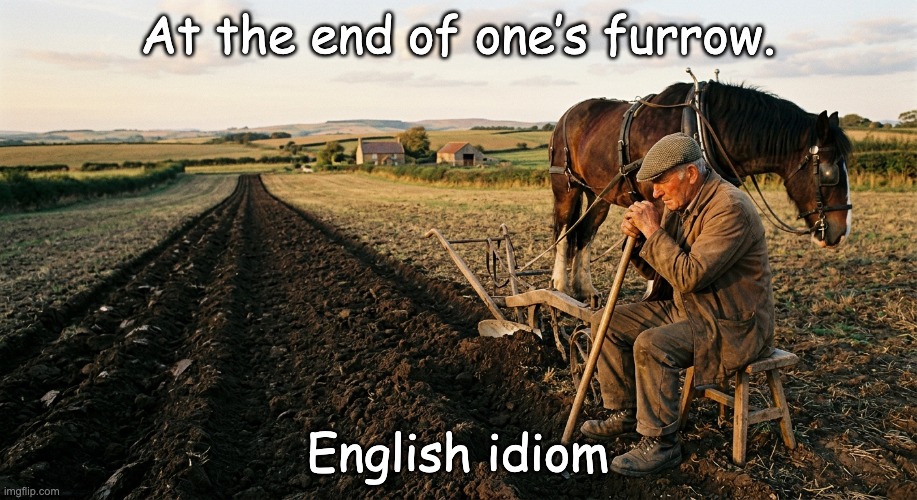
The idiom is a poetic and metaphorical expression. It carries two primary, related meanings:
– Completion and Rest:
It signifies reaching the absolute end of a long, difficult task, project, or period of labor. It implies that the work is finished, and the time for rest or reflection has arrived.
– Finality (Often Mortal):
Historically, it was frequently used as a metaphor for reaching the end of one’s life, implying a life spent in productive, honest toil. Just as a plowman completes the final row before the day ends, a person reaches the end of their life’s work.
It evokes a sense of weariness but also satisfaction and peace.
🕰️ Origin:
The idiom is deeply rooted in ‘agrarian history’.
– The Furrow:
A furrow is the long, narrow trench made in the ground by a plow for planting seeds. Plowing a field, especially before mechanized farming, was backbreaking, repetitive, and essential work.
– The Metaphor:
A single furrow represents a unit of labor, a path, or a journey. To be “at the end of one’s furrow” meant the physical task of that specific row was done. Over centuries, this literal endpoint became a powerful metaphor for finishing any demanding endeavor, and eventually, for finishing life itself.
✍️ Author: There is ‘no single author’ credited with creating this idiom.
It is a piece of folk wisdom and traditional imagery that evolved naturally within agricultural communities over centuries. Its usage can be found in various forms in English literature and poetry dating back at least to the Middle Ages, often used by writers seeking to evoke rustic simplicity or the finality of a well-spent life. Because it is a product of common language rather than a specific literary work, it belongs to the collective heritage of English speakers.
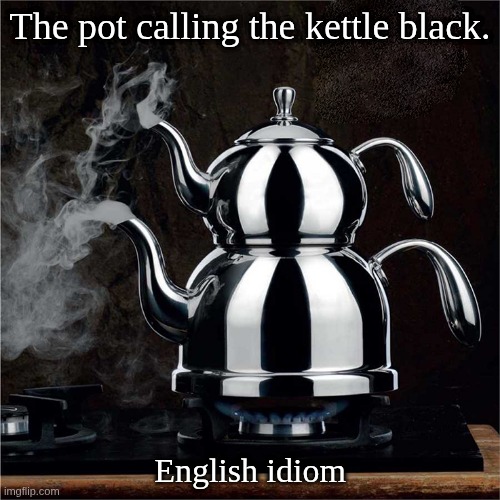
The pot calling the kettle black.
One year’s seeding makes seven years’ weeding.

– If you allow weeds to produce seeds for just ‘one year’, you may have to spend ‘many years removing the weeds’ that grow from those seeds.
– More broadly, it warns that ‘a small act of neglect today can create long-lasting trouble later’.
🌿 Figurative Meaning:
It can apply to life, work, habits, or problems:
– Ignoring a small problem can make it much harder to fix later.
– Bad habits, once allowed to develop, may take years to overcome.
– Carelessness now can create repeated consequences in the future.
🧺 Example:
> If you let small debts pile up, remember: “One year’s seeding makes seven years’ weeding.”
Meaning: letting a problem grow now may cause long-term difficulty.
📜 Origin:
– The saying comes from ’traditional farming and gardening wisdom’.
– Farmers noticed that when weeds are allowed to go to seed, those seeds can remain in the soil and continue producing weeds for years.
– The number “seven” is often used proverbially to mean “many,” though in gardening some weed seeds really can survive in the soil for several years.
✍️ Author: Unknown
– It is an ‘anonymous traditional proverb’, not the work of a specific writer.
– Common variants include:
– “One year’s seed makes seven years’ weed.”
– “One year’s seeding, seven years weeding.”
– “One year of seed, seven years of weed.”
I passed by the field of the lazy one,
By the vineyard of the man lacking good sense.
I saw that it was overgrown with weeds;
The ground was covered with nettles,
And its stone wall was broken down.
I saw it and learned this lesson.
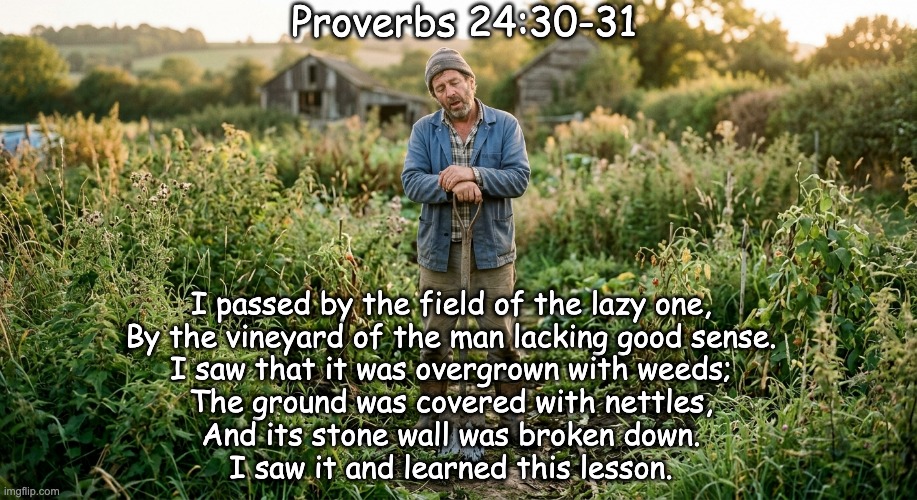
This is an observational parable rather than a direct command: the speaker walks past a field belonging to a lazy, thoughtless man and finds it overrun with thorns and nettles, its protective wall collapsed. From this visible neglect, the speaker draws a lesson (v. 32: “I saw it and learned this lesson”). The core idea matches is the direct, unsurprising consequence of idleness and lack of care, and the wise observer should learn from it rather than simply pity or condemn the negligent man.
Origin:
The passage belongs to the “words of the wise” section of the Book of Proverbs (roughly Proverbs 22:17–24:34), a collection distinct from the sayings explicitly attributed to Solomon elsewhere in the book. Scholars date the material broadly to the first millennium BCE, and this section shows notable parallels with earlier Egyptian wisdom literature (the Instruction of Amenemope), suggesting the compilers drew on a wider Near Eastern wisdom tradition rather than composing entirely original material.
Author:
No single named author. Tradition attributes the Book of Proverbs broadly to King Solomon, but the text itself explicitly labels this particular section as anonymous “sayings of the wise” (24:23), distinguishing it from Solomon’s own proverbs. It’s best understood as an anonymous entry in a multi-author wisdom anthology, compiled and edited over generations.
To call a spade a spade.
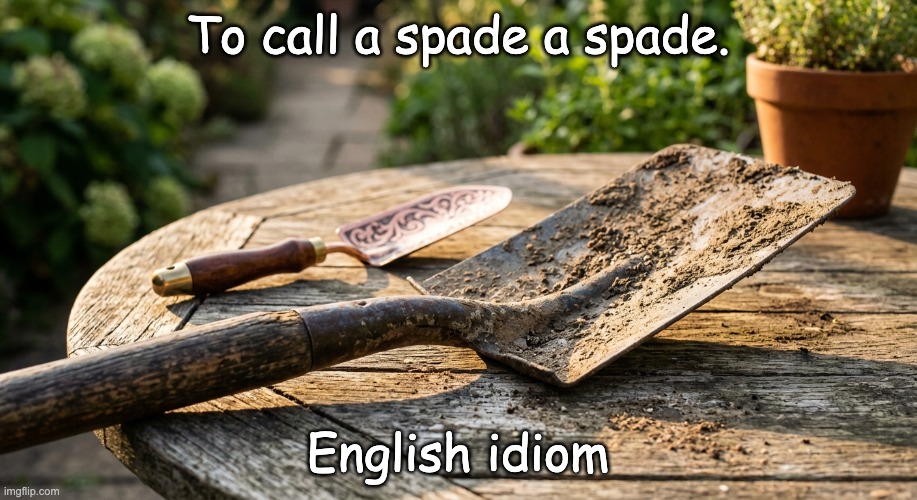
– To speak ‘plainly and directly’
– To describe something ‘honestly’, without softening the truth
– To be ‘blunt or straightforward’, even if the truth is unpleasant
📌 Example:
> “Let’s call a spade a spade — the project failed because of poor planning.”
🏛️ Origin:
The idiom comes from an ‘ancient Greek expression’ that meant something like:
> “To call a fig a fig, and a trough a trough.”
This phrase was associated with ‘plain, honest speech’.
Later, the Greek word for “trough” was translated into Latin and then English in a way that became “spade.”
✍️ Author 🗣️ / Earliest Source:
The expression is commonly traced to Plutarch, the ancient Greek writer and philosopher, in his work “Moralia”.
However, the English form “call a spade a spade” became known through Nicholas Udall’s 1542 English translation of the works of Erasmus.
So:
– Original source: Plutarch
– Popular English form: Nicholas Udall’s translation of Erasmus, 1542
– Exact original author: Not definitively known, as it likely came from earlier Greek usage
⚠️ Note:
In modern English, the idiom is generally not intended offensively. However, because the word “spade” has also been used as a racial slur in some contexts, the phrase may sound sensitive to some audiences, especially in American English.
To clump around in clodhoppers.

This charmingly clumsy idiom evokes a clear image! Let’s break down
“To clump around in clodhoppers” means to walk heavily, noisily, and awkwardly, especially in large, heavy, or poorly fitting shoes.
– ‘Clump around’:
This verb perfectly captures the sound and motion – a series of heavy, distinct, and often clumsy footsteps. Think of someone stomping or plodding.
– ‘Clodhoppers’:
This is the key noun! It’s a humorous and slightly derogatory term for large, heavy, and often old-fashioned or work-wear boots or shoes. The implication is they are designed for function (like working in muddy fields or “clods” of earth) rather than style or elegance, and are often noisy and cumbersome.
So, when someone is “clumping around in clodhoppers,” they aren’t just walking; they are making a production of it, likely due to their choice of footwear. It can also be used metaphorically to describe someone moving or acting in a clumsy, uncoordinated, or graceless manner, regardless of their actual shoes.
🕰️ Origin:
This idiom is a true piece of folk language, and its exact origin isn’t tied to a single event or publication. Instead, it seems to have evolved organically from the combining of two descriptive words.
1. Clodhopper:
This word has been in use since at least the late 18th century. It originated in rural areas and was initially used to describe a ploughman or a rustic, someone who literally “hopped” (or walked awkwardly) over “clods” of earth while working in the fields. Over time, the term shifted from describing the person to describing the type of heavy, sturdy footwear they typically wore. By the 19th century, “clodhoppers” was firmly established as a slang term for large, heavy boots.
2. Clump:
This verb, meaning to walk with a heavy, dull sound, has been around even longer, with roots going back to Middle English. It’s an onomatopoeic word, meaning it sounds like the noise it describes.
The phrase “to clump around in clodhoppers” likely emerged in the 19th or early 20th century as people naturally paired these two descriptive and slightly humorous words. It was a vivid way to describe a specific kind of noisy and awkward movement, particularly associated with rural or working-class life where such heavy footwear was common. Its popularity spread through oral tradition and eventually found its way into literature and everyday speech.
✍️ Author:
There is ‘no single author’ credited with creating the idiom “to clump around in clodhoppers.” It’s a prime example of a phrase that grew out of common usage and folk language. Its power lies in its descriptive imagery, which is why it has endured and continues to be used today.
Blue collar.

“Blue collar” (adjective/noun) refers to workers who perform manual work requiring physical strength or skill, such as in construction, mining, or maintenance, as opposed to office work. It stands in contrast to “white collar” (office/desk work). Think of professions like factory worker, mechanic, construction worker — people who work with their hands, often on an hourly wage rather than a salary basis (blue-collar workers are those who do manual work and are usually paid by the hour, whereas white-collar workers do administrative or managerial work and usually have a fixed salary).
Origin:
The term comes from the clothing choices of manual laborers: they wore sturdy, blue denim or chambray shirts as workwear, because navy and light blue colors concealed dust, mud, or oil stains better and made the worker look neater. White-collar and office workers, on the other hand, wore white shirts, which would become visibly dirty during physical work. The term “white collar” appeared earlier, in 1910, in a newspaper in Nebraska, praising the wisdom of the colonist who “had the good will to give up a cheap office job… and follow the plow.” “Blue collar” followed shortly thereafter. The first documented use of the term dates from 1924, in a newspaper in Alden, Iowa, with the text:
“If we may call professions and office positions white collar jobs, we may call the trades blue collar jobs.”
Some sources point to even older British traces of the word usage, possibly dating back to the 1880s according to the Oxford English Dictionary.
The expression became more common in the 1930s and first appeared (in quotation marks) in the New York Times in 1945.
Author:
There is ‘no identifiable individual author or originator’. The term arose organically in the American press of the early 20th century, as a journalistic/editorial invention to distinguish professional groups from one another — not as a consciously coined term by a single writer. The etymologist Barry Popik has documented the earliest known use (1924, Alden Times, Iowa), but he is the researcher who traced the term, not its originator.
To put one’s hand to the plough.
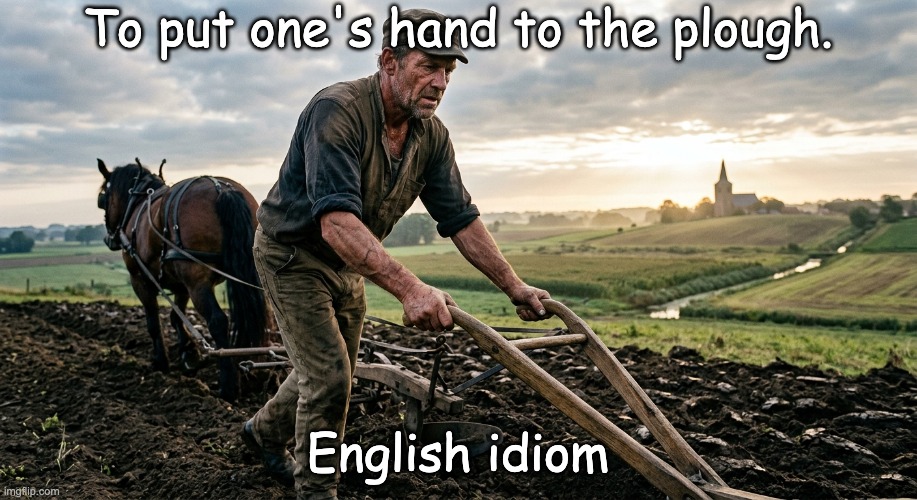
This idiom means to ‘undertake a task’ or to ‘begin a significant project’, often implying a commitment to see it through to completion. It suggests hard work, determination, and a focus on the job at hand.
– Synonyms:
‘To set to work, to get down to business, to put one’s shoulder to the wheel.’
– Example:
“After months of planning, it was finally time for the team to put their hands to the plough and start building the new community center.”
🌱 Origin:
The origin of this idiom is rooted in ‘agriculture and the Bible’. In ancient times, plowing a field was an arduous task that required unwavering attention. A farmer had to keep their hand firmly on the plough and their eyes fixed straight ahead to ensure the furrows were straight. Looking back would cause the plough to veer off course.
The phrase is most famously associated with a passage in the New Testament.
✍️ Author and Source:
The idiom comes directly from the Gospel of Luke in the Christian Bible. Specifically, it is a quote attributed to Jesus Christ.
> “No one who puts a hand to the plow and looks back is fit for service in the kingdom of God.”
> — Luke 9:62 (NIV)
In this context, Jesus was speaking to a potential follower who wanted to first go home and say goodbye to his family. Jesus used the metaphor of plowing to illustrate that following him required total commitment without looking back or hesitating.
Don’t put the cart before the horse.
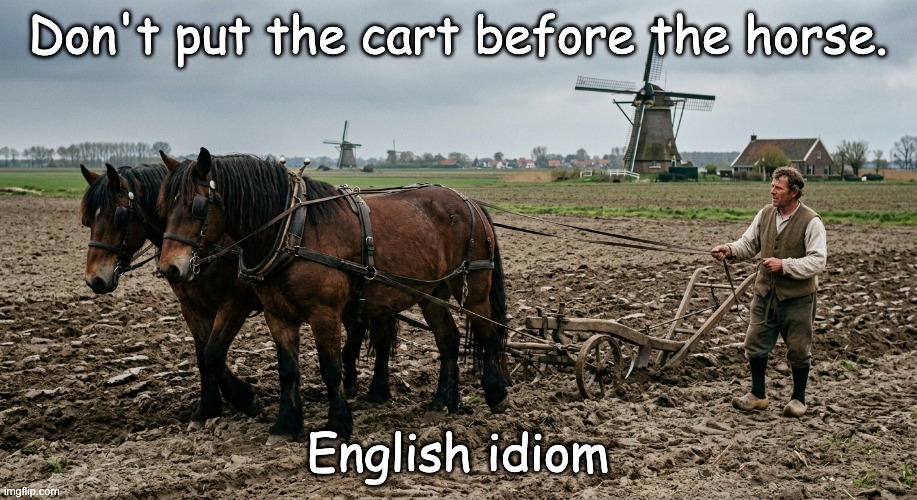
This idiom means to do things in the wrong order — reversing the logical or natural sequence of events. It refers to focusing on a later step before completing an earlier, more foundational one, or drawing conclusions before considering the necessary evidence. For example, planning a wedding before getting engaged, or spending money before earning it.
Origin:
The phrase draws its imagery from the literal absurdity of placing a cart in front of the horse pulling it — which would make the whole system useless, since the horse needs to be in front to pull the cart forward. This visual metaphor made it an intuitive way to describe any situation where the natural or logical order has been reversed.
Author/history:
There’s no single identifiable author — it’s a proverb that evolved through common usage rather than being coined by one person. It has roots going back to at least the 1500s in English:
– The concept appears in Latin as “currus bovem trahit” (“the cart draws the ox”) — a similar backward-order metaphor used by ancient writers like Cicero to criticize illogical reasoning.
– In English, versions of the phrase appear as early as the 16th century. One of the earliest recorded uses is often attributed to English clergyman and writer John Heywood, who compiled proverbs in his 1546 work “A Dialogue Conteinyng the Nomber in Effect of All the Prouerbes in the Englishe Tongue” — a major early collection of English idioms and sayings.
Because it emerged from folk speech and proverb collections rather than a single literary work, it’s classified as an anonymous proverb, much like “the early bird catches the worm” or “don’t count your chickens before they hatch” (both of which share the same “wrong order” theme).
To put the cart before the horse.
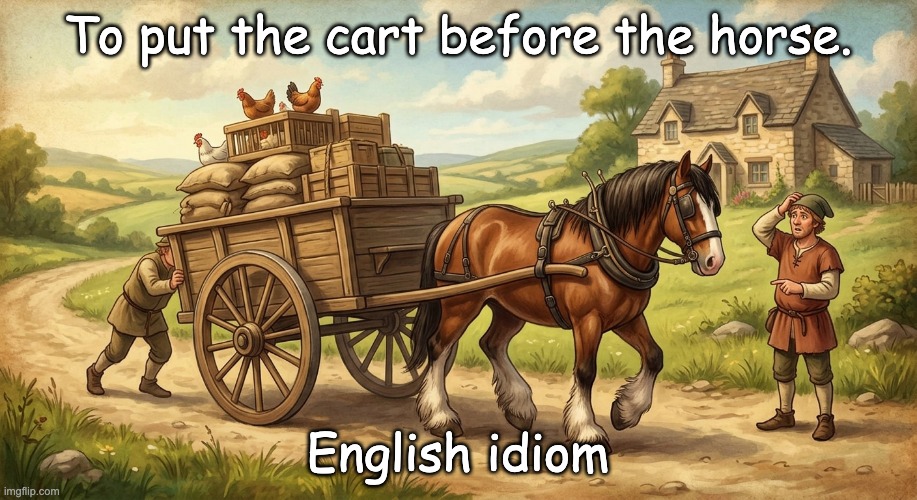
This idiom describes a situation where someone is approaching a task or situation backward, doing things in reverse or illogical order. It implies that the essential prerequisite or logical first step is being ignored or delayed in favor of a later, dependent action.
Doing things out of sequence:
Tackling a project or problem by focusing on the later stages before completing the necessary groundwork.
Reversing priorities:
Prioritizing the outcome or a secondary element over the foundational or primary element.
Confusing cause and effect:
Assuming a certain result will happen before the necessary actions have been taken.
Examples:
Buying all the furniture for a new house before you’ve even found a house to buy.
Writing the conclusion of an essay before doing the research or writing the body paragraphs.
Planning a lavish celebration for a business milestone before you’ve even launched the company.
🕰️ Origin:
The idiom has ancient roots, with the core concept of a reversed order between horse and cart existing in various languages and cultures long before it became common in English.
Ancient Greek and Roman: Similar expressions existed in ancient Greek and Latin, often referencing reversing the natural order of things. For example, a Latin proverb states currus bovem trahit (“the cart draws the ox”).
Middle Ages:
The concept persisted through the Middle Ages in Europe, appearing in various forms in different languages.
English Language:
The specific phrase “to put the cart before the horse” started appearing in English literature in the 16th century. One early recorded instance is from the writing of John Heywood, a prominent English playwright and author, in the 1540s. It quickly gained popularity and became a staple in the English language.
✍️ Author:
Like many idioms, there isn’t a single “author” of the phrase “to put the cart before the horse.” Its origins are collective and evolutionary, stemming from a common human observation about the natural order of things (horses pull carts, not the other way around).
While John Heywood’s usage is an early and notable example in English, he didn’t invent the concept, but rather captured a widely understood idea in a memorable way. The idiom, like language itself, developed over centuries through usage and adaptation.
Education may buy status, but it won’t buy brains.

This idiom highlights ’the distinction between formal education and innate intelligence’. While obtaining a degree can lead to social and professional advancements, it does not guarantee critical thinking skills, common sense, or genuine wisdom. In essence, while schooling can elevate your position in society, it cannot substitute for natural intellectual ability.
Origin:
The sentiment expressed in the idiom has been a recurring theme throughout history, often questioning the true value of formal education. Similar ideas can be found in various cultures and time periods, suggesting a long-standing awareness that academic achievement does not always equate to true intelligence. The specific phrasing “Education may buy status, but it won’t buy brains” likely emerged in the 20th century as access to higher education became more widespread.
Author:
There is ‘no definitive author for this idiom’. It is considered a piece of folk wisdom or a proverbial saying that has evolved over time. While sometimes attributed to figures like A.A. Milne or Mark Twain, these attributions are generally considered inaccurate and are likely due to the idiom’s alignment with their known wit and social commentary.
The proof of the pudding is in the eating.
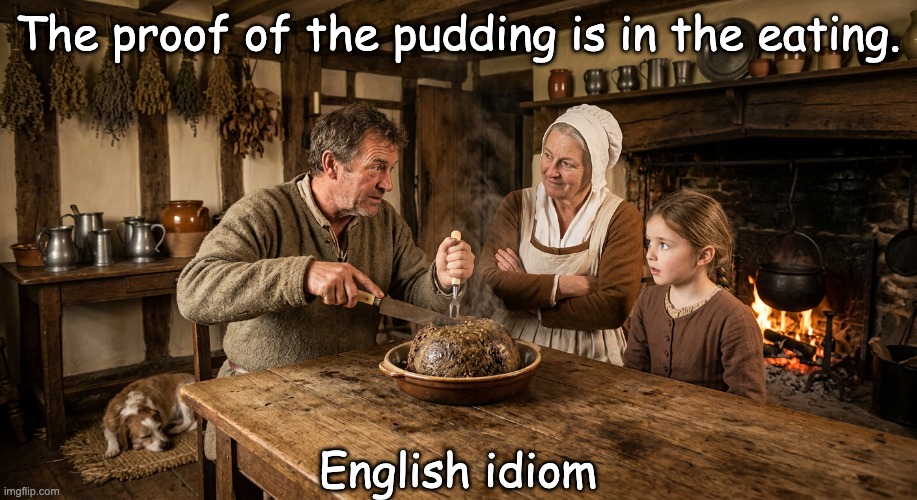
This proverb means that the true value, quality, or effectiveness of something can only be judged when it is put to the test or experienced firsthand.
– Key Idea:
Don’t judge based on appearances or promises. You must actually ‘use’ or ‘experience’ something to know if it is good.
– Modern Context:
We often use this when a new product is launched, a new policy is implemented, or someone makes a big claim. The “eating” is the actual trial or usage.
📜 Origin:
The phrase dates back to at least the 14th century, but it became popular in its current form in the 17th century.
– 1. The Context of “Pudding”:
In the Middle Ages, “pudding” did not mean the sweet, creamy dessert we think of today. It was a savory dish, often a type of sausage or haggis, made by stuffing meat, organs, spices, and cereal into an animal’s stomach or intestine and boiling it.
– 2. The Practical Meaning:
This kind of pudding could be hit-or-miss. It could look fine on the outside, but it might be poorly seasoned, undercooked, or even spoiled. There was no way to be sure about its quality until you cut it open and actually ate it.
✍️ Author / First Recorded Use:
While the concept was likely a common folk saying, the earliest known recorded use of the phrase in its recognizable form is credited to the famous Spanish author Miguel de Cervantes.
He used it in his masterpiece, “Don Quixote”, published in two parts in 1605 and 1615. The line appears in the 1615 volume (Part II, Chapter XXIV).
The Original Text (Spanish):
> “…y al freír de los huevos lo verá.”
(…and you will see it when the eggs are frying.)
This is a closely related Spanish proverb. However, in the most famous English translations of “Don Quixote”, such as the 1700 translation by Peter Motteux, it was rendered as:
> “The proof of the pudding is in the eating.”
This translation helped solidify the idiom in the English language.
Better to remain silent and be thought a fool than to speak and remove all doubt.

The saying is a warning against the impulse to speak just to seem clever or knowledgeable. Staying quiet might leave people uncertain about what you know, but opening your mouth carelessly can settle the question — often unfavorably. It’s essentially: silence preserves ambiguity in your favor; speech risks confirming the worst.
Origin:
The idea has deep roots. A version appears in the biblical Book of Proverbs (17:28): “Even fools are thought wise if they keep silent, and discerning if they hold their tongues.” That’s the ancestral form — wisdom through silence — though it doesn’t yet have the “remove all doubt” twist.
The specific phrasing we know today traces to a much later, more obscure source. The earliest known use of the modern wording has been found in a 1907 book called ‘Mrs. Goose, Her Book’ by Maurice Switzer, which reads close to the modern version. Journalist and researcher Fred Shapiro (editor of the Yale Book of Quotations) confirmed this 1907 Switzer text as the earliest evidence he could find — and, in a strange twist, when he tried tracking down a later reprint credited to author Anne Rice, she confirmed she’d unknowingly borrowed the line into one of her own introductions, not realizing it wasn’t original.
Author:
There is ‘no verified single author’. It’s frequently misattributed:
– Abraham Lincoln — the most common attribution, but the earliest known attribution to Lincoln only appeared in Golden Book magazine in November 1931, some 66 years after his death — far too late and unsupported to be credible. Fred Shapiro affirmed there’s no proof Lincoln said it, even though he mistakenly included it under Lincoln’s name in his own book.
– Mark Twain — also commonly credited, but there is no substantive evidence that either Abraham Lincoln or Mark Twain actually used this maxim.
– Other names sometimes attached include Samuel Johnson, George Eliot, and even Confucius, none with solid documentation.
Bottom line: it’s a proverb-like saying with biblical roots, popularized in its current wording by Maurice Switzer in 1907, and later attached (without evidence) to famous wits like Lincoln and Twain because it “sounds like” something they’d say.
As you sow, so shall you reap.
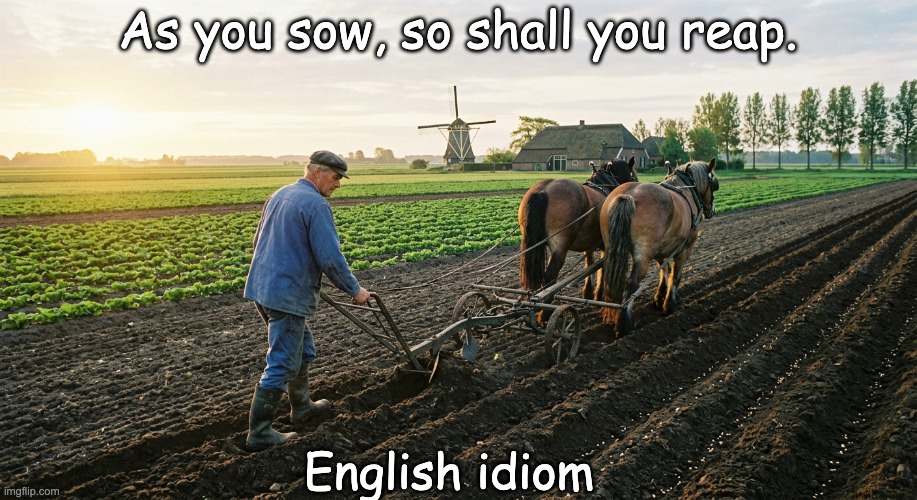
– ‘Your actions have consequences.’
– If you do good things, you are likely to receive good results.
– If you do bad things, you may face bad consequences later.
In simple words: ‘What you do today will affect what happens to you tomorrow.’
📌 Example:
– If you treat people with kindness, they will likely treat you kindly too — ‘as you sow, so shall you reap’.
– A student who works hard will get good results; one who neglects studies may fail.
📖 Origin:
The saying comes from the Bible, specifically from the ‘New Testament’. The famous line appears in Galatians 6:7 :
> “Whatsoever a man soweth, that shall he also reap.”
This is from the King James Version of the Bible, published in 1611.
✍️ Author:
The verse is traditionally attributed to Saint Paul / Apostle Paul, who wrote the ‘Epistle to the Galatians’.
However, the idea itself is very ancient and comes from farming life:
– ‘Sowing’ means planting seeds.
– ‘Reaping’ means harvesting the crop.
– So the metaphor suggests that the “seeds” of our actions produce similar “harvests” in life.
Faith without works is dead.
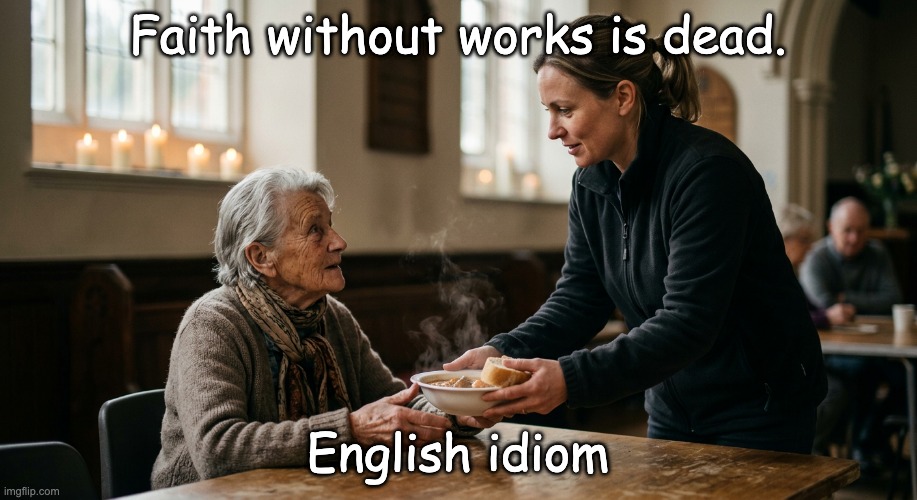
– Core idea: Believing in God is not meant to be only a mental/verbal claim — ‘real faith should produce outward actions’.
– “Dead” means ‘lifeless, ineffective, or counterfeit’ faith: belief that doesn’t lead to obedience, love, and service.
– Often summarized as: ‘genuine faith naturally shows itself through works’.
📜 Origin:
– The phrase comes from the Bible, specifically the ‘New Testament’:
James 2:17:
– Text: “So also faith by itself, if it does not have works, is dead.”
– The surrounding verses make the point even more clearly:
– James 2:18 – faith is shown by actions
– James 2:19–20 – belief alone isn’t enough without doing what’s right
– James 2:26 – “faith without works is dead also”
✍️ Author:
– The ‘epistle (letter) of James’ is traditionally attributed to ‘James’, commonly identified as:
– James the Just (often associated with being Jesus’ brother, though exact historical details are debated)
– So the “origin and author” in common Christian usage:
– Origin: Book of James (New Testament)
– Author: James
🌟 Extra clarification (why people quote it):
– Christians use it to argue against the idea that someone can have ’true faith’ while living in ways that contradict it.
– It’s also used in discussions about ‘faith vs. works’, especially in relation to moral conduct and charity.
Fine feathers make fine birds.
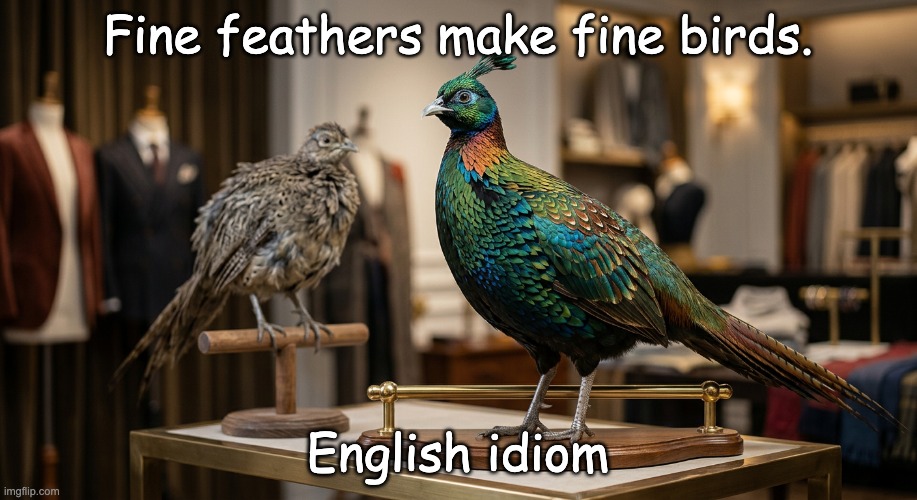
– ‘Good quality/appearance contributes to good performance/results.’
– There’s a subtle implication that ‘what looks “fine” on the outside often reflects something good underneath’ (preparation, quality, status, etc.).
Figurative example:
– A person who is well dressed and well equipped is often expected to perform well.
📜 Origin:
– It’s an ‘English proverb’ with roots in older European (often ‘Latin/learned’) proverb traditions.
– The idea is connected to the broader theme that ‘appearance or outward quality signals inner worth’.
– The phrase as commonly known in English comes from later print usage, but the underlying proverb idea is ‘older’ than the modern exact wording.
✍️ Author:
– The ‘most commonly cited attribution’ in reference works is “Desiderius Erasmus” ✅ (a major Renaissance humanist).
– However, with proverbs, ‘a single definitive “author” is often hard to prove’, because they spread through oral tradition and print over time.
Still, Erasmus is the name you most often see attached.
All show and no substance.

This idiom is used to describe something or someone that is visually impressive or flashy but lacks depth, quality, value, or real character.
– “All show” refers to the attractive outer appearance, performance, or presentation.
– “No substance” refers to the complete lack of essential quality, content, or integrity.
It’s similar to other idioms like:
– “All bark and no bite”
– “All sizzle and no steak”
– “A wolf in sheep’s clothing”
🧐 Origin and Author:
Unlike many specific quotes, this idiom does not have a single, famous author or a precise date of origin. It is a common colloquial expression that evolved over time in the English language.
The concept it describes is timeless, and variations of this sentiment have existed for centuries. However, the exact phrasing “All show and no substance” likely gained popularity in the 19th or early 20th century, becoming a standard way to criticize things that were overly concerned with aesthetics at the expense of functionality or truth.
Holier than thou.

The phrase “holier than thou” is an idiom used to describe a person who is self-righteous, morally superior, or judgmental of others.
– Self-Righteous: Someone who believes their own actions and beliefs are always correct and morally better than others.
– Judgmental: An individual who frequently criticizes or condemns others for their perceived moral failings.
– Arrogant: The idiom carries a strong connotation of arrogance and condescension.
When you call someone “holier than thou,” you are suggesting they are trying to appear more virtuous than they actually are, often in a hypocritical or showy manner.
Origin and Author:
The idiom “holier than thou” has its roots in the ‘King James Version (KJV)’ of the Bible.
Biblical Origin:
The phrase comes directly from the Old Testament, specifically from the ‘Book of Isaiah, Chapter 65, Verse 5’.
In the context of the verse, the prophet Isaiah is speaking on behalf of God, criticizing the Israelites who have become corrupt and rebellious. These people were engaging in sinful practices yet still considered themselves morally superior to others, even to those who were truly faithful.
The full verse (KJV) reads:
> “Which say, Stand by thyself, come not near to me; for “I am holier than thou”. These are a smoke in my nose, a fire that burneth all the day.”
Author:
The primary author of the text is the Prophet Isaiah, who is traditionally credited with writing the Book of Isaiah in the Hebrew Bible. The idiom, therefore, is a direct quote from his writings, as translated in the 1611 King James Version.
Transition to Common Usage:
While the phrase originated in a religious context, its usage has evolved over centuries. It transitioned from a specific critique of religious hypocrisy to a general idiom used in everyday language to describe anyone displaying an air of moral superiority, regardless of the context (religious, political, or social).
I couldn’t care less.

– I do not care at all.
– I have no interest or concern.
– My level of care is already zero.
Example:
> “People are criticizing my outfit, but I couldn’t care less.”
Meaning:
> “I don’t care about their criticism at all.”
Literal Idea 🧠:
The phrase means that your amount of caring is so low that it ‘cannot be lower’.
– If you “couldn’t care less,” then you care ‘0%’
– There is no smaller amount of care possible
Origin 📜:
The idiom is generally believed to have originated in ‘British English’ in the early-to-mid 20th century.
– It became common in Britain before spreading more widely.
– It is recorded in use by the 1940s.
– Later, it became common in American English as well.
Author ✍️:
There is ‘no known individual author’ of the idiom.
Like many idioms, it likely developed naturally in everyday speech rather than being invented by a specific writer or public figure.
Note: “I could care less” ⚠️
In American English, people also often say:
> “I could care less.”
However, this is logically different because it literally suggests that the speaker ‘does care somewhat’.
Still, in casual American usage, “I could care less” is often understood to mean the same thing as “I couldn’t care less.”
More precise version:
✅ ‘I couldn’t care less.’
A wolf in sheep’s clothing.
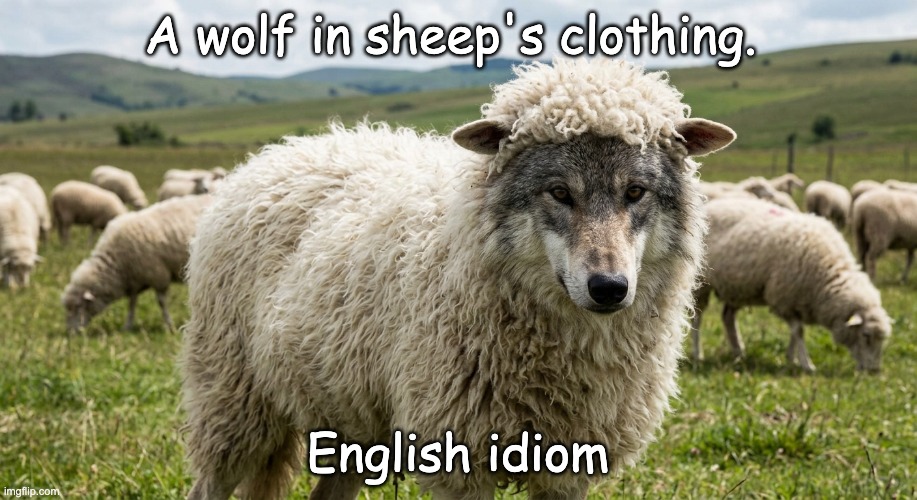
The phrase “A wolf in sheep’s clothing” is used to describe a person who appears to be friendly, harmless, or innocent but is actually dangerous, malicious, or treacherous. It’s a warning about ‘deception’ and the importance of looking beyond surface appearances.
– ‘Appearances are deceiving’: The wolf, a natural predator, disguises itself in the gentle fleece of a sheep, allowing it to blend in with the flock undetected.
– ‘Malicious intent’: The disguise is not innocent; it’s a calculated move to gain trust and access in order to cause harm or exploit vulnerability.
– ‘Hidden danger’: The real threat is concealed beneath a facade of kindness or harmlessness.
This idiom is often applied to people who manipulate others by pretending to share their values or interests, only to betray them later.
Origin:
The origin of this idiom is rooted in ancient literature and religious texts, with two main sources contributing to its widespread use.
1. Aesop’s Fables:
The primary origin is attributed to “Aesop’s Fables”, a collection of moral stories credited to the ancient Greek storyteller Aesop, who believed to have lived around 620–564 BCE. While the exact wording might vary across different translations and versions, the core story remains the same:
– The Fable: In one version of the fable, a wolf finds a sheepskin and uses it as a disguise. It successfully blends in with a flock of sheep, gaining access to the fold. The shepherd, not realizing the wolf’s true identity, later kills the “sheep” (the wolf in disguise) for food, ironically falling victim to the very deception the wolf employed.
2. The Bible:
The phrase is also strongly associated with a passage from the “New Testament of the Bible” , specifically Matthew 7:15. In this passage, Jesus warns his followers:
> “Watch out for false prophets. They come to you in sheep’s clothing, but inwardly they are ferocious wolves.”
This biblical use reinforces the idea of dangerous individuals (false prophets) who pretend to be harmless and righteous (sheep) but are actually destructive and predatory (wolves).
Author:
There isn’t a single “author” of the idiom in the modern sense. Instead, its authorship is distributed across two sources:
– Aesop: As the creator of the fable that popularized the concept, Aesop is often considered the original source of the imagery.
– The Bible (Matthew): The specific phrasing “in sheep’s clothing” is directly from the biblical text, contributing significantly to its common usage.
Therefore, you can attribute the ‘imagery and concept to Aesop’ and the ‘specific phrasing to the Bible’.
Ultimately, the idiom “a wolf in sheep’s clothing” has endured for centuries because it powerfully captures a universal truth about human nature and the need for vigilance against deception.
This classic idiom, “a wolf in sheep’s clothing,” is a powerful metaphor for deception. It warns us to be wary of those who appear harmless but hide malicious intent.
To put in one’s two cents.
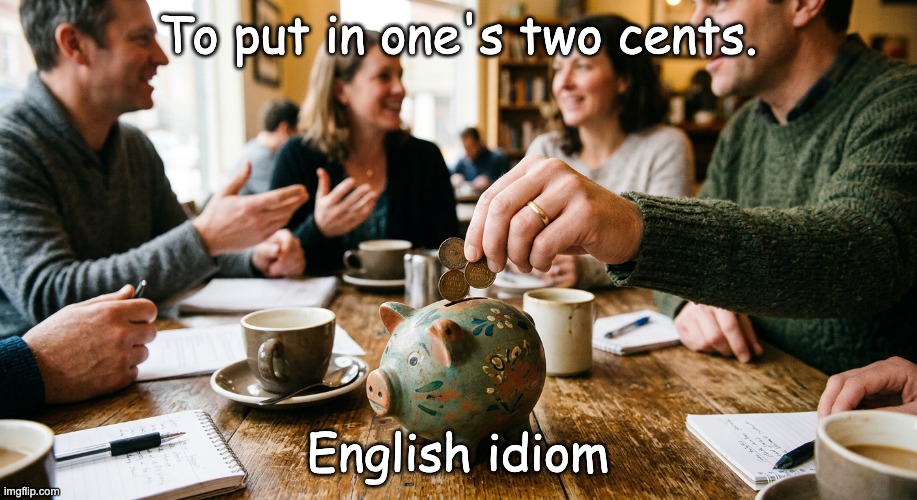
This idiom is used when you want to ‘offer your opinion’ or add a point to a discussion, but you are doing so in a way that is intentionally modest or humble.
– It implies that you know your opinion might not be highly valued or expert, but you’re offering it anyway.
– It’s often used when you are giving an unsolicited opinion or when you are not the primary expert on the topic.
🕰️ Origin:
The exact origin of the phrase is not entirely clear, but there are a few leading theories:
1. ‘The “Two-Penny Post” Theory’: This is the most widely accepted theory. In the early 19th century, the British postal service was expensive. To make it more accessible, they introduced a “two-penny post” for local letters. Sending a letter costs two pennies. The idea is that your opinion is worth the cost of the postage—a small, affordable amount.
2. ‘The “Cheapest Bettor” Theory’: Another theory links the phrase to poker. In some versions of poker, the minimum bet (or “ante”) was two cents. To be part of the game and “have your say” (by betting), you had to put in your two cents.
3. ‘The “Literal Value” Theory’: A simpler explanation is that two cents is simply a very small amount of money, symbolizing a low-value opinion.
👤 Author:
Like most common idioms, this phrase was ‘not coined by a single author’. It evolved naturally over time in the English language.
The earliest recorded uses of similar phrases (like “to have my two cents’ worth”) appear in American literature in the mid-19th century, but the exact phrasing we use today is likely much older in spoken language.
To play the hypocrite.

– ‘Publicly condemn a behavior they privately engage in.’ For example, someone who strongly argues against lying, but is caught lying themselves.
– ‘Feign feelings or beliefs they don’t hold.’ For instance, pretending to be deeply religious or moral when they are not, simply to gain social approval.
– ‘Express shock or disapproval at something they themselves are guilty of.’
In essence, “playing the hypocrite” is about presenting a false image of oneself to others, often with the intention of gaining advantage or avoiding criticism.
Origin:
The word “hypocrite” itself has ancient roots, and the concept of hypocrisy has been recognized and criticized for centuries. The idiom “to play the hypocrite” likely evolved naturally from the noun “hypocrite,” combined with the verb “to play” in the sense of “to act a part” or “to pretend.”
– Etymology of “Hypocrite”: The word “hypocrite” comes from the ancient Greek word ‘hypokrites’, which meant “an actor” or “a stage player.” In ancient Greek theater, actors wore masks to portray different characters, and their role was to embody a persona that was not their own. Over time, the term ‘hypokrites’ began to be used metaphorically to describe people who acted a part in real life, pretending to be someone they were not.
– ‘Development of the Idiom’: The phrase “to play the hypocrite” likely emerged in the English language as a way to describe this act of pretending. The earliest recorded uses of the phrase date back to the 16th century, though the concept of hypocrisy itself is much older.
Author:
It’s impossible to attribute the idiom “to play the hypocrite” to a single author. Like many common idioms, it likely arose through a gradual process of linguistic evolution, with the phrase being used and adopted by many different speakers over time. While individual writers and thinkers throughout history have certainly used the phrase, no one person can be credited with its invention.
Instead, the idiom is a product of the shared language and cultural understanding of hypocrisy as a human behavior. It’s a testament to the enduring nature of this concept and the human tendency to observe and critique it.
Good from far, but far from good.
This idiom is often used to express disappointment when an expectation, built upon a superficial or distant observation, is shattered by the reality of closer examination. It highlights the difference between perceived quality and actual quality.
– “Good from far”: This part signifies that when viewed from a distance, the object, person, or situation appears attractive, well-made, or desirable. The imperfections are not visible, or the overall impression is positive.
– “But far from good”: This is the crucial twist. It states that despite the initial positive impression, the reality is quite the opposite. When examined closely, the quality is poor, the flaws are evident, and the overall standard is low.
Common Scenarios for its Use:
– Physical Objects: A used car that looks shiny and new from across the lot, but has a rusted engine and a worn-out interior. A piece of clothing that looks stylish on a mannequin but is made of cheap, poorly-stitched fabric. A house that has a beautiful facade but is structurally unsound.
– Abstract Concepts: A job that seems ideal on paper but has a toxic work environment. A relationship that appears perfect on social media but is full of conflict. A piece of art that looks impressive from a distance but is revealed to be amateurish upon close inspection.
– People: (Use with caution, as it can be perceived as insulting) A person who looks attractive and confident from afar, but whose personality is unpleasant or whose actions are disappointing.
🕰️ Origin and Author:
The exact origin and author of the idiom “Good from far, but far from good” are difficult to pinpoint. It’s an example of a “proverbial phrase” or a “catchphrase” that has evolved over time through common usage. It relies on a rhetorical device known as ‘chiasmus’ or a ‘pun’, which is a popular technique in creating catchy, memorable sayings.
Key points about its origin:
– No Single Author: It’s unlikely that a single, identifiable person coined this phrase. It’s more probable that it emerged organically in English-speaking cultures as a concise way to express a common human experience of disappointment.
– Evolution of Language: The phrase uses common English words and a simple, yet effective, structure. Its popularity stems from its cleverness and its ability to clearly convey a nuanced idea.
– Oral Tradition: Like many proverbs and idioms, it was likely passed down through oral tradition before being documented in writing. Its exact point of entry into written language is hard to determine.
Similar Idioms and Proverbs:
– “All that glitters is not gold”: This is a very similar proverb, often attributed to William Shakespeare (though variations existed before him), which also warns against judging things by their outward appearance.
– “Don’t judge a book by its cover”: This common idiom also advises against making judgments based on initial, superficial impressions.
– “Beauty is only skin deep”: This phrase suggests that physical attractiveness doesn’t necessarily reflect a person’s inner character or quality.
In essence, “Good from far, but far from good” is a timeless observation about the nature of appearances and reality, condensed into a memorable and witty phrase. It serves as a reminder to look beneath the surface and to not be easily swayed by initial impressions.
A leopard can’t change its spots.

Core character is fixed:
– A person’s innate personality, deep-seated habits, and fundamental nature are very difficult, if not impossible, to alter significantly.
– Past behavior predicts the future:
If someone has consistently shown certain negative traits or behaviors in the past, they are likely to continue showing them.
– Skepticism of sudden change:
It expresses doubt that a person, especially one with a history of bad behavior, can truly and permanently reform.
In essence, it’s a cautionary phrase advising people not to be naive about the potential for deep-seated change in others. While people ‘can’ grow and change, this idiom emphasizes the enduring power of fundamental personality traits.
📜 Origin and Author:
This idiom has a very long and distinguished history, with roots in ancient literature.
– The Ultimate Source: The Bible:
It appears in the Old Testament, in the book of Jeremiah.
– The Verse: “Can the Ethiopian change his skin, or the leopard his spots? then may ye also do good, that are accustomed to do evil.” – Jeremiah 13:23 (King James Version)
Context within Jeremiah:
Jeremiah (late 7th and early 6th centuries BC) was a prophet in ancient Judah, known for his stern warnings to the people about their persistent sins and turning away from God. In this passage, he uses rhetorical questions to emphasize the deeply ingrained nature of their wickedness. He’s saying that just as it is naturally impossible for an Ethiopian to change their skin color or a leopard to change its spots, it is equally impossible for the people of Judah, who are so accustomed to doing evil, to suddenly start doing good. It’s a powerful metaphor for spiritual and moral stubbornness.
Other Influences:
While the biblical verse is the direct source of the modern idiom, the concept of a leopard’s spots being unchangeable appears in the classical literature. For example, the ancient Greek playwright Sophocles (c. 496 – c. 406 BC) wrote in his play “Tyro”:
> “One cannot wash a leopard’s spots.”
This shows that the image was a recognized metaphor for permanence and fixed nature.
Threatened men live long.

This is a traditional folk proverb, not a quote from a known author — it belongs to that large body of anonymous proverbial wisdom found in many languages.
It means that people who are merely ’threatened’ often escape the harm entirely and go on to live a long time — threats are cheap and frequently don’t turn into real action. It’s a wry, reassuring observation: don’t worry too much about someone who threatens you, because words rarely translate into deeds. A closely related idea is captured in the barking-dog family of sayings — “Threatening does not always lead to action: Harsh words may disguise a different feeling, intention or ability.”
There’s also a secondary, more cynical reading: a person who is always complaining of threats or danger tends to be overly cautious and thus, ironically, safer and longer-lived than someone who is reckless.
Origin and “author”:
– There’s no individual author — it’s a proverb collected from oral tradition.
– It’s catalogued as an established English proverb in Tilley’s Dictionary of Proverbs in England, listed as “Threatened FOLKS (men) live long”, a standard scholarly reference for early modern English proverbs (Tilley’s collection draws mainly on 16th–17th century sources).
– The same saying shows up as a Spanish proverb too: «Los hombres amenazados viven mucho tiempo», alongside close variants like “A threatened man lives long, if he can get bread” and “There are more threatened than hurt.”
– Similar sentiments appear worldwide, e.g. the Basque proverb: “Jende gehiago mehatxatzen dituzte kolpatzen dituzten baino” and the Chinese proverb “Draw the bow but don’t shoot — it is a bigger threat to be intimidated than to be hit.”
So the idiom is best described as an old, anonymous proverb of European origin (English and Spanish forms are both well-attested), part of a broader family of sayings across cultures making the same point: threats are more common than actual harm.
His bark is worse than his bite.
This idiom is used to describe someone who appears intimidating, angry, or aggressive through their words or attitude, but is actually much milder and less harmful in their actions.
– They might yell, threaten, or criticize loudly (the “bark”).
– However, they are unlikely to follow through with any harmful consequences or physical aggression (the “bite”).
Basically, their outward show of anger is more imposing than the actual threat they pose.
🕰️ Origin:
The origin of this phrase is ancient and rooted in common observations of animal behavior.
The core idea — that a loud noise or fierce presentation does not always equate to true danger—dates back to classical antiquity.
The comparison specifically between a dog’s bark and its bite is a very old and intuitive concept that existed in various forms in multiple languages long before it became a fixed English idiom.
The underlying wisdom — “do not be deceived by appearances”—is a universal human observation.
✍️ Author:
There is ‘no single author’ credited with inventing this idiom.
It is a piece of folk wisdom and proverbial language that evolved naturally over centuries through common usage. The phrase is a collective creation of the English language, derived from everyday life and shared understanding, rather than the work of a specific writer or poet.
All talk, no action.

This idiom is used to describe a person who makes impressive-sounding promises or plans but fails to carry them out. It’s often used to express disappointment or frustration with someone who is full of grand ideas but lacks the discipline or commitment to make them a reality.
🕰️ Origin:
The exact origin of the idiom “all talk, no action” is not entirely clear. However, it’s likely that the phrase has roots in the idea that actions speak louder than words. Throughout history, there have been many examples of people who make bold claims but fail to deliver on them. The idiom likely emerged as a way to describe this common human tendency.
✍️ Author:
There is no known author of the idiom “all talk, no action.” It’s a phrase that has evolved over time through common usage. The concept behind the idiom, however, has been explored by many writers and thinkers throughout history. For example, the ancient Greek philosopher Aristotle famously said, “We are what we repeatedly do. Excellence, then, is not an act, but a habit.” This quote highlights the importance of action over mere words.
Barking dogs seldom bite.

People who make a lot of noise, threats, or angry statements often ‘do not actually take action’.
– Those who are truly dangerous or determined usually ‘act quietly’, rather than loudly threatening others.
💬 Example:
> Don’t worry too much about his threats. “Barking dogs seldom bite.”
Meaning: He talks aggressively, but he probably won’t do anything.
🌍 Origin:
The proverb is very old and appears in many languages and cultures.
– In English, it was recorded as early as the 16th century.
– A well-known early English version appears in “John Heywood’s collection of proverbs”, published in 1546.
The idea may be even older, with similar expressions found in ancient Latin writings, suggesting that the saying existed long before it became common in English.
✍️ Author: There is ‘no single known author’ of this idiom.
– It is a ’traditional proverb’, passed down through common speech.
– John Heywood did not invent it, but he helped preserve it in written English.
Many hands make light work.
– ‘If many people work together, the task becomes easier and quicker’, because the effort is shared.
– Even a heavy job feels “lighter” when it’s divided among many helpers.
🕰️ Origin:
– This idiom is ‘very old’ and appears in ‘different forms across languages’.
– A widely cited early source is ‘Proverbs’ (traditional proverb heritage), closely related to the idea of teamwork found in ‘Biblical/early proverb traditions’.
– In English, the exact phrase is commonly traced to ‘medieval/early modern proverb usage’, but the concept itself is universal: ‘shared labor = easier work’.
> Note: Because proverbs often evolve and circulate orally, it’s hard to point to a single “first” author with absolute certainty.
✍️ Author:
– ‘No single author’—it’s a ’traditional proverb’, not attributed to one person.
– Over time it was adopted into common English and literature, but it isn’t considered the work of a specific named writer.
📚 Examples (how it’s used):
– “Let’s split the chores—many hands make light work.”
– “The community cleanup went fast because—many hands make light work.”
Clothes do not always make the man.

This is a variant of the older saying “Clothes make the man,” and it essentially argues against judging someone’s character, worth, or ability purely by their outward appearance or attire.
The idiom warns against superficial judgment. While clothing can create a strong first impression — suggesting status, professionalism, or competence — the saying reminds us that appearances can be misleading. A well-dressed person isn’t necessarily honest, capable, or virtuous, and a poorly or plainly dressed person isn’t necessarily lacking in those qualities. It’s essentially a caution against equating outer presentation with inner substance.
Origin:
The root saying, “clothes make the man” (sometimes rendered as “the apparel proclaims the man” or “fine feathers make fine birds”), has very old roots:
– It echoes a sentiment found in Quintilian’s “Institutio Oratoria” (1st century AD), which touches on the importance of appropriate dress for an orator.
– A commonly cited Latin form is “Vestis virum facit” (“clothes make the man”), which became proverbial in medieval and Renaissance Europe.
– Erasmus included versions of this saying in his collection of proverbs, “Adagia” (1500), helping popularize it across Europe.
– Shakespeare alludes to a related idea in “Hamlet” (1600–1601), when Polonius advises Laertes: “the apparel oft proclaims the man” — reinforcing that how one dresses reflects on one’s character or station.
The negated form — “clothes do “not” always make the man” — emerged as a kind of folk correction or counter-proverb, pushing back against taking the original saying too literally or too far. It doesn’t have one identifiable single author; rather, it evolved as common wisdom, used to balance the original adage with a reminder that appearances can deceive.
A famous related quip:
Mark Twain is well known for playing with this very idiom, joking that “clothes make the man” while adding the witty corollary that naked people have little influence in society — using humor to underline just how much we ‘do’ judge by appearance, even while acknowledging we probably shouldn’t.
In short: the phrase isn’t attributed to a single named author but is part of a long proverbial tradition (Quintilian, Erasmus, Shakespeare, and various folk variants) cautioning against judging people by their attire alone.
That patient is not like to recover who makes the doctor his heir.
The proverb means: A patient who makes the doctor his heir is essentially signaling that he expects death, not recovery.
Therefore, it implies: Such a patient is not likely to recover, because making a will for the doctor suggests the person believes they won’t live long.
🌍 Origin:
It originates from Latin Roman moral/proverb tradition (short sententious sayings), where health and fate were often discussed through warnings and ethical maxims.
The Latin wording is:
“Parum sibi consulit aegrotus qui medicum heredem facit .”
(“does little for himself… who makes the doctor his heir”).
✍️ Author: Publius Syrus (1st century BC),
a Roman author known for moral sayings/epigrams (sententiae) that later became proverbial.
A lawsuit is a fruit-tree planted in a lawyer’s garden.
This proverb means that ‘lawsuits often benefit lawyers more than the people involved in the dispute’.
– A ‘fruit-tree’ produces fruit again and again.
– A ‘lawyer’s garden’ represents the lawyer’s professional world.
– So, a lawsuit is compared to a tree that keeps producing “fruit” — ‘fees, income, and profit’ — for the lawyer.
In simple words:
> ‘When people go to court, the lawyers may profit from the dispute, while the clients may lose money, time, and peace.’
⚖️ Message / Moral:
The saying is a cynical warning about litigation:
– Lawsuits can become long and expensive.
– Lawyers may earn whether their clients win or lose.
– It advises people to avoid unnecessary legal battles if possible.
🏛️ Origin:
This is generally regarded as a ’traditional proverb’, often cited as an ‘Italian proverb’.
It belongs to a long tradition of European sayings that criticize the cost of legal disputes and the way lawyers profit from them.
✍️ Author: There is ‘no known individual author’.
🔁 Similar Sayings:
– “When two dogs fight for a bone, a third runs away with it.”
– “Going to law is losing a cow for the sake of a cat.”
– “Only lawyers profit from lawsuits.”
A good lawyer is a bad neighbour.

This proverb means that ‘a lawyer may be useful professionally, but troublesome in everyday life—especially as a neighbour’.
– A lawyer knows the law well.
– They may be quick to argue, object, complain, or threaten legal action.
– As a neighbour, such a person could become difficult because they can use legal knowledge to protect every small right or dispute.
In simple words 💡:
> A person who is very skilled at arguing or using the law may not be pleasant to live near.
Origin 📜:
The saying is an ‘old English proverb’, found in early proverb collections. One early form is:
> “A good lawyer, an evil neighbour.”
It appears in ’17th-century English proverb collections’, including works associated with George Herbert and later proverb compilers such as John Ray.
Author ✍️: There is ‘no known single author’.
– It is generally considered a ’traditional proverb’.
– George Herbert and others helped record it, but they are not necessarily the original authors.
Type of expression 🗣️:
It is more accurately a ‘proverb’ rather than an idiom, because it expresses a general piece of wisdom or warning.
The cowl does not make the monk.

The phrase warns against judging people solely by their ‘external signs’, such as clothing, titles, or symbols. It emphasizes that ’true character is revealed through actions and inner qualities’, not superficial markers.
Origin: The phrase dates back to ‘medieval Latin’ and appears in the “Disticha Catonis” (or “Distichs of Cato”), a collection of moral maxims from late antiquity (likely 2nd–4th century CE).
Author: Traditionally attributed to Cato the Younger (or a later Pseudo-Cato), though the actual authorship is ‘uncertain’ and likely anonymous. The “Disticha Catonis” were widely used as school texts in medieval Europe.
Exact Source: The line appears in “Distich 1.36” of the “Disticha Catonis”:
> “Cucullus non facit monachum, sed in hoc est veritas.”
(Though the full line varies slightly in manuscripts.)
Modern Usage:
Today, the idiom is used in English and other languages to highlight ‘hypocrisy’, ‘deception’, or the ‘fallacy of judging by appearances’. For example:
> “Just because he wears a suit and drives a luxury car doesn’t mean he’s trustworthy. Cucullus non facit monachum.”
Related Concepts:
– “All that glitters is not gold” (Shakespeare): Similar idea about deceptive appearances.
– “Wolf in sheep’s clothing”: A more dramatic metaphor for hidden danger.
We can’t all be doctors.
– Not everyone can have the same prestigious or highly skilled job.
– Society needs people in many different roles.
– People have different talents, opportunities, interests, and abilities.
– It can also mean: ‘not everyone will reach the same social or professional status.’
🗣️ Example:
> “Don’t feel bad that you didn’t become a surgeon. We can’t all be doctors.”
Meaning: It is okay to choose or end up in a different profession; not everyone needs to follow the same path.
🌍 Origin:
The expression comes from a general proverbial pattern in English:
> “We can’t all be…”
For example:
– “We can’t all be leaders.”
– “We can’t all be rich.”
– “We can’t all be heroes.”
The word “doctors” is often used because doctors are commonly seen as educated, respected, and successful professionals.
✍️ Author: There is ‘no known single author’ of the phrase “We can’t all be doctors.”
It is best understood as a ‘common saying or proverb-like expression’, not a quotation from one specific writer.
⚠️ Tone and Use:
Depending on context, it can sound:
– ‘Practical’: accepting that people have different paths.
– ‘Encouraging’: reminding someone their value is not tied to one profession.
– ‘Dismissive or classist’: if used to discourage ambition or imply some people “belong” in lower-status jobs.
So the meaning depends heavily on how and why it is said.
A fair-weather friend.

A “fair-weather friend” is someone who is friendly and supportive ‘only when things are going well’, but disappears or refuses to help when you face trouble, loss, or difficulty.
✅ In simple words:
– A friend in good times only
– Not a true or loyal friend
– Someone who leaves during “stormy” times
Example:
> ‘When I lost my job, he stopped calling me. I realized he was just a “fair-weather friend”.’
🌱 Origin of the Idiom:
The idiom comes from the contrast between:
– “Fair weather” = pleasant, calm, easy conditions
– ‘Stormy/bad weather’ = difficulties, troubles, hardship
So, a “fair-weather friend” is like someone who stays with you only while the “weather” of life is pleasant, but leaves when storms come.
The expression developed from an old proverbial idea: “true friends are known in times of trouble”.
✍️ Author:
There is ‘no single known author’ of the English idiom “fair-weather friend.” It is considered a ’traditional proverb/idiomatic expression’ that evolved naturally in English.
However, the idea is very ancient. A similar thought appears in the writings of the Roman poet ‘Ovid’:
> “As long as you are fortunate, you will have many friends;
> if times become cloudy, you will be alone.”
So, while Ovid expressed a similar idea, the exact idiom “fair-weather friend” has ‘no confirmed individual author’.
Apothecaries want to be counted among physicians.

– People in a ‘lower or related profession’ often want to be regarded as equal to those in a ‘higher-status profession’.
– More generally, it refers to ‘pretension’, ‘status-seeking’, or ‘claiming expertise beyond one’s role’.
In simple words:
> ‘Someone with partial knowledge or a supporting role may want to be treated as a full expert.’
🏛️ Historical Context :
– An ‘apothecary’ was a person who prepared and sold medicines—roughly like a pharmacist.
– A ‘physician’ was a university-trained medical doctor.
– In earlier centuries, apothecaries sometimes gave medical advice, which caused tension with physicians.
– So the proverb reflects the old rivalry between ‘pharmacists/apothecaries’ and ‘doctors’.
🌍 Origin:
– It is an ‘old English proverb/adage’, recorded in early proverb collections.
– A common early source is John Ray’s “A Collection of English Proverbs” in the 17th century, where similar wording appears.
✍️ Author
– ‘No single known author.’
– It is best described as a ’traditional proverb’ or ‘anonymous saying’.
– John Ray and later collectors recorded it; they did ‘not necessarily create it’.
Even a clever person can be thrown off.

– ‘Intelligence doesn’t make someone immune to confusion or disruption.’
– Even knowledgeable or quick-thinking people can ‘lose their footing’ when circumstances change—e.g., stress, distraction, misinformation, surprise, or unexpected problems.
> Synonyms (similar sense):
– “Nobody’s perfect.”
– “Even the best can be thrown off.”
– “Smart people can still make mistakes.”
📜 Origin:
– This exact wording—“Even a smart person can be thrown off” — is ‘not a widely documented, classic idiom’ with a single known origin or specific author in major quote/idiom references.
– It reads like a ‘modern paraphrase’ of older, more general ideas/phrases such as:
– “Even a fool may be right sometimes.” (older proverbial structure)
– “Confusion can affect anyone.” (general proverb-like sentiment)
– The idiomatic idea behind “thrown off” is common in English (to be disrupted, disoriented, or thrown out of one’s usual rhythm), but ’the full sentence’ itself appears more like ‘general English usage’ than a fixed proverb.
🧑💼 Author:
– ‘No specific author is reliably associated’ with this exact line.
– If you saw it quoted somewhere (book, show, tweet), the ‘source may be the speaker of that paraphrased thought’, not the creator of a traditional idiom.
The winner of a lawsuit is often the loser.
This saying means that ‘even a person who wins a court case may suffer so much loss’—money, time, stress, reputation, relationships, and peace of mind—that the “victory” may not feel like a real win.
In other words:
– ⚖️ You may win the legal judgment
– 💸 But spend a lot on lawyers and court costs
– ⏳ Lose months or years of time
– 😟 Suffer emotional stress
– 🤝 Damage personal or business relationships
So the “winner” can still end up worse off overall.
🌍 Origin:
The saying comes from a long tradition of ‘proverbs and legal wisdom warning against unnecessary litigation’. Many cultures have similar sayings, such as:
– “A bad settlement is better than a good lawsuit.”
– “Better a lean peace than a fat victory.”
– “Going to law is losing a cow for the sake of a cat.”
The exact phrase “The winner of a lawsuit is often the loser” is generally treated as a ‘proverb or idiom’, not as a formal legal rule.
✍️ Author: There is ‘no confirmed single author’ of this idiom. It is usually considered ‘anonymous’ or a ’traditional proverb’.
Sometimes similar ideas are attributed to lawyers, judges, or old proverb collections, but the exact wording does not have a clearly established author.
🧠 Simple Interpretation:
‘Winning in court does not always mean truly winning in life.’
To go to law for a sheep and lose a cow.
– ‘To spend more money, time, or effort fighting over something than the thing is worth.’
– Especially used about ‘lawsuits or disputes’ where legal costs become greater than the original loss.
– In simple terms: ‘Don’t fight over a small matter if the fight may cost you much more.’
🧠 Example:
> ‘He sued his neighbor over a minor fence issue, but the legal fees ruined him. He went to law for a sheep and lost a cow.’
Meaning: He fought over something small and ended up losing something much more valuable.
🌍 Origin:
– The idiom is an ‘old English proverb’.
– It comes from rural life, where a ‘sheep’ was valuable, but a ‘cow’ was usually worth much more.
– The saying warns that going to court over a small loss, like a sheep, may cost so much that you effectively lose something bigger, like a cow.
✍️ Author:
– The proverb has ‘no known single author’.
– It is considered a ’traditional English proverb’.
– It was recorded in old proverb collections, including those associated with ‘John Ray’, the 17th-century English naturalist and collector of proverbs.
A bad settlement is better than a good lawsuit.

– It is often better to ‘settle a dispute’, even on imperfect terms, than to continue a lawsuit.
– Lawsuits can be ‘expensive, slow, stressful, uncertain, and damaging’ to relationships.
– Even if you “win” a lawsuit, you may still lose money, time, and peace of mind.
In simple words 💬 :
> ‘An imperfect agreement is usually better than a long legal fight.’
Origin 📜:
This saying is a ‘legal proverb’ or ’traditional maxim’, not a modern idiom with one clearly proven inventor.
A closely related older version is:
> “A lean compromise is better than a fat lawsuit.”
This version is commonly attributed to George Herbert.
Author ✍️: Likely associated author: George Herbert
– George Herbert was a 17th-century English poet and priest.
– The saying appears in collections of proverbs associated with him, especially ”Jacula Prudentum”.
However, the exact wording “A bad settlement is better than a good lawsuit” is more of a later variation and is generally treated as an ‘anonymous legal proverb’.
Related Saying ⚖️:
Abraham Lincoln expressed a similar idea:
> “Discourage litigation. Persuade your neighbors to compromise whenever you can…”
This supports the same principle: compromise is often wiser than court conflict.
Great pains deserve great gains.

This expression conveys that ‘hard work, effort, and suffering are prerequisites for significant rewards or success’. “Pains” here refers to laborious effort, care, and toil — not physical pain — while “gains” refers to achievements, rewards, or profit. In short: ‘you reap what you sow, proportionally to how hard you work.’
Origin:
The idiom belongs to a long family of English proverbs linking effort to reward. Its roots trace back to the 16th–17th century, a period rich with similar sayings:
– “No pain, no gain” — the most direct ancestor, recorded as early as the 1500s.
– Benjamin Franklin popularized the idea in ‘Poor Richard’s Almanack’ (1758) with the line “There are no gains without pains,” which is the closest literary precursor to this phrase.
The specific phrasing “great pains deserve great gains” is a ‘folk elaboration’ of Franklin’s version, amplifying the proportionality — not just ‘any’ effort, but ‘great’ effort merits ‘great’ reward.
Authorship:
There is ‘no single identifiable author’. Like most proverbs, it evolved organically through oral tradition and popular usage. It is best attributed to:
> Anonymous / English proverbial tradition, with Benjamin Franklin’s ‘Poor Richard’s Almanack’ as its most influential literary ancestor.
No man is a good judge in his own cause.

– A person cannot be fully fair or impartial when judging a matter that directly affects them.
– It warns against ‘bias’, ‘self-interest’, and ‘conflict of interest’.
– In law, it supports the principle that judges or decision-makers must be neutral. ⚖️
🏛️ Origin:
– The saying comes from an old legal maxim in Latin:
“Nemo judex in causa sua”
meaning “No one should be a judge in his own case.”
– It is a key principle of ‘natural justice’ and has roots in ‘Roman and English law’.
✍️ Author:
– The exact original author is ‘unknown’.
– In English legal tradition, the idea was famously expressed by Sir Edward Coke, a 17th-century English jurist, who said it was against reason for anyone to judge their own case.
Lawyers’ houses are built on the heads of fools.

– This proverb suggests that lawyers often profit from the mistakes, quarrels, and foolish decisions of others.
– “Fools” refers to people who get into unnecessary disputes, lawsuits, or legal trouble.
– The “houses” symbolize the wealth or success lawyers gain from such cases.
📜 Origin:
– It is an old English proverb, commonly found in early proverb collections.
– It was recorded in the 17th century, including in collections such as George Herbert’s “Jacula Prudentum”.
✍️ Author:
– The saying has no confirmed single author.
– George Herbert helped preserve it in writing, but he likely collected it rather than created it.
Lawyer in name only.

– “Lawyer in name only” means a person is called a lawyer by title 👨⚖️, but does not truly act like one or does not have the real qualities, skills, or conduct expected of a lawyer.
– It can suggest:
– they have the ‘label’, but not the ‘substance’.
– they are a lawyer ‘officially’, but not ‘competently or genuinely’
✅ Simple sense:
> ‘A lawyer only by title, not in reality.’
🔹 Origin:
– This is ‘not a famous standalone quotation’ with a clear historical source 📜.
– It is built from the common English expression “in name only”.
– “In name only” has been used for a long time to describe something that exists ‘just by label’, but ‘not in true form’.
Example:
– ‘A king in name only’ 👑 = called a king, but has no real power
– ‘A friend in name only’ 🤝 = called a friend, but does not behave like one
– ‘A lawyer in name only’ ⚖️ = called a lawyer, but does not truly function as one
🔹 Author:
– ‘No specific author is known’ ✍️
– It is best understood as a ‘general phrase’, not a quotation from one famous person.
Lawyers prosper on quarrels.
– ‘Lawyers earn their living from disputes’ between people.
– When people ‘argue, fight, or sue each other’, lawyers may benefit because they are hired to handle the conflict.
– It is usually meant as a ‘cynical or critical proverb’, suggesting that legal professionals gain from other people’s disagreements.
In simple words:
> ‘No quarrel, no lawsuit; no lawsuit, no lawyer’s fee.’
⚠️ It is a ‘generalization’, not a fair description of every lawyer. Many lawyers also help:
– prevent disputes,
– settle conflicts peacefully,
– protect rights,
– and give useful legal advice.
🏛️ Origin:
This is best understood as an ‘old proverb-like saying’, not a quotation with one clear source.
What we can say about its origin:
– It comes from a ‘long tradition of popular suspicion about lawyers’.
– Similar sayings have existed in ‘English and European folklore’ for centuries.
– The idea behind it is very old: ‘legal professionals benefit when people are in conflict’.
Related old proverb:
A well-known similar English proverb is:
> “Lawyers’ houses are built on the heads of fools.”
This expresses nearly the same idea:
– foolish people quarrel,
– quarrels lead to lawsuits,
– lawsuits enrich lawyers.
So, “Lawyers prosper on quarrels” is likely a ’traditional proverb or proverb-style saying’, rather than a line invented by one known writer.
✍️ Author: Most likely answer:
– ‘Anonymous’
– ‘Traditional proverb’
– ‘No single confirmed author’.
There is ‘no widely accepted, specific author’ for the exact saying “Lawyers prosper on quarrels.”
🧭 Tone and Interpretation: This saying is:
– ‘critical’
– ‘ironic’
– ‘skeptical about the legal profession’
It reflects an old social attitude that:
– conflict creates business for lawyers,
– therefore lawyers may seem to benefit from human disagreement.
But in modern interpretation, it is better taken as a ‘satirical proverb’, not a literal truth.
As soon as a law or rule is introduced, there’s a loophole.

The expression “As soon as a law or rule is introduced, there’s a loophole” means:
– “As soon as a rule or law is introduced,”
– “Someone immediately finds a way around it,”
– “exploiting its loopholes, ambiguities, or exceptions.”
👉 In other words:
It means that human ingenuity is often used not only to comply with the rules, but also to circumvent them without openly violating them.
✅ Example:
– A new tax is introduced.
– Some people find a legal way to avoid paying it altogether.
➡️ “As soon as a law is made, there’s a loophole.”
🏛️ Origin:
The expression is a very old English proverb, born from observation of social and legal reality.
Some key points:
– It derives from the “popular proverbial tradition”;
– It reflects a centuries-old idea:
“Every rule also generates attempts to circumvent it”;
– It is linked to the culture of law, bureaucracy, and practical cunning.
📜 Historical context:
The proverb spread in an Italy where:
– There were many local and administrative rules;
– People were accustomed to dealing with prohibitions, taxes, and constraints;
– The “art of making do” was seen as a frequent response to impositions.
✍️ Author: “It has no specific author.”
It is, in fact, an “anonymous popular proverb,” therefore:
– It is not attributed with certainty to a specific writer or philosopher;
– It belongs to “popular wisdom”;
– It was passed down orally and then included in collections of proverbs.
⚠️ Note:
Sometimes similar proverbs are generically linked to legal tradition or ancient wisdom, but “there is no universally recognized author for this specific formula.”
💬 Modern paraphrase:
– “Every rule has those who try to exploit its loopholes.”
– “Where there’s a rule, there’s often a way around it.”
To be a defender of lost causes.

– ‘someone who strongly advocates for a cause that actually already seems hopeless’
– ‘someone who stands up for people, ideas, or goals with little chance of success’
– sometimes also: ‘someone who is principled and stands up for the unpopular or seemingly impossible’
Possible nuance:
The expression can be intended ‘positively’ or ‘slightly ironically’:
– ✅ Positive: ‘someone is courageous, true to their convictions, idealistic’
– ⚠️ Ironic / critical: ‘someone puts a lot of energy into something that cannot be won anyway.’ 🌍 Origin:
As far as is known, this is ‘not a fixed classical saying with a single known origin’, but rather a ‘free formulation’ based on older expressions such as:
– “a lost cause”
= a hopeless undertaking
– “to defend someone / to plead for something”
= to act as a lawyer in a figurative sense
The imagery comes from the ‘legal world’:
– a “lawyer” defends a client or case
– a “lost cause” is a case that is unlikely to be won. Together, therefore, you get the image of:
> ‘someone who defends even the seemingly unwinnable’.
✍️ Author: No unambiguous author.
There is ‘no generally recognized, famous author’ of exactly the formulation:
> “To be a good lawyer for lost causes”
It looks more like:
– a ‘general figurative expression’
– or a ‘modern paraphrase’
– or a ‘loose translation / adaptation’ of an English formulation.
A lawyer’s opinion is worth nothing unless paid for.

The saying conveys that legal advice has no real value — and should not be trusted or relied upon — unless the lawyer giving it has a financial stake in the matter (i.e., has been retained and paid). When a lawyer gives a casual, offhand opinion for free, they have no professional obligation, no liability, and arguably no real incentive to be thorough or careful. A paid opinion, by contrast, comes with accountability.
It also carries a subtler cynical edge: that lawyers, by nature, are motivated primarily by money, and their professional engagement is conditional on payment.
Origin & Author:
It is classified as a ’traditional proverb’ with no known individual author. It is listed as anonymous across all major reference sources.
That said, the sentiment is very old. A closely related idea appears in ‘Shakespeare’s “King Lear”‘ (Act 1, Scene 4), where the Fool responds to being called “nothing” by saying: “Then ’tis like the breath of an unfee’d lawyer. You gave me nothing for ’t.” This draws a direct comparison between worthlessness and the unpaid lawyer’s opinion. This shows the idea was already proverbial in the early 17th century.
In short: anonymous traditional proverb, origin uncertain but at least as old as Shakespeare’s time (~1606), expressing the practical and somewhat cynical wisdom that professional advice — legal or otherwise — is only seriously rendered when it is paid for.
The first thing we do, let’s kill all the lawyers.

Origin:
A famous line from Shakespeare’s ¨Henry VI, Part 2¨ (Act 4, Scene 2), spoken by the character Dick the Butcher — a follower of the rebel Jack Cade.
Written around 1591, the play depicts a peasant uprising. The line appears in a scene where Cade’s mob fantasizes about remaking society in their image, abolishing literacy, property rights, and the rule of law.
Author: William Shakespeare.
A man who is his own lawyer has a fool for a client.

– ´People are usually poor judges of their own case.´
– When someone defends or advises ´themselves´, they may:
– become too ´emotional´
– lose ´objectivity´
– make bad decisions
– overlook important legal or practical details
In simple words:
– ´Even if you are intelligent, you may not think clearly when your own interests are involved.´
– It suggests that ´professional distance and expert advice matter´, especially in law.
Broader meaning 🌍:
Although it refers to lawyers, it is often used more generally to mean:
– don’t rely only on yourself in matters where you are too personally involved
– expert outside advice can be wiser than self-judgment
👤 Author:
Most common attribution:
– The saying is ´commonly attributed to Abraham Lincoln.
But:
– The exact wording is ´older and proverb-like´, so the attribution is ´not fully certain´.
– It is often treated as a ´traditional legal maxim´ rather than a quote with one definite author.
Safer answer:
– ´Commonly attributed to Abraham Lincoln, but probably older in origin and not securely traceable to a single author´.
🏛️ Origin:
– It comes from ´legal tradition´ and long-standing courtroom wisdom.
– Variants of the saying have circulated for a long time in English.
Important note:
– The version ´“He who represents himself has a fool for a client” is very well known in legal culture.
– The wording “A man who is his own lawyer…” is one of several common versions.
Historical reliability:
– There is ´no universally agreed first source´ for the exact sentence.
– Because of that, scholars often treat it as:
– a ´proverb´
– a ´legal aphorism´
– a saying later attached to famous figures like Lincoln
✍️ Best concise answer
– Meaning: A person handling their own legal case is likely to make foolish decisions because they lack objectivity.
– Origin: A traditional legal proverb from English-speaking legal culture.
– Author: ´Often attributed to Abraham Lincoln´, though the exact authorship is ´uncertain´.
💡 Modern equivalent:
– “Don’t be your own expert when you’re too personally involved.”
– “You need outside judgment in important matters.”
Even the strongest case needs a good lawyer.

– “Even the strongest case needs a good lawyer” means that ´having truth or strong evidence is not always enough´ in a legal matter.
– A ´skilled lawyer´ is needed to:
– present the case effectively
– follow legal procedure correctly
– avoid technical mistakes
– argue persuasively
> In simple words: ´Even a winning case can fail without good legal representation.´
🏛️ Origin:
– The phrase appears to be ´modern in wording´ and resembles a ´legal advertising slogan or professional tagline´.
– There is ´no well-established historical source´ for this exact wording.
– Although it is ´sometimes linked to Daniel Webster´, the phrasing does ´not clearly match a verified classic quotation´ from him.
> So, the origin is best described as: ´uncertain, likely modern, and possibly later attributed to a famous legal figure;.
✍️ Author:
– ´No definitively verified author is known´ for this exact phrase.
– It may be presented as:
– ´Attributed to Daniel Webster´
– ´But not conclusively proven´
The lawyers who agree the most make the best living.

This is a ‘cynical proverb about the legal profession’.
It suggests that:
– ‘Lawyers often benefit when they cooperate with each other’, even if they appear to be on opposite sides.
– In many cases, ‘mutual understanding between lawyers’ can lead to:
– more cases being processed smoothly,
– more settlements,
– more billable work,
– and therefore ‘better income’.
In simple words:
– The saying implies that ‘lawyers who know how to work together profit more’ than those who constantly fight everything.
– It can also carry a ‘slightly critical tone’ 😏 — suggesting that the legal system may sometimes reward professional cooperation more than conflict.
🌍 Origin:
Most likely origin:
– This is generally treated as an ‘old legal saying / proverb’ rather than a clearly sourced literary quotation.
– It appears to be part of ‘legal folklore’, especially in English-speaking legal circles.
Important note:
– There is ‘no widely accepted, definitive original source’ for this line.
– It is often repeated ‘without citation’, which usually means its origin is ‘uncertain or traditional’.
✍️ Author:
– ‘Unknown anonymus’
– There is ‘no firmly established author’ for this quotation.
– It is best described as:
– an ‘anonymous proverb’,
– or a ’traditional saying about lawyers’.
It’s so blunt it can’t even cut butter.
This expression means:
– Literally: a knife, blade, or tool is ‘extremely dull’
– Figuratively: something or someone is ‘ineffective, weak, or lacking sharpness´.
Simple idea:
Butter is ‘soft and easy to cut’, so if something ‘can’t even cut butter’, it is being described as ‘uselessly blunt’.
Example:
– ‘This knife is so blunt it can’t even cut butter.’
– Figurative use: ‘His argument was so blunt it couldn’t even cut butter’ — meaning it lacked force or precision.
🕰️ Origin:
The phrase is a ‘common idiomatic exaggeration’ based on everyday experience:
– ‘Butter is soft’
– A normal knife should cut it easily
– So saying a blade “can’t even cut butter” is a ‘hyperbolic way’ of saying it is ‘very dull’.
Likely origin type:
– ‘Colloquial / folk expression’
– Developed naturally in everyday English speech
– Not known to come from a famous literary source
Related forms: You may also hear variants like:
– “It wouldn’t cut butter”
– “Too blunt to cut butter”
– “So dull it can’t cut butter”
👤 Author: There is ‘no known single author’.
This is best understood as:
– a ’traditional common saying’
– part of ‘everyday spoken English’
– a phrase that likely evolved through common usage rather than being coined by one identifiable person.
Give them an inch and they’ll take a mile.

If you give someone a small amount of freedom, power, or advantage, they will greedily take far more than was intended. It’s a warning about people who abuse generosity or leniency.
Origin:
The expression is much older than the “mile” version — it originally used “ell” (an old unit of measurement, roughly 45 inches in England):
> “Give him an inch and he’ll take an ell.”
This version appeared as early as 1546 in John Heywood’s “A Dialogue of Proverbs”, one of the first major collections of English proverbs. The sentiment was already considered a well-known saying by then, suggesting it predates even that.
As the “ell” fell out of common usage, it was gradually replaced by “mile” for clarity and impact — the contrast being more vivid to modern ears. By the 17th and 18th centuries, both versions were in circulation.
Author:
There is ‘no single author’. It is a ’traditional proverb’ of English origin, meaning it evolved anonymously through common speech over centuries. John Heywood is the earliest ‘recorder’ of the “inch and ell” form, but he didn’t coin it — he was simply documenting existing folk wisdom.
Notable uses:
– John Smyth (c. 1607) used the ell version in writing.
– Daniel Defoe and other 17th–18th century writers used variations of it.
– The “mile” version became dominant in ‘American English’ during the 19th century, likely because miles were more familiar than ells to everyday speakers.
If you make yourself a sheep, the wolves willeat you.

– ‘If you act too weak, submissive, or naïve, others may take advantage of you.’
– It warns against:
– excessive passivity
– lack of boundaries
– making yourself an easy target
In simple words:
> ‘If you let people treat you like prey, predators will exploit you.’
✍️ Author: The quote is “commonly attributed to Benjamin Franklin’.
Famous wording:
> “If you make yourself a sheep, the wolves will eat you.”
🕰️ Origin: Although many people credit ‘Benjamin Franklin’, the idea is ‘older than Franklin’.
Most accurate explanation:
– Franklin ‘popularized’ the saying in English.
– But it is likely based on an ‘older European proverb’, with similar versions existing before him.
Related older form: A very similar proverb existed earlier in English and French, such as:
– “He that makes himself a sheep shall be eaten by the wolf.”
So, Franklin may not have ‘invented’ it, but he is the ‘best-known source’ for the modern quote.
📚 Attribution note: So if you want to cite it carefully, you can say:
– ‘Commonly attributed to Benjamin Franklin’
– ‘Probably derived from an older proverb’
💡 Usage: Example:
– In business, if you never stand up for yourself, people may exploit you — as the saying goes, “If you make yourself a sheep, the wolves will eat you.”
You made your bed, now lie in it.

– ‘You must accept the consequences of your own actions.’
– If you created a difficult situation, ‘you are responsible for dealing with it’. ✅ Simple explanation:
If someone makes a choice that leads to trouble, others may say:
> “You made your bed, now lie in it.”
Meaning:
– ‘It’s your own doing’
– ‘Now you have to live with the result*’
🗣️ Example:
– He ignored everyone’s advice and quit his job without a plan.
‘Now he has no money — he made his bed, now he has to lie in it.’
🏛️ Origin:
The expression is ‘very old’ and comes from a ‘proverbial idea’ rather than a modern saying.
📚 An older version is:
> “As you make your bed, so you must lie on it.”
This form has been used in English for ‘centuries’.
🌍 Deeper roots:
– The idea appears in ‘European proverb traditions’
– Similar expressions existed in ‘other languages’, especially in ‘French’ and ‘Germanic’ traditions
– It developed from the literal image of ‘making a bed for yourself’ and then having to sleep in whatever condition you created
⏳ Historical note:
Versions of this proverb are recorded from around the ’16th century’ in English, and the thought may be even older in continental Europe.
✍️ Author: There is ‘no single known author’.
– This is a ’traditional proverb/idiom’
– It was passed down through ‘common speech’
– Like many idioms, it ‘evolved over time’ and was not invented by one identifiable person
🧠 Nuance:
This idiom is often used:
– to emphasize ‘personal responsibility’
– sometimes in a ‘harsh or unsympathetic’ tone
– when someone wants to say:
“You caused this, so don’t expect others to fix it.”
To worm one’s way in.

– to ‘gain access’ to a place, group, or person’s trust
– to do it ‘slowly, cleverly, and often secretly’
– sometimes with a sense of ‘cunning or manipulation’
Example:
– ‘He wormed his way into the company by flattering the boss.’
– ‘She wormed her way into their confidence.’
🏛️ Origin:
The idiom comes from the image of a ‘worm’:
– a worm moves ‘slowly’
– it ‘wriggles its way through small spaces’
– so the phrase became a metaphor for someone who ‘gets in gradually and slyly’.
Language background:
– “Worm” has been used as a ‘verb’ in English for centuries, meaning:
– to ‘move slowly’
– to ’twist or wriggle’
– to ‘make one’s way gradually into something’
So “worm one’s way in” likely developed naturally from this physical image.
✍️ Author: There is ‘no known single author’ of this idiom.
– It is ‘not credited to one writer’
– It grew out of ‘common English usage’
– Like many idioms, it probably evolved over time rather than being invented by one person
📚 In simple words
“To worm one’s way in” = to get into a place, position, or someone’s trust gradually and cleverly, often in a sneaky way.
Whoever smelt it, dealt it.

This is a ‘humorous childish rhyme’ used when someone notices a ‘bad smell’, especially a ‘fart’.
– “Smelt it” = smelled it first / noticed it
– “Dealt it” = caused it / produced it
👉 Overall meaning: It jokingly means:
> “The person who first mentions the bad smell is probably the one who caused it.”
It is usually said as a ’teasing comeback’, not as a serious accusation.
🧠 How it is used: People say it in informal, playful situations:
– Someone says: “Ew, what’s that smell?”
– Another person replies: “Whoever smelt it, dealt it!”
It works because of the ‘rhyme’ and the quick joke.
🕰️ Origin: The exact origin is ‘uncertain’.
– It is part of ‘English-speaking playground / schoolyard humor’
– It has likely been used ‘orally for many years’
– It became popular as a ‘children’s taunt’ and comic expression
– Variants exist, such as:
– “He who denied it, supplied it”
– “The one who said the rhyme did the crime”
Important note:
There is ‘no single verified historical source’ or exact first documented inventor that scholars universally credit.
So the phrase is best described as:
– folk humor
– anonymous
– traditional slang / playground rhyme
✍️ Author: There is ‘no known individual author’.
To sit on one’s money.

To refrain, decline, or refuse to spend one’s money. It describes someone who holds onto their wealth without spending or investing it — hoarding it, essentially. It can apply to cautious saving, excessive frugality, or missed investment opportunities.
Examples in use:
– “I thought about buying a new car, but I decided to sit on my money for now.”
– “Her family is wealthy, but you’d never know it from the way her parents sit on their money.”
Origin:
No single named author coined this phrase — it is an ‘anonymous idiomatic expression’ that evolved organically in English over time, as most idioms do.
Its roots lie in the broader “sit on” construction, which in English has long meant to ‘hold something back’ or ‘suppress it’ — as in “to sit on a report” (delay its release) or “to sit on an idea.” Applied to money, it carries the image of physically sitting atop one’s wealth, keeping it pinned down and inaccessible, rather than letting it circulate.
There is also likely a folk image at play: that of a “brooding hen sitting on her eggs”, a bird that wants nothing more than to sit on a clutch of eggs until they hatch — guarding them jealously, going nowhere, and producing nothing new. In slang, “sit on it” has come to mean waiting or hoarding/holding onto something until the right time to sell it or let it go.
This connects idiomatically to the related expression “nest egg” — a sum of money tucked away in savings, an expression that apparently dates back to 1686.
– Tone: | Often mildly critical — implying missed opportunity or excessive caution |
Nothing goes right for him.

This idiom means that a person experiences a continuous streak of bad luck, failure, or misfortune — nothing they attempt succeeds, and circumstances consistently work against them. It expresses a sense of persistent, unavoidable adversity across multiple areas of life.
It’s used to describe someone who seems cursed by bad fortune, where even simple or routine things turn out badly. Similar expressions include “everything that can go wrong, does go wrong” or “he can’t catch a break.”
Origin:
The phrase stems from the very common idiom “to go right”, meaning to proceed correctly, smoothly, or successfully. Its opposite — things not going right — has been a natural part of English expression for centuries.
The construction reflects a broader family of idioms built around “right” as a synonym for correct, proper, or fortunate (e.g., “set things right,” “put it right,” “right as rain”). This usage dates back to Old and Middle English, where “right” carried strong moral and functional connotations of things being in their proper order.
Phrases like “nothing goes as planned” or “fortune is against him” appear in classical literature and folk sayings across many cultures, and the English version solidified during the 17th–19th centuries as everyday idiomatic speech developed.
Author:
This is not attributed to a single author. It is an anonymous, organic idiom that evolved naturally in everyday spoken English, as most common idioms do. It belongs to the general folk wisdom of the language rather than to any literary or philosophical source.
In a Sentence:
“He missed the bus, spilled his coffee, and lost his wallet — nothing goes right for him lately.”
He’s done for.

– ‘He is finished’
– ‘He is ruined’
– ‘He is in serious trouble’
– In some contexts,’he is likely to die’ or ‘cannot recover from a bad situation’.
🔹 Example uses:
– ‘After the scandal, he’s done for in politics.’
→ His career is probably over.
– ‘When the boat started sinking, they thought he was done for.’
→ They thought he would not survive.
🧭 Origin: 🔸 Literal background:
The phrase comes from the verb “to do for”, an older English expression meaning:
– ’to destroy’
– ’to ruin’
– ’to kill’
– ’to finish off’
So “done for” literally suggests someone has been ‘finished of’ or ‘brought to ruin’.
🔸 Historical usage:
– The expression “do for” in the sense of ‘ruin/kill’ appears in ‘British English’ from at least the 18th–19th century.
– “Done for” developed naturally from that usage and became a common colloquial phrase.
👤 Author: There is ‘no single known author’ of this idiom.
– It is a ’traditional English idiom’
– It ‘evolved in common speech’
– It was ‘not invented by one identifiable writer’
Many authors later used it in literature and dialogue, but ‘none can be credited as its creator’.
📝 Nuance: Depending on context, ‘“He’s done for” can sound:
– 😟 ‘serious or tragic’ — ‘He won’t survive.’
– ⚠️ ‘dramatic’ — ‘He’s in big trouble.’
– 😬 ‘informal/slang-like’ — ‘His chances are over.’
Don’t Get Above Yourself.
This idiom means ‘don’t become arrogant, conceited, or think more highly of yourself than you should’. It’s a warning against excessive pride or ambition — a reminder to stay humble and know your place. It can also imply: don’t overstep your social station, authority, or abilities. It’s often used as a gentle rebuke or caution, e.g.: “She’s been getting a bit above herself since the promotion.”
Origin: The expression draws on a very old concept in English culture: the idea that society has a natural order, and that trying to rise ‘above’ one’s rightful level is presumptuous or dangerous. Related thinking can be found in:
– “Medieval notions of the “Great Chain of Being” — a divine hierarchy where everyone had a fixed place, and to overreach it was sinful.
– “The sin of pride (hubris)” — prominent in both classical Greek thought and Christian tradition, where pride was considered the root of all sin.
The phrase itself belongs to a wider family of English expressions using ‘above’ to denote inappropriate elevation — such as “above one’s station” or “too big for one’s boots.” These were particularly common in ‘British English from the 18th and 19th centuries’, when class consciousness was strong and social boundaries were fiercely observed.
Authorship: No single author coined it. It is an ‘anonymous folk idiom’ that evolved organically in everyday English speech. Like most proverbs and idioms of this type, it reflects a shared cultural attitude rather than one person’s invention. A thematically close sentiment appears in the Bible — ‘Proverbs 16:18’: “Pride goes before destruction, a haughty spirit before a fall” — which likely reinforced the idiom’s moral weight over centuries.
Appearances can be deceiving.

– Someone may look unfriendly, but actually be very kind.
– A cheap-looking item may turn out to be very valuable.
🏛️ Origin: This is a ’traditional proverb / common saying’, not a modern coined phrase by one identifiable person. 📚 Background:
The idea behind it is ‘very old’ and appears in many cultures and writings. Similar older expressions include:
“All that glitters is not gold” . Popularized by William Shakespeare in “The Merchant of Venice”. Meaning: something that looks valuable or good may not really be so. Earlier versions of that idea existed even ‘before Shakespeare’, so the concept is much older than the exact modern wording. ✅ So the origin is:
– Ancient/common folk wisdom
– The exact phrase became common in English over time
– The idea has existed for centuries
👤 Author: There is ‘no single known author’ of “Appearances can be deceiving.”
– It is considered a ‘proverb / idiomatic saying’
– Such expressions usually develop through ‘common usage’
– Unlike a quotation from a book or speech, it is ‘not firmly credited to one person’. 🌍 Similar expressions:
– ‘Don’t judge a book by its cover’
– ‘All that glitters is not gold’
– ‘Things are not always as they seem’.
You can’t make an omelette without breaking eggs.
“On ne fait pas d’omelette sans casser des œufs.”
(“You can’t make an omelette without breaking eggs.”)
📚 Historical background: The expression has been used in ‘French for centuries’. It later became common in English as a proverb. It has often been used in ‘politics, war, and reform’ to justify harsh actions taken in pursuit of a larger goal. ✍️ Author: There is ‘no single known author’. Important note: This is a ‘proverb / idiom’, not a quotation invented by one clearly identified person. So the ‘author is considered unknown’. ⚠️ Common confusion: Some people wrongly attribute it to historical figures such as:
– Napoleon
– Lenin
– French Revolution figures
But these people may have ‘used’ the saying—they did ‘not necessarily create’ it.
Marry your daughters betimes, lest they marry themselves.
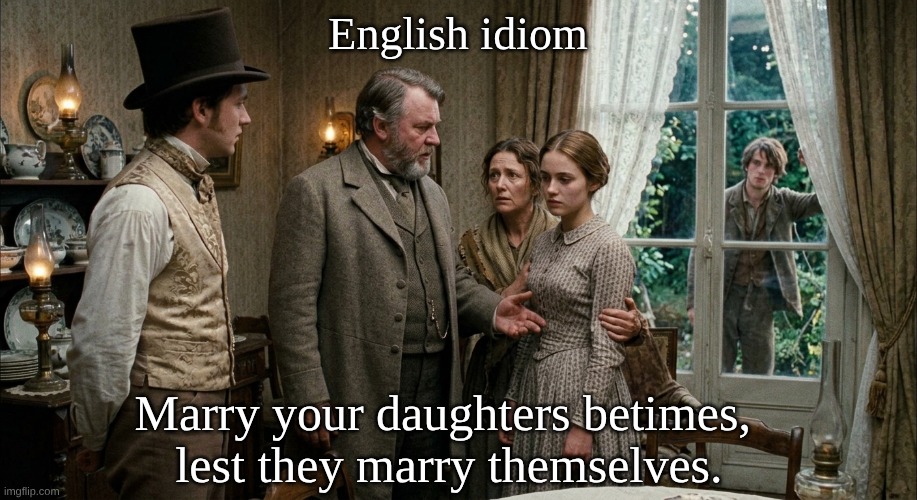
If you lie down with pigs, you’ll smell like one.
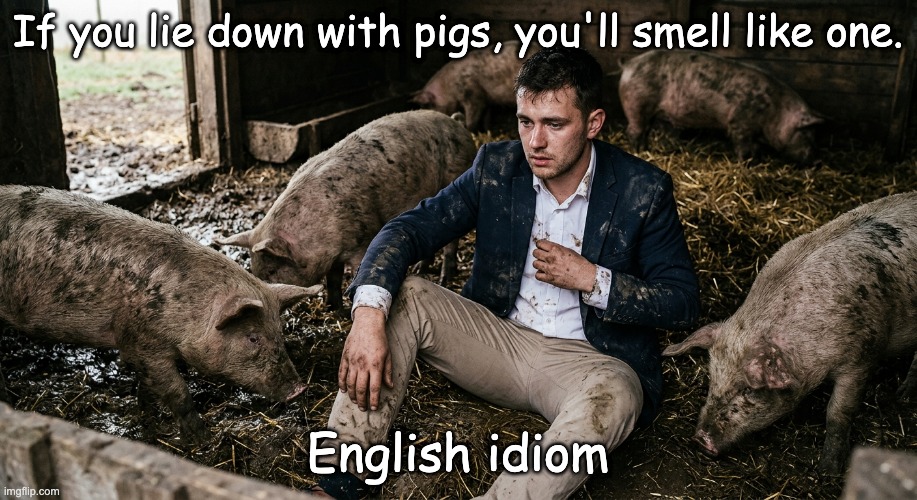
💡 Figurative sense: The image is very direct: If you literally lie down with pigs, you will end up smelling like pigs. Figuratively, if you surround yourself with people of poor character, their habits or reputation will “stick” to you. 🏛️ Origin: Is this an old proverb? Yes — but the ‘exact wording with “pigs” is not a famous classical proverb with a clearly traceable first source’. It appears to be a ‘folk-style variation’ of older proverbs such as: “He that lies down with dogs shall rise up with fleas.” “If you lie down with dogs, you get up with fleas.” These older forms have been known for ‘centuries’ and express the same idea: close association with undesirable people brings unpleasant consequences. Likely background: The “pigs” version seems to be: a ‘modern adaptation’, more rustic or colorful, and based on the same traditional moral lesson. ✍️ Author: ‘No single confirmed author is known’ for the exact phrase: “If you lie down with pigs, you’ll smell like one.” It is best described as a ‘proverbial or anonymous saying’, not a quotation with a definite author. 📚 Related sayings: Here are similar idioms and proverbs: “If you lie down with dogs, you get up with fleas.” “Bad company corrupts good morals.” from ‘1 Corinthians 15:33’ in the Bible: “A man is known by the company he keeps.” “He who touches pitch shall be defiled.” an older proverbial idea meaning contact with corruption stains you.
Too lazy to wipe his own ass.

To land on one’s feet.

Only by pride cometh contention.

When pride comes, then comes disgrace.

Courtesy costs nothing.

All hat and no cattle.

Often associated with: Ann Richards, former Texas governor, who helped popularize colorful Texas expressions. It has also been used about politicians and public figures who seem impressive but lack depth or results. However, ‘she did not create the idiom’ — she was just one of the public figures who used that style of language. 📝 Example sentence: “He talks like a successful businessman, but he’s all hat and no cattle.”
Everyone has to start somewhere.

Set a beggar on horseback, and he’ll ride to the devil.

This is an ‘old proverb’, not a phrase invented by one clearly known modern writer. Likely background: It comes from a long tradition of ‘European proverbial wisdom’ about sudden elevation in status’. A horseback rider historically suggested ‘rank, authority, and prestige’, since owning and riding a horse was associated with higher social standing. The saying reflects an old moral idea: ‘rapid social rise can expose vanity and lack of self-control’. Related older proverb: A very close earlier form is: “Set a beggar on horseback and he will ride to the devil.” This proverb has been recorded in English for ‘centuries’ and appears in collections of proverbs rather than as a quotation from a single author. ✍️ Author: Short answer: ‘No single definite author is known.’ It is generally treated as a ’traditional proverb / anonymous saying’. Proverbs usually develop through ‘oral tradition’. Later writers may quote them, but that does ‘not’ make them the original author. 📚 Earliest known use: The proverb is often traced in English to ‘early modern proverb collections’. It is associated with ‘John Ray’s’ proverb collections in the 17th century, though he is considered a ‘recorder/compiler’, not necessarily the creator. 🧠 Tone and usage: It can sound ‘critical or cynical’. It suggests that ‘newly gained power may reveal bad character’. Modern caution: Today, some people may see it as: ‘classist’, ‘unfairly generalizing about poor people’. So in modern writing, it is often best used: in ‘historical discussion’, when analyzing ‘power, corruption, or social mobility’, with awareness of its negative stereotype. 📝 Example: ‘After getting promoted, he started treating everyone badly — set a beggar on horseback, and he’ll ride to the devil.’
Power reveals character.

1. Robert G. Ingersoll (1883) — the true originator of the modern phrasing. The original version of the quotation came on January 16, 1883, during a speech in Washington, D.C., by the prominent writer and orator Robert Ingersoll. He said it ‘about’ Abraham Lincoln: “Most people can bear adversity. But if you wish to know what a man really is, give him power. This is the supreme test.” For a few decades, Ingersoll’s praise of Lincoln was widely cited and correctly attributed in American newspapers, but the subject of the quotation appears to have been conflated with its author beginning in the 1930s, and in the present day Ingersoll’s original authorship has been almost entirely eclipsed.
2. Wrongly attributed to Abraham Lincoln. The condensed version — “Nearly all men can stand adversity, but if you want to test a man’s character, give him power” — is today most commonly (but incorrectly) attributed to Lincoln. In reality, Lincoln never uttered or wrote those words, or words to that effect. Rather, they were said about him.
3. Thomas Carlyle (1841). A precursor was crafted by Thomas Carlyle in 1841, making the philosophical observation a recurring theme in 19th-century thought.
4. Robert A. Caro (modern reformulation). The crisp version “power doesn’t corrupt, it reveals” is strongly associated with the celebrated biographer Robert A. Caro. Caro wrote: “We’re taught Lord Acton’s axiom: all power corrupts, absolute power corrupts absolutely. I believed that when I started these books, but I don’t believe it’s always true anymore.” His decades of research into Lyndon B. Johnson led him to conclude that power is more of a revealer than a corruptor. The sentiment is ancient (Plato touched on it too), but the punchy modern form belongs most accurately to Ingersoll and Caro.
The higher they climb, the harder they fall.

People who live in glass houses shouldn’t throw stones.

To put all one’s cards on one thing.

To bite the bullet.

And I’m the Queen of England.

A: “I’m going to win the lottery tomorrow!”
B: “And I’m the Queen of England!”
In this example, B is expressing their strong disbelief that A will win the lottery, implying that A’s claim is just as unlikely as B being the Queen of England. Origin: The idiom is believed to have originated in the late 19th or early 20th century. While the exact origins are unclear, it’s likely that the phrase gained popularity due to the prominent figure of the Queen of England, who represents an unattainable or highly unlikely role for most people. Author: The author of this idiom is unknown. Like many common idioms and phrases, it’s the result of collective usage and has evolved over time.
She is wearing the trousers.

To butter someone up.

1. Religious Rituals (Ancient India): This is a popular theory, particularly in online circles. It suggests a connection to the ancient Hindu practice of offering ghee (clarified butter) to deities as a sign of respect and to curry favor. While the ‘act’ of offering something valuable to gain favor is similar, the direct linguistic link from an ancient Indian practice to a modern English idiom is difficult to trace and might be a later interpretation.
2. Bread and Toast Metaphor (18th Century England): This is a strong contender, linking the phrase directly to the sensory experience of butter and bread. Metaphor of Smoothening and Making Pleasing: The action of spreading butter onto bread makes it easier to eat and enhances its flavor. Similarly, “buttering someone up” is seen as making them more “palatable” and receptive, easing the process of interaction and potentially making them more agreeable to your wishes. The idiom effectively uses the idea of smoothing out edges and making something more desirable as a metaphor for manipulating someone’s mood. Early Usage in English: The first recorded usages of “to butter up” in English date back to the late 18th century, making this timeframe crucial for understanding its development. Examples can be found in 18th-century writing and dictionaries, with meanings relating to flattery and excessive praise becoming firmly established. ✍️ Author and Specific Text: It is generally accepted that this idiom is a colloquialism that arose organically within the English language, primarily as a metaphor relating to a common culinary practice (spreading butter on bread). Therefore, it cannot be attributed to a single author or a specific text. Collective Language Development: Idioms typically evolve through widespread usage over time within a language community. The phrase gained popularity because the metaphor was clear, relatable, and resonated with people’s shared experiences. The Metaphor is Key: The success of the idiom lies in its metaphorical power. The physical act of buttering bread provided a perfect analogy for the social act of softening someone up with flattery. No one person “invented” the concept; rather, the language naturally adopted a metaphor that was universally understood and easy to grasp. Attributing to an Author: Sometimes idioms are mistakenly attributed to famous authors, but in this case, there’s no evidence pointing to any single figure. It’s a testament to the dynamic and collaborative nature of language that such common expressions can emerge from the collective imagination of a people.
It’s hard to eat cherries with the powerful.

Lose trach of.

Figuratively, it means ‘following progress’, ‘keeping a record’, or ‘staying aware’. So “losing track” means ‘failing to continue following something’. 🔹 Origin: The expression comes from the older meaning of “track” as: a ’trail’ ; a ‘course to follow’ ; a ‘set of marks’ ; something that helps you ‘keep your way’. 🌿 How the meaning developed: Originally, if you were ’tracking’ something, you were literally following its trail. Over time, English speakers began using ’track’ more figuratively: keep track = keep count / remain informed; lose track = stop following / forget / become unaware. So the phrase likely developed naturally from the idea of: ‘following a trail → following information/progress/time.🔹 Author: ❌ There is ‘no known single author’ of “losing track” or “lose track of.” It is ‘not a quotation invented by one writer’. It is a ‘common English expression’ that evolved gradually in everyday usage. Important note: Many idioms in English: do ‘not’ have one identifiable creator; grow over time through common speech; become fixed expressions after repeated use.
To jump from one thing to another.

Author / Coiner: There is ‘no single author’ credited with coining this phrase. It evolved organically from everyday language and the French idiom above. The word ‘jump’ itself first appeared in English around the 1520s, with no clear source in Old or Middle English — possibly imitative in origin, or borrowed from Gallo-Roman dialects during the Hundred Years’ War. In shorts: This is a centuries-old metaphor rooted in the physical act of leaping — applied to the mind’s tendency to leap erratically between ideas. Its trail leads back to 16th-century France and England, but no single writer invented it; it grew from common speech.
Make a clean breast of it.

Get It Off Your Chest: This emphasizes the feeling of relief that comes with confessing. Spill Your Guts: This is more informal and dramatic, often suggesting a forceful or emotional confession. Spill the Beans: This means to reveal a secret, but not necessarily about a personal wrongdoing. So, when someone says “make a clean breast of it,” they’re encouraging honesty and the courage to face up to one’s mistakes. It’s about letting go of the burden of secrets and moving forward with a clear heart and mind. 🌟
To crap oneself / To shit oneself.

You can’t take it with you.

Time flies.

To Roast someone.

To know the ropes.
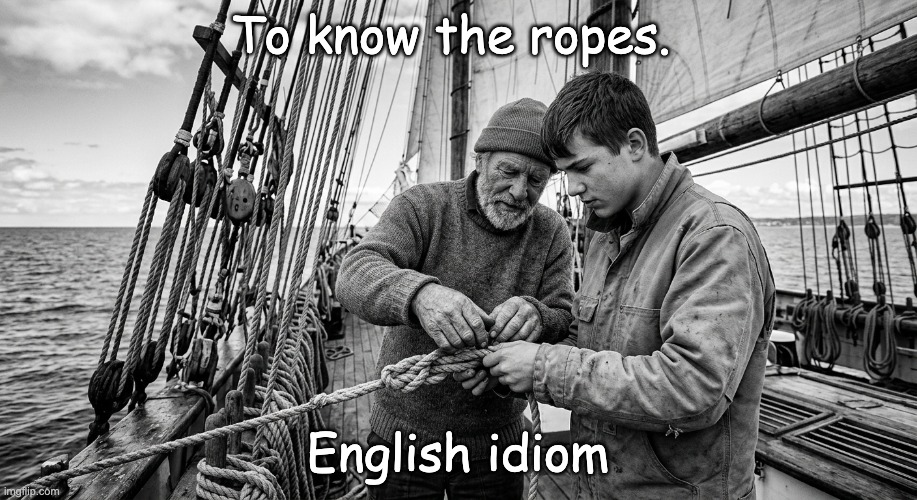
Monkeys want to break the mirrors that reflect their ugliness.

Blaming the Messenger: Instead of addressing their internal issues, they attack the person, situation, or tool (“the mirror”) that reveals or points out those issues. Destroying the Evidence: The act of “breaking the mirror” represents attempting to destroy or silence whatever is forcing them to see themselves clearly, in the hope that the flaw will disappear along with the reflection. Short-sightedness: In the metaphor, breaking the mirror doesn’t make the monkey beautiful; it just removes the ability to see reality. Similarly, suppressing criticism or ignoring truth doesn’t solve the underlying problem. In summary: It is an observation on how people would rather destroy a source of truthful (but unpleasant) information than confront their own defects. 🌎 Origin: Core Concept: The idea of attacking a “mirror” that reflects an unpleasant reality is a recurring theme across many cultures and is often linked to fables about human nature. The fable of the “Monkey and the Mirror” exists in various forms, including collections attributed to Aesop. The Fable Framework: Fables often use animals (like monkeys) as stand-ins for human traits. In this case, the monkey represents human vanity or a defensive ego. Idiomatic Proverb: While the underlying fable is old, this specific phrasing acts as a punchy, idiomatic summary. While difficult to pinpoint a single “first time” it was said exactly this way, it belongs to a category of universal folk wisdom about self-delusion. ✍️ Author: Attributed to Folk Wisdom/Aesop (Traditional): There is no single known individual who can definitively be credited with originating this exact idiom. Like many proverbs, it is considered a piece of collective folk wisdom that has evolved. Due to its fable-like structure, it is often associated with the broad traditions of Aesop, but a specific, traceable original story by Aesop with this exact quote is difficult to verify. Attributed to Arthur Schopenhauer (Often misattributed): In modern online quote databases, this idiom is frequently and incorrectly attributed to the German philosopher Arthur Schopenhauer. The misattribution likely stems from his writing on similar themes, such as vanity and human folly. For example, he did write: “A man is rarely as bad as he makes himself out to be. We tend to judge people on their appearance…” or “Every man takes the limits of his own field of vision for the limits of the world.” While related, these are not the idiom from your image. Therefore, the author is best described as “Traditional,” with the sentiment frequently—though incorrectly—linked to Schopenhauer.
You can’t make a silk purse out of a sow’s ear.
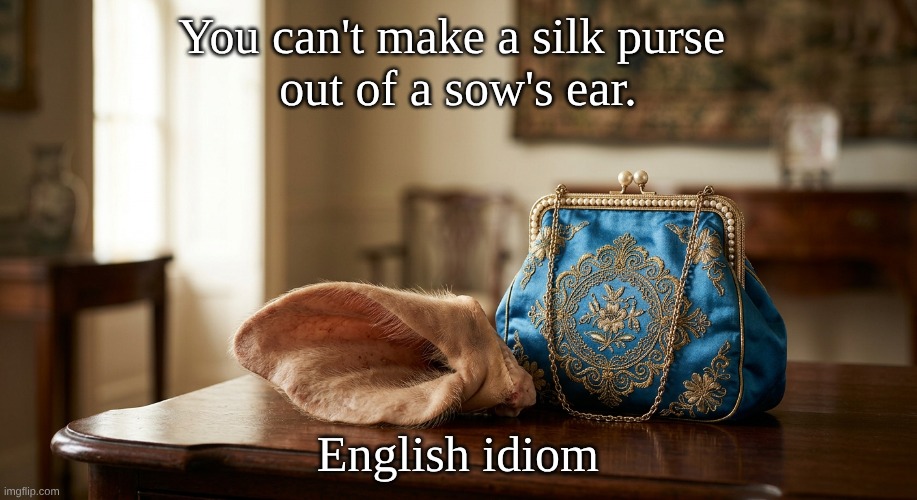
To be on the horns of a dilemma.

This has neither hand nor foot.

I’d stake my life on him.

To have a fire in one’ s belly.

To play jokes.

To drag something in by the hair.

That goes below the belt line.
The bigger they are, the harder they fall.

To be out to pasture.

To let grass grow over something.
To pull yourself up by your bootstraps.

The higher the monkey climbs, the more he shows his tail.

Origin and Author 🌍: This proverb is widely recognized as an African proverb. It’s difficult to pinpoint a single author because proverbs are typically orally transmitted wisdom that evolves over generations within a culture. They are often anonymous and become ingrained in the collective consciousness of a people. While specific regions or tribes in Africa might have their own variations or slightly different interpretations, the core message is universal and resonated strongly within many African societies that value humility and perceive a connection between character and one’s actions, especially when in a position of authority. So, while we can’t name a single author, its roots are deeply embedded in the rich oral traditions of the African continent.
Don’t be a laughing stock.

Pigs might fly.

You can’t teach an old dog new tricks.

Give a dog a bad name and hang him.

Fine Feathers Make Fine Birds.

Don’t let the wolf into the sheepfold.

To let things slide.

Follow in someone’s footsteps.
To sail under false colours / False colors

Better safe than sorry.

“An ounce of prevention is worth a pound of cure.” (commonly associated with Benjamin Franklin) ✍️ Author : No single confirmed author is credited with inventing the idiom. It’s considered a traditional proverb/idiom that emerged through common usage rather than being coined by one identifiable person. 🌍 Notes on usage: Tone: practical, informal, everyday ✅ Used when: Advising caution. Justifying an extra safety step. Making a preventive choice.
To be neither flesh / fish nor good herring.

To take credit for someone else’s work.

To cut the Gordian knot.

A mnemonic.

To the bitter end.

To get a rise out of someone.

Register & Nuance 📌: Informal; common in everyday speech. Often implies intent: the provoker is trying to “bait” the other person. Synonyms & Near-Equivalents 🔁: Provoke, needle, bait, wind up (BrE), push someone’s buttons, get under someone’s skin. Related idiom: “Don’t take the bait.”
Like a bull in a china shop.

To walk on eggshells.

A dog in the manger.

It’s not about winning, it’s how you play the game.

Through thick and thin.

To speak with one voice.

Synonyms: “present a united front,” “speak in unison,” “sing from the same hymn sheet” (UK), “be on the same page.”
In bed together.

To put/turn/tighten the screws on someone.

To beat around/about the bush.

Cash on the nail.

Market-counter/merchant practice (popular explanation) 🛒 In several British and Irish trading cities (famously Bristol and Cork), deals were concluded on brass-topped posts or counters called “nails,” where payment was placed “on the nail.” These “nails” date to the late 16th–17th centuries and likely reinforced the expression. Whether they originated the phrase or were named for an existing practice is unclear.Counter/cask “nail” or metal studs 🔩. Some suggest payments were placed on the “nail” (a studded counter or the head of a cask) as a visible, decisive act—another route to the same metaphor: Immediate, public settlement. Most lexicographers note the precise source is uncertain, but the idea of visibly placing payment “right now” is consistent across the explanations. Timeline and attestations ⏳:
“On the nail” (meaning “immediately, without delay”) is recorded in English by the late 16th to early 17th century. “Pay (or paid) on the nail” becomes common in the 17th century. “Cash on the nail” is a later, transparent variant that emphasizes the form of payment (cash), widespread by the 18th–19th centuries. Variants and related idioms 🔁: Pay/paid on the nail; money on the nail. Money up front; cash up front; money on the table. Close cousin: “cash on the barrelhead” (U.S.). Parallels in other languages: French: Payer rubis sur l’ongle; payer comptant. Italian: Pagare sull’unghia. German: Bar auf die Hand; Geld auf den Tisch. Register and usage 🎯: Slightly old-fashioned but still understood, especially in British & Irish English. Tone: Firm/no-nonsense; businesslike. Author 👤: No individual author. It’s a traditional idiom that evolved in trade and everyday speech. Sources and notes 📚: Major dictionaries (e.g., OED), phrase / etymology references (e.g., Brewer’s, Etymonline) note early modern attestations and the uncertain but well-motivated origins (Romance-language influence and/or market “nails”).
As clear as mud.

The devil is God’s ape/monkey.

Author 👤: No unique author: It is a traditional, early Christian saying. Early attestations / attributions: Tertullian (c. 160–220): often cited as a source of the formulation/idea.
Augustine (354–430): extensively develops the imitation motif. Luther (1483–1546): widely popularized the saying in German. Variants and translations 🌍: Latin: Diabolus est Dei simia; Satan simia Dei. German: Der Teufel ist Gottes Affe. English: The devil is God’s ape/monkey. Dutch: De duivel is Gods aap. Examples of use 📎: Warning against “false” sacraments or miracles that imitate true religion. Criticism of pseudo-piety or ideological copies of Christian truths. General: Indication that evil often masquerades as something good. Further reading 📚: Tertullian, De Baptismo (on demonic imitation of rituals). Augustine, De civitate Dei and other works (on demons and imitation). Martin Luther, sermons, and Tischreden (where the German form appears frequently).
To read tea leaves.

That’s strong stuff.

You could read the paper through this tea / coffee / beer.

A different kettle of fish.

To push up daisies.

Something’s fishy.

“I don’t trust his explanation; something’s fishy about it.” “When she changed her story, I thought something was fishy.” Conclusion:
“Something’s fishy” is a metaphorical expression that conveys skepticism and is widely recognized in English-speaking cultures. 🐟🔍
To use someone as a cat’s paw.

To have a long face.

Cultural Reference: It reflects a common human experience where emotions are expressed through facial expressions, making it relatable across different cultures. Author: Authorship: There is no specific author attributed to this idiom, as it is a part of the colloquial English language that has evolved over time. Idioms like this often emerge from everyday speech rather than being penned by a single individual. Additional Information: Synonyms: ¨To look glum¨; ¨To have a sour expression” . Usage in Sentences: “When she heard the news, she had a long face all day.” Conclusion: The idiom “to have a long face” effectively conveys feelings of sadness and disappointment through a vivid visual metaphor, and it has become a staple expression in the English language.
Toasting to beauty with a pint.

When the fish is caught, the sharks come.

To be stranded.

Barking up the wrong tree.
The chick thinks it knows better than the hen.
To have broad shoulders.

Hope gives life.

Like trying to catch smoke with your bare hands.

He is a safe harbor.

In safe harbor

As honest as the day is long.

From old beams one carves new spoons.
Even the best fisherman lets a fish escape.

To affix one’s seal to something.

Other people are also people.

Slippery as an eel.

From A to Z.

No fish escapes the net.

To be broke.

Break the ice.

Xantippe.

To put something on the line.

Nothing stops the flow.

Bring your own spoon.

Cultural Relevance: Hospitality is an important aspect of human interaction and connection. Modern Usage: Still relevant in conversations about hospitality, although the original meaning may be less well-known.
You don’t know what spoon you’re stirring with.

Christmas is a time when dreams can come true.

Christmas is a time for giving.

To make someone laugh until they cry.

Sabbath Journey.

We have neither word nor sign from him.

Good advice is expensive.

Quintessence
Draw the line.

Origin: The expression derives from the metaphor of placing posts and fences to demarcate a certain area. This symbolizes the idea of demarcating what is and isn’t permitted. There is no specific author associated with this expression, as it is folk wisdom that has evolved into the English language over time. The use of such expressions is often anonymous and culturally determined.
Oh dear!

He knows the ropes.

It weighs heavily on his mind.

He’s got a screw loose.

To name and shame.
To say yes to everything.

Fools don’t blush.

Send someone packing.

Good fortune is fragile.

Visit begets visit.

A despised torch/firebrand.

Life is a seesaw.

Every flow must have its ebb.

Origin: An old proverb with its roots in maritime history. For seafaring trading nations, the metaphor of ebb and flow was an obvious comparison for the changing fortunes of trade.
Fortune is like the tide.

Caught in the act.

He/she had it coming.

He can’t tell A from B.
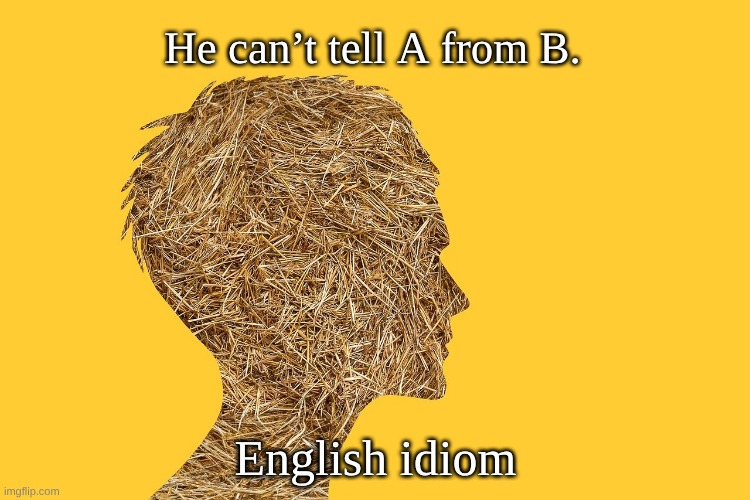
To spoon-feed someone.

Imbued with it from childhood.

To tilt at windmills.

Origin: Comes directly from the famous Spanish novel Don Quixote (El ingenioso hidalgo Don Quijote de la Mancha) by Miguel de Cervantes, published in 1605 (part I) and 1615 (part II). In one of the most famous scenes, Don Quixote sees windmills in the distance and thinks they are giants. He charges at them, gets tangled up in the blades and is knocked over.
To get on someone’s nerves.

To live on one’s nerves.

It gets on my nerves.

Origin: The saying dates back to the 19th century, a time when the word “nerves” was still used quite literally: the idea that emotions, tensions or overstimulation were located in the “nerves”. In old medical and colloquial language, any form of nervousness or psychological tension was attributed to “the nerves”. There is no specific author; it is a colloquial expression that developed organically in Dutch.
A lot of water will have to flow under the bridge before…

The imagery is simple: it refers to a large, constantly flowing river. When you say that a lot of water still has to flow, you mean that a lot of time has to pass, just like the water that flows incessantly and never stops.
Origin: The saying comes from popular parlance and dates back to the 19th century, possibly even earlier.
This is similar to old proverbs that link time and rivers (as in several European languages). Rivers traditionally serve as a metaphor for the passage of time.
Killing time.

Origin: Comes from general European usage and is not linked to any one author. It is an idiomatic expression that has been used in various languages since the 16th–17th century. The origin lies in the metaphor of time being represented as something alive or active that you can “kill”, i.e. eliminate or render harmless. In reality, it means letting time pass without purpose.
Being thrown in at the deep end.
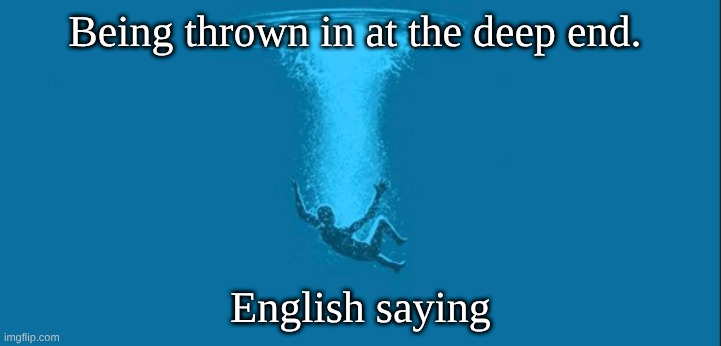
To have bread on the table.
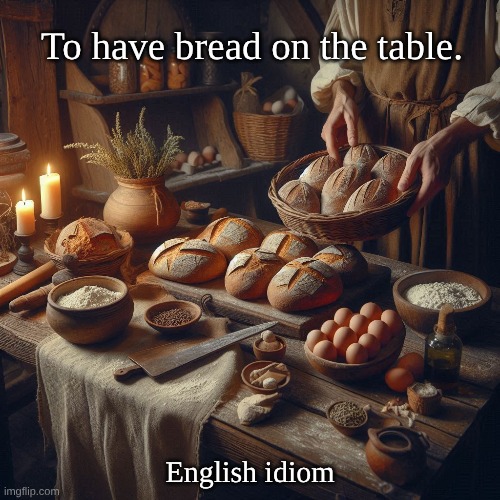
To water something down.

You “dilute” your own wishes, as it were, so that cooperation or peace becomes possible. Origin: Traditional folk saying. The expression comes from the ancient European drinking culture.
In classical antiquity (particularly among the Greeks and later also the Romans), wine was almost always diluted with water. Drinking pure wine was considered uncivilised or unhealthy.
Someone who was willing to add water to their wine showed that they were willing to keep the peace, avoid conflict or take a more moderate stance. In the Middle Ages and early modern times, this imagery remained: adding water to wine weakens the taste → figuratively: you weaken your position to make it acceptable to others.
It all went off the rails.

He doesn’t know the first thing about it.

The straw that breaks the camel’s back.

To pull someone over the table.

To put obstacles in someone’s way.
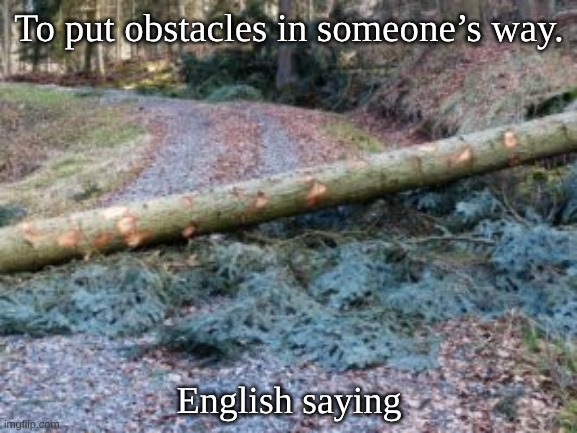
Swear by all that is holy.
A friend in need is a friend indeed.

To be thick as thieves.
In older forms of English (and also in other Germanic languages), dik often meant close, strong or intense. This meaning of “dik” as “close or strong” can already be found in texts from the 17th century.
Can’t make heads or tails of it.
To be at one’s wit’s end.

Origin: The expression comes from Medieval Latin education.
At the time when Latin was the language of science and education (the Middle Ages until the 18th century), it literally meant: someone has reached the point where he no longer knows what to say in Latin — so he has no more words, his knowledge is exhausted. Later it was used figuratively: someone has no more resources or ideas left — he is “at the end of his Latin”.
A prophet for profit.
To swear by heaven and earth.

To be in a foul mood.

Love doesn’t pay the bills.

If you play with fire, you’ll get burned.

If you tease a dog, expect to get bitten.
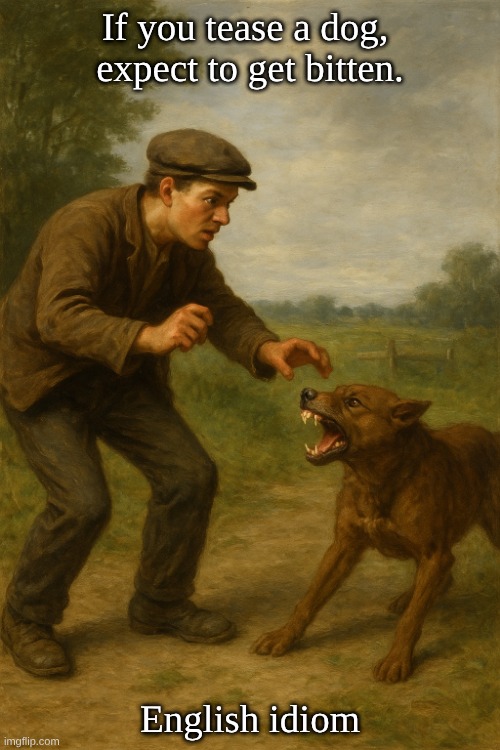
Better to keep your mouth shut and appear stupid than open it and remove all doubt.

Time flies when you’re having fun.

Meaning: The saying emphasises the transience of life and the need to use time wisely. Origin: Virgil (c. 29 BC)
Time Flies.

Take a step back to see the bigger picture.

To take to one’s heels.

Where there’s a will, there’s a way.

Origin: This expression dates back to the 17th century. The earliest known version comes from the Latin work Jacula Prudentum (1640) by the English poet and preacher George Herbert, which states:
“To him that wills, ways are not wanting.”
This literally means: “For him who wills, ways are not wanting.”
The modern form of the saying, as we know it today, appeared in English-language publications around the early 19th century.
To be on top of the world.

To reinvent the wheel.

Whatever you do, do it with all your heart.

It’s not what you do, but how you do it.

The reputation of a thousand years may be determined by the conduct of one hour.

A broken vase can be mended, but the cracks will always show.

I can’t see the wood for the trees.

It’s right under your nose.
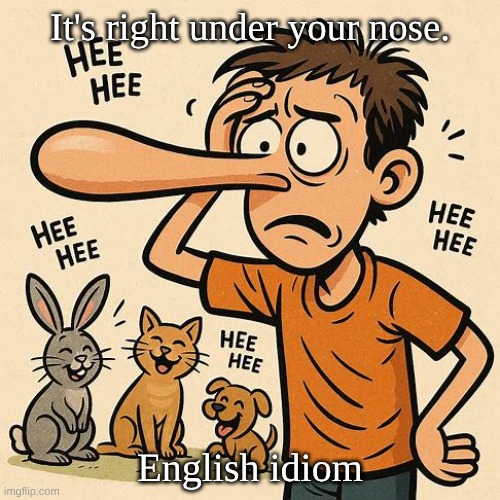
Between a rock and a hard place.

To eat humble pie.
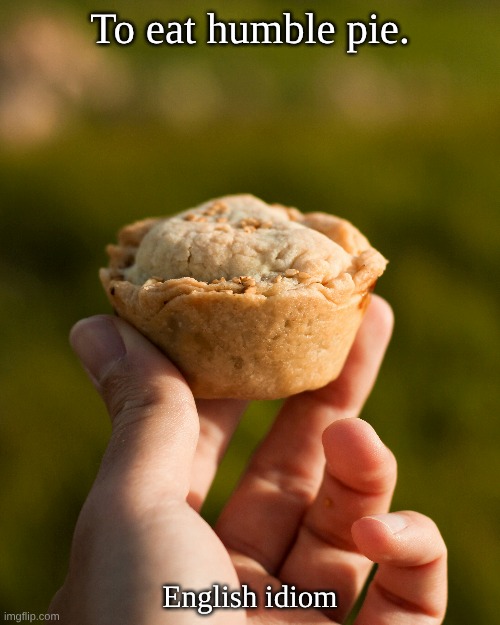
See no evil, hear no evil, speak no evil.
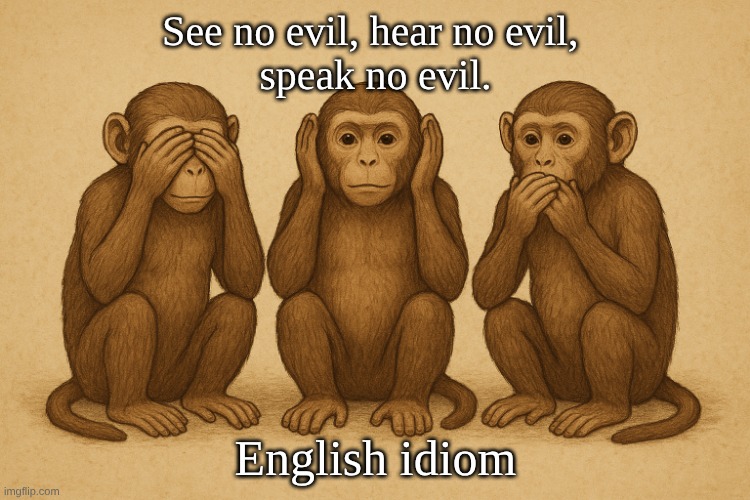
Origin: The saying comes from Japan, where it was associated with a sculpture at the Tōshō-gū shrine in Nikkō as early as the 17th century. There are three wood carvings of monkeys depicting the rule.
To have blinkers on.

Where the buses don’t run.

In the middle of nowhere.

No-man’s-land.

Just wait and see.

Too much familiarity breeds contempt.

Absence makes the heart grow fonder.

Those who sow in tears shall reap with shouts of joy.
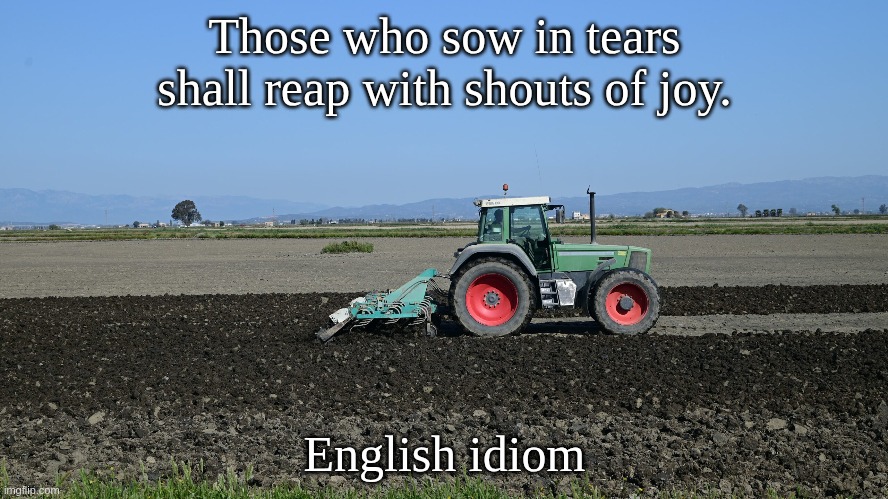
Vale of tears.

He was crying buckets.

Good fences make good neighbors.

Neither a borrower nor a lender be.

When poverty comes in at the door, love flies out of the window.

You are known by the company you keep.

Experience is the best teacher.

Old love does not rust.

Still wet behind the ears.
The image derives from a newborn child whose amniotic fluid (or the white vernix) behind the ears hasn’t yet dried—a spot that, like the armpits and groin, stays moist for a while. A Dutch reference dates back to 1612: the Amsterdam writer Gerbrand Bredero has a character say in his comedy:
“You’re barely dry behind your ears, and you let them cheat so young?”
Easier said than done.

Red sky at night, shepherd’s delight; red sky in morning, shepherd’s warning.

Where there’s smoke, there’s fire.

A piece of cake.

To pack up one’s traps.
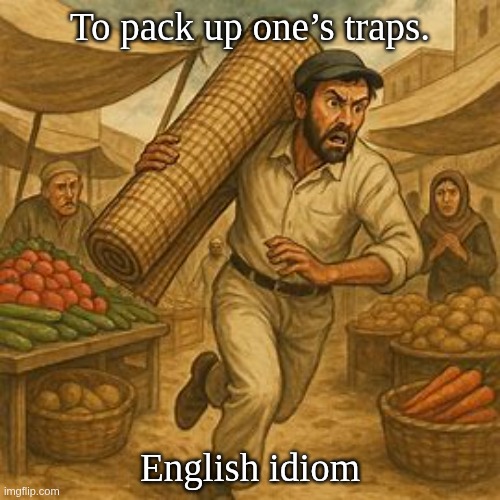
Revenge is sweet.

Actions speak louder than words.

To bend over backwards.

Be thankful for what you’ve got.

Practice makes perfect.

Crime doesn’t pay.

We’ll cross that bridge when we come to it.

True friends are the ones you never see – they’re right behind you.

Walls have ears.

Beat around the bush.

A bad workman blames his tools.

Little pitchers have big/great ears.
Every bird sings according to the shape of its beak – figuratively speaking: Everyone speaks and acts in a manner appropriate to their nature, upbringing, or talent.

To give something a facelift.

When tha cat is away, the mice will play.

The grass is always greener on the other side (of the fence).

The best things in life are free.

One man’s meat is another man’s poison.
Well Begun is half done.

If the shoe fits, wear it.
On the spot.
All work and no play makes Jack a dull boy.

The greatest loneliness is to have no true friend.

Rolling on the floor laughing.

Actions speak louder than words.

Under the weather.

Give him an inch and he’ll take a mile.

Honesty is the best policy.

Never judge a book by its cover.

No news, good news.
Misfortunes never come singly.
Don’t judge a book by its cover.
De pot verwijt de ketel dat hij zwart ziet.
Seize the day!

To thoroughly investigate.

To be fed up with something.

Strike while the iron is still hot.
Don’t put all your eggs in one basket.

False friends are worse than open enemies.

Short reckonings make long friends.
Something is better than nothing.
Forewarned is forearmed.

Dot the i’s and cross the t’s.
The ends justify the means.
You reap what you sow.

What goes around, comes around.

It is no use crying over spilt milk.

Half a loaf is better than none.
– Getting ‘some’ of what you need is better than getting ‘nothing’.
– Even a ‘partial solution’ is preferable to waiting for a perfect one.
📌 Example:
– If you can’t find a full job offer, taking a ‘part-time’ role is still progress—’better than no income’.
🗣️ Origin:
– The phrase is generally traced to the “Bible” —specifically to the “Book of Proverbs” (in the broader tradition of ‘providence vs. delay and the value of “a little”’).
– The most commonly cited wording is similar to:
– “Better is a dinner of herbs where love is…” (Proverbs 15:17, conceptually related)
– And the general idea appears across biblical aphorisms about accepting what’s available rather than getting nothing.
📌 Important note:
The exact modern wording:
“Half a loaf is better than none”,
is older in English proverb collections, but its ‘core idea’ is strongly connected to ‘biblical proverbs’ and later proverb tradition.
✍️ Author:
– It is a ‘proverb’, not a quote from a single named author.
– So there’s ‘no one definitive author’ of the idiom itself.
It’s raining cats and dogs.
It’s raining buckets.

Appearances can be deceiving.

This expression means that ‘you should not judge something or someone solely on their outward appearance’. A person who looks calm might be incredibly anxious, a task that seems simple might be complex, and a place that looks rundown might hold hidden treasures. It’s a warning against superficial judgments and a call for deeper investigation.
📚 Origin:
The core idea of this idiom is ancient and can be found in various forms throughout history and literature, long before the phrase itself became standardized. It’s a fundamental truth about human perception and the nature of reality vs. perception.
Here are a few early examples and parallel ideas:
– “Aesop’s Fables” (c. 6th Century BCE): Many of Aesop’s fables, like “The Wolf in Sheep’s Clothing,” illustrate this exact concept. The outward appearance of the wolf is a deliberate deception.
– Ancient Greek Philosophy: Philosophers like Plato, with his Allegory of the Cave, explored the idea that what we perceive with our senses can be a mere shadow of reality.
– The Bible: There are verses that touch on this, such as 1 Samuel 16:7: “But the Lord said to Samuel, ‘Do not look at his appearance or at his physical stature, because I have refused him. For the Lord does not see as man sees; for man looks at the outward appearance, but the Lord looks at the heart.'”
– Latin Proverb: The Latin phrase “Non omne quod nitet aurum est” translates to “Not all that glitters is gold,” another classic idiom with the same underlying message.
✍️ Author:
Because this concept is so old and has been expressed in so many ways by countless cultures and writers over millennia, there is ‘no single author’ credited with creating this specific idiom.
It is a proverbial expression that has evolved and been refined over time, becoming a part of our shared linguistic heritage. The exact wording we use today is simply the most popular way to convey this universal truth.
In essence, this idiom is a timeless piece of wisdom that reminds us to look beyond the surface, ask questions, and seek a deeper understanding before forming judgments.
To slip through someone’s fingers like an eel.

Silence is the true friend that never betrays.

All that glitters is not gold.
Rome wasn’t built in a day.

All good things come to an end.
All’s well that end well.

All roads lead to Rome.

The origin lies in the literal truth of the statement during the heyday of the Roman Empire. Rome was the political, economic and cultural centre of the empire, and indeed there was an extensive network of roads connecting all corners of the empire to the capital.
Make a fool of oneself.
A man’s home is his castle.

A change of heart.

It’s all Greek to me.

The wish is father to the thought.

He who laughs last, laughs best.

That’s where the shoe pinches.

The origin of this saying lies in its literal meaning: when a shoe is too tight or does not fit properly, it wriggles in certain places and causes pain or discomfort. This physical experience was transferred to abstract situations to indicate exactly where the difficulty or problem is.
Every begin is difficult.

Still waters run deep.

Patience is a virtue.

The cherry on the top.

Having the wind at your back.

Seeing the glass as half-full or half-empty.
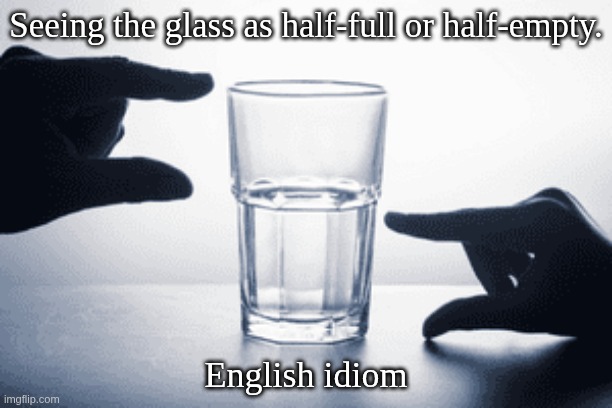
Being all thumbs.

Let sleeping dogs lie.

To have a bone to pick with someone.

He does it with a bleeding heart.

– To do something with ‘great reluctance’.
– To do something that causes you ‘much sorrow’ or ‘pain’.
– To make a decision that is necessary, but which weighs heavily on you emotionally.
Example: The mayor decided with a bleeding heart to close the historical library due to budget cuts. 📚 👤 The Author: There is ‘no specific author’ to be identified who coined this saying. It is an expression that arose organically in the language. ⏳ The Origin: The origin lies in the centuries-old, universal symbolism of the ‘heart’ as the ‘seat of emotions’, particularly ‘love’ and ‘sorrow’. When someone is experiencing intense grief, the emotional pain can be felt physically in the chest area. The metaphor of a heart that “bleeds” (is wounded) visualizes this deep, inner suffering. Similar expressions occur in many languages (e.g., Dutch: ‘met bloedend hart’, German: ‘mit blutendem Herzen’), which indicates a shared cultural and emotional metaphor.
Not have a red cent.
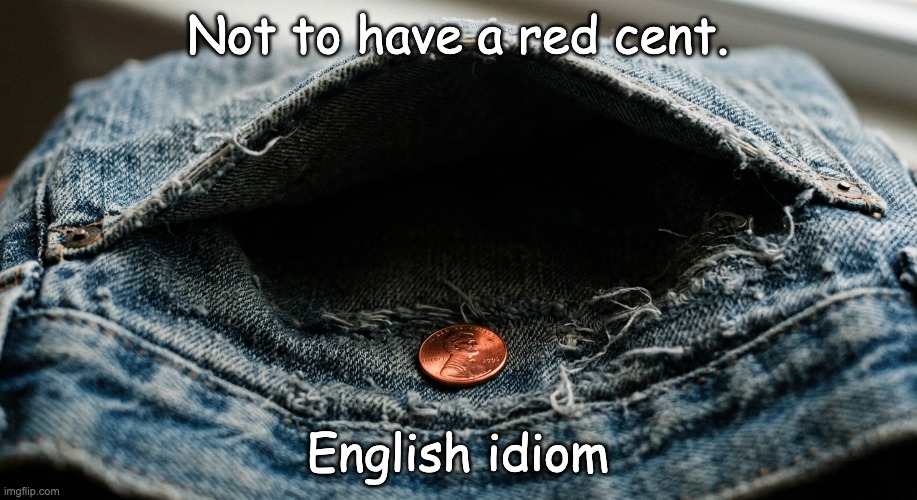
Sitting on his lazy ass.

In half a shake.

Throw in the towel.

Have clean hands.

One hand washes the other.
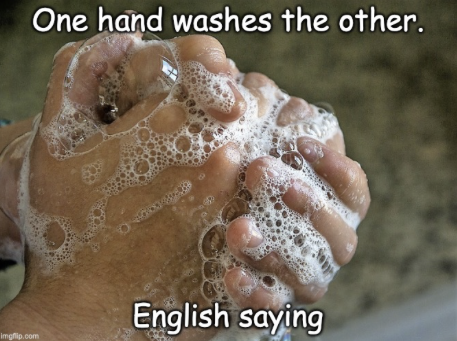
Never look a gift horse in the mouth.
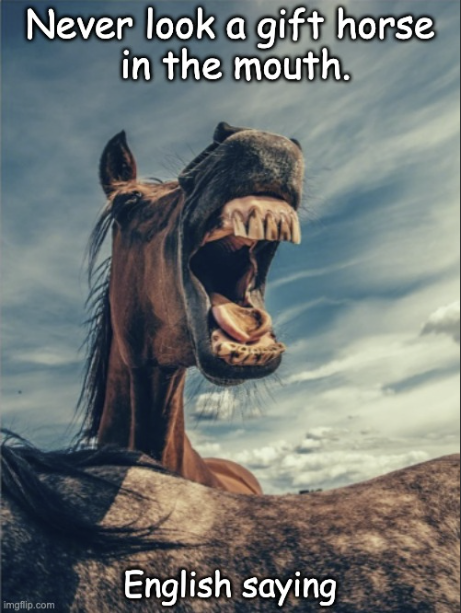
To catch someone on the wrong foot.
To have a frog in the troath.

The penny has dropped.

To hear the grass grow.
To bite the dust.

To have your head in the clouds.
Don’t make a fuss!

Let bygones by bygones.

Almsgiving never made any man poor.
Follow in someone’s footsteps.
To get cold feet.

To put a flea in someone’s ear.

To kill two birds with one stone.
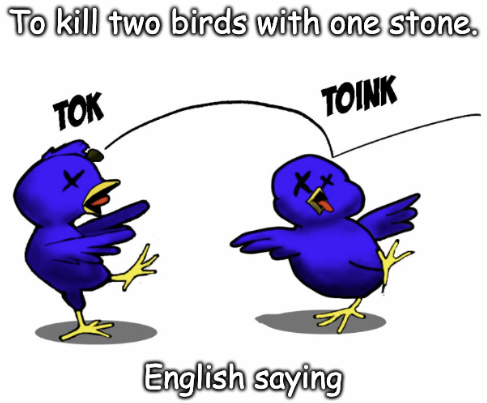
To be neither flesh / fish nor herring.
Get one’s fingers burnt.

Be steady as a rock.

Just hanging out….

” I’m spending time casually” (often with no special plan). ” I’m relaxing / killing time”. ” I’m socializing informally” (alone or with friends). Typical contexts: Someone asks “What are you doing?” → “Just hanging out.” Someone asks “What’s the plan?” → “Nothing—just hanging out.” Tone/nuance: Casual, friendly, low-commitment. Often implies “nothing urgent or structured” is happening. 🧠 Breakdown of the phrase: “just” → “only / nothing more than”. “hanging out” → “spending time informally”. So the whole phrase emphasizes: “Nothing special—just relaxing/socializing.” 🕰️ Origin & history (etymology) 📚:
1) Older literal meanings of **hang out**Historically, **“hang out”** literally meant: to “hang outward” or “protrude” (e.g., “the sign hangs out”); to “display” something outward (e.g., a sign, a flag). This literal sense is “much older” than the “relax/socialize” meaning. 2) How it shifted into the modern social meaning: The “spend time / loiter / socialize” sense likely developed through steps such as: “hang about / around” → to linger, stay nearby without purpose ; “hang out” → to stay somewhere casually, then “spend time socially”. This kind of meaning shift (from “physically hanging/lingering” → “lingering socially”) is common in English slang development. 3) When did the casual “spend time” meaning become common? The social meaning is especially associated with “modern colloquial English”, strongly popularized in “American English”, and became very widespread in the “20th century” (and is now global via media). ✍️ Author👤: There is “no single known author” of “Just hanging out.” It’s “not a quotation” that can be reliably attributed to one person. It emerged through “everyday spoken usage” (slang evolution), spreading gradually.
Be like a bull in a china shop.
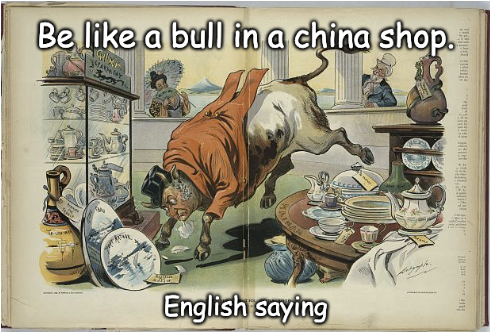
Burying one’s head in the sand.
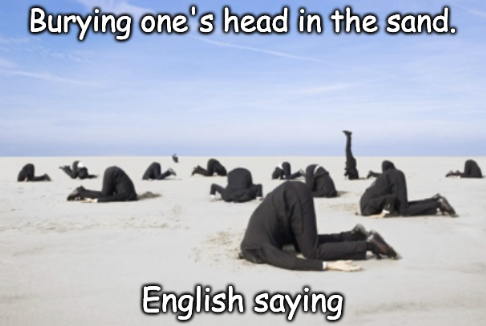
To do some frank talking.

Tell someone the unvarnished truth.

Thwarting someones plans.

To swear stone and bone.
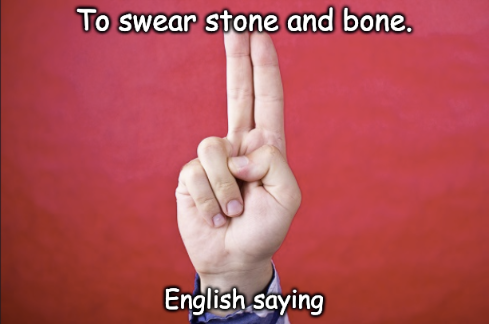
Where there’s a will, there’s a way.

Off-the-cuff
After a storm comes a calm.
The venom is in the tail.

To look for a needle in a haystack.

The wolf may lose his teeth but never his nature.

Speech is silver, silence is golden.

A bird in the hand is worth two in the bush.
A bird cannot fly with one wing.

He that stays in the valley, shall never get over the hill.

A swarm of bees in May is worth a load of hay. A swarm of bees in June is worth a silver spoon. A swarm of bees in July is not worth a fly.
– ‘A swarm of bees early in the season is worth a lot’, because the bees still have enough time to:
– build combs,
– gather food,
– grow into a strong colony,
– possibly produce honey before winter.
– “A swarm in May” is therefore “worth a load/pile of hay”: very valuable.
– ‘A swarm in June’ is still useful, but less valuable: “worth a silver spoon”.
– ‘A swarm in July’ comes too late: it often has too little time to become strong or build up winter stores, and is therefore “not worth a fly”.
In short: ’the earlier the swarm, the more valuable it is to the beekeeper’.
🇬🇧 English origin:
This is an old English beekeeper’s saying:
The shorter form also occurs:
> A swarm in May is worth a load of hay;
> a swarm in June is worth a silver spoon;
> a swarm in July is not worth a fly.
📜 Origin and author:
– The saying is ‘anonymous’.
– It is a ’traditional English folk saying’ from beekeeping.
– There is therefore no known “author” in a literary sense.
– The saying was included in English proverb and agricultural collections, attributed among others to the tradition that was also recorded by collectors such as John Ray in “A Collection of English Proverbs” from the 17th century.
Important: ‘John Ray was not the originator’, but a collector of existing English proverbs. 🌾 Why “hay”, “silver spoon”, and “fly”?
The images were chosen primarily for their ‘rhyme and recognizability’:
– “hay / May”
– “June / spoon”
– “July / fly”
But they also express a scale of value:
1. “load of hay” – great practical value in an agricultural society;
2. “silver spoon” – still valuable, but smaller;
3. “fly” – worth virtually nothing.
🐝 Modern note:
For modern beekeepers, the saying is not always literally true. With feeding, hive management, and artificial swarms, a late swarm can sometimes still be saved. Nevertheless, the core remains correct:
> ‘An early swarm has a much greater chance of developing into a strong, productive bee colony than a late swarm.’
Make a mountain out of a molehill.

His heart sank into his boots.
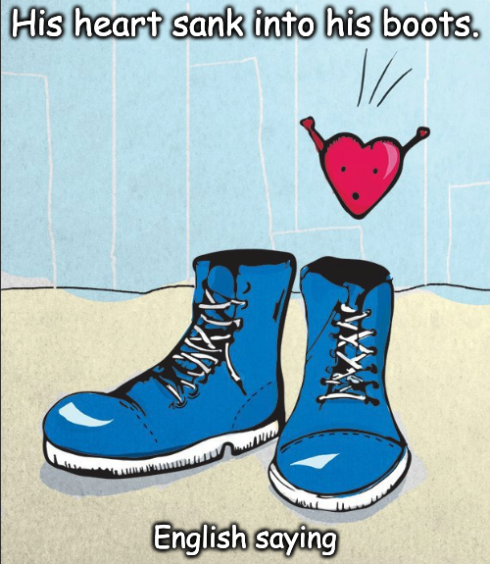
Was in the merry month of May when flowers were a bloomin’, sweet William on his death bed lay for the love of Barbara Allen.

These lines immediately set the tone of the song:
– “the cheerful month of May” and ‘blooming flowers’ evoke an image of:
– spring
– youth
– love
– new life
– In contrast stands:
– William on his deathbed
– dying of heartbreak
– because of Barbara Allen
🎭 Contrast:
The power of the opening lies in the contrast between:
– vibrant nature
– and death / unrequited love
That makes the ballad immediately tragic:
while everything in nature is blooming, William is dying of heartbreak.
🏰 Origin:
“Barbara Allen” is an ‘old English folk ballad’ from the tradition of:
– Scotland
– England
– later also Ireland and North America
📜 Historical background:
– The ballad has been known since the 17th century. – One of the earliest mentions appears in the diary of Samuel Pepys from 1666, where he mentions a “little Scottish song” about ‘Barbara Allen’.
– The text later appeared in various ‘broadsides’ and oral variants.
🎶 Folk song tradition:
Because it is a folk ballad:
– there are ‘many different versions’
– rules vary by region
– names, place names, and formulations sometimes change
The English version of the quote often reads approximately:
> “It was in the merry month of May,
When green buds they were swelling,
Sweet William on his death-bed lay,
For love of Barbara Allen.”
✍️ Author: There is ‘no certain, known author’. – “Barbara Allen” is an ‘anonymous traditional ballad’
– originating from ‘oral tradition’
– therefore not written by one clearly identifiable poet or writer
📚 The ballad is known as:
– ‘Child Ballad No. 84’
– named after ‘Francis James Child’, the collector of English and Scottish ballads
❤️ What is the song generally about? Broadly speaking, the ballad tells the story:
– “Sweet William” is sick or dying
– he has “Barbara Allen” summoned
– she responds coolly or dismissively
– William dies
– Barbara later regrets it
– in many versions, she dies too
– the song often ends symbolically with:
– a ‘rose’ growing from his grave
– and a ‘blackberry/thorn bush’ from hers
– intertwining as a sign of eternal love
A smooth sea never made a skilled sailor.

Pull somebody’s leg.
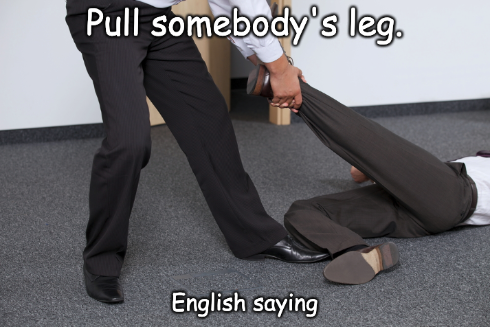

Compare apples and oranges.
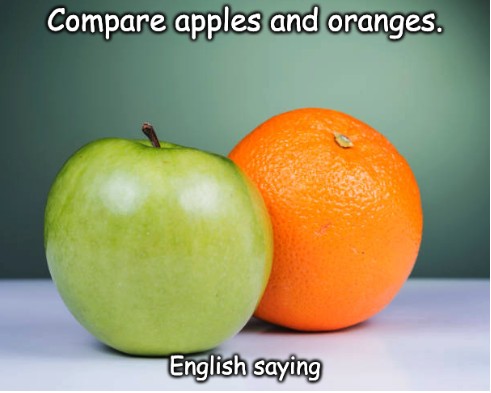
To be at one’s wit’s end.
April weather, rain and sunshine both together.

To give one’s two cents worth.
You’re pulling my leg.

– You’re joking with me
– You’re teasing me
– You’re trying to make me believe something that isn’t true.
It is usually said in a light, playful way.
Example:
> “I won the lottery yesterday.”
> “Really? You’re pulling my leg!”
Meaning: ‘I don’t believe you — you must be joking.’
🕰️ Origin:
The exact origin is ‘uncertain’, but the idiom became common in English in the late 19th century, especially in British and American informal speech.
One common theory is that it comes from the idea of ‘physically tripping someone by pulling their leg’, making them look foolish. Over time, the meaning changed from a physical trick to a verbal trick — ’teasing or deceiving someone for fun’.
✍️ Author: There is ‘no known single author’ of the idiom.
Like many idioms, “pulling someone’s leg” developed naturally in everyday speech rather than being invented by a particular writer or famous person.
In the middle of nowhere.
As through the poplar’s gusty spire, the March wind sweeps and sings, I sit beside the hollow fire, and dream familiar things; Old memories wake, faint echoes make a murmur of dead springs.

Winds of March, we welcome you, There is work for you to do. Work and play and blow all day, Blow the winter wind away.

March winds and April showers bring forth May flowers.

March comes in like a lion and goes out like a lamb.

See which way the wind blows.
Better late than never.