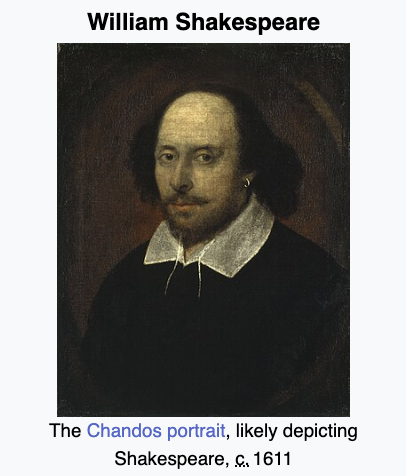
(Stratford-upon-Avon, ± 23 April OS 1564, baptised 26 April 1564 – there, 23 April 1616)
English playwright, poet and actor.
Photo: wikipedia.org
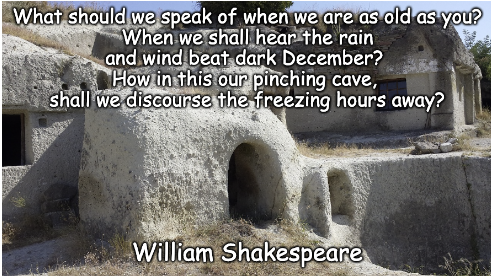
What should we speak of when we are as old as you? When we shall hear the rain and wind beat dark December? How in this our pinching cave, shall we discourse the freezing hours away?
Photo: Aranka Margittal. Meaning: The text evokes themes of: Old age and wisdom: Reflection on the experiences and conversations that occur as time passes. The influence of nature: Rain and wind symbolize the challenges and transience of life. Existential questions: The “constricting cave” can symbolize the limitations and isolation of aging. Origin: From the play “King Lear.” It is often interpreted as a moment of introspection where the characters reflect on the cycle of life and the changes that old age brings. Author:William Shakespeare: One of the greatest playwrights and poets in English literature, active in the late 16th and early 17th centuries. Conclusion: Shakespeare’s work offers a profound reflection on the human experience, and this particular passage invites us to reflect on old age, nature, and the conversations we have about our lives.
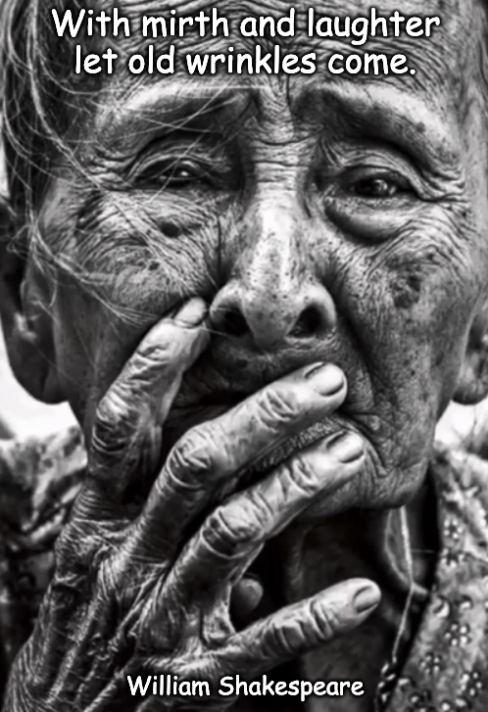
With mirth and laughter let old wrinkles come.
Photo by evangelinar
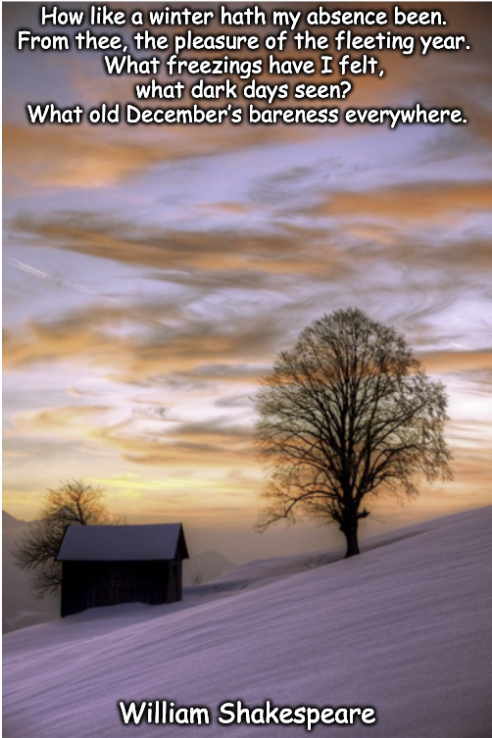
How like a winter hath my absence been. From thee, the pleasure of the fleeting year. What freezings have I felt, what dark days seen? What old December’s bareness everywhere.
Photo by s-usans-blog
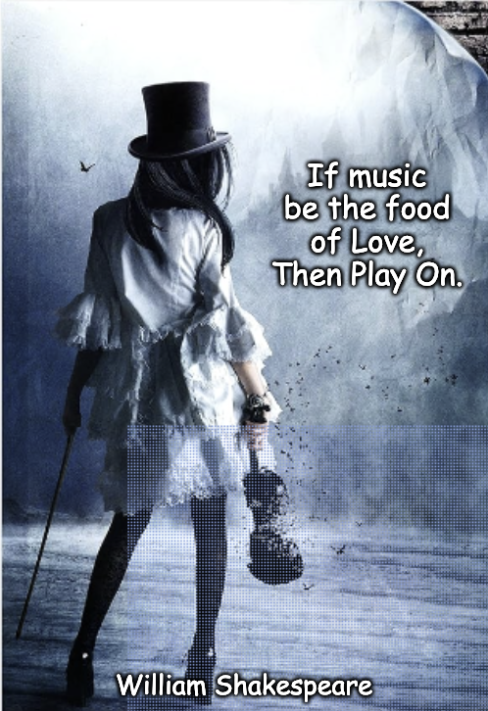
If music be the food of Love, Then Play On.
Photo by Liliana Sanches
The course of true love never did run smooth.
Photo by Lenny Löwenstern
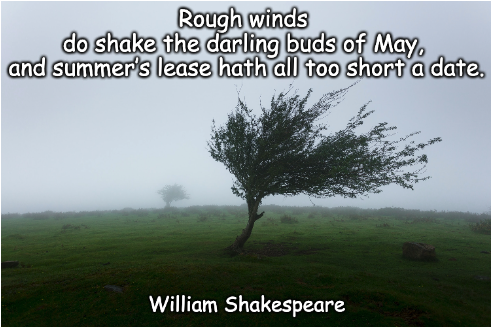
Rough winds do shake the darling buds of May, and summer’s lease hath all too short a date.
Photo: Khamkeo Vilaysing. Meaning 📜 ✨ 🌿 :Literal: “Rough winds shake the sweet buds of May” = harsh spring winds can damage the delicate blossoms and young buds. “the summer lease has too short an expiration date” = summer is short; its “lease term” is running out quickly. 💭 Figurative meaning: Shakespeare is saying here that: beauty is fragile and temporary, nature is not permanently perfect, and even the most beautiful period — summer — passes quickly. In the poem, he uses this to show that the person he is singing about is ‘more beautiful and enduring than a summer day’, because that beauty lives on in the poem. Origin & 📚 Source: 🖋️ Author:William Shakespeare (1564 – 1616).Work: Sonnet 18. Opening line: “Shall I compare thee to a summer’s day?” The original English line reads: “Rough winds do shake the darling buds of May, And summer’s lease hath all too short a date.” Published in 1609 in the collection ‘Shakespeare’s Sonnets’.
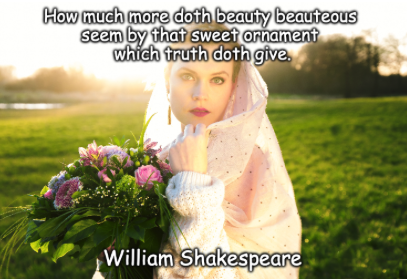
O! how much more doth beauty beauteous seem By that sweet ornament which truth doth give.
Photo by Štefan Štefančík
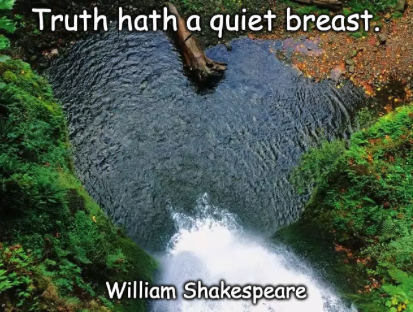
Truth hath a quiet breast.
Photo by Melissa Askew
Love is not love which alters it when alteration finds.
Photo by Ben Kerckx
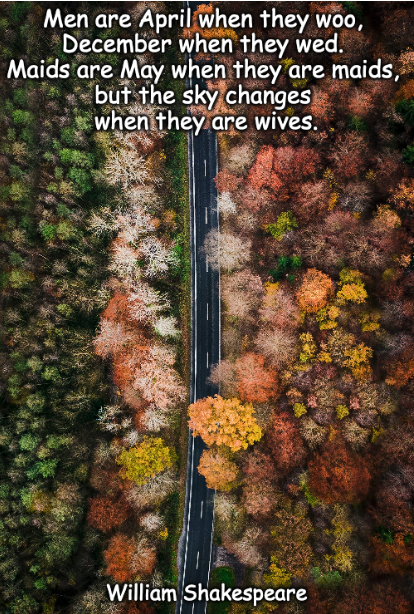
Men are April when they woo, December when they wed. Maids are May when they are maids, but the sky changes when they are wives.
Photo: Fabio Jock. Meaning 📖 : The quote is a metaphorical observation about how people change as their relationship status changes, specifically from the courtship stage to marriage. It uses the months of the year to symbolize emotional states. ‘Men are April when they court’: 🌞 ‘April’: Symbolizes spring, a time of blossoming, hope, freshness and youthful energy. 💐 Meaning: When a man woos (tries to seduce or win over) a woman, he is charming, attentive, full of life and promise, just like spring. He shows his best side. ‘December when they get married’: ❄️ ‘December’: Symbolizes winter, a time of cold, darkness, and often a more sober or reserved atmosphere. 💍 Meaning: Once the man is married and the ‘loot is in’, his attitude may change. He becomes more serious, perhaps more distant, or less romantic. The excitement of the hunt is over and the reality of everyday life (winter) sets in. ‘Maids are May when they are maids’: 🌸 ‘May (May)’: Another spring month, often seen as the most beautiful and flowery month, a time of pure innocence and beauty. 🎀 Meaning: When a young woman (“maid” or “maiden” in the context of the times) is still unmarried, she is seen as at her most beautiful, full of promise, innocence and vivacity, similar to the month of May. ‘but the sky changes when they are wives’ : 🌦️ ‘The sky changes’: This suggests a change in the atmosphere or state of mind. It’s not the constant ‘May’ sunshine anymore. 👰 Meaning: Once the woman gets married and takes on the role of wife, her attitude or how she is perceived changes. The idealization of the “maid” phase gives way to the complexities and responsibilities of marriage, which can lead to mood swings or a change in her character (the air that changes). In summary: The quote is a somewhat cynical or pragmatic view of the transience of romantic ideals and the down-to-earth reality that often follows marriage. It suggests that the passion and charm of courtship (spring) inevitably gives way to the more austere reality of married life (winter/changeable skies). 🎭 The Origin and Author: The quote was written by William Shakespeare. Play: “As You Like It” Context: The quote is from ‘Act IV, Scene 1’. In this scene, the character Rosalind is disguised as a young man named Ganymede. Her lover, Orlando, does not know she is Rosalind and asks Ganymede to help him woo “Rosalind” (by pretending Ganymede is Rosalind). In this particular passage, Rosalind (as Ganymede) warns Orlando about the unreliability and fickleness of men and women in love, using the familiar metaphors of the months.
April hath put a spirit of youth in everything.
Photo: James Baldwin. Meaning: 📜 🌸 The meaning is as follows:Rejuvenation and Vitality: The quote describes how the month of April, a symbol of the full bloom of spring, brings renewed vitality and freshness (“spirit of youth”) to all of nature. Contrast in the Sonnet: In the context of Sonnet 98, however, this description is ironic or even melancholic. The speaker is separated from his beloved in the spring (“From you have I been absent in the spring”). Despite all the liveliness and beauty of April, the speaker cannot truly enjoy it because his beloved is not present. The liveliness of nature actually emphasizes his own sense of loss and ‘wintery’ emptiness, even in the midst of the blooming spring. 🖋️ Origin and Author: This quote was written by the world-famous English poet and playwright William Shakespeare. It comes from one of his most famous works: Work:Sonnets: (a collection of 154 sonnets). Specifically: Sonnet 98. Published: 1609. 🌿 The Original English Text: The full opening stanza of Sonnet 98 reads: “From you have I been absent in the spring, When proud-pied April, dressed in all his trim, Hath put a spirit of youth in every thing, That heavy Saturn laughed and leaped with him.”
How much more doth beauty beauteous seem by that sweet ornament which truth doth give.
Photo by Max Poschau
All things that are, Are with more spirit chased than enjoyed.
Photo by Andrea Piaquado
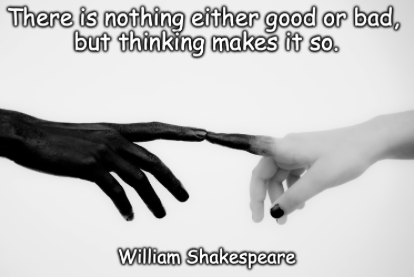
There is nothing either good or bad, but thinking makes it so.
Photo by Rishabh Dharmani
O, while you live, tell truth, and shame the Devil!
Photo by Maksym Vlasenko
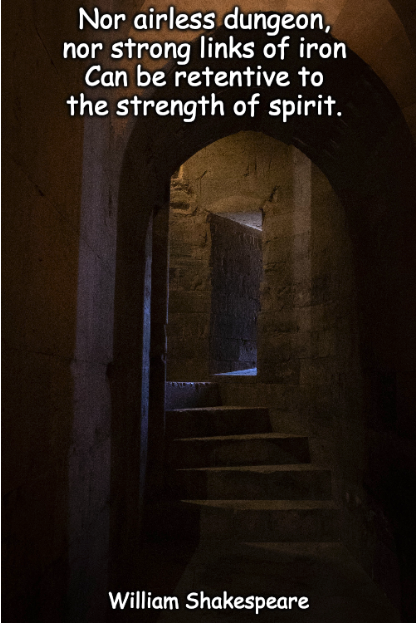
Nor airless dungeon, nor strong links of iron Can be retentive to the strength of spirit.
Photo by Elena Maffioli
I were but little happy, if I could say how much.
Photo by Kal Visuals
No legacy is so rich as honesty.
Photo by Gray
We are such stuff As dreams are made on, and our little life Is rounded with a sleep.
Photo by Vasily Nemchinov
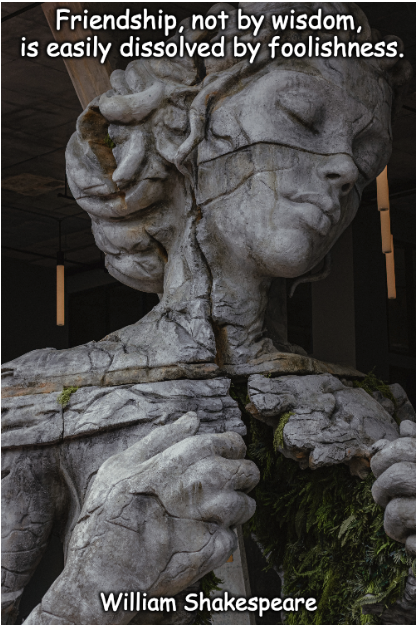
Friendship, not by wisdom, is easily dissolved by foolishness.
Photo by Marianna Smiley
There are more things in heaven and earth, Horatio, than are dreamt of in your philosophy.
Photo by Мельниченко
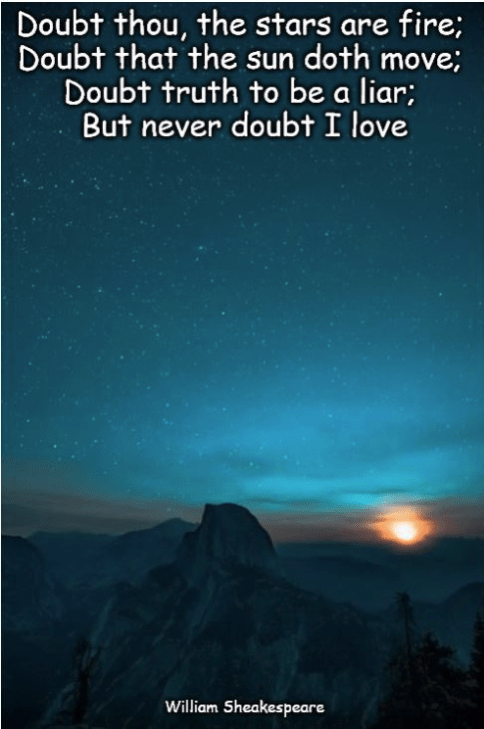
Doubt thou, the stars are fire; Doubt that the sun doth move; Doubt truth to be a liar; But never doubt I love.
Photo by Casey Horner
Hell is empty and all the devils are here.
Photo by Spencer Selover
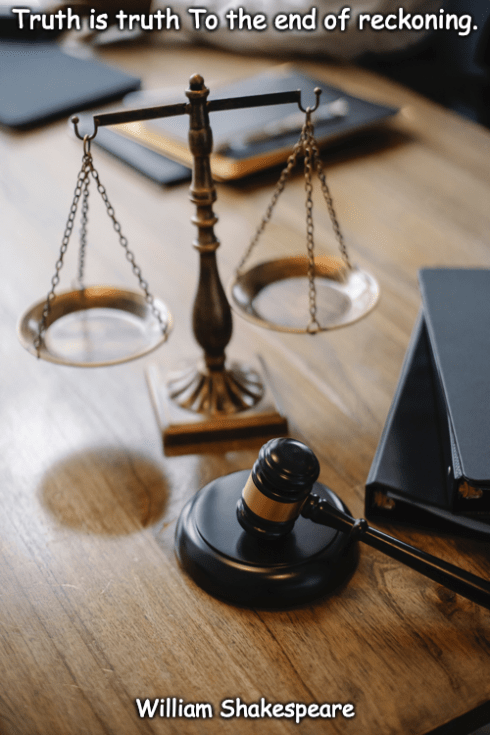
Truth is truth To the end of reckoning.
Photo by Sora Shimazaki
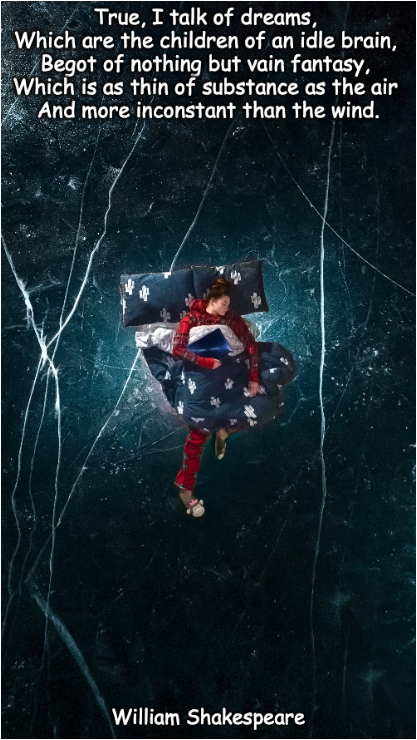
True, I talk of dreams, Which are the children of an idle brain, Begot of nothing but vain fantasy, Which is as thin of substance as the air And more inconstant than the wind.
Photo by Egor Vikhrev
If we are true to ourselves, we can not be false to anyone.
Photo by Louis Droege
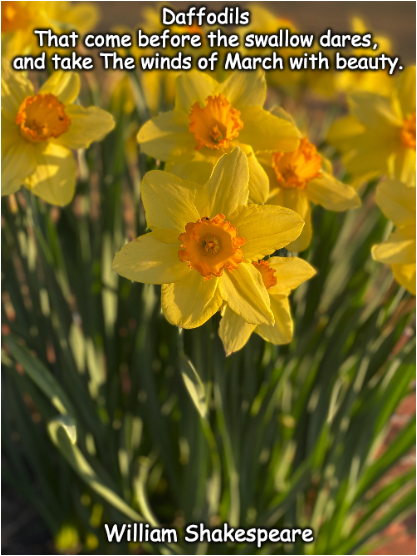
Daffodils That come before the swallow dares, and take The winds of March with beauty.
Photo: Heidi Samuelson. Meaning 🌼📜 🤔: This saying is a poetic hymn to the first spring flowers, in this case the daffodil. It carries a deeper meaning: Braving the elements: Daffodils bloom early in spring, when the weather can still be unpredictable and bleak (“the winds of March”). They have the courage to bloom before other symbols of spring, such as the swallow, arrive. Beauty and resilience: The sentence emphasizes that these flowers not only survive, but actually “receive” the harsh winds with beauty. They transform a cold time into something beautiful. Metaphor for courage and hope: It is often seen as a metaphor for people or ideas that are brave enough to emerge first in difficult times, paving the way for the warmth and beauty that will follow. 🏛️ The Origin: The original text comes from William Shakespeare. It is an excerpt from his play “The Winter’s Tale”, one of his later works (a “romance”). 🖋️ The English Original Text. The quote is from Act 4, Scene 4. It is spoken by the character Perdita, a young woman who, unknowingly, is a princess but has been raised by shepherds. She hands out flowers and describes their beauty: “Daffodils, That come before the swallow dares, and take The winds of March with beauty…” (In modern English spelling and punctuation). ✍️ Author: William Shakespeare. Birth/Death | 1564 – 1616 | | Occupation | Playwright, poet, actor | Nickname | The Bard of Avon (The Bard of Avon) | Known Works | Hamlet, Romeo and Juliet, Macbeth, A Midsummer Night’s Dream, Sonnets. Shakespeare’s Impact: He is considered the greatest playwright of all time and his work has had an inestimable influence on the English language and world literature. His ability to understand human nature and express it in beautiful poetry, as in this quote about the daffodils, is legendary.
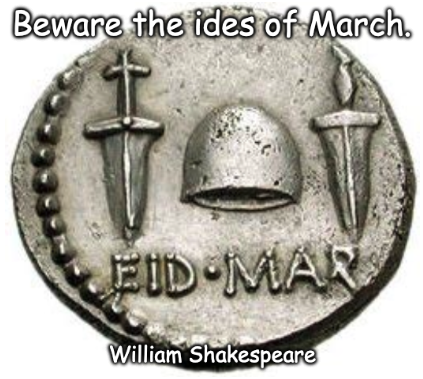
Beware the ides of March.
Photo by bookofdaystales.com. Meaning 🎭: The expression “Beware of the Ides of March” means that you must be alert to danger or misfortune on a specific, often predetermined, date. It is a warning to be cautious, because something negative might happen. 📜 Origin: The origin of this expression lies in ancient Rome and is directly connected to the assassination of Julius Caesar. Ides of March: This refers to the 15th day of the month of March in the Roman calendar. At that time, months were divided into “kalendae” (the first day), “nonae” (the 5th or 7th day), and “idus” (the 13th or 15th day). The Ides of March fell on March 15. Divination: According to tradition (and later recorded by writers such as Plutarch), Julius Caesar was warned by a diviner to beware of the Ides of March. Assassination of Caesar: On March 15, 44 BC. Julius Caesar was assassinated in the Senate by a group of conspirators, including Brutus and Cassius. He ignored the warning, and it proved to be his fateful day. ✍️ Author:Although the warning itself dates back to Roman history, the specific phrasing “Beware the Ides of March” (in English) and its popularization are largely attributable to: William Shakespeare: He used the phrase in his famous tragedy *Julius Caesar*. In the first act, scene 2, Caesar is approached by a soothsayer who warns him: “Beware the Ides of March.” Context in the play: Caesar initially dismisses the warning as “a dreamer,” but the warning lingers and creates a sense of threat throughout the play, until the fateful day arrives. Thus, although the historical event is the origin, Shakespeare anchored the expression in his play and made it famous worldwide.
Friendship is constant in all other things save in the office and affairs of love.
Photo by Josh Hild
Be patient, for the world is broad and wide.
Photo by Vinit Pathak
All the world’s a stage, and all the men and women merely players: they have their exits and their entrances; and one man in his time plays many parts, his acts being seven ages.
Photo by Wendy Wei
Don’t waste your love on somebody, who doesn’t value it.
Photo: jhgarabatos
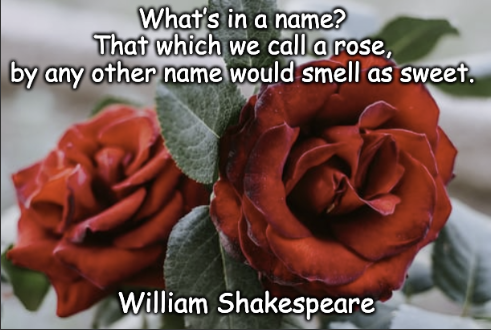
What’s in a name? That which we call a rose, by any other name would smell as sweet.
Photo: Ashkan Forouzani
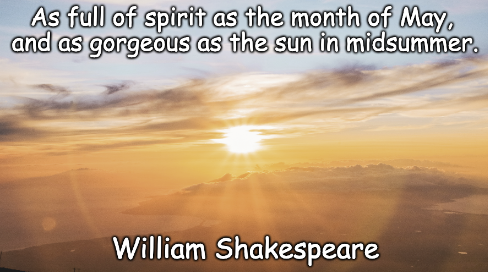
As full of spirit as the month of May, and as gorgeous as the sun in midsummer.
Photo: Neora Aylon. Meaning 📖 ✨ :This sentence roughly means: “full of zest for life, energy and youthful vigor, radiant, impressive and beautiful to see.”The comparison uses two powerful images of nature: “the month of May”🌿 stands for: spring, growth, freshness, vitality, hope and life force, the sun in midsummer ☀️ stands for: full shine, splendor, strength, majesty, beauty. Together, the quote describes someone who is: vibrant with energy, appears charismatic, impressive and almost radiantly present. 🏛️ Origin:This statement comes from: William Shakespeare, Henry IV, Part 1,Act 4, Scene 1. The words are spoken by ‘Vernon’ describing ‘Prince Hal’ (later King Henry V).The passage goes something like this: Vernon talks about how impressive Prince Hal looked in full armor. He depicts him as: young, lively, noble, beautiful, almost superhuman in appearance. The quote is therefore part of a ‘paean to Prince Hal’.👤 Author: William Shakespeare 🎭. Lived: 1564–1616. Nationality: ‘English’. Literary function of the simile: Shakespeare uses ‘figure of speech’ and ‘seasonal symbolism’ here: Why May? May is the symbol of: youth, freshness, romance, natural life force. Why midsummer?Midsummer is the peak of light and warmth: It evokes an image of full glory, brilliance, royal splendor. So the combination suggests someone who: is ‘inwardly full of spirit and fire’ and ‘outwardly radiates with greatness’. 📝🇬🇧 Bonus:Modern English paraphrase: “He was as lively as springtime and as radiant as the summer sun.”
You’d be so lean that the blast of January would blow you through and through.
Photo: watson.ch. Meaning: The saying can be interpreted as a comment on vulnerability and fragility. It suggests that someone is so thin that they cannot withstand the powerful forces of nature or the challenges of life. Origin: This phrase comes from the work of William Shakespeare, one of the most influential writers in English literature. The idea of vulnerability and the influence of nature on humans is a recurring theme in Shakespeare’s works. Author:William Shakespeare (1564-1616) was an English playwright, poet, and actor. He is often called the greatest writer in the English language, and his works are world-renowned. This specific saying may come from one of his plays, although the exact wording may vary depending on the translation. Conclusion: The saying reflects the themes of vulnerability and the influence of environment in Shakespeare’s works. The use of powerful imagery and metaphors is characteristic of his writing style, which allows him to convey complex emotions and situations.
It’s easy for someone to joke about scars if they’ve never been cut.
Photo: Flemming Voxtrup
Love me or hate me, both are in my favour… If you love me, I’ll always be in your heart … If you hate me, I’ll always be in your mind.
Photo: evangelinar
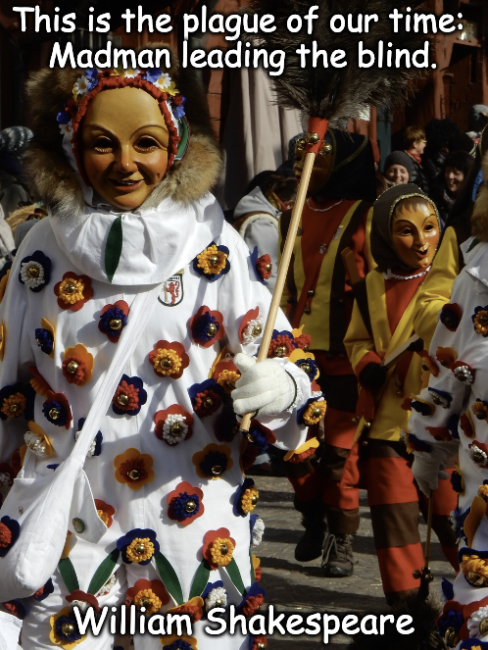
This is the plague of our time: Madman leading the blind.
Photo: M W
Blessed is the season which engages the whole world in a conspiracy of love.
Photo: s-usans-blog. Meaning:Season of love: The saying refers to a time of year, probably spring or summer, when feelings of love and romance blossom. Conspiracy of love: This suggests that nature and the world around us contribute to promoting love, as if they are working together to bring people closer together. Origin:Cultural context: These types of statements are common in literature and poetry, especially in romantic and seasonal themes. Symbolism: Nature and the different seasons are often used as metaphors for human emotions and relationships. Author:William Shakespeare: This saying is a paraphrase of a quote by William Shakespeare, specifically from his play ‘A Midsummer Night’s Dream’. In this work, Shakespeare explores the themes of love, magic and the influence of nature. Sometimes also attributed to Hamilton Wright Mabie (1846-1916), an American essayist, critic and editor. Mabie may have been inspired by the themes Shakespeare explores in his works, and his own formulations can be seen as a modern or alternative interpretation of those ideas. Conclusion: This saying emphasises the powerful influence of the seasons on human emotions, especially love, and is often associated with Shakespeare’s poetic and romantic style.
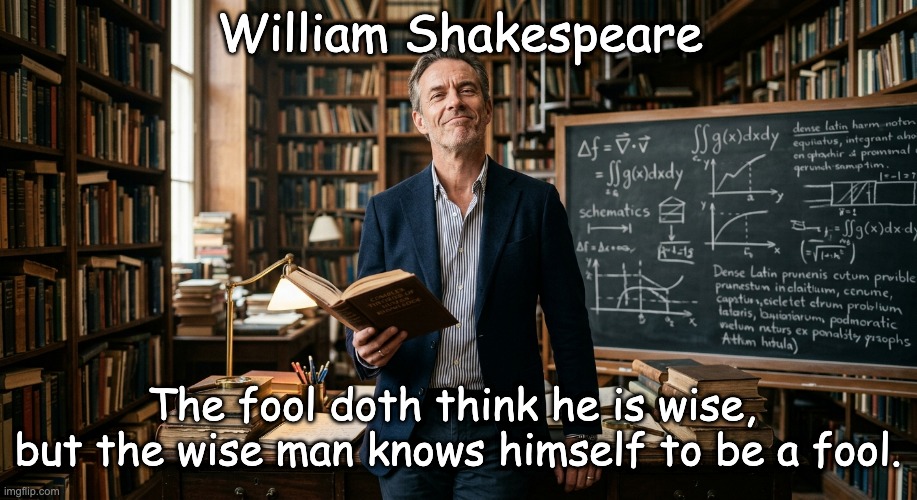
The fool doth think he is wise, but the wise man knows himself to be a fool.
Image: Peter van Geest AI. Meaning 📖 ✨🧠 : A foolish person is often overconfident and believes they know everything. A truly wise person is ‘humble’ and understands that their knowledge is limited. Real wisdom includes: ‘self-awareness’, ‘humility’, ‘recognizing one’s own ignorance’. In simple words: Fools are too sure of themselves. Wise people know there is always more to learn. 👤 Author: William Shakespeare. 🏛️ Origin: The quote comes from Shakespeare’s play ‘As You Like It’, Act 5, Scene 1. It is spoken by the character ‘Touchstone’. Original wording in the play: “The fool doth think he is wise, but the wise man knows himself to be a fool.” 📝 Is it really an idiom? Not exactly. This is ‘not a traditional idiom’. It is better described as: a ‘quotation, an ‘aphorism’, a ‘wise saying’. An ‘idiom’ usually has a figurative meaning different from the literal words, like: “break the ice”, “spill the beans”. This Shakespeare line is a ‘direct statement of wisdom’, not an idiom. 🌍 Deeper idea: The quote reflects a timeless truth: People with little understanding may ‘overestimate themselves’. People with real knowledge often become ‘more modest”. The more you learn, the more you realize ‘how much you do not know. This idea is similar to the famous philosophical attitude of Socrates, who suggested that true wisdom begins in knowing one’s own ignorance.
The first thing we do, let’s kill all the lawyers.
Image: Peter van Geest AI. Meaning:Contrary to how it’s often used today, this is not an anti-lawyer joke. Dick says it as part of a revolutionary plot to overthrow order and law so that Cade can seize power. Lawyers are the guardians of legal rights and social order, so eliminating them is a prerequisite for tyranny. It’s actually a ´compliment´ to the legal profession — lawyers stand between citizens and despotism. Origin: A famous line from Shakespeare’s ¨Henry VI, Part 2¨ (Act 4, Scene 2), spoken by the character Dick the Butcher — a follower of the rebel Jack Cade. Written around 1591, the play depicts a peasant uprising. The line appears in a scene where Cade’s mob fantasizes about remaking society in their image, abolishing literacy, property rights, and the rule of law. Author:William Shakespeare.
Not all those who show their teeth bite.
Image: Peter van Geest AI. 🐺 Meaning: – ‘Just because someone looks threatening doesn’t mean they will actually harm you.’ – In other words, ‘some people threaten, intimidate, or act tough’, but ‘may not follow through’. 🗣️ Origin: This phrase is widely recognized as part of the ‘Iago / Shakespearean’ tradition, but its closest common origin is: – Attributed to William Shakespeare – Appears in “The Merchant of Venice” (c. 1596–1597) The most-cited version of the line is often rendered as: – “Not all those that seem to be like wolves are wolves.” (paraphrase in many retellings). The exact famous line is commonly associated with: – Shakespeare, “The Merchant of Venice”, Act 3, Scene 1 (spoken by ‘Iago’ in the play) > Note: Many modern quotes slightly vary in wording across editions and retellings, but the Shakespeare/Iago attribution is the standard source. ✍️ Author: – William Shakespeare ✅ (character commonly credited: “Iago” in “The Merchant of Venice”) 🧠 Quick Example: – Someone threatens you loudly in public, but later they ‘don’t actually do anything’. – Or a person acts aggressive but is really ‘all talk’.
He that knows better how to tame a shrew, / Now let him speak.
Image-Peter van Geest – AI Meaning: The line is Petruchio’s triumphant, boastful challenge at the close of the play — essentially: “If anyone knows a better way to tame a strong-willed woman than what I’ve just shown, let him speak up now.” It’s a self-congratulatory mic-drop, delivered right after his wife Katherina gives her famous (and much-debated) speech on wifely obedience. The word “shrew” plays on the play’s central metaphor of taming a wild or unruly creature, and Petruchio is claiming clear victory in that process. Worth noting: the line’s tone is disputed by scholars. Some read it (and the ending generally) as a straightforward, era-typical endorsement of a husband’s dominance over his wife. Others see irony in it — reading Kate’s obedience as performative or the whole ending as a satire of Petruchio’s smugness rather than a celebration of it. Productions vary widely depending on which interpretation they favor. Origin: The line comes from the very end of the play — Act 5, Scene 2 — spoken right after the wager among the three husbands about whose wife is most obedient, which Petruchio wins decisively. Author:William Shakespeare, from his comedy “The Taming of the Shrew”, generally dated to around 1590–1594.
Door Pieter
Mensenmens, zoon, echtgenoot, vader, opa.
Spiritueel, echter niet religieus.
Ik hou van golf, wandelen, lezen en de natuur in veel opzichten.
Onderzoeker, nieuwsgierig, geen fan van de mainstream media (MSM).