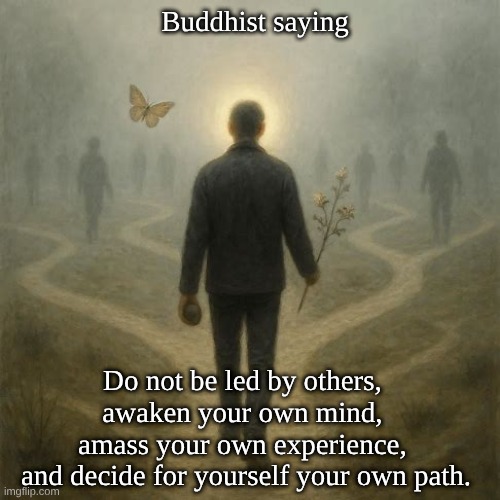
Do not be led by others, awaken your own mind, amass your own experience, and decide for yourself your own path.
Image: Peter van Geest AI. Origin: The message comes unmistakably from the Buddhist tradition and maintains the essence of the Buddha’s teaching on self-confidence and personal discovery.
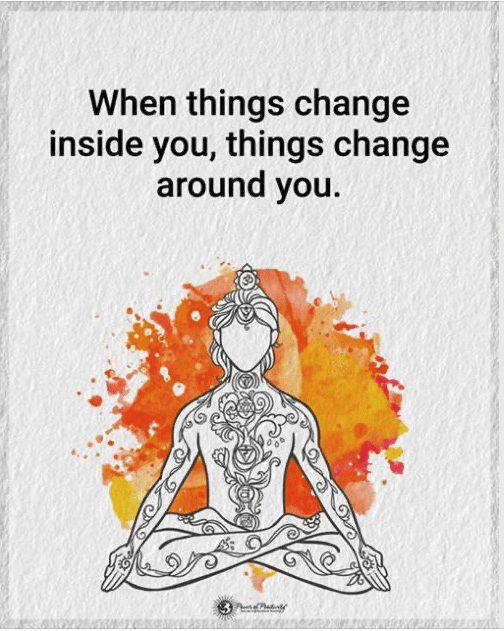
When things change inside you, things change around you.
Photo by unknown
Family is not about blood. It’s about who’s willing to hold your hand when you need it the most.
Photo by unknown
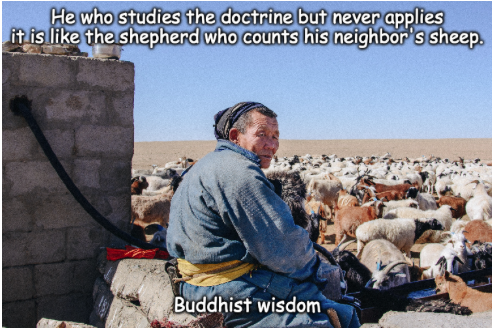
He who studies the doctrine but never applies it is like the shepherd who counts his neighbor’s sheep.
Photo by Adli Wahid
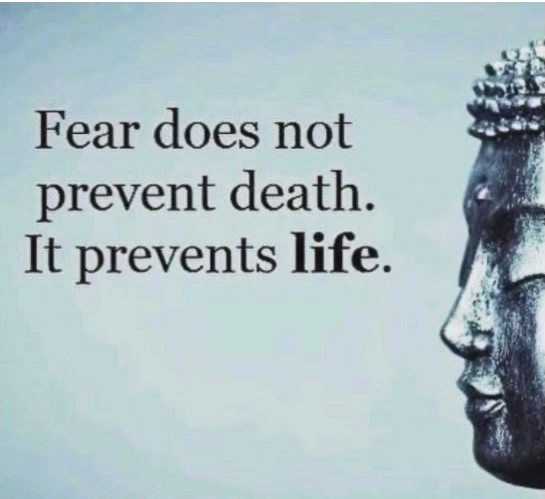
Fear does not prevent death. It prevents life.
Photo by unknown
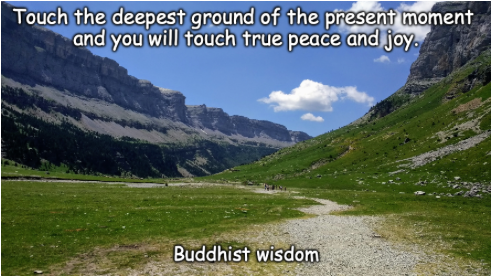
Touch the deepest ground of the present moment and you will touch true peace and joy.
Photo by Marco Montero Pisani
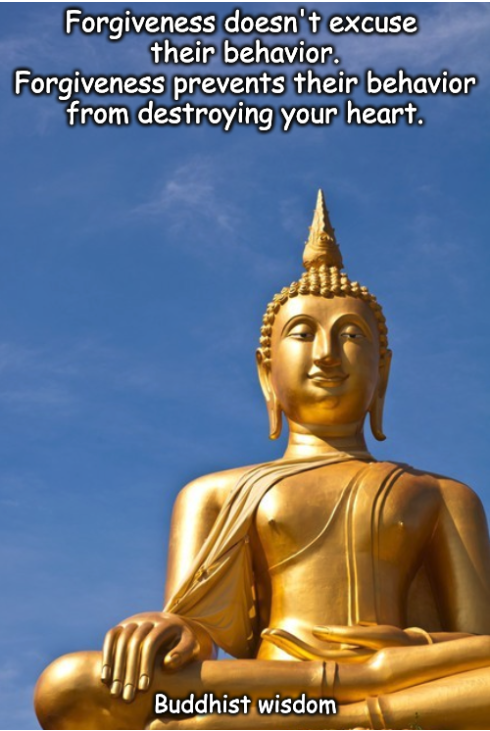
Forgiveness doesn’t excuse their behavior. Forgiveness prevents their behavior from destroying your heart.
Photo: pixers. 📌 Meaning:Forgiveness = not the same as approval. The saying emphasizes that you can forgive someone without saying that the behavior was “okay.” Forgiveness is primarily protection for yourself. By forgiving, you prevent anger, bitterness, resentment, or pain from continuing to corrode your inner self. Boundaries remain possible (and sometimes necessary). You can forgive and still: keep your distance, allow consequences, demand safety and respect. ✅ Key message:Forgiveness is a way to keep your own heart free, not to justify their behavior. 🧠 Deeper explanation: The proverb actually says: “I will not let your mistake determine how I live inside.” 💛 🏛️ Origin: This is not a classical English proverb from an ancient source, but a modern (often Christian/Buddhist/psychologically inspired) saying. The idea has clear roots in: Buddhist Christian ethics (forgiveness as liberation, but not as a denial of injustice), therapeutic/self-help language (forgiveness as letting go of resentment to heal oneself). 📚 The exact formulation circulates mainly as quotes on social media, posters, sermons, and motivational texts. Therefore, it doesn’t have a single, fixed “origin” moment, as with traditional proverbs. ✍️ Author:There is no single, reliably identifiable author for this exact English formulation. It is often: shared anonymously, or attributed to different speakers without attribution.
No wisdom without confusion.
Photo by Uday Mittal
Desire what you have.
Photo by Johan Godínez
Door Pieter
Mensenmens, zoon, echtgenoot, vader, opa.
Spiritueel, echter niet religieus.
Ik hou van golf, wandelen, lezen en de natuur in veel opzichten.
Onderzoeker, nieuwsgierig, geen fan van de mainstream media (MSM).