Pierre-Joseph Proudhon

Pierre-Joseph Proudhon:

(Besançon, 15 January 1809 – Passy (Seine) near Paris, 16 January 1865).
French self-taught economist, sociologist and theorist of socialism who is considered one of the first anarchist thinkers. Proudhon was the first person to call himself an anarchist and he introduced the word anarchism in 1840. He opposed authoritarian socialism and capitalism. He advocated instead a cooperative society, without government. Proudhon believed that anarchism should be achieved peacefully. Proudhon had great influence on Mikhail Bakunin and Peter Kropotkin. Besides being a theorist, Proudhon was also a man of practice. He tried to set up a bank that would grant interest-free loans and laid the foundations of a mutual aid system whose principles are still applied in the insurance world today (see also Peter Kropotkin’s book Mutual Aid).
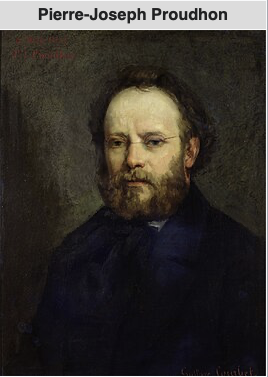
Pierre Joseph Proudhon (1865) / Gustave Courbet – Photo wikipedia.org

Always the flag of freedom served to cover despotism.

Photo: đź‘€ Mabel Amber

There is only happiness in freedom and greatness in growing freedom.
Photo: citations.quest-france.fr. Remark: The statement reflects Proudhon’s belief in progress through freedom, whereby he saw both individual and collective emancipation as essential to human development and happiness.

It is not about killing individual freedom but about socializing it.

Image: Peter van Geest AI. Meaning: Proudhon explicitly opposed state centralism and the form of socialism that entails state ownership and bureaucracy. He saw the state—even a democratic one—as often as tyrannical as a monarchy. For him, “socializing” also meant: voluntary association, ownership based on use/possession (not private accumulation), cooperatives, direct economic democracy, free agreement (contract) between equal producers/consumers. For Proudhon, freedom—both individual and collective—is not something to be won by force, but something that arises from voluntary, reciprocal relationships between people. Source: The System of Economic Contradictions or The Philosophy of Poverty (original French: Système des contradictions économiques, ou Philosophie de la misère) by Proudhon.

To be governed is to be watched over, inspected, spied on, directed, legislated at, regulated, docketed, indoctrinated, preached at, controlled, assessed, weighed, censored, ordered about, by men who have neither the right, nor the knowledge, nor the virtue.

Image: Peter van Geest AI. Meaning: Essence: This saying describes the negative aspects of governance and the way individuals are controlled and restricted by authorities. Surveillance: The idea that the government is constantly monitoring its citizens. Control: The way individuals are regulated and their freedom is restricted. Destructive authority: It suggests that the people exercising this control often lack the appropriate qualities (such as law, knowledge, or virtue).
Origin: Context: This quote is part of a broader discussion about the nature of government and its impact on individual freedom. It critically examines how governance can lead to oppression and control. Author: This quote comes from Pierre-Joseph Proudhon, a French philosopher and political activist known for his anarchist views. He is often considered the father of anarchism. Summary: The saying emphasizes the negative aspects of being governed, emphasizing control and the lack of justice by ruling authorities. Proudhon’s work remains relevant in discussions of freedom and authority.


Door Pieter

Mensenmens, zoon, echtgenoot, vader, opa. Spiritueel, echter niet religieus. Ik hou van golf, wandelen, lezen en de natuur in veel opzichten. Onderzoeker, nieuwsgierig, geen fan van de mainstream media (MSM).

Geef een reactie

Je e-mailadres wordt niet gepubliceerd. Vereiste velden zijn gemarkeerd met *