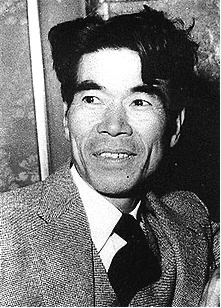
(August 11, 1892 – September 7, 1962).
Japanese historical novelist. Among his best-known novels are revisions of older classics. He was mainly influenced by classics such as The Tale of the Heike, Tale of Genji, Water Margin and Romance of the Three Kingdoms, many of which he retold in his own style. As an example, Yoshikawa took up Taiko’s original manuscript in 15 volumes to retell it in a more accessible tone and reduce it to only two volumes. His other books also serve similar purposes and, although most of his novels are not original works, he created a huge amount of work and a renewed interest in the past. He was awarded the Cultural Order of Merit in 1960 (the highest award for a man of letters in Japan), the Order of the Sacred Treasure and the Mainichi Art Award just before his death from cancer in 1962. He is cited as one of the best historical novelists in Japan.
Eiji Yoshikawa. Photo: wikipedia.org
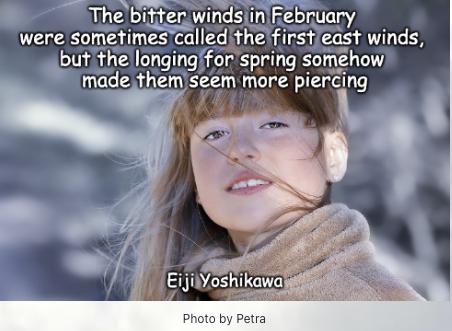
The bitter winds in February were sometimes called the first east winds, but the longing for spring somehow made them seem more piercing.
Meaning 🧊🌬️: The quote states that the “cold February winds” were sometimes already referred to as the “first east winds” (i.e., an early sign that the seasonal shift towards spring is approaching). But precisely because people were so “longing for spring,” these winds were experienced as “subjectively sharper/more penetrating”: you hope for mildness, but you still get a biting cold, making the contrast even more striking. In short: it’s about “seasonal symbolism” and “psychology” (expectation intensifies the disappointing cold). Origin / background 🌸📚: There are clear traces of (East Asian) seasonal and wind imagery: In Japanese poetry and literature, the “east wind” (東風, “kochi”) is a classic sign of spring. At the same time, “east wind” (especially in a European/Dutch sense) can also feel “cold and bleak.” The phrasing sounds like “narrative prose” (not a loose aphorism), so it likely comes from a novel or story setting a scene. Author:Eiji Yoshikawa 👤 . This quote cannot be attributed “with certainty” to Eiji Yoshikawa based on the sentence alone (and without the source text/book edition). Such sentences are often “quoted separately” online and sometimes “misattributed.” What is likely:The tone and type of nature description “fit” with historical, narrative Japanese novels (which Yoshikawa indeed falls under). If it is by Yoshikawa, the most likely source is a passage from one of his best-known novels, such as “Musashi” (published serially 1935–1939), which contains many of these kinds of seasonal sketches.
Door Pieter
Mensenmens, zoon, echtgenoot, vader, opa.
Spiritueel, echter niet religieus.
Ik hou van golf, wandelen, lezen en de natuur in veel opzichten.
Onderzoeker, nieuwsgierig, geen fan van de mainstream media (MSM).