(born October 31, 1932).
American writer best known for children’s novels, including Bridge to Terabithia.
For four different books published 1975–1980, she won two Newbery Medals and two National Book Awards. She is one of four people to win the two major international awards; for “lasting contribution to children’s literature” she won the biennial Hans Christian Andersen Award for Writing in 1998 and for her career contribution to “children’s and young adult literature in the broadest sense” she won the Astrid Lindgren Memorial Award from the Swedish Arts Council in 2006, the biggest monetary prize in children’s literature. Also for her body of work she was awarded the NSK Neustadt Prize for Children’s Literature in 2007 and the Children’s Literature Legacy Award from the American Library Association in 2013. She was the second US National Ambassador for Young People’s Literature, serving 2010 and 2011.
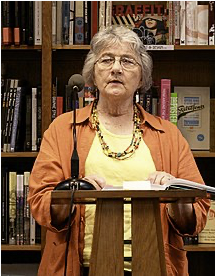
Katherine Paterson (2011). Photo: wikipedia.org
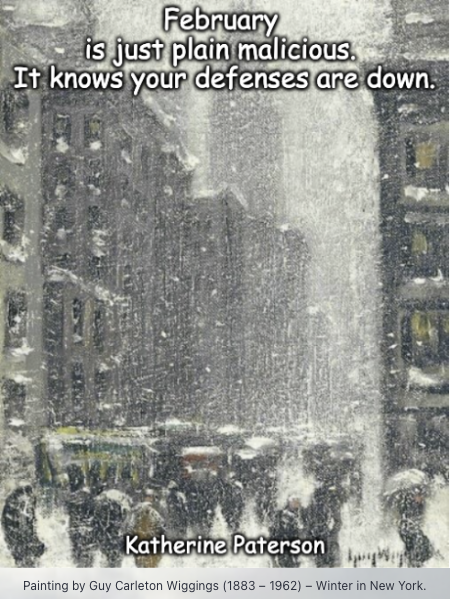
February is just plain malicious. It knows your defenses are down.
Meaning: It expresses that February can feel psychologically “evil”: cold, dark, long after the holidays, and with depleted energy/reserves. 🥶🔋 “It knows your defenses are down” personifies the month: when you’re tired and vulnerable, February feels especially unforgiving. 🛡️⬇️ 🗓️ Origin/source: The quote is widely attributed to Katherine Paterson, but there is no single, verifiable primary source (specific novel/essay/page) that is routinely cited. 📚 In quotation collections, it circulates primarily as a quote; without a hard citation, it’s best to consider it “commonly attributed” rather than definitively traced. 🔎 Author:Katherine Paterson American children’s author (b. 1932), known for Bridge to Terabithia and Jacob Have I Loved. 📖 Multi-award-winning (including two Newbery Medals); themes of loss, resilience and empathy often recur in her work.
I used to try to decide which was the worst month of the year. In the winter, I would choose February. The reason God made February short a few days was because he knew that by the time people came to the end of it, they would die if they had to stand one more blasted day.
Meaning 💡: Hyperbolic, bitingly humorous complaint about the gloom and exhaustion of winter, especially February. It expresses both the physical hardships (cold, grayness, feeling of endlessness) and the emotional state of the narrator. Not intended to be theological; “God” functions as a rhetorical device to emphasize the intensity of the annoyance. Fits the novel’s themes of growing up in a harsh environment, jealousy, resilience, and survival on an isolated island. Variants and translations 🌐: Shortened paraphrases circulate online, such as: “God made February short because no one could bear another day of the month.”Additional context 🧭: Jacob Have I Loved is set on an island in the Chesapeake Bay (USA) in the 1940s; the harsh winters amplify the story’s grim, introspective tone. Author ✍️:Katherine Paterson (1932–), award-winning American children’s book author. Origin/source 📚:Novel: Jacob Have I Loved (1980). Narrator: the first-person narrator Sara Louise (“Wheeze”). The line appears early in the book and is often shared online as a separate quote. Original English meaning: “The reason God made February short …” (continued: that people wouldn’t last another day).
Door Pieter
Mensenmens, zoon, echtgenoot, vader, opa.
Spiritueel, echter niet religieus.
Ik hou van golf, wandelen, lezen en de natuur in veel opzichten.
Onderzoeker, nieuwsgierig, geen fan van de mainstream media (MSM).