(Field Place (Sussex), 4 August 1792 – at sea near La Spezia, 8 July 1822).
English poet of the Romantic period.
Percy Bysshe Shelley (1819) Amelia Curran, National Portrait Gallery
There is a harmony in autumn and a brilliance in the air.
Photo: Michelle LaRose
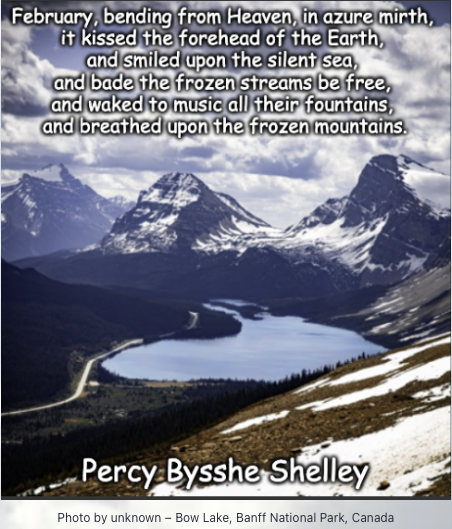
February, bending from Heaven, in azure mirth, it kissed the forehead of the Earth, and smiled upon the silent sea, and bade the frozen streams be free, and waked to music all their fountains, and breathed upon the frozen mountains.
Meaning (line by line) 🌤️: “February, bowing from the sky” → February is personified as a heavenly figure descending: beginning of the thaw/bright onset of spring. “kissed the earth’s forehead in azure gaiety” → The blue, clear sky “kisses” the earth; the light becomes kinder and warmer. “smiled at the still sea” → Calmer weather; winter storms subside. “bid the frozen streams to be free” → Thaw: the ice breaks, rivers begin to move again. “woke all their fountains with music” → The rippling and bubbling of meltwater sounds like music. “blew on the frozen mountains” → Warmer/drier wind (foehn-like) that erodes snow and ice. About the author 🧑🎨: Probably often misattributed to Percy Bysshe Shelley: In standard editions of Shelley’s poems, there is no passage with “February/Februari” that matches this phrasing or imagery. Shelley’s nature verses (e.g. Ode to the West Wind, The Cloud, The Sensitive Plant) personify seasons and elements, but not specifically “February”. The combination “smiled on the silent sea / bade the frozen streams be free” is rather generic thaw diction from 18th/19th century nature poetry. Possible context/alternatives: 19th century “month” poems or calendar poetry (e.g. Longfellow’s The Poet’s Calendar – February) personify the month; some translations paraphrase freely. The exact English counterpart of this quotation, however, is not traceable in Longfellow. James Thomson’s The Seasons (Winter/Thaw) contains very similar imagery (“loosening” of frozen streams), but not with “February” and not in the specific phrasing of the quotation. Conclusion: the quotation sometimes circulates online with Shelley’s name, but there is no reliable source attributing it to him. It appears to be a free paraphrase in the 19th-century style rather than a direct translation from a well-known, identifiable Shelley poem.
Door Pieter
Mensenmens, zoon, echtgenoot, vader, opa.
Spiritueel, echter niet religieus.
Ik hou van golf, wandelen, lezen en de natuur in veel opzichten.
Onderzoeker, nieuwsgierig, geen fan van de mainstream media (MSM).