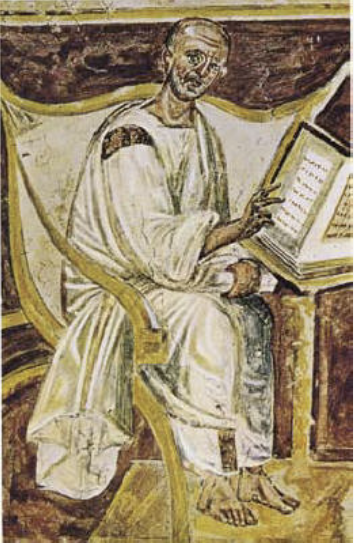
(Latin: Aurelius Augustinus Hipponensis), also called Saint Augustine.
(Thagaste, Algeria, 13 November 354 – Hippo, Algeria, 28 August 430)
Bishop of Hippo, theologian, philosopher and church father. He is considered the most important church father of the West. Among his best-known works are the Confessions and De civitate Dei.
Augustine of Hippo (6th century) Fresco in St John of Lateran, Rome.png
Happiness is continuing to long for what you already have.
Photo: Marie Claire
A friend is someone who knows everything about you and still loves you.
Photo: Jeremias Ybanez
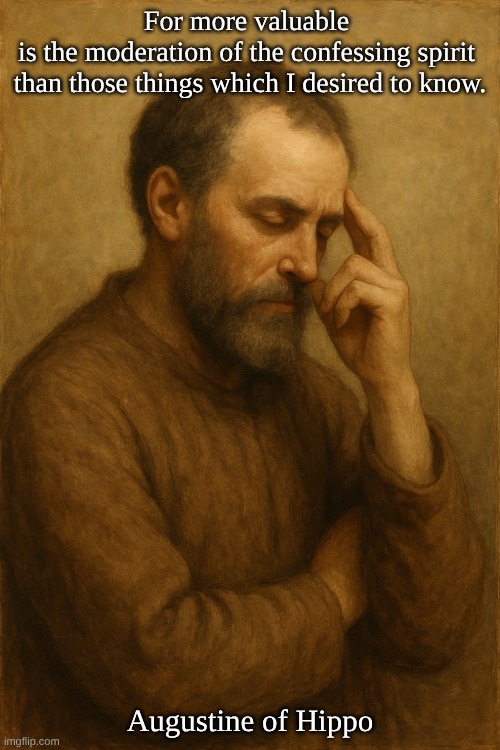
For more valuable is the moderation of the confessing spirit than those things which I desired to know.
Image: Peter van Geest AI. Meaning: A hymn to humility in the pursuit of knowledge: it is not the urge to know everything that makes one wise, but the ability to acknowledge what one does not know. Origin: Aurelius Augustinus (Saint Augustine) from his work Confessiones, written circa 397–400 AD.
The past and the future only exist when we think about them.
Photo: Olga Volkovitskaia. Meaning 🤔: This saying raises fascinating questions about our perception of time. The core of this statement lies in the subjective experience of time. It suggests the following: The Eternal Now: 🕰️ The only reality we experience directly is the present moment (the ‘now’). Mental Constructs: Past and future have no independent, physical existence in the world around us. They ‘exist’ only in our minds. The Role of the Mind: 🧠 The past exists only as a memory that we retrieve at this moment. The future exists only as an expectation or imagination that we form at this moment. Conclusion: Without a consciousness that remembers or expects, past and future would not exist, in this philosophical sense. Origin: The deeper philosophical roots of this thought are very old. Although the exact formulation may vary, the fundamental idea is strongly connected to: Classical Antiquity: Early philosophers were already pondering the nature of time and being. Christian Philosophy: The most prominent and influential early exploration of this specific concept is found in the Western Christian tradition, particularly in the early Middle Ages. It was an attempt to understand the relationship between temporal man and the timeless (eternal) God. Author: The author to whom this profound insight is attributed is: 🥇 Aurelius Augustine (Augustine of Hippo). He was a crucial Church Father and philosopher (354 – 430 AD). The most extensive and famous exposition of this thought is found in his work “Confessions,” specifically in Book XI. In it, he analyzes the nature of time and concludes that there are in fact three times: “a present time of past things, a present time of present things, and a present time of future things.” All three exist only in the human mind (the ‘soul’). Other names mentioned (Alain, Paulo Coelho): Although these and other modern authors may address similar existential or spiritual themes, the origin of the specific philosophical argument that time exists only in the mind can undeniably be traced back to Augustine.
Door Pieter
Mensenmens, zoon, echtgenoot, vader, opa.
Spiritueel, echter niet religieus.
Ik hou van golf, wandelen, lezen en de natuur in veel opzichten.
Onderzoeker, nieuwsgierig, geen fan van de mainstream media (MSM).