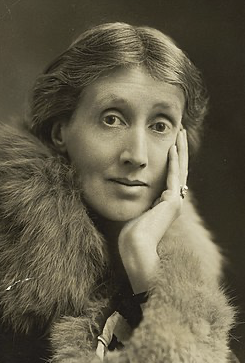
(née Sackville-West; 9 March 1892 – 2 June 1962).
Usually known as Vita Sackville-West, was an English author and garden designer.
Sackville-West was a successful novelist, poet and journalist, as well as a prolific letter writer and diarist. She published more than a dozen collections of poetry and 13 novels during her life. She was twice awarded the Hawthornden Prize for Imaginative Literature: in 1927 for her pastoral epic, The Land, and in 1933 for her Collected Poems. She was the inspiration for the protagonist of Orlando: A Biography, by her friend and lover Virginia Woolf.
Vita Sackville-West. Photo: wikipedia.org
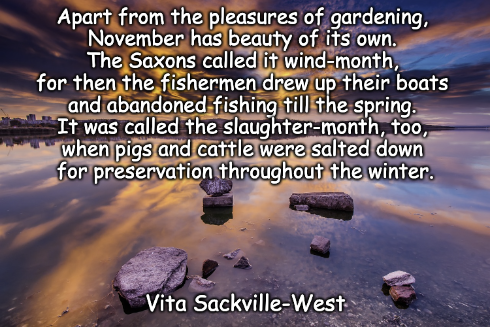
Apart from the pleasures of gardening, November has beauty of its own. The Saxons called it wind-month, for then the fishermen drew up their boats and abandoned fishing till the spring. It was called the slaughter-month, too, when pigs and cattle were salted down for preservation throughout the winter.
Photo: Christo Anestev. Meaning 📜: The text reminds us that autumn, and specifically the month of November, despite its often bleak image, possesses its own subdued beauty. It is a period of stillness, preparation, and necessary rest: Gardening: It marks the end of the active growing season. The garden ‘goes to sleep’ and offers rest after the busy summer months. Historical Context: The text links our current experience of November to that of the past. The Saxons, for example, viewed it as a time to: 🛶 Stop fishing and pull boats ashore (‘wind month’). This symbolizes withdrawing from dangerous conditions and seeking the safety of the land. 🐖 Slaughter and pickle meat (‘slaughter month’). This was a crucial preparation for the long, food-scarce winter, a time of pragmatism and survival. The “beauty” therefore lies not in blooming flowers or warm weather, but in the cyclical nature of nature, the period of rest it offers, and human ingenuity to adapt and prepare. 🔍 Origin and Author: The text was (very likely) written by Vita Sackville-West ✍️. Vita Sackville-West (1892-1962) was a well-known British poet, novelist, and above all, a celebrated gardener. She created the famous gardens of Sissinghurst Castle in Kent, England. 🏠 In Which Work Is It? This specific piece about November can be found in her weekly columns written for the newspaper ‘The Observer’, which were later collected into various books. It is likely in one of her “Sissinghurst” gardening books, such as: ‘In Your Garden’ or ‘In Your Garden Again’. 🌿 In summary: Author:Vita Sackville-West. Origin: Originally from her garden columns for The Observer. Core: A reflection on the specific, quiet, and pragmatic beauty of the month of November, drawing a connection to the history of the Saxons.
Apart from the pleasures of gardening, November has beauty of its own. The Saxons called it wind-month, for then the fishermen drew up their boats and abandoned fishing till the spring. It was called the slaughter-month, too, when pigs and cattle were salted down for preservation throughout the winter.
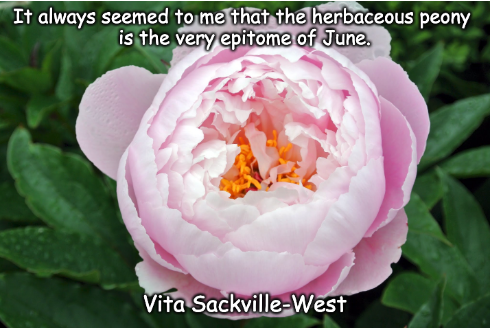
It always seemed to me that the herbaceous peony is the very epitome of June.
Photo: themarthablog.com. Meaning 🧐 : This quote is a poetic way of expressing how strongly certain flowers are connected to a specific time of the year. The Core Idea: The speaker believes that the herbaceous peony is the perfect representative of the month of June. Symbolism: Peonies are known for their large, lush, and often fragrant flowers that are at their most beautiful in early summer (June). They often symbolize abundance, beauty, and romance. By saying that they are the “embodiment of June,” the author suggests that if you had to capture June in the form of one living thing, it would be this flower.✍️ Author and Origin: This quote is generally attributed to the celebrated English poet, novelist, and gardener Vita Sackville-West. Vita Sackville-West (1892–1962) was a central figure in the Bloomsbury Group and is best known for creating the world-famous gardens at Sissinghurst Castle in Kent, England, together with her husband Harold Nicolson. The text is taken from her weekly garden correspondence for the newspaper ‘The Observer’. Her writings were later collected in popular books, such as ‘In Your Garden’ (1951) and its sequels. The original English text reads: “It has always seemed to me that the herbaceous peony is the very embodiment of June.” Context: Sackville-West was known for her passion for abundant, romantic plants that stimulated the senses. The peony, with its dramatic but short-lived bloom, fit perfectly into her garden philosophy. In short, this quote is an ode to the peony as the ultimate flower of early summer, written by one of the most influential gardeners of the 20th century.
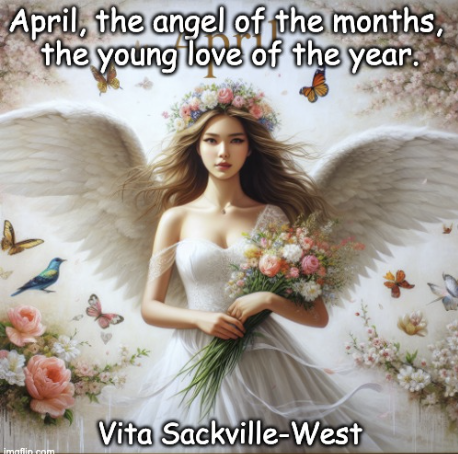
April, the angel of the months, the young love of the year.
Image: Peter van Geest – AI. 🇳🇱 Meaning: “April, the angel of the months, the young love of the year.” April as ‘Angel of the Months’: This signifies the gentleness, hope, and renewal that April brings after the cold winter. Like an angel, April is seen as a messenger of the good news of spring, gently awakening the earth with its mild temperatures and blooming flowers. ‘The Young Love of the Year’: This refers to budding nature, the first spring flowers, the return of birds, and the awakening of new life. It symbolizes the freshness and innocence of first love, full of promise and untamed energy, just like the beginning of spring. 📜 Origin and Author: This is where the confusion often arises! Although the exact wording as you cite it in Dutch may be a beautiful translation or adaptation, the quote itself is often attributed to: 🇬🇧 Author:Vita Sackville-West (a British poet, writer, and garden designer, best known for her gardens at Sissinghurst Castle). 🖋️ Origin: The quote is often associated with her love of nature and the seasons, and likely comes from one of her poems or writings on gardening, but it cannot be directly found in any of her most famous works with this exact phrasing. Important Note: It is possible that the specific Dutch translation you are using is a free translation or paraphrase that has become popular over the years. However, the sentiments in the quote (April as an angel, young love) are very typical of the romantic and passionate language Sackville-West used to describe the beauty of spring. 😊
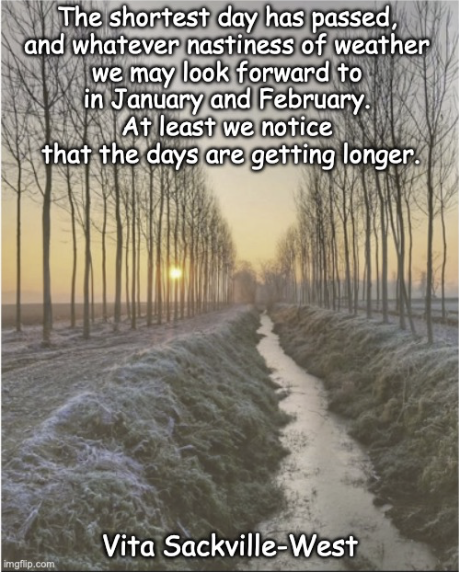
The shortest day has passed, and whatever nastiness of weather we may look forward to in January and February. At least we notice that the days are getting longer.
Photo: wenaturelovers. Meaning:Seasonal Change: This quote reflects an appreciation for natural cycles and the optimism that comes from the changing seasons. Emotional Resonance: It emphasizes the humanity in coping with winter and the hope for the longer days to come. Author:Vita Sackville-West.Background: Vita Sackville-West (1892–1962) was an English writer and poet, known for her poetry, novels, and her involvement in the literary world of the early 20th century. Style: Her work is characterized by a strong connection to nature and a refined, often melancholic reflection on life and the seasons. Impact: Cultural Relevance: Her observations are timeless and remain relevant to many who appreciate the seasons and their influence on the human experience. Inspiration: Sackville-West’s work inspires readers to embrace the beauty and challenges of nature. Conclusion: Vita Sackville-West’s words about the shortest day of the year and the hope for longer days reflect her deep connection with nature and the cycle of life.
Door Pieter
Mensenmens, zoon, echtgenoot, vader, opa.
Spiritueel, echter niet religieus.
Ik hou van golf, wandelen, lezen en de natuur in veel opzichten.
Onderzoeker, nieuwsgierig, geen fan van de mainstream media (MSM).