Emily Elizabeth Dickinson:
(10 December 1830 – 15 May 1886).
American poet whose work, together with that of Walt Whitman, ushered in a new era in American poetry: modernism. Although she led a reclusive life and achieved little fame during her active years, after her death she was recognised as one of the most important and influential figures in American poetry.
It is also November. The noons are more laconic and the sunsets sterner, and Gibraltar lights make the village foreign.
September’s Baccalaureate – a combination is of crickets, crows, and retrospects. And a dissembling breeze that hints without assuming.
The poem uses “Baccalaureate” — a term for a graduation ceremony or its address — as a metaphor for September itself as a kind of seasonal commencement: a summing-up. She catalogs what September is made of: the dying sound of crickets, crows overhead, and a mood of retrospection (looking back over summer). Then there’s the “dissembling Breeze” — a wind that seems to promise something (an early autumn chill, a change coming) without ever stating it outright. She calls this an “Innuendo sear” — a withered, faded suggestion of what’s ending — and says its effect is to make the heart set aside its lightness (“put up its Fun”) and become reflective, “turn Philosopher.”
Origin:
Dickinson wrote it in the early-to-mid 1870s (Ralph W. Franklin places it among her last major manuscript sets, or “fascicles”-adjacent groupings, in The Manuscript Books of Emily Dickinson). Like almost all her poetry, it wasn’t published in her lifetime — Dickinson wrote nearly 1,800 poems privately, of which fewer than a dozen appeared in print before her death in 1886. This one later surfaced in early 20th-century printings (it’s noted appearing in “The Youth’s Companion” in 1945-era reprintings, and in the 1955 and 1960 variorum/Johnson editions), which is why you sometimes see small differences in punctuation and capitalization between versions — Dickinson’s original dashes and capitals were often “normalized” by early editors before scholars returned to her manuscripts for more faithful transcriptions.
Author: Emily Dickinson.
It’s quoted (with slight rewording) the opening of her short poem “September’s Baccalaureate,” catalogued as poem “1271” in the standard numbering (Franklin edition; also numbered in Johnson’s edition of her complete poems). The full poem reads:
> “September’s Baccalaureate”
> A combination is
> Of Crickets — Crows — and Retrospects
> And a dissembling Breeze
> That hints without assuming —
> An Innuendo sear
> That makes the Heart put up its Fun
> And turn Philosopher.
A light exists in Spring, not present in the year. At any other period, when March is scarcely here.
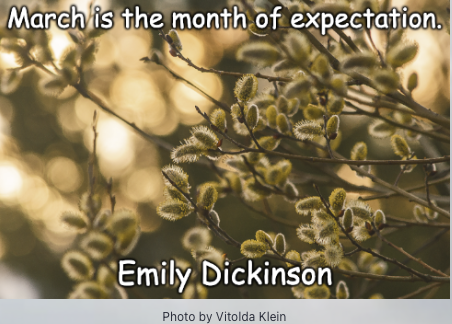
March is the month of expectation.
The things we do not know
Themselves are coming most of all
In just a little show –
That opens like a pod, or pad,
And holds the flower after
For an hour, or a day,
Then leaves the play to winter –
Except the little seed,
That opens up in spring,
And has a new and stronger life,
And always will begin.
Although there are sometimes slight variations in the citation, the essence that March is a month of anticipation and blossoming life is clearly present in her work. Emily Dickinson was known for her observations of nature and the cycles of life, death, and spirituality, and this poem fits perfectly within her oeuvre.
