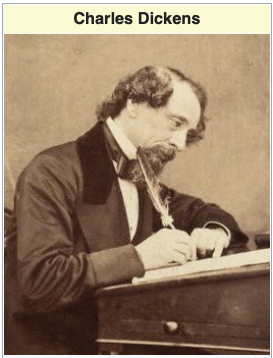
Charles John Huffam Dickens:
(Landport near Portsmouth, 7 February 1812 – Higham (Kent), 9 June 1870).
One of the most important English writers during the Victorian era and the first literary chronicler of the metropolis in the midst of the Industrial Revolution. Until after World War I, he remained England’s most popular writer. He achieved fame with The Pickwick Papers (The posthumous papers of the Pickwick Club), which appeared monthly from 1836. Then Oliver Twist appeared in Bentley’s Miscellany, which he edited, in 1837-1838, Nicholas Nickleby in 1838-1839, The Old Curiosity Shop and Barnaby Rudge, both in 1841. His most famous novels are David Copperfield (1849-1850, partly autobiographical), Great Expectations (1860-1861), Oliver Twist, Nicholas Nickleby and A Christmas Carol (1843). A tale of two cities ranks number seven among the world’s best-selling books with 200 million copies.Characteristic of his stories are their social ills, story structure, cartoonish characters and humour.
Of all the months of the year, there is not a month one half so welcome to the young, or so full of happy associations, as the last month of the year.
The whole difference between construction and creation is exactly this: that a thing constructed can only beloved after it is constructed; but a thing created is loved before it exists.

It was the best of times, it was the worst of times.

– “It was the best of times, it was the worst of times” expresses ‘extreme contrast happening at the same time’.
– It usually means:
– People are experiencing ‘hope and despair simultaneously’
– Society or a situation can feel ‘both improving and worsening’
– Times can be ‘good in some ways and terrible in others’ (often politically, socially, or economically)
📜 Origin:
– The line is the ‘opening sentence’ of a famous novel by Charles Dickens.
✍️ Author: Charles Dickens ✅
📚 Source Text:
– From “A Tale of Two Cities” (1859), the novel’s opening includes the full contrast passage starting with:
– “It was the best of times, it was the worst of times…”
🌍 Why it’s often quoted:
– It became widely quoted because Dickens neatly captures the feeling of:
– ‘historic upheaval’
– ‘contradictory lived realities’
– ‘polarized circumstances’ (e.g., privilege vs. suffering).
My advice is, never do to-morrow what you can to-day. Procrastination is the thief of time. Collar him.
Don’t put off until tomorrow what you can do today, because wasted time can never be recovered. “Collar him” personifies procrastination as a thief you should physically seize and stop — i.e., don’t just resolve to be less lazy, actively grab hold of the habit and defeat it.
Origin:
The middle phrase, “procrastination is the thief of time,” didn’t originate with Dickens — he’s echoing (essentially quoting) an already-famous line from Edward Young’s long poem “Night Thoughts” (1742), which contains the line “Procrastination is the thief of time.” By Dickens’s era the phrase was a well-known proverb, and he put it in Micawber’s mouth as the kind of grand, quotable maxim that character loves to deliver, even as he fails spectacularly to live by it.
Author: This line is spoken by Wilkins Micawber in Charles Dickens’s novel “David Copperfield” (1849–50). Micawber, David’s eccentric, perpetually broke but endlessly optimistic landlord and friend, offers it as a piece of moral advice — somewhat ironic given that he himself is a chronic procrastinator and debtor throughout the book. It appears as part of the advice Mr. Micawber gives to David Copperfield.
How much great minds have suffered for the truth in every age and time.
It is a melancholy truth that even great men have their poor relations.

It was one of those March days when the sun shines hot and the wind blows cold: when it is summer in the light, and winter in the shade.