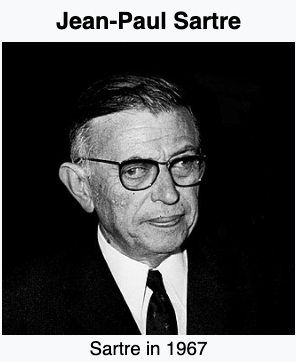
Jean-Paul Charles Aymard Sartre:
( 21 June 1905 – 15 April 1980 )
French philosopher, playwright, novelist, screenwriter, political activist, biographer, and literary critic, considered a leading figure in 20th-century French philosophy and Marxism. Sartre was one of the key figures in the philosophy of existentialism (and phenomenology).
To read a poem in January is as lovely as to go for a walk in June.
‘Poetry can provide the same joy, freshness, and zest for life as a beautiful summer experience’.
– “January” stands for cold, darkness, winter, and staying indoors.
– “June” stands for warmth, light, nature, and walking outdoors.
– Reading a poem can therefore give you the same inner feeling as a pleasant walk in the summer.
In short: ‘literature and imagination can make life lighter, warmer, and more beautiful — even in the middle of winter.’
Author ✍️:
The statement is usually attributed to:
> Jean-Paul Sartre
> French philosopher, writer, and existentialist
> 1905–1980
Sartre is best known for works such as “L’Être et le Néant”, “La Nausée”, and “Les Mots”. Origin 🕯️:
This is usually attributed to Jean-Paul Sartre. However, an exact original source or place in his work is not always mentioned in collections of quotations, making some caution appropriate.
Possession is a friendship between man and things.
To read a poem in January is as lovely as to go for a walk in June.
‘Poetry can provide the same joy, freshness, and zest for life as a beautiful summer experience’.
– “January” stands for cold, darkness, winter, and staying indoors.
– “June” stands for warmth, light, nature, and walking outdoors.
– Reading a poem can therefore give you the same inner feeling as a pleasant walk in the summer.
In short: ‘literature and imagination can make life lighter, warmer, and more beautiful — even in the middle of winter.’
Author ✍️:
The statement is usually attributed to:
> Jean-Paul Sartre
> French philosopher, writer, and existentialist
> 1905–1980
Sartre is best known for works such as “L’Être et le Néant”, “La Nausée”, and “Les Mots”. Origin 🕯️:
This sentence is ‘not a traditional Dutch proverb’, but a ‘literary saying or quote’ that has been handed down in translation.
The frequently cited English form reads:
> “To read a poem in January is as lovely as to go for a walk in June.”
This is usually attributed to Jean-Paul Sartre. However, an exact original source or place in his work is not always mentioned in collections of quotations, making some caution appropriate.
What the theater can show most movingly is a character in the making, the moment of choice, of the free decision which engages a whole morality and a whole life.
Every word has consequences, every silence too.
I exist. It is soft, so soft, so slow. And light: it seems as though it suspends in the air. It moves.
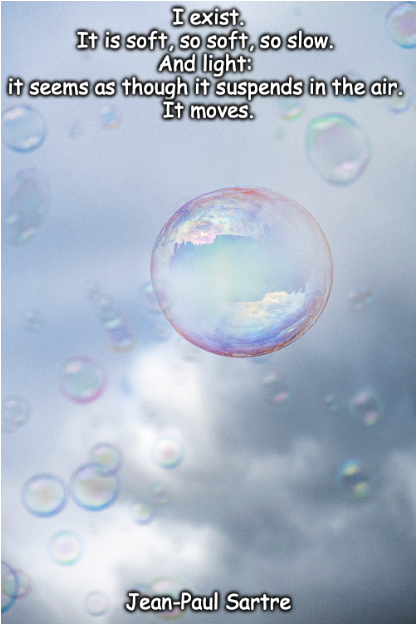
This passage illustrates one of the central themes of the novel and of Sartre’s existentialist philosophy: the ‘contingency of existence’. Roquentin discovers that existence is not something abstract, something contemplated from afar, but a raw, almost physical reality that “imposes itself” on consciousness—sometimes with a disturbing gentleness, sometimes with disgust (hence the novel’s title). In this particular excerpt, the experience is described as gentle and light rather than nauseating: Roquentin observes his own body (his hand, his mouth, his saliva) with a kind of detached astonishment, as if the very fact of existing—independent of any meaning or justification—were becoming perceptible, almost palpable.
This moment prepares the way for the famous scene at the chestnut tree root, later in the novel, where this awareness of contingency culminates in the actual “nausea”: the discovery that things (and he himself) exist without reason, without necessity, simply ‘superfluous’.
Author: This sentence is by Jean-Paul Sartre, from his novel “Nausea” (1938).
Context within the work: This is not a traditional “saying” but an excerpt from the novel’s prose. The narrator, Antoine Roquentin, experiences an acute and almost hallucinatory awareness of his own physical existence: he feels the water in his mouth, observes his hand resting on the table as if it were no longer entirely familiar, and perceives with unusual intensity the simple fact of being alive, of inhabiting a body.
It is in anguish that man becomes conscious of his freedom.
Man is not sum of what he has already, but rather the sum of what he does not yet have, of what he could have.
I’m always conscious of myself—in my mind. Painfully conscious.
Jean-Paul Sartre, La Transcendance de l’Ego (1936/37), Jean-Paul Sartre, L’Être et le Néant (1943) — English: Being and Nothingness, Sartre elaborates there that consciousness is always already “co-conscious of itself”, without the need to hypostatize a separate Ego in experience. Relevant (real) Sartre formulations 📝: “Toute conscience positionnelle de quelque chose est en même temps conscience non positionnelle (ou non‑thétique) de soi.” Free English rendering: “Every positional act of consciousness of something is at the same time a non‑positional (non‑thematic) consciousness of itself.” Source: La Transcendance de l’Ego (and resumed in L’Être et le Néant). In Being and Nothingness, Sartre develops this further as “pre-reflexive self-consciousness”: Consciousness is aware of itself in and through its orientation toward the object. Work: Being and Nothingness (L’Être et le Néant). The Transcendence of the Ego (English translation often: The Transcendence of the Ego). (English: Nausea). The thought in question can be found mainly in The Transcendence of the Ego and Being and Nothingness. Example for clarification 👀: You are reading a book with concentration: You are not explicitly concerned with yourself, but there is implicit self-consciousness “I am the one reading.” When someone calls your name, your consciousness can shift to reflection (“am I distracted?”). The former is pre-reflective; the latter reflective. Conclusion 🧭: The quote in question is not an authentic literal Sartre quote, but an accurate paraphrase of his teaching on pre-reflective self-consciousness.
There is no such thing as a given freedom; you have to conquer your passions, your race, your class, your nation, and conquer other men along with you.
Once freedom has exploded in a man’s soul, the gods can do nothing more against him.
Duty is the will of the other within me, the alienation of my own freedom.
Three o’clock is always too late or too early for anything you want to do.
Freedom is what you do with what’s been done to you.
With despair, true optimism begins: the optimism of the man who expects nothing, who knows he has no rights and nothing coming to him, who rejoices in counting on himself alone and in acting alone for the good of all.
What he means by the statement (or the paraphrase thereof) is typical of Sartre: despair (in the sense of no hope for external salvation) is not passive, but rather the beginning of a radical optimism rooted in personal responsibility and action for a broader human interest.
