Haruki Murakami:
(Kyoto, 12 January 1949).
Japanese writer and translator.
Murakami was born in Kioto and grew up in Kobe. His father was the son of a Buddhist priest. His mother was the daughter of a merchant from Osaka. Both taught Japanese literature. However, Murakami was always more interested in American literature, so he adopted a Western writing style that set him apart from his Japanese contemporaries.
Silence, I discover, is something you can actually hear.
You’re seeking something, but at the same time, you are running away for all you’re worth.

In the deepening spring of May, I had no choice but to recognize the trembling of my heart. It usually happened as the sun was going down.
“Norwegian Wood”, “Kafka on the Shore”, “Sputnik Sweetheart”, “The Wind-Up Bird Chronicle”, “1Q84”. On Murakami’s style: melancholic tone, introspective characters, strong atmospheric descriptions, a mixture of everyday life and emotional depth. That makes this quote very recognizable as Murakami: sensitive, simply formulated, but emotionally rich.
I’ve decided to make myself strong. As far as I can tell, that’s all I can do.

And you’ll return to real life. You need to live it to the fullest. No matter how shallow and dull things might get, this life is worth living. I guarantee it.
– 🌱 ‘You should return to ordinary life after pain, grief, or emotional escape.’
– 🕰️ ‘Even if daily life feels ‘boring, shallow, repetitive, or dull’, it still has value.
– ❤️ ‘Life does not have to be dramatic or profound all the time to be worth living.’
– 💪 ‘It is an encouragement to ‘keep living fully’, rather than withdrawing into sadness, fantasy, or the past.’
In short: ‘ordinary life is still worth choosing and living.’
📚 Origin:
This line is commonly attributed to Haruki Murakami, from his novel:
“Norwegian Wood”
– Original Japanese title: ノルウェイの森
– Published: 1987
– English translation: commonly by Jay Rubin
The quote appears near the later part of the novel, in the context of grief, recovery, and returning to everyday life after emotional devastation.
👤 Author: Haruki Murakami ✅
However, because this is from a translated novel, the exact English wording may be the translator’s rendering rather than Murakami’s literal original Japanese phrasing.
So a precise attribution would be:
> Haruki Murakami, “Norwegian Wood”, translated into English by Jay Rubin.
🧭 Context in the Novel:
The sentiment is connected to the character’s need to move forward after loss and emotional isolation. It reflects one of Murakami’s recurring themes:
– loneliness
– grief
– emotional survival
– returning to normal life
– accepting that ordinary existence still matters
✨ Short Interpretation
> ‘Even when life feels plain or disappointing, it is still precious. You must return to it, participate in it, and live it as fully as you can.’
In this world, there are things you can only do alone, and things you can only do with somebody else. It’s important to combine the two in just the right amount.

Memories warm you up from the inside. But they also tear you apart.

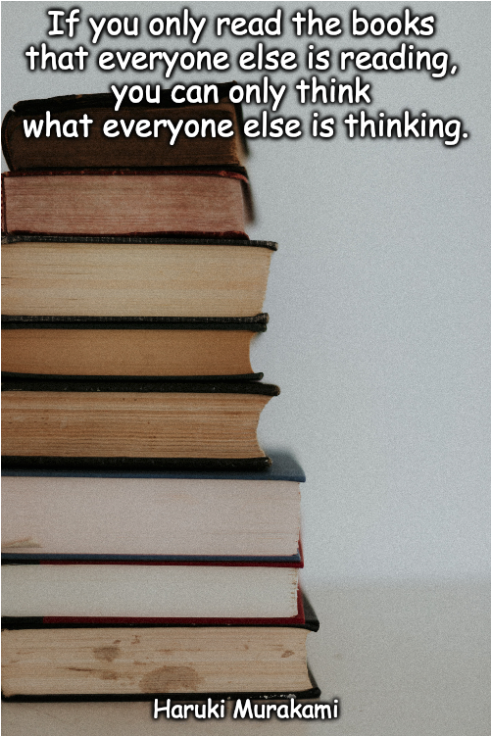
If you only read the books that everyone else is reading, you can only think what everyone else is thinking.
I am an imperfect person, more than you can imagine.
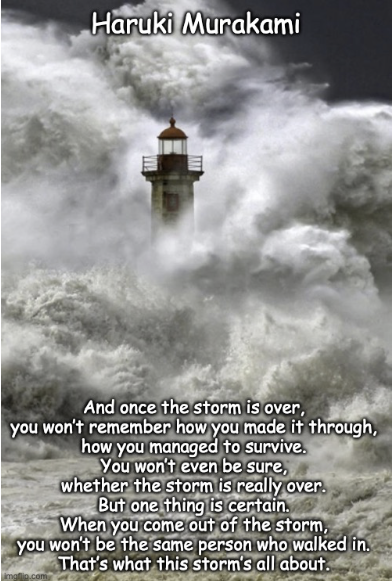
And once the storm is over, you won’t remember how you made it through, how you managed to survive. You won’t even be sure, whether the storm is really over. But one thing is certain. When you come out of the storm, you won’t be the same person who walked in. That’s what this storm’s all about.
Memories and thoughts age, just as people do. But certain thoughts can never age, and certain memories can never fade.

1. ‘Ordinary thoughts and memories’
– They change over time
– They lose intensity
– They become blurred, reshaped, or less important
2. ‘Certain unforgettable inner experiences’
– Some emotions, ideas, or memories remain permanently vivid
– They do not “grow old” in the same way
– They continue to affect who we are, even years later
In simpler words:
– Most memories fade
– Some stay alive forever
🧠 Deeper interpretation: Murakami often writes about:
– memory
– loss
– identity
– emotional time
– the way the past continues to live inside us
So this line suggests that although ’time changes people’, there are some inner experiences that remain untouched by time:
– a deep love ❤️
– a trauma 💔
– a powerful realization 💡
– a defining moment 🌙
These become part of a person’s core self.
✍️ A natural paraphrase. You could paraphrase it as:
> “Just as people grow older, so do most thoughts and memories — but some remain eternally fresh and unforgettable.”
👤 Author: Haruki Murakami 🇯🇵:
– A contemporary Japanese novelist known for surreal, philosophical, and emotionally reflective writing.
📚 Origin:
– Most commonly attributed to Murakami’s novel “Kafka on the Shore”.
– Original Japanese novel published in 2002
– English translation published in 2005
– The English wording may depend on the ’translator/edition’, so slight variations are possible.
📌 Note: With literary quotes online, exact phrasing is sometimes altered slightly when shared on quote sites or social media.
