(West Hills (New York), 31 May 1819 – Camden (New Jersey), 26 March 1892).
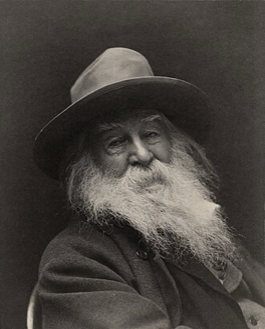
American poet, journalist and essayist whose poetry collection Leaves of Grass marked a milestone in the history of American literature. He is what Americans call a ‘self-made’ man: he started out as an errand boy in a law firm, then worked in a print shop, then became a village schoolteacher, founded several magazines, built houses, and planned and wrote further on his magnum opus, Leaves of Grass, meanwhile. Whitman never married, never left America, never pursued property and wealth, belonged to no society and preferred to associate with ordinary people rather than the rich, and he was always optimistic and cheerful. He was a distinct, imposing figure, tall in stature, slow-moving, tolerant, democratic, receptive, and towards everyone generous and of good will.
Walt Whitman (1887). Photo wikipedia.org
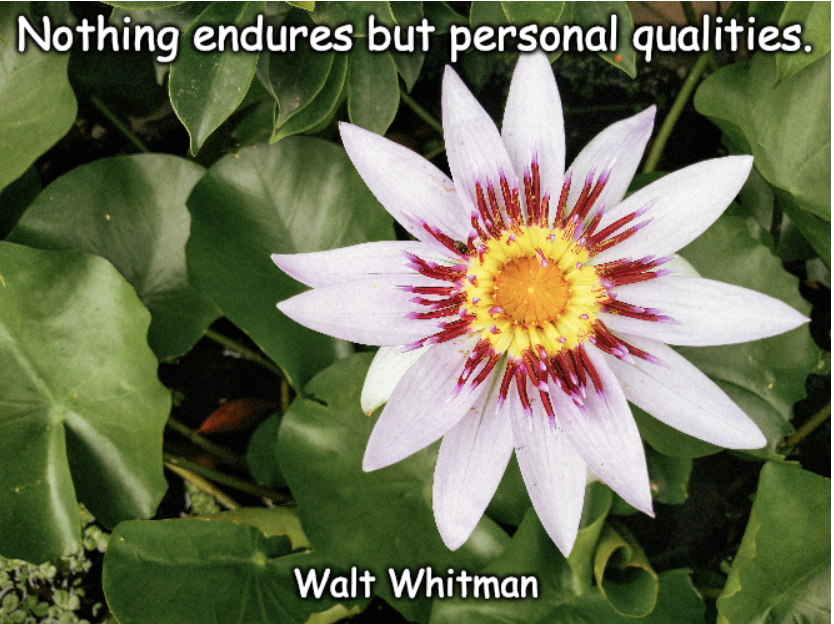
Nothing endures but personal qualities.
Photo: Satit Wongsampan. Meaning 🤔: This is a philosophical statement that emphasizes the transience of material things and the durability of human character. Here are the key points of the meaning:Temporality: All physical possessions (such as money, houses, and status) and even our physical bodies are temporary. They will eventually perish or disappear. Imperishability: What a person truly possesses—their character, integrity, courage, kindness, and talents—are the only things that have lasting value. These qualities survive physical and material losses and define a person’s true legacy. The True Treasure: It suggests that we should focus on developing our inner selves, rather than on accumulating external wealth. 🖋️ Origin and Author: This saying is attributed to Walt Whitman. The Source: The quote comes from his famous poetry collection, “Leaves of Grass,” which was first published in 1855 and was revised and expanded many times during his lifetime. The quote appears in the poem “Song of the Broad-Axe.” 🌿 About Walt Whitman: One of the most influential American poets, essayists, and journalists of the 19th century. His Philosophy: Whitman’s work is known for its celebration of nature, democracy, the individual, and the human experience. He strongly believed in the inherent value of every person, independent of their social status or possessions. The Theme: The quoted line aligns perfectly with his broader conviction that the true greatness of a person and a nation lies in the character of its people, not in its material wealth or power. 💡 Why This Saying Is Still Relevant Today: It is a powerful reminder in our materialistic world. It encourages self-reflection and personal growth. It emphasizes that our actions and our character are our lasting impact on the world.
Some people are so much sunshine to the square inch.
Photo by Johen Redman
I like the scientific spirit—the holding off, the being sure but not too sure, the willingness to surrender ideas when the evidence is against them: this is ultimately fine—it always keeps the way beyond open—always gives life, thought, affection, the whole man, a chance to try over again after a mistake—after a wrong guess.
Photo: Alexander Grey. Meaning: This quote by Walt Whitman glorifies the scientific spirit and emphasizes the importance of intellectual openness and honesty. It is not so much about the specific content of scientific theories, but rather about the way of thinking inherent in science. “I love the scientific spirit, the holding back…” – Whitman begins with an expression of admiration for the scientific approach, in particular the tendency to suspend judgment until there is sufficient evidence. “…the fact certain but not too certain…” This emphasizes the importance of critical thinking and the willingness to revise existing beliefs based on new insights. It is not absolute certainty, but a “provisional certainty that is open to refinement. ” ” …the willingness to surrender ideas when the evidence is against them…” This is the core of the scientific method and a hallmark of intellectual integrity. It testifies to the courage to admit mistakes and the willingness to adjust one’s beliefs to reality. “…this is ultimately fine; it always keeps the way forward open; it always gives life, thought, affection, the whole person, a chance to try again after a mistake or a wrong guess.” Whitman concludes with a plea for the value of this approach to human life. It enables us to learn from our mistakes, to grow, and to adapt to a changing world. It is a call for intellectual humility and an open mind. In short, Whitman advocates for an attitude to life characterized by curiosity, critical thinking, honesty, and a willingness to learn. This attitude is not only valuable for scientists, but for everyone striving for a deeper understanding of the world and themselves. Origin: The origin of this quote is Walt Whitman’s Camden Conversations. This is not a poetry collection, but a collection of conversations Whitman held with his friend Horace Traubel during the final years of his life. Traubel visited Whitman daily in Camden, New Jersey, and took notes of their conversations. These notes were later published as a book, in which this quote can be found. Author:Walt Whitman (1819–1892), one of the most important American poets of the 19th century. He is known for his poems that glorify the beauty of nature, democracy, and the human spirit. Although Whitman is primarily known as a poet, this quote testifies to his broad interest in science and his appreciation for the scientific method.
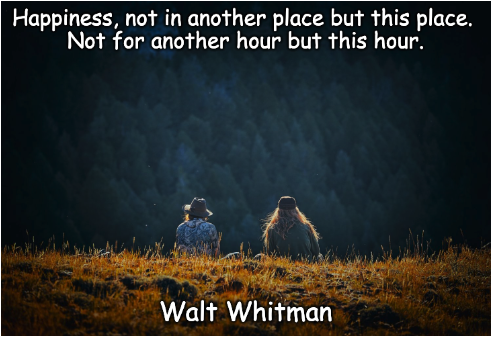
Happiness, not in another place but this place. Not for another hour but this hour.
Photo by travelingwithkristin.com. Meaning: The sentence can be seen as a reflection of Whitman’s ideas about personal freedom and self-expression. Whitman encouraged readers to live authentically and follow their own path. Origin: The specific sentence is inspired by themes that often recur in his work, but cannot be quoted directly from his work without further context. Whitman’s work has had a lasting impact on American literature and poetry in general. He is often seen as a pioneer of free verse and a voice for the democratic ideals of his time. Walt Whitman embodies the spirit of freedom and independence, and his work continues to inspire to this day.
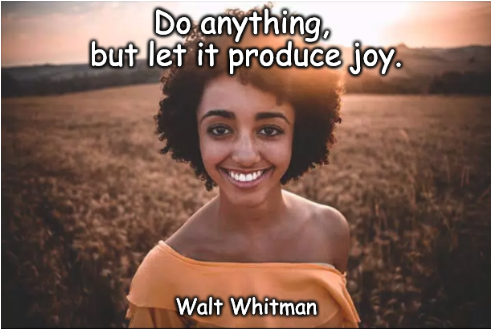
Do anything, but let it produce joy.
Photo: w.apkpure.com. Meaning: This saying emphasizes the importance of joy in all our activities. It suggests that no matter what we do, our efforts and choices should be aimed at creating happiness and satisfaction. This statement is a powerful reminder to consider joy as an important goal in our lives and activities. It encourages us to make our choices with well-being and joy in mind. Origin: While the exact wording of the saying may not be literally found in “Leaves of Grass,” the spirit of the saying can certainly be found in the themes and messages of Whitman’s poetry.
Not I, or anyone else can travel that road for you. You must travel it by yourself. It’s not far. It is within reach. Perhaps you have been on it since you were born, and did not know. Perhaps it is everywhere-on water and land.
Photo: rare-galary.com. Meaning:Personal Journey: The lyrics emphasize the importance of individual experience and the personal journey that everyone must take in life. Self-Discovery: The idea that you must walk the path yourself suggests that self-discovery and personal growth are essential. Accessibility: The message that the path is “not far” and “within reach” implies that possibilities and answers are often closer than we think. Origin: The aforementioned lyrics and the philosophy behind them may be inspired by the ideas of Walt Whitman, an influential 19th-century American poet. Whitman’s work, such as “Leaves of Grass,” explores themes of individuality, nature, and the human experience. No Direct Source: The lyrics themselves are not a direct quote from Walt Whitman, but the ideas expressed within them are certainly consistent with his philosophies.
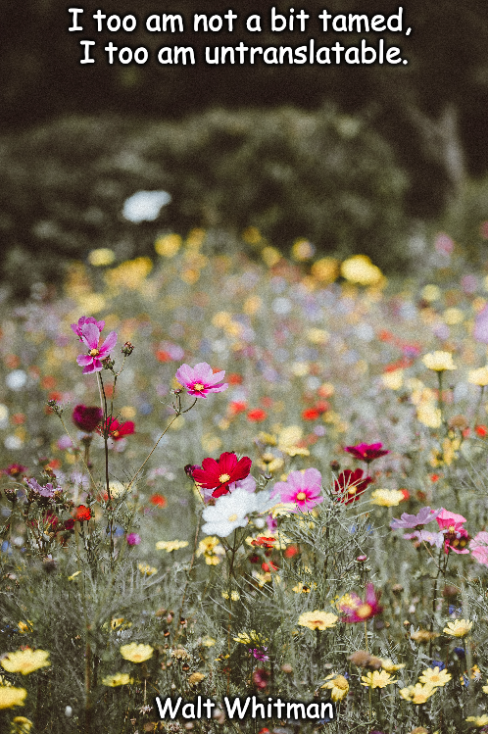
I too am not a bit tamed, I too am untranslatable.
Photo: Annie Spratt. Meaning: The speaker sees himself as free and devoid of categorization or simplification. It conveys a sense of independence and the complexity of one’s own identity. Origin: Sometimes attributed to Herman Hesse, Walt Whitman is the original author of this notion. He is best known for his collection “Leaves of Grass,” in which he celebrates the beauty of humanity and nature. Whitman’s style is innovative and revolutionary, with a strong focus on democracy and human connection. His work is often characterized by his use of free verse and a strong personal voice, which has given him a unique place in American literature.
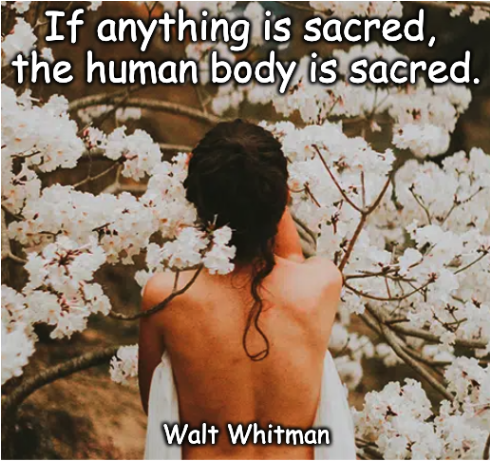
If anything is sacred, the human body is sacred.
Photo by unsplash. Meaning:Sanctity of the Human Body: The statement emphasises that the human body, and therefore human beings themselves, deserve intrinsic value and respect. This may refer to the beauty and complexity of life and the need to value ourselves and others. Human Dignity: The idea that every individual is entitled to respect and reverence, which ties in with broader themes of human rights and humanity. Origin: Walt Whitman, who is known for his celebration of humanity, nature, and individualism in his work. His poems, especially in ‘Leaves of Grass,’ reflect a deep respect for the human body and the human experience. Cultural and Philosophical Context: The statement can be seen in the context of 19th-century Romantic and humanist traditions, which emphasised individuality and the value of human existence.
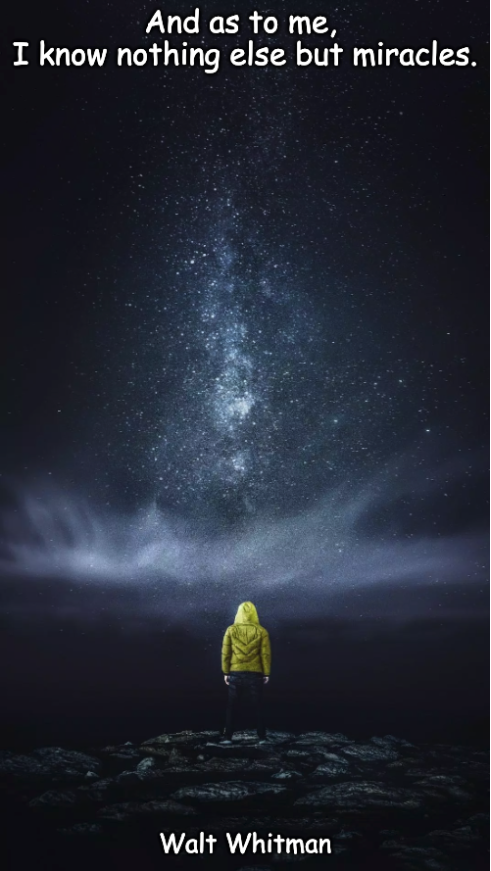
And as to me, I know nothing else but miracles.
Photo: m.apkpure.com. Meaning: A deep sense of wonder and appreciation for the beauty and magic of life. It suggests that the speaker is constantly surrounded by wondrous experiences and that these influence their worldview. Origin: The saying comes from the work of Walt Whitman and was published in ‘Leaves of Grass’, which plays an important role in American literature and offers a profound exploration of the wonders of life. 📖🌿
Whatever satisfies the soul is truth.
Photo: Ilya Shishikhin. Meaning💡 :Let’s break it down:1.The Supreme Court of the Soul:“Whatever thoroughly satisfies the soul is truth, whatever the litigation, whatever the cause to be argued, or the knot untied, this is the bar of appeals, the supreme court.” Whitman argues that, regardless of the intellectual arguments (“litigation”, “cause to be argued”) or the complexity of a problem (“the knot untied”), the ultimate test of truth lies not in logic, but in a deep, inner sense of satisfaction or ‘goodness’ within the soul. The Metaphor: He uses legal language (“bar of appeals”, “supreme court”) to emphasize that this inner knowing is the highest authority, standing above all other judgments. 2.A Call to Critical Thinking: “Re-examine all you have been told at school or church or in any book.” Meaning: This is a radical call for intellectual independence. Whitman encourages us not to blindly accept what authority figures (teachers, religious leaders) or written texts tell us. Everything must be reconsidered and tested. 3.The Instinctive Compass: “There is in the soul an instinctive test of the sense and actuality of anything — of any statement of fact or morals. Let this decide.” Whitman believes that we are all born with a built-in, instinctive ’testing mechanism’. This mechanism can judge the truth and morality of any claim. He advocates letting this instinct make the final decision. 🧐 Analysis: This quote is a powerful expression of Whitman’s philosophy, which was deeply rooted in Transcendentalism. Here are some key points:Intuition over Intellect: Whitman places intuition and inner feeling above rational analysis and external authority. The truth is not something you find only in books; it is something you “feel”. Individualism: The truth is personal. What satisfies one person’s soul may not do so for another. This emphasizes the importance of individual experience. Spiritual Democracy: Whitman believed that everyone has access to this inner source of truth. It is not reserved for an elite of scholars or priests. Unity of Body and Soul: In his broader work, Whitman often celebrates the body and the senses as pathways to the soul. The “satisfaction” he speaks of is likely a holistic experience, not just an abstract concept. 🤔 A Critical Note: While Whitman’s idea is liberating, it also raises questions: Subjectivity: If everyone has their own “truth” based on what satisfies their soul, how can we find common ground for morality and justice? Can someone not find “satisfaction” in something that is harmful to others? The Role of Reason: Does this mean that logic and facts do not matter at all? Probably not, but Whitman emphasizes that they are subordinate to the ultimate ’test of the soul’. ✅ Conclusion: Walt Whitman’s statement, “What satisfies the soul is truth,” is more than just a beautiful phrase. It is a bold declaration of independence, a call to trust our own inner compass and to question all external dogmas. It reminds us that the deepest truths are often those that resonate most with our deepest beings.
I exist as I am, that is enough.
Photo: Lane Smith. Meaning: Self-acceptance: The quote emphasises that you should be content with yourself. Value of the individual: It indicates that everyone is valuable, regardless of the opinions of others. Authenticity: It encourages staying true to yourself and your own identity. Source: Although the quote is often attributed to Herman Gorter, the original author is Walt Whitman, who is best known for his collection ‘Leaves of Grass,’ in which he explores themes of democracy, nature, and individuality. Whitman’s work often emphasises the beauty of life and the value of the individual.
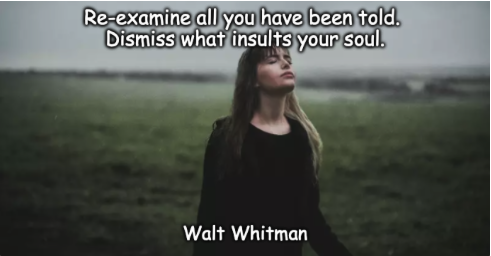
Re-examine all you have been told. Dismiss what insults your soul.
Photo by ibelieve.com
We were together. I forget the rest.
Photo: Fredrik Sellgren. Meaning:Personal Memory: It emphasizes the value of being together and how these experiences are more important than other details. Emotional Connection: It suggests that shared moments are the core of our lives, even as other things fade. These words remind us that the moments we share together are unforgettable and form the foundation of our memories. Source: Walt Whitman: A prominent figure in American literature, known for his work “Leaves of Grass,” in which he explores themes of connection, nature, and humanity.
I discover myself on the verge of a usual mistake.
Photo Annie Spratt. Meaning: In short: he asks for a moment, after suffocation, dreaming, sleep — and realizes that he is about to make the usual mistake. In the following lines, this mistake is implicitly clarified: it is the mistake of forgetting his own suffering, mockery, tears, and wounds — of ignoring or dismissing this pain and struggle as unimportant (“forget the mockers and insults! … forget the trickling tears and the blows …”) Source: Famous poetry collection Leaves of Grass (first edition 1855). More specifically, it seems to be referring to a passage from the poem Song of Myself. – Walt Whitman.
What is that you express in your eyes? It seems to me more than all the print I have read in my life.
Photo by Luke Braswell. Meaning: What someone expresses with their eyes – feelings, personality, truth – is perceived as deeper and more genuine than what books or written language can convey. Source: Walt Whitman (1819–1892), an influential American poet, best known for his collection ‘Leaves of Grass’.
Peace is always beautiful.
Photo by Daniel Mingook Kim. Meaning:Literally: Peace is always beautiful, regardless of circumstances—a universal truth about the value of peace over conflict. In the context of Whitman’s work: Whitman wrote during and after the American Civil War. For him, peace represented not only the absence of war, but also reconciliation, brotherhood, and the unity of all people. Philosophically: It suggests that peace has an intrinsic beauty independent of external factors—it is a state of being valuable and beautiful in itself. Origin: The quote comes from Walt Whitman’s famous collection of poems, Leaves of Grass. More specifically, it appears in the poem “The Sleepers.”
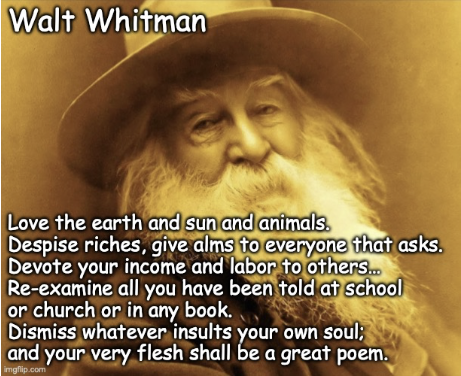
Love the earth and sun and animals. Despise riches, give alms to everyone that asks. Devote your income and labor to others… Re-examine all you have been told at school or church or in any book. Dismiss whatever insults your own soul; and your very flesh shall be a great poem.
Photo: Tao & Zen. Meaning 📖 ✒️: This passage is a beautiful and powerful manifesto for living an authentic, compassionate, and free life. The core themes are: 🌱 Connection with nature: It encourages us to love and cherish the natural world – the earth, the sun and the animals – as fundamental parts of our existence. 🤲 Disdain for materialism and generosity: It teaches a rejection of the pursuit of wealth for its own sake and advocates radical generosity, both financially and through the time and effort one spends helping others. 🧠 Critical thinking and self-empowerment: It challenges us not to blindly accept tradition or authority (“what you were told at school or in church or in any book”). Instead, we must use our own judgment and intellectual inquiry. ✨ Spiritual Integrity: The last and perhaps most important instruction is to “reject anything that offends your own soul.” This is a call to align your actions with your deepest inner conscience. In doing so, your entire life – your “flesh” – becomes a beautiful expression of the truth, like “a great poem.” 📜 Origin and Author: This famous quote is from the legendary American poet Walt Whitman. Walt Whitman (1819–1892) was one of America’s most influential and innovative poets, often called the father of free verse. These lines are from the 1855 Preface to his masterpiece collection of poems, “Leaves of Grass.” In this preface, Whitman outlined his vision of an ideal poet and, by extension, an ideal human life, rooted in democracy, individuality, and a deep love for all creation. It’s timeless advice that continues to inspire people around the world.
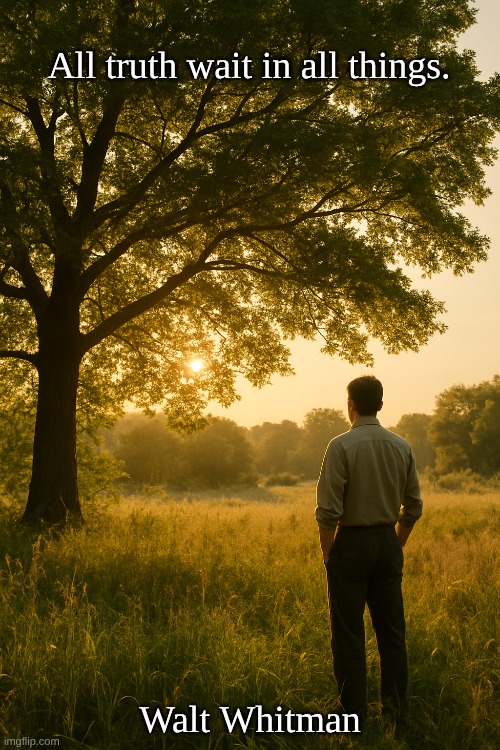
All truth wait in all things.
Image: Peter van Geest AI. Meaning: The statement means that truth is not hidden in one book, one faith or one authority, but is present in all things: every experience, every person, every object, nature, everyday life. Whitman emphasises that those who truly want to understand must be open to the world. Truth can be found everywhere, if you are willing to look and listen. It is an optimistic, democratic idea: reality itself contains meaning, not just the words of scholars or religious leaders. Origin: It comes from Leaves of Grass (1855), specifically from the poem ‘Song of Myself’. Whitman opens this poem with a series of statements about the connection between man, nature and truth — and this is one of the most quoted lines.
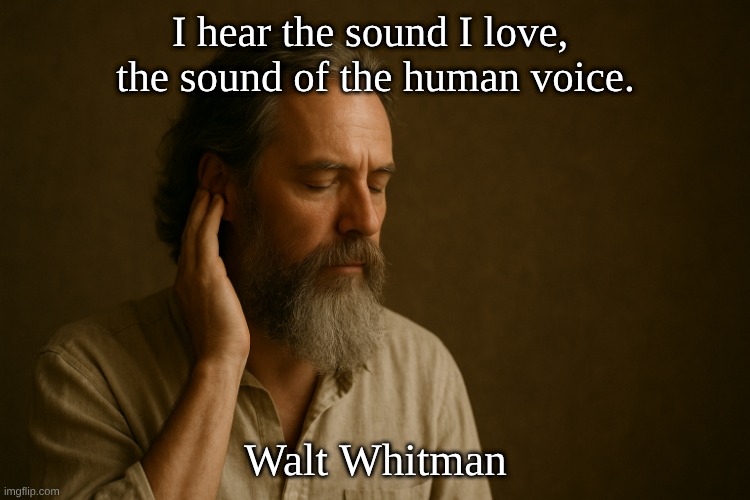
I hear the sound I love, the sound of the human voice.
Image: Peter van Geest AI. Meaning: It is a lyrical description of attentive listening, in which the human voice is the most precious and pure sound. The text emphasises receptivity, beauty in simplicity and the emotional power of the voice. Source: Song of Myself (Whitman, 1855).
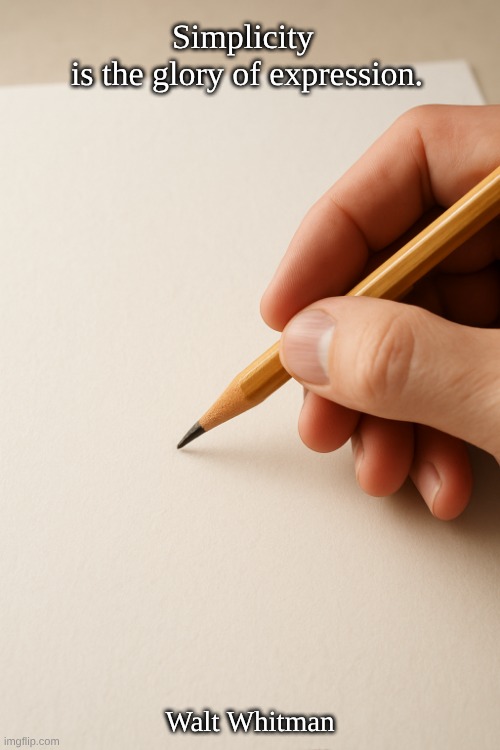
Simplicity is the glory of expression.
Image: Peter van Geest AI. Meaning: It is a paean to sober, precise wording: simplicity as the highest form of linguistic mastery. Source: Specimen Days & Collect (1882) – Walt Whitman.
A morning-glory at my window satisfies me more than the metaphysics of books.
Image: Peter van Geest AI. Meaning: The primacy of direct, sensory, and mystical experience (here: dawn) over abstract philosophy from books. It is a romantic-transcendentalist idea, succinctly expressed in the movement that sees nature as the greatest teacher. Source: “Leaves of Grass,” specifically in the poem “Song of Myself” (version 1855 and later), Walt Whitman’s masterpiece.
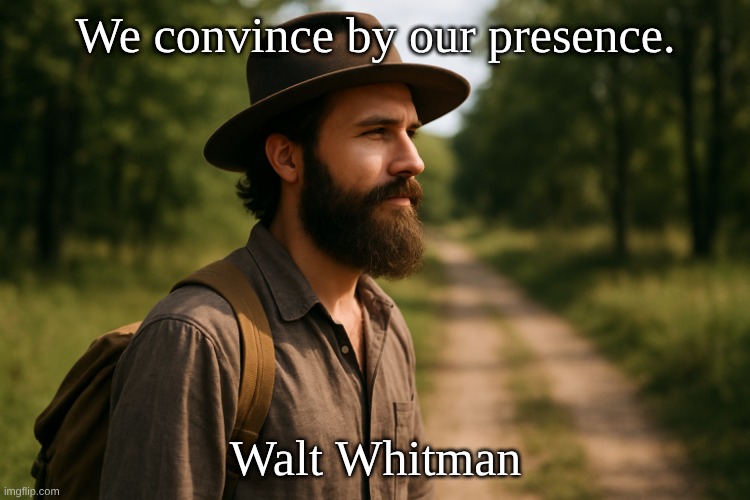
We convince by our presence.
Image: Peter van Geest AI. Meaning: True conviction doesn’t always come from reasoning, arguments, or fine words, but rather from the presence and authenticity of one’s being. When you “are there”—when you are real, yourself, with integrity and sincerity—then that often has far more impact than anything you say. Source: The poem was published in 1856 as part of Leaves of Grass, the collection that made Whitman famous. Sometimes, incorrectly attributed to Ralph Waldo Emerson.
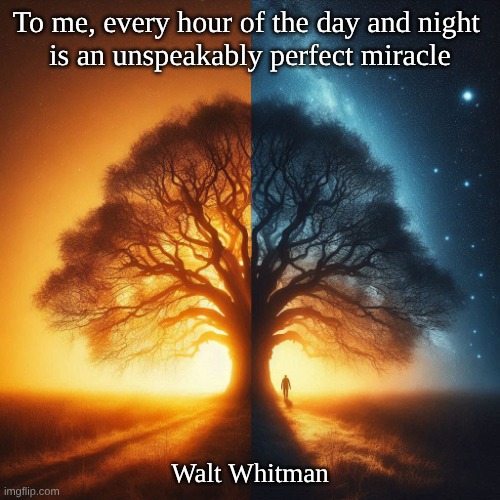
To me, every hour of the day and night is an unspeakably perfect miracle
Image: Peter van Geest AI. Meaning:Everyday Miraculousness: Whitman sees not only extraordinary events as miraculous, but every moment of daily life. This reflects a mindset of mindfulness and complete presence in the present. Unspeakably Perfect: “Perfection” is “unspeakable”—too great for words. It is an experience that cannot be fully grasped rationally, but is felt intuitively. Spiritual Attitude: For Whitman, this was not an isolated statement, but the core of his worldview. He believed in the inherent beauty and meaning of life itself, independent of religious dogma. This attitude aligns with transcendentalist ideas that saw the divine in nature and human existence. Antidote to Cynicism: The quote invites us to live consciously and to look for the miracle in seemingly ordinary moments—the sunshine, a night sky, a simple breath. In short, Whitman expresses a deep gratitude and wonder at the pure fact of being, where every moment of the day and night is an unspeakably perfect miracle. Source: From the poem “Poem of Perfect Miracles” (later known as “Miracles”) in the 1856 edition of Leaves of Grass by Walt Whitman.
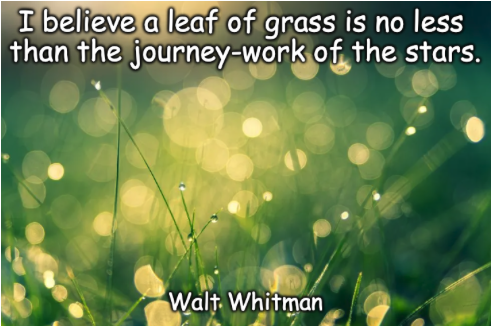
I believe a leaf of grass is no less than the journey-work of the stars.
Photo by Aaron Burden. Meaning: Everything in the universe is interconnected and equal. A simple blade of grass is just as wondrous and meaningful as the stars. There is no hierarchy between the large and the small, the sublime and the mundane. Nature contains the same creative power everywhere; the divine is in everything. It is a celebration of democracy, nature, spirituality and connectedness. In short: the everyday carries the same cosmic beauty and value as the sublime. Source: Leaves of Grass (first edition 1855, later expanded several times). The passage is from the poem ‘Song of Myself’ by Walt Whitman.
Photo by bewustzijnsontwikkelaar.nl. Meaning: The sentence can be seen as a reflection of Whitman’s ideas about personal freedom and self-expression. Whitman encouraged readers to live authentically and follow their own path. Origin: The specific sentence is inspired by themes that often recur in his work, but cannot be quoted directly from his work without further context. Whitman’s work has had a lasting impact on American literature and poetry in general. He is often seen as a pioneer of free verse and a voice for the democratic ideals of his time. Walt Whitman embodies the spirit of freedom and independence, and his work continues to inspire to this day.
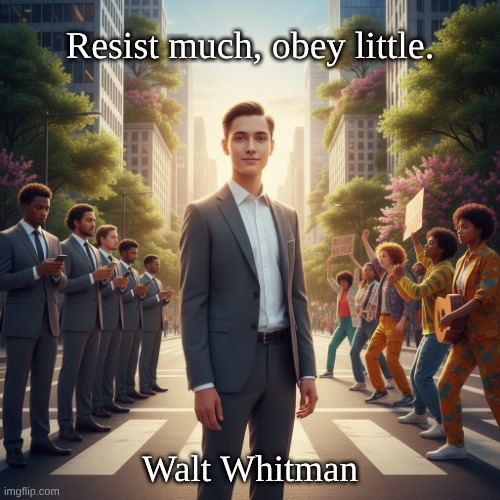
Resist much, obey little.
Image: Peter van Geest AI. Meaning:Resistance and Obedience: In the context of Whitman’s work, the statement “Resist much, obey little” can be interpreted as an encouragement of individuality and self-expression. Whitman encouraged people to forge their own path and not blindly obey societal norms. Characteristics of Whitman’s Work: Individualism: Whitman celebrated the unique experience of each individual and the power of the personal voice. Nature and Humanity: He often connected humanity with nature, emphasizing the beauty of life and the connection between people. Inclusivity: Whitman’s poetry is known for its inclusive approach, embracing diverse voices and experiences. Origins: Whitman explored themes of resistance and obedience in his work, particularly in the context of civil rights, freedom, and American identity. His poetry encourages readers to be authentic and not bow to societal pressures. Conclusion: The statement “Object much, obey little” can be seen as a reflection of the spirit of Walt Whitman’s work, which celebrates the value of personal freedom and the power of individual voices. Whitman’s influence is still felt in contemporary literature and social movements.
Door Pieter
Mensenmens, zoon, echtgenoot, vader, opa.
Spiritueel, echter niet religieus.
Ik hou van golf, wandelen, lezen en de natuur in veel opzichten.
Onderzoeker, nieuwsgierig, geen fan van de mainstream media (MSM).