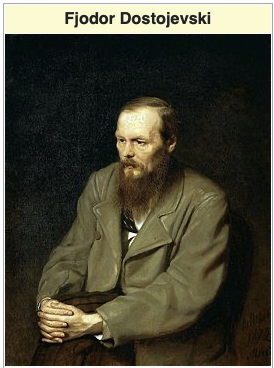
(11 November [O.S. 30 October] 1821 – St Petersburg, 9 February [O.S. 28 January] 1881).
Russian novelist and publicist. He is one of the best-known authors in Russian literature. He is counted among the so-called ‘Realist School’ in Russia, although his work is distinguished from many other realists by its philosophical content and dominant dialogue form. Dostoevsky left behind an extensive body of work.
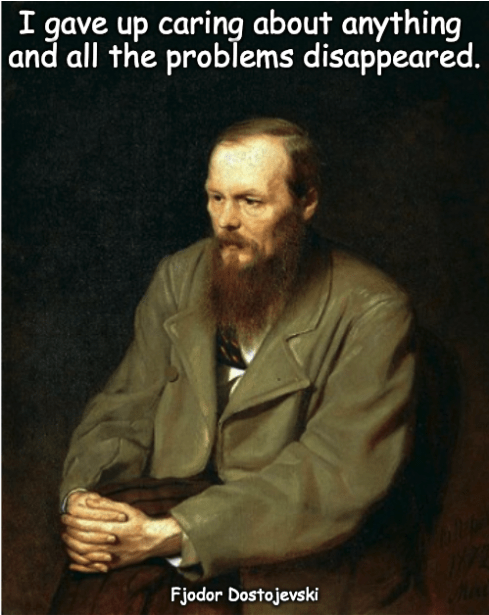
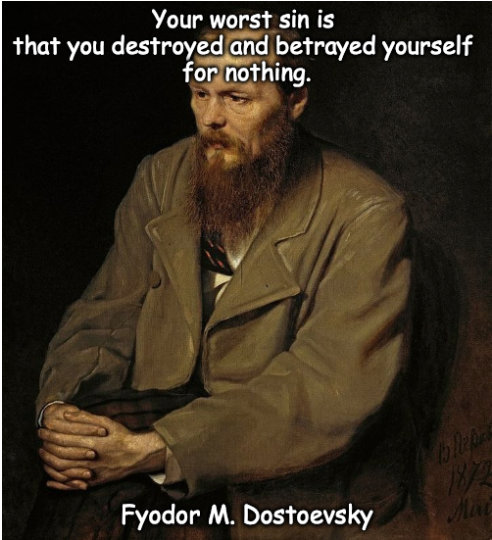
Fjodor M. Dostojewsky (Vasili Perov, 1872)
The darker the night, the brithter the stars. The deeper the grief, the closer is God.
Photo: Gerd Altmann
What is hell? I maintain that it is the suffering of being unable to love.
Photo by Dimitris Vetsikas
It’s life that matters, nothing but life – the proces of discovering, the everlasting and perpetual process, not the discovery itself, at all.
Photo by Rondell Melling
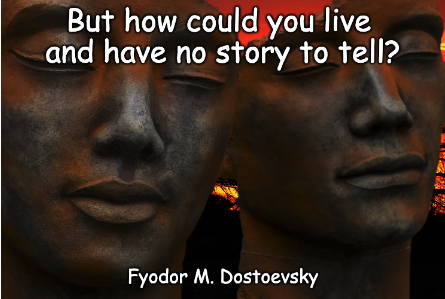
But how could you live and have no story to tell?
Photo by Lars Nissen
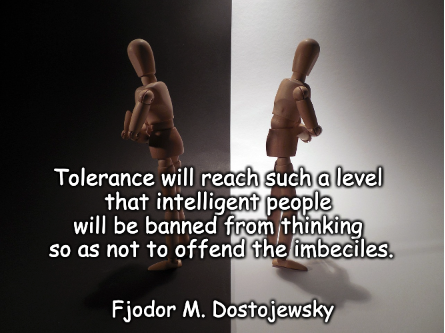
Tolerance will reach such a level that intelligent people will be banned from thinking so as not to offend the imbeciles.
Photo by Succo
I gave up caring about anything and all the problems disappeared.
Photo by Vasili Perov
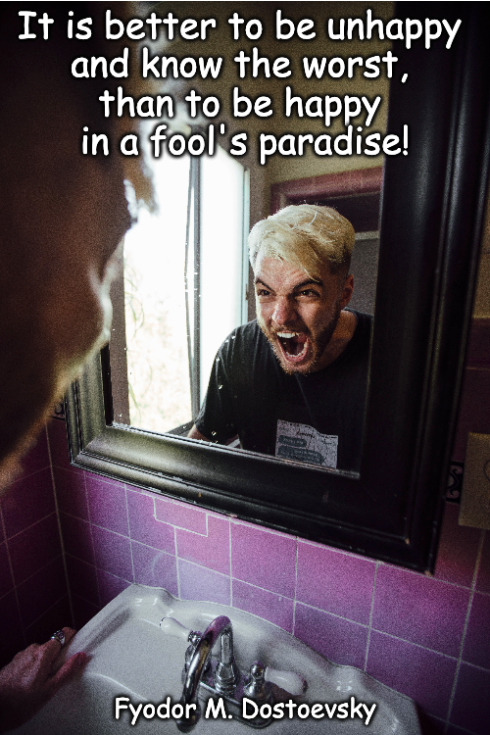
It is better to be unhappy and know the worst, than to be happy in a fool’s paradise!
Photo by Christopher Ott
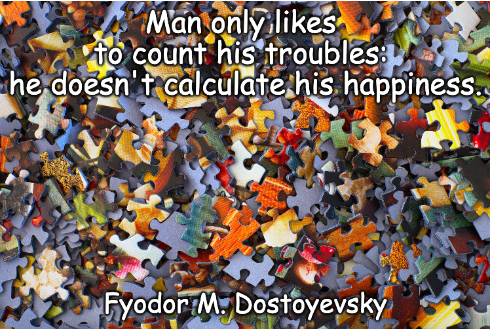
Man only likes to count his troubles: he doesn’t calculate his happiness.
Photo by Hans Peter Gauster
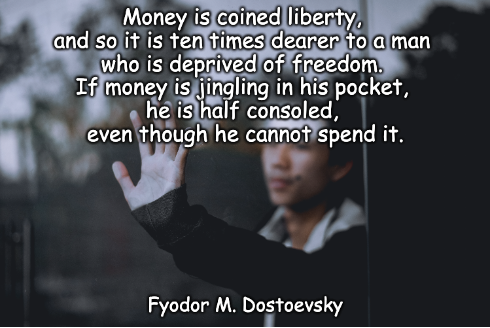
Money is coined liberty, and so it is ten times dearer to a man who is deprived of freedom. If money is jingling in his pocket, he is half consoled, even though he cannot spend it.
Photo by Nijwam Swargiary
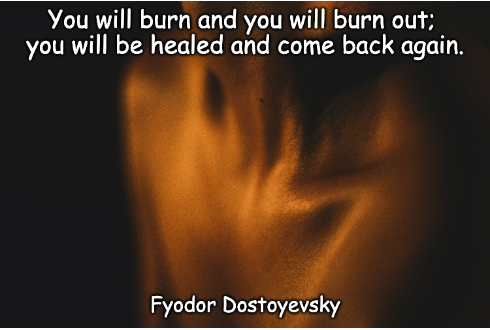
You will burn and you will burn out; you will be healed and come back again.
Photo by Ramez E. Nassif
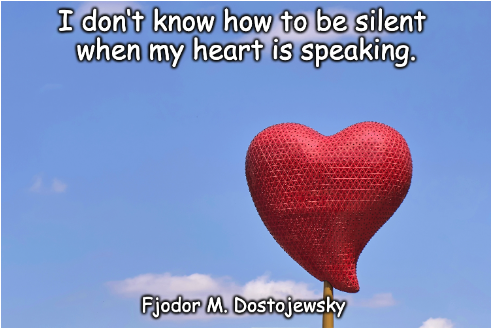
I don‘t know how to be silent when my heart is speaking.
Photo by Jean Louis Paulin
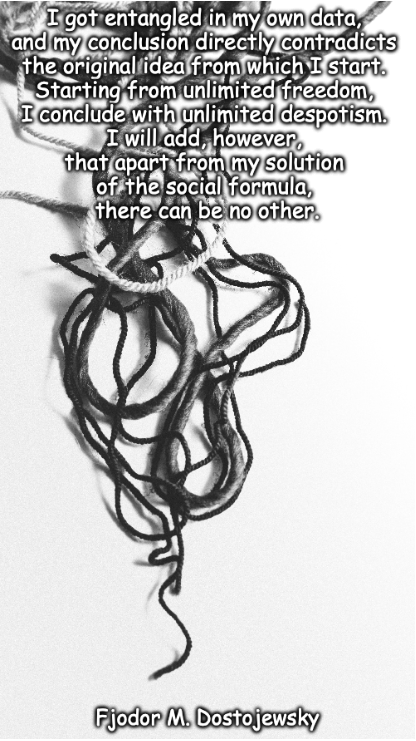
I got entangled in my own data, and my conclusion directly contradicts the original idea from which I start. Starting from unlimited freedom, I conclude with unlimited despotism. I will add, however, that apart from my solution of the social formula, there can be no other.
Photo by Kier in Sight
Your worst sin is that you destroyed and betrayed yourself for nothing.
Photo by Vasily Perov
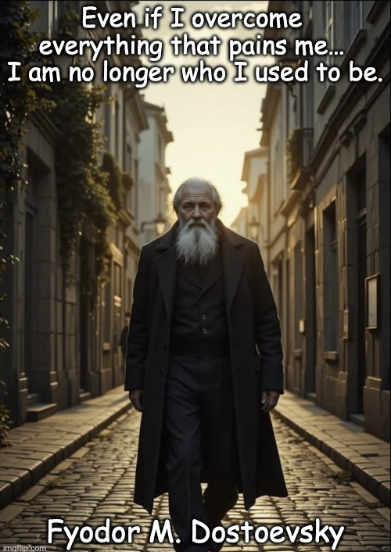
Even if I overcome everything that pains me… I am no longer who I used to be.
Photo: Mar English – fb
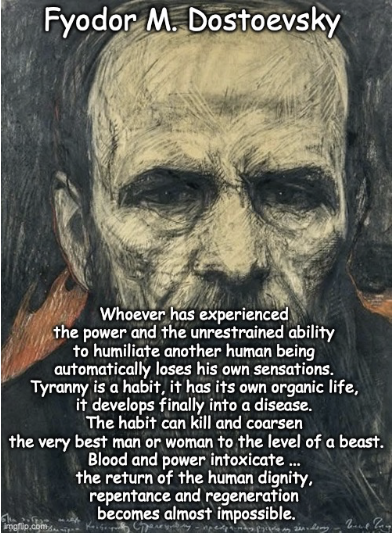
Whoever has experienced the power and the unrestrained ability to humiliate another human being automatically loses his own sensations. Tyranny is a habit, it has its own organic life, it develops finally into a disease. The habit can kill and coarsen the very best man or woman to the level of a beast. Blood and power intoxicate … the return of the human dignity, repentance and regeneration becomes almost impossible.
Fyodor M. Dostoevsky. Photo: Arbab Taimoor Khan Kasi – fb
Only what we want to forget remains in memory.
Image: Pete Linforth – AI
Don’t let us forget that the causes of human actions are usually immeasurably more complex and varied than our subsequent explanations of them.
Photo: proartspb. Meaning: The quote expresses a central theme in Dostoevsky’s psychological literature: Complexity of Motivations: Human actions arise from an immensely complex interplay of conscious and unconscious factors—instincts, emotions, social pressures, moral considerations, personal history, and situational circumstances. These causes are “immeasurably more complex and varied” than we realize. Limitations of Ex-Post Rationalization: We attempt to explain human behavior retrospectively with simplistic, linear reasoning that often fails to capture the true motivations. We create coherent narratives that satisfy our own need for clarity but obscure the deeper, inconsistent truth. Criticism of Reductionism: The quote implicitly critiques scientific, moral, or legal systems that attempt to reduce human behavior to simple causal relationships. For Dostoevsky, the human soul is an ocean of contradictory currents that defies schematic representation. Religious and existential dimension: In the context of The Idiot, Prince Myshkin defends a perspective of empathy and modesty. He recognizes the inherent unknowability of the human soul, which is an invitation to humility and the avoidance of quick judgments. Source: From the novel “The Idiot” (Ivory Coast, 1869) by Russian writer Fyodor Mikhailovich Dostoyevsky (1821–1881). The quote is spoken by Prince Lev Nikolayevich Myshkin, the novel’s protagonist.
Above all, avoid falsehood, every kind of falsehood, especially falseness to yourself. Watch over your own deceitfulness and look into it every hour, every minute.
Photo: Joel Naren
So many tender and painful, sweet and bitter, emotions crowd into my soul… You cannot dream how bitter it is for me when people don’t understand me, when they mistake what I say, and see it in the wrong light.
Photo: My Loves
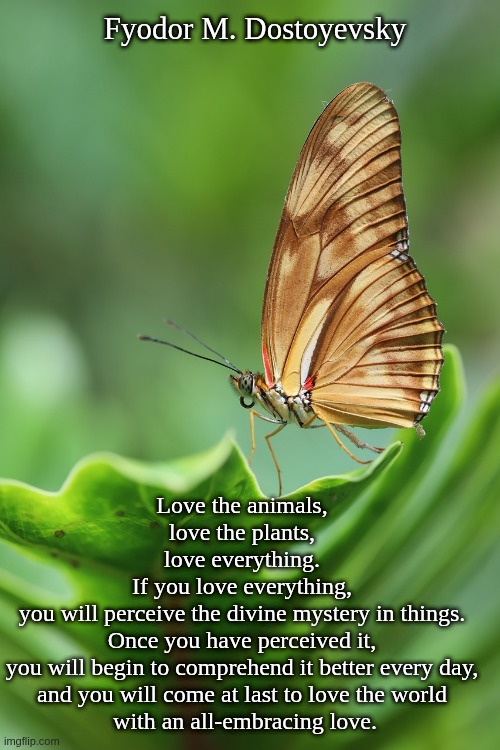
Love the animals, love the plants, love everything. If you love everything, you will perceive the divine mystery in things. Once you have perceived it, you will begin to comprehend it better every day, and you will come at last to love the world with an all-embracing love.
Photo: Richard Middelbos
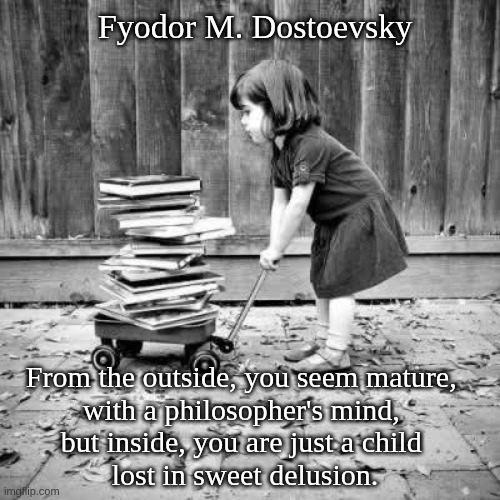
From the outside, you seem mature, with a philosopher’s mind, but inside, you are just a child lost in sweet delusion.
Photo: English Literature. Meaning: Refers to the paradoxes of human nature – how people can appear to be one thing on the outside, while being something completely different on the inside.
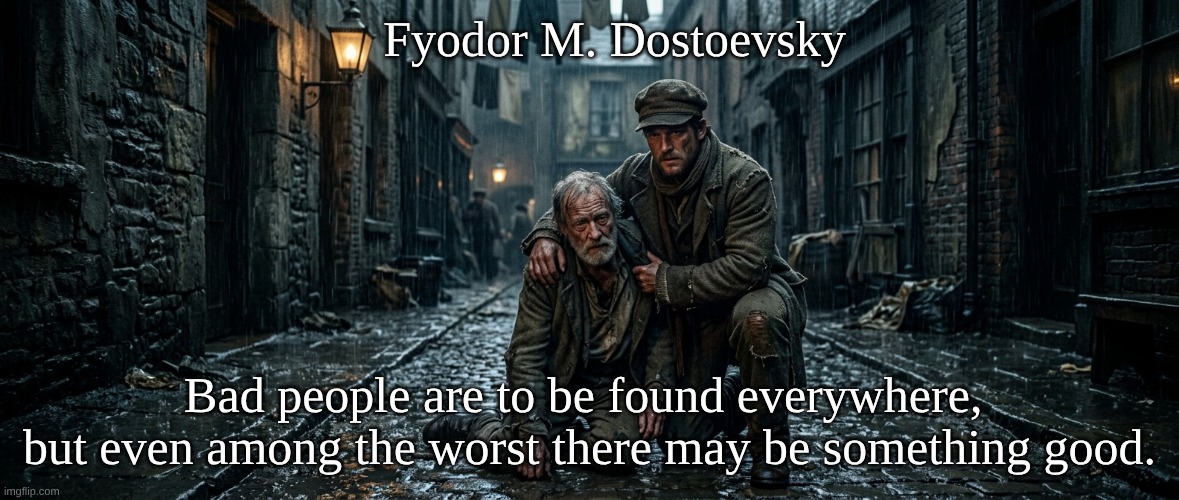
Bad people are to be found everywhere, but even among the worst there may be something good.
Image: Peter van Geest AI. Meaning 🧐 : At its core, this quote is about the complexity of human nature. 👥 Everyone is Complete: It states that no one is purely ‘good’ or purely ‘bad’. Even in people who are labeled “evil,” there may be sparks of goodness, humanity, or compassion. ⚖️ Against Judgment: It is a warning against prejudice and judging people too quickly. It suggests that we need to look beyond the surface and the ‘stamps’ that society places on someone. 💡 Glimpse of Hope:The quote also offers a ray of hope: even in the darkest situations and under the most difficult circumstances, the fundamental goodness of humanity cannot be completely erased. 📖 Origin: The quote comes from the book: “Notes from a House of the Dead” (Russian: Записки из Мёртвого дома). Year of publication: 1862. Context: “Notes from a House of the Dead” is a semi-autobiographical work. In this book, Dostoyevsky describes the horrors of camp life, but also the unexpected moments of humanity he observed there. The quote probably goes back to his observations of his fellow prisoners. Although many had committed serious crimes, Dostoyevsky saw that they were still capable of kindness, compassion, and even artistic expression. ✒️ Author:Fyodor Dostoyevsky. The author of this powerful quote is indeed Fyodor Dostoyevsky (1821-1881). 🇷🇺 Russian Writer: Dostoyevsky is considered one of the greatest writers in world literature. 🧠 Psychological Insight: He was known for his profound psychological insights into the human soul. He explored themes of guilt, redemption, good and evil, and the nature of faith. 🛠️ Personal Background: Dostoyevsky spoke from experience. He had spent years in a Siberian prison camp after being arrested for political activities. These experiences formed the basis for ¨Notes from a House of the Dead¨. 🤔 Conclusion: The quote “Bad people can be found everywhere, but even among the worst there can be something good” is an apt summary of Fyodor Dostoyevsky’s humanistic view of life. It reminds us that the world is not black and white, and that even the darkest circumstances cannot completely extinguish the spark of human goodness.
Door Pieter
Mensenmens, zoon, echtgenoot, vader, opa.
Spiritueel, echter niet religieus.
Ik hou van golf, wandelen, lezen en de natuur in veel opzichten.
Onderzoeker, nieuwsgierig, geen fan van de mainstream media (MSM).